Last time I've checked, some telecoms such as Vodafone didn't even supported IPv6 yet.
b2b telecoms as a consequence also have at best zero incentive since if the consumer doesn't have ipv6, businesses don't need or want ipv6.
the solution here, which will inevitably strike a nerve with some, is to have a regulatory mandate for ipv6. a soft version would start with 'government networks must run exclusively on ipv6, this applies to any and all contractors, including govclouds' and work upwards from there. I understand such policies were in place or at least planned; OTOH in the current political climate it'll be sort of a miracle if the existing ipv4 networks keep working.
I spent a decade writing element management systems. An element is a network device - switch, router, ROADM, etc. Often you give the customer kit & software and they spend a couple of years assessing it. This software would be installed on secure out of band networks with no route to the internet. 10/8 would have been adequate for the lifetime of the hardware currently in service - 200G stuff. However, that's not how things played out.
When I started working on EMS software IPv6 support was a requirement but it was just a box ticking exercise. No one was actually going to use it. A decade later IPv6 HAD to work for northbound and southbound traffic, on an internal network. Otherwise, no sale. IPv6 is being used in anger in telecoms. I have no idea how long that will take to filter to in band networks.
I don't think this is true. The IPv4 address exhaustion is still a problem and it's getting worse, and telecoms which also provide internet services need to allocate addresses to their clients. With the 5G rollout these telecoms need to make room for new devices, and that's not feasible with IPv4.
Not entirely true. 10/8 is only so big, so the management of addresses very much has a nonzero opex cost.
And on top of that there's capex on "carrier grade NAT".
For the biggest providers 10/8 is not even big enough for their production environment. And then they acquire some some company that (obviously) also uses 10/8.
No, there's definitely incentive there. Just… not enough.
It was never a viable option for the Internet (million or billions of devices would never support it, and anyway it'd only buy us like 3 months), but in theory it should work better in the (more, but not entirely) controlled environment of a large prod environment.
I know of several massive setups that when running out of 10/8 evaluated 240/4 but deemed it less feasible, riskier, and definitely more work, than to "just" move to IPv6. Sorry, can't namedrop them, since I don't want to doxx myself. I've never seen 240/4 actually chosen.
Works fine in Linux, doesn't really work on Windows and some BSDs.
https://blog.benjojo.co.uk/post/class-e-addresses-in-the-rea...
I'm also convinced that the length of IPv6 addresses and the difficulty in typing them is a major reason for lack of adoption. Very seemingly small UX annoyances can have a large effect.
I've been convinced of this since around 2000. Every network utility dealing with IPv4 had... dotted quad addresses. You could remember them, you could read them, you could speak them to someone else. Brainwise, we can remember 3-5 things - segments, digits, etc. Remembering more is harder for the average person.
Having the 6 be literally dotted sextant(?) - 5.73.192.168.0.4 for example - would have been much much much easier to transition in to, and would have given us 64k x 4 billion addresses. Yes, it's not the near infinity we have with IPv6, where apparently every molecule in the universe can have multiple IP addresses or whatever the max number is. But it would have been much much easier to transition. 27 years later we're not transitioned from ipv4, and we've got another 27 years of dotted quad baked in to daily usage everywhere.
No, it wouldn't have taken 'exactly as much work to transition'. See another reply. In 2024, I'm still reading about BGP/routing table issues, and hardware having problems keeping up with IPv6 networking - it's just too large. How was this supposed to work in 1999?
A smaller stepped transition from 4 billion addresses to... 64k of those would have been an easier transition step, and the ease - mental, UI, training, testing, security, etc would have given everyone involved the confidence and positive feedback to tackle a next stage to IPv6 (eventually).
But even if they had the counter argument to "128 bit addresses are too long, 48 bit would have been better" is obviously not "that's the same thing just with 48 bit addresses!"
Part of this would just be transitory, but... would take up far less space. Even as late as last year, I'm reading stories about BGP issues and slowdowns because routing tables are too large/many for the hardware. In 2024. How on earth was this expected to work on hardware from 1999?
https://blog.apnic.net/wp-content/uploads/2023/01/Figure-1-%...
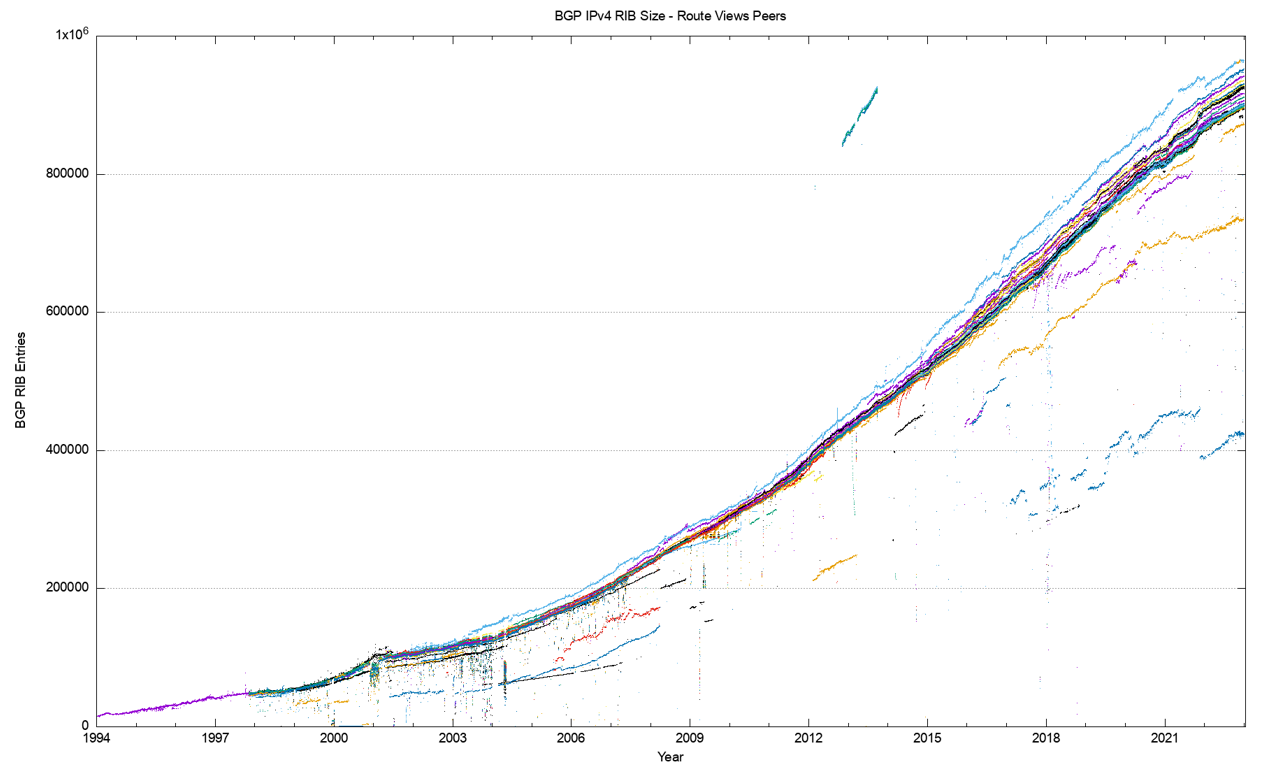
https://blog.apnic.net/wp-content/uploads/2023/01/Figure-14-...

Actually mDNS does exactly what they said just fine. You’re confusing it with the ability of a DHCP server to make updates in DNS on behalf of clients. There is more than one way to skin the cat. Both achieve the same affect, just differently.
> nor do they necessarily ever consider your local DNS server.
Hardcoded DNS servers are just as equally a thing with IPv4.
Of course, but they aren't the baseline expectation like it is with ipv6 since ipv6 baseline assumption is SLAAC. And SLAAC is terrible. If you control all the devices on the network, like a cloud install, you can just pretend SLAAC doesn't exist and live in a much better world.
If it's a home network then you're stuck expecting at least some usage of SLAAC. And you're better off just not supporting ipv6 at all at that point
Why not? Are you saying your computer doesn't need to know the IP address of any dns server in order to be useful?
What do you mean when you say that SLAAC is terrible? Especially when you control all the devices on the network, you are in full control of what SLAAC manages for you. Also, SLAAC is the only way to use the IPv6 Privacy Extensions.
Rather, most routers add DHCP hostname requests to the local DNS routes. That doesn't require mDNS, nor would you want to replace it with mDNS as mDNS is more limited & flakier.
Ping foo on my machine results in foo.local being successfully pinged. Your mileage may vary.
> would potentially use mDNS if you have a ping that does such a thing
It's not a feature of ping, it's a feature of the name resolution setup on your machine (nsswitch and/or resolved on Linux).
> Rather, most routers add DHCP hostname requests to the local DNS routes
What do you mean?
Things like RA and NDP would clue hosts into the local DNS server as well. You don't need DHCPv6 to advertise a local DNS server.
Possibly, but I think it's also that some aspects of IPv6 are just badly designed, and subsequent updates only fixed some of the issues.
SLAAC, for example, is godawful stupid. And while DHCPv6 exists to fix some of that, critical aspects of the protocol, like prefix delegation, are manually configured. This is beyond idiotic and makes things like subnets massively more difficult than they have any right to be.
SLAAC and PD combine to create the worst sin of all - flakiness. It's hard to figure out why IPv6 isn't working because everything is telling you it is (it "auto configured" a valid IP despite not having any actual route to anywhere else, so helpful! /s). If IPv6 was literally just "IPv4 but 128-bit addresses instead of 32-bit ones" it almost certainly would have been adopted en masse by now. But it isn't, it made things more fragile and harder to configure for no goddamn reason.
And of course you then have ISPs doing silly stuff, like my ISP only gives me a /64 so I literally can't use IPv6 on my network since I want VLAN isolation. 18446744073709551615 possible addresses are given to me yet dividing that up into 3-5 subnets is completely impossible. Fucking stupid protocol.
The core of V6 -- longer IPs -- is great. SLAAC and /64 being the smallest need to be deprecated. It's asinine.
Really absolutely everything but longer IPs should be deprecated and was a mistake.
are you sure? what about homepods, Chromecasts, Hue bridges, kasa smart plugs, esphome, etc etc etc...?
How much are you willing to bet your home network on Android being the final user of SLAAC? And how much time do you want to invest in figuring that out in the first place?
Although https://www.rfc-editor.org/rfc/rfc7217 doesn't require a /64 or shorter prefix for its variant of address auto-configuration, for example Linux doesn't allow otherwise.
Heck, I would have probably simply added an Options flag for "long address" to support longer addresses. With the first part of the address being the IPv4 address of some ISP backbone router and the next 3 words being a device address on the network (with the all-0 device address reserved for the router itself). Then you don't even need to upgrade most of the routers beyond configuring them to accept packets with that option set. It would have been so simple and elegant and we would have probably upgraded most of the world by 2001.
The quantity of existing deployments that need to change is much larger for v6 than it was for v4. The problem with deploying v6 isn't that it's too different from v4, the problem is that it's different at all. Your v7 will have the same problems.
Indeed. I meant that if evaluating the two de novo, IPv4+NAT is harder.
Then there are crimes against network protocols like NAT66 that are borderline necessary in some situations because terrible ISPs have decided to dynamically alter IPv6 prefixes so they can charge extra for a static prefix.
I still think NAT makes everything harder than it should be, but I get why some people struggle with IPv6 if their ISP is particularly terrible.
Everyone should bomb Android bug reports with complaints about lack of DHCPv6 until they fix it. Then people can de-facto deprecate SLAAC. AFAIK Android is the only major offender here.
Some corporate networks already don't do SLAAC if they don't need Android to work on them.
This is dependent on the firewall features of the NAT router, but at least its something, and the router provides one centralized point of protection from interent traffic.
In IPv6 typically every machine on a LAN is directly connected to the internet with a public IP address. Every one of those machines now needs a full strength internet firewall.
This complicates some intra-LAN communications, and removes the feature of having the LAN be a walled garden, mostly isolated from the interent.
Which is, coincidentally, exactly how it works if your LAN is made up of devices with publicly-routable IPv4 addresses as well, which happens in business/academic/military networks all the time.
They just want to watch some reels.
No they don't.
Most ISP boxes only implement the bare minimum of functions to make sure that youtube is available to the users. Which includes NAT, because otherwise youtube does not work, and does not include anything else.
Anyway, NAT is costlier than a firewall. It uses more memory, it requires rewriting packets on-the-fly, and typically if you're using embedded Linux (I'll assume that the vast majority of consumer devices for this are) then you're already using `iptables` or `nftables` to get NAT functionality. It is comparatively to set default inbound/forward drop policies.
But yes, I should have said "in my experience," since it's true that I only know the networking equipment of a few people in a small country with limited IPv6 rollout (my ISP does not provide it).
NAT wasn't invented for the home-broadband user, you know.
But I'm at least glad we've cleared up the myth that NAT provides any security benefit when, in fact, it's the often deployed accompanying stateful firewall that's actually providing this.
You quite regularly see people pop up in these threads arguing something like, oh, I dunno, "In IPv6 typically every machine on a LAN is directly connected to the internet with a public IP address. Every one of those machines now needs a full strength internet firewall.", as if this is somehow a problem with IPv6 rather than a problem with their own understanding. It's hard enough to get people to deploy v6 as it is without them mistakenly believing that a lack of NAT means their router can't provide firewalling either.
Pretty much everything else in a firewall in the modern world is just useless feature creep.
Take two networks that are identical, except one is doing NAT and one isn't, and test them. Every connection that works on the without-NAT network will also work on the with-NAT network. The only difference you'll find is that some outbound connections which didn't work on the former will work on the latter.
Some would argue that "every connection that used to work still works, and some connections that didn't work before do now work" is kind of the opposite of a firewall.
It absolutely does. There is no way with NAT to connect from the outside network to the inside ("but what if the attacker is directly attached to the next hop blahblahblah"). That's all that firewalls need to do, everything else is useless noise in the current world.
> Take two networks that are identical, except one is doing NAT and one isn't, and test them.
Here's my IP: 192.168.80.36. Feel free to attack me. Go on. The public IPv4 of my router is 76.191.126.81. I even opened a port 8871 for you with a static page with a Bitcoin wallet worth $1000, you just need to get to it.
You can't. There's no way to get to my computer without hacking the NAT server first.
That's why NAT _is_ a firewall, and a foolproof one at that. It's secure by default, unlike IPv6 firewalls that can fail open.
https://sh.itjust.works/pictrs/image/421c9549-83ee-487a-9fa0...

When I set one up for you (back here: https://news.ycombinator.com/item?id=39173556) I gave you the access needed to actually do the test (...but you either missed that message or opted to ignore it, so you never tried it). You need to either move your network to routed IPs or give me a tunnel to the upstream network of your router first.
Not doing either of those doesn't make you right. NAT is still not acting as a firewall here. I'm just not in a position to take advantage of that, due to your use of RFC1918 addresses on the LAN side.
Nope. Even with a misconfigured box that forwards the traffic from WAN to LAN, you need to be in the direct contact with the NAT server (an OpenWRT box). And that's the point, you are _not_, as is pretty much everybody else in the world, outside of people who have keys to my house and my ISP.
In practice, this provides all the practical security you need from a firewall.
> I'm just not in a position to take advantage of that, due to your use of RFC1918 addresses on the LAN side.
Well, duh. That's the whole point of NAT (when used typically). You don't get to access my internal network, you simply can't do that physically.
All you need to be able to do is send a packet that ends up at your router with the dest IP set to one of your LAN machines. This only requires being directly attached to your router if you're using RFC1918 on the LAN; if you're using a properly routed prefix then it can be done from anywhere.
> Even with a misconfigured box that forwards the traffic from WAN to LAN
Forwarding traffic from WAN to LAN isn't a misconfiguration. Your router needs to do that for TCP to work, or get replies to outbound UDP.
Or control the internal network of my ISP.
> All you need to be able to do is send a packet that ends up at your router with the dest IP set to one of your LAN machines.
Which you can't do.
> if you're using a properly routed prefix then it can be done from anywhere.
If I had a publically routed /24, then I wouldn't be using NAT in the first place. Which is the case in point: NAT _is_ a firewall.
> Forwarding traffic from WAN to LAN isn't a misconfiguration
Sigh. I mean allowing the SYN packets to be forwarded from WAN to LAN.
Whether or not someone can get that packet to your router in the first place is a separate question. If you're using RFC1918 then yeah, they'd need access to your direct upstream network. But the point I've been trying to make is that NAT doesn't influence the answer to this question: whether or not you do NAT has no influence on the behavior of any of the routers upstream of you.
NAT has no influence on whether these packets can reach your router or not, or on whether your router will forward them if they do arrive. That's why it's not a firewall: because it's not actually doing any firewalling.
> If I had a publically routed /24, then I wouldn't be using NAT in the first place. Which is the case in point: NAT _is_ a firewall.
It's not possible to go from "I wouldn't be using NAT if I had a routed /24" to "NAT's a firewall".
If you had a routed /24 then you might not use NAT, but that says nothing about whether NAT works as a firewall or not. The relevant part isn't "would I still be using NAT if the situation was different?", it's "does NAT block inbound packets?". Since it doesn't, it's not.
> Sigh. I mean allowing the SYN packets to be forwarded from WAN to LAN.
Well, yeah, allowing those is generally a misconfiguration... in the firewall. The routing part of the router doesn't pay any attention to TCP flags, just IP addresses.
I suspect when people talk about "NAT" in the context of a residential connection, what they actually mean is a "default-deny firewall with connection tracking".
(Are you going to point out that statelessly blocking a fixed IP range used to be called "firewalling" so a device without connection tracking can still technically be a "firewall" next?)
A system that can't track connection state, or doesn't have enough capacity to do so at line rate, can't meaningfully firewall. When the norm for home equipment is ISPs sending it out for "free", they absolutely send out the cheapest stuff they can get away with, and in the pre-smartphone era that meant "modems" that would just provide a straight PPPoA connection with no firewalling.
Is that a real, full firewall? Heck no, I'm equally worried about what my systems leak than outside threats, and it does nothing for that.
but aren't we nitpicking a little here? veering on the "technically correct, worst kind of correct".
Yes, but that's because it's co-located with a stateful firewall, sharing the same connection tracking state. Without that firewall, if a device on the WAN side sends to your router a packet with destination address on the LAN side, your router will route that packet to the LAN, even though it's not a reply to anything sent from the LAN to the WAN. That is: it's a misconception that port mapping NAT blocks incoming connections; port mapping NAT only affects outgoing connections and replies to them.
This can happen only if the device is directly attached to the NAT server. Basically, only your ISP can do that.
Most NAT servers by default also prohibit this kind of routing (because why even allow it?!?), but even the most misconfigured bad NAT server is still vulnerable only if you control the ISP, in practice.
But it is. Even a "full" firewall can't do anything against something on one of the inner host leaking into the outside. Most of the traffic is encrypted, even DNS. So the firewall can't operate on much more than the destination address to decide if a connection should be allowed.
If you want more security, you need to secure individual endpoints.
If anything, IPv4 is much harder. The Internet is in an abusive relationship with NAT, thinking it's normal.
But we're in a world where if a service breaks IPv4, they lose a very large set of their customers and it's the service's fault. If they break IPv6, it's is perceived that if any customer fails to connect, then it's the customer's fault (or their ISPs fault).