Re:IPv6 Is Hard
by yrro on Sunday February 16, 2025 @01:59PM
(#43070591)
You have merely re-invented IPv6 but with a 48-bit address space. In your universe you would still have to run dual-stack with IPv4 indefinitely.
[ Parent
| on HN ]
They didn't invent SLAAC, so no that wasn't a reinvention of IPv6.
But even if they had the counter argument to "128 bit addresses are too long, 48 bit would have been better" is obviously not "that's the same thing just with 48 bit addresses!"
Re:IPv6 Is Hard
by lowercased on Sunday February 16, 2025 @08:56PM
(#43074083)
Prefix every IP with 'missing' info with 0.0.
Part of this would just be transitory, but... would take up far less space. Even as late as last year, I'm reading stories about BGP issues and slowdowns because routing tables are too large/many for the hardware. In 2024. How on earth was this expected to work on hardware from 1999?
Re:IPv6 Is Hard
by Dylan16807 on Monday February 17, 2025 @01:07AM
(#43075718)
Those routing tables are badly made. An IPv6 route takes twice as much memory as an IPv4 route, and there are a lot less than half as many IPv6 routes.
https://blog.apnic.net/wp-content/uploads/2023/01/Figure-1-%...
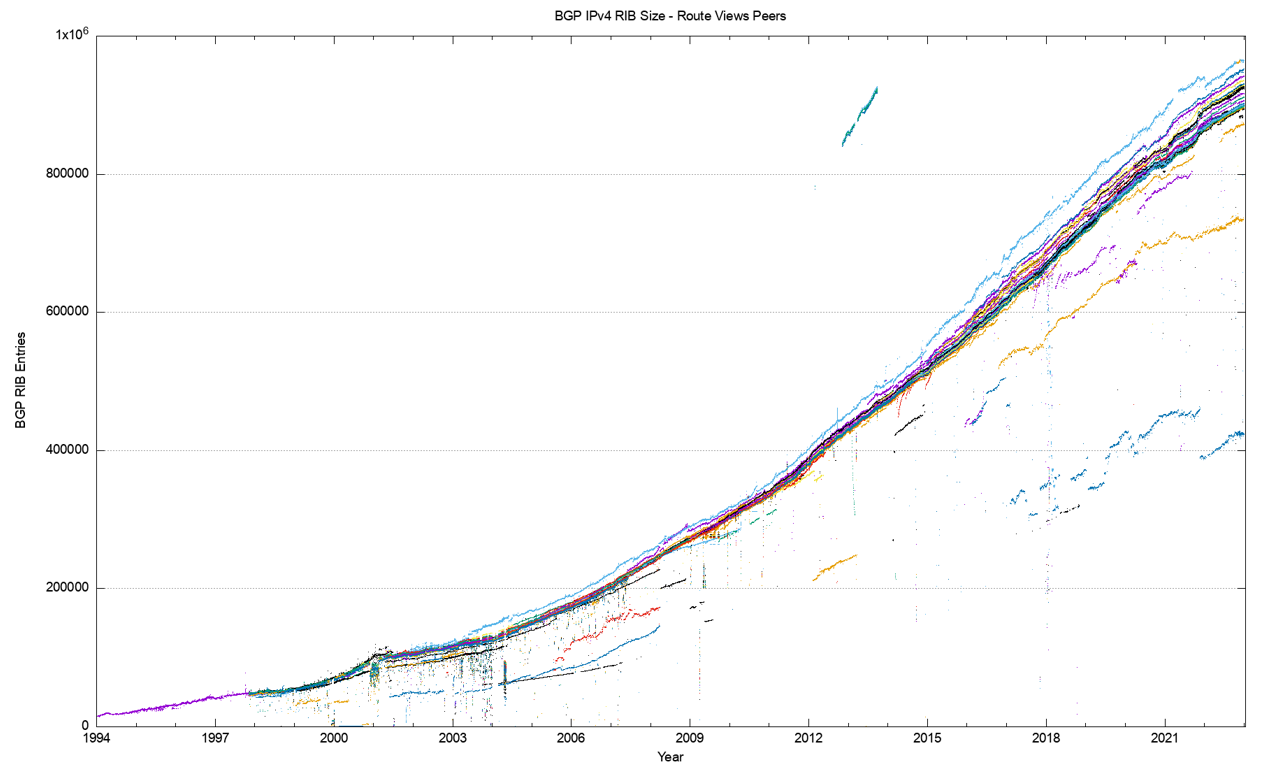
https://blog.apnic.net/wp-content/uploads/2023/01/Figure-14-...

there is something called an "IPv4-compatible IPv6 address" and it's exactly the scheme you suggest: the first 96 bits are zero. It doesn't help deal with the billions of devices that only handle a 32-bit address space, however. What do you suggest we do with them? _They_ are the long tail that keeps us in the dual stack world.