The name is just a piece of hacker lore from back in the day
The worst are when they pick a generic English word for a project that has nothing to do with that word. I'm not going to name and shame, but there are so many examples of new project that get posted to HN monthly that have irrelevant and unsearchable names. We see things like "Show HN: Banana - A lightweight URL parsing library in Rust". WTF does URL parsing have to do with bananas? How do you expect that word to be uniquely searchable back to your project??
It can go too far the other direction too, for example the generic names like Files, Phone, etc either preloaded on the device by the manufacturer (eg Samsung) or by Google, or some third party.
The worst is when an application's display name is different from its actual name. Like on my MATE desktop it took me years to fully internalize that “Files” is actually `caja` if I want to invoke it from a terminal. At least Nautilus was a type of shell lol
"Adoption of our Ogg Vorbis format isn't where we hoped it to be"
"Fork me on Git"
Yes, really:
https://archive.kernel.org/oldwiki/git.wiki.kernel.org/index...
But i totally get your point.
I'm wondering that if some random gibberish might even be better to name a project nowadays. At least there would be less SEO collision.
It is one of the most common words in the English language. It is also one of the most popular board games in the world, and it has nothing to do with it. It can mean plenty of other things, just look at the Wikipedia disambiguation page. It is enough of a problem that it is often called "golang" to make it more searchable.
And ironically, it is made by Google.
C is pretty terrible too, being a popular and extremely influential language with a one-letter name.
Strawberry isn't the most solid program (a few times a year, its search hiccups and gets stuck for a few seconds), but it carries the torch of Clementine's UX - which is my ideal music listening experience.
Compare Amarok 1.4: https://amarok.kde.org/files/amarok14/shot7.png
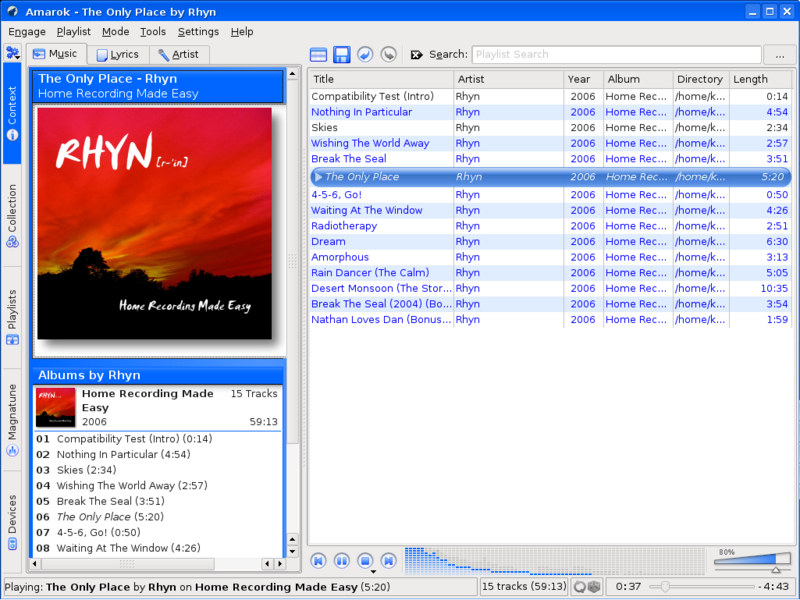
To Amarok 2.0 alpha 1: https://web.archive.org/web/20110820190636/http://blog.lydia...

It was so widely disappointing that the “Amarok 2.0 FAQ” had an entry for “IMO Amarok 2.0 looks terrible” even though that's not a question lol https://web.archive.org/web/20090208231357/http://amarok.kde...
Luckily the Clementine project came along to deliver a straight port of Amazon 1.4 from Qt3 to Qt4 which was all 99% of people really wanted.
*James Rolfe voice* What were they thinking‽‽
Really? I noticed it's slower to start up but other than that it seems the same. I use it pretty regularly because foobar components handle formats the others can't.
Other than that, I'd say Audacious is the closest Linux analogue to foobar2000. My one big gripe was freezing up for a bit when a stream cuts out (blocking socket?) but they fixed that.
Makes it easy to understand why there’s more players than can be counted but few worth using.
Without going too far out into the weeds, lack of integration between filemanagers/filesystems and music players is the main problem. File managers aren’t conducive to sorting by audio file metadata - even those that support it force the user to manually enable those columns in list mode and support is spotty across file formats, meaning the user has to fall back on “hacks” like modifying filenames to sort properly when sorting by name.
Additionally, the browser-type design that’s dominant in file managers doesn’t lend to versatile use with other programs.
This is one area where I think BeOS had the right idea. There, audio metadata was accessible by way of the filesystem which made it easy to access by applications and meant that the file manager more robustly supported sorting by that metadata. Additionally, the file manager was similar to that of Classic Mac OS where windows were dead simple and each represented a single folder, which made it easy to use a file manager window as a playlist window.
Putting the equalizer upstream at the speaker level means that all of your audio is affected by it. And yet there are many times where I am playing certain types of music, such as classical or tracker impulse chiptune that needs some adjustments - i'd much rather be able to adjust it at the playlist and/or player level.
The advantage of a music player that builds a library from a set of folders is that it's infinitely faster to be able to do fuzzy searches particularly around metadata such as Idv3 tags.
Etc. etc.
How do you manage albums that could be classified as two or more genres?
I have recently landed on Tauon which has a pretty particular UI that is pretty unlike most others, but after some getting used to worked well for me. Audacious is mostly fine as well, but at some point I did not want to use it anymore because it would just stop responding to MPRIS events too often
For remote playing I have been really enamoured with Navidrome (in combination with Symfonium) lately. It's not super pretty, but it really has the best organization of albums I have seen so far and I kinda just dont use it for local files, because I dont want to do everything in the browser...
Apple Music on macOS broke album artist (click the artist column a few times) a few releases ago and you now have to resort it on every launch. Maddening. They then added an explicit “sort by album artist” column which… does not work.
In Musium (https://docs.ruuda.nl/musium/) I also handle collaboration albums that have multiple album artists, based on Musicbrainz album artist id.
At the time, the developers claimed changing it to work as people would expect it to would break existing user workflows and so they wouldn't do it.
What are the own goals you speak of?
And many of the few that get "Album Artist" won't respect tags that set the sort order for it either. If you are lucky, they will at least special case "The" so that "The Beatles" are under B, but they'll still put John Denver under "J".
The only one I know of that gets both of these right is cmus; I don't choose to use a terminal-based music player, I'm forced to.
And the name is terrible.
Strawberry is better for me but still kind of janky. Quod Libet and Rythmbox would seem closer to my ideal interface-wise, but scored massive own goals they seemingly will never recover from. How in 2025 music players refuse to (not can't, refuse to) get "Album Artist" right blows my mind.
Since I subscribe to Plex I find I'm using Plexamp more than anything else, but that's not really open source.