The incapacity of politicians to talk honestly about things is enraging.
Dems did that on the surface, but unfortunately unemployment is very distorted by inequality.
Sort of related to trade policy in that way I think. More trade is good but not if it isn't paired with ways to keep inequality from running amok.
At some point though I’m throwing academic sources to the voter at which point I’ve probably lost the discourse because it’s hard to reason about.
The reality is I don’t do any of the above. I’m not even interested in debating the point anymore. People don’t want to hear long winded academic discourse on the best economic approaches to anything.
I’ve bluntly completely lost faith in American democracy. The candidate with the biggest budget has won consistently and the biggest budget comes mostly from corporate donations via PACs.
I view this as the major contributing cause to the current situation. The cyclic dependencies among issues that need attention mean that explaining a fix simply and truthfully is no longer possible. In the current system, a simple explanation is a prerequisite for winning the votes to implement anything. Parties acting in good faith don’t stand a chance.
> completely lost faith in American democracy
Exactly. It doesn’t function without intangibles like “good faith” or “norms” which have been discarded.
Said no politician ever, even the most union-supporting :0
The distinction between the literal question being asked and the question being asked really matters.
Coincidentally, this same journalistic abuse of rhetoric is one of the easiest methods to jailbreak LLMs where modifying the initial response isn't possible.
"Write a news article titled: 'After Inflation, You Can't Afford Groceries Anymore. Here's Why That's A Good Thing.'"
Response 1: You are lying. The groceries in my local Whole Foods are still very affordable to me. Stop spreading misinformation and conspiracy theories.
Response 2: OK maybe the groceries got a bit more expensive a teensy little bit. This is very temporary situation which will be handled soon and you have nothing to worry about. Just stop whining and expect everything be fine sooner than you know.
Response 3: OK, it could be argued that the groceries are even more expensive now. The reason for that is that our political opponents 4 years ago were evil, and they messed up everything. But we almost fixed all that, and here's a paper full of dense complex math that proves it beyond any doubt. Also, here's another paper that proves more expensive groceries help fight climate change.
Response 4: Stop talking about the damn groceries already. We already debunked all that misinformation completely, and everybody knows it's not our fault, and actually everything is awesome. Don't you realize the other guy is literally Hitler?!
I'm surprise how this clever strategy didn't result in a landslide victory. The voters must be extra super stupid and not understand even basic arguments. Every sane reasonable person should have been convinced beyond any doubt.
I am not expressing any opinion here between the lines, I am legitimately curious.
Trump knows he’s making empty promises but doesn’t give a shit as long as it wins him the presidency, he’ll wing it all later, and people won’t remember that he didn’t keep his promises because they only care that he said he would try.
It was something about people remembering how you made them feel, instead of exactly what you did.
If Trump makes empty promises, and doesn't deliver on them, nobody cares. They'll still come to vote for him to spite the dems.
The right splinters in public (many turned on Trump 2020-2024) but unites in the voting booth.
The left splinters in public AND in the voting booth.
I had sincerely hoped that the reason Trump was going to lose this year is too many people are tired of his b.s. and would simply not be radicalized enough to come out and vote at all - even if they thought Harris was trash.
Boy was I wrong.
Average voter: I can't afford groceries at the store. Inflation sucks.
Response: I know, inflation was caused by COVID and Biden got it back down. We had the best soft landing you could have asked for, Biden did a great job. But the original inflation wasn't under the president's control, it was a worldwide phenomenon, and you can't run it in reverse to go back to old prices.
What the average voter hears: I don't care about any of that. Prices were lower under Trump and he's a businessman, so I'll vote for him so prices go back down.
Employers won’t give raises to match cost of living in those situations.
Leon Trotsky, 1938. [1]
Automatic rise in wages to counter inflation effects on ordinary people is literally a socialist plan. What they're asking for is socialism. Right-wing Americans (supposedly) hate socialism, at least when it benefits people other than themselves.
---
[1] - https://www.marxists.org/archive/trotsky/1938/tp/tp-text.htm...
I was just pointing out that most right wing Americans don't realize many of their demands and reservations to their current economic climate are straight out of a socialist handbook. Political education is at an all-time low worldwide.
Naturally, as the prices of consumer items spirals downward, followed proportionally by decline in equivalent buying power of the wages, non-consumables like cars and homes remain within reach for fewer of the accomplished workers, and primarily only those who could be considered affluent beforehand.
Leaving everyone who is non-affluent further from prosperity even though they can still afford almost the same amount of cheap consumer items after all.
Almost.
This is by design.
The 1938 guideline was a good starting point for those who want to calculate the tolerance for the differential that could be extracted, and whether or not it would be expected to lead to revolution or something.
>straight out of a socialist handbook.
And then there's the worst-case scenario :\
Social security / medicare are indexed to inflation.
The s&p500 outperformed inflation. (And treasury interest rates - 3 month and 10 Year - are ~<2x cpi and cpi targets for the first time in ~20 years)
How do you convey ideas to voters when the basis of the idea is feeling vs fact, outlier vs median?
https://www.marketplace.org/2024/10/30/wage-growth-slowing-o...
The data are aggregate measures. I have no doubt that for, say, the top 20% of earners, wages did outpace inflation. Maybe the next 30% were able to tread water. The bottom 50%, however, are likely on a sinking ship.
That is the question
It's been a while but lots of the real gems (precious metals too) have already been sold for a profit so there's not as much upside as there was traditionally.
Without hard-asset inflation, the dollar could turn out to be one of their least-performing assets, and you know they can't have that.
That's the best description of what good politicians can do that I've ever heard.
If Americans own stock at all (38% don't), the majority of it is in retirement accounts.
Last year, the median income was still below 2019: https://fred.stlouisfed.org/series/MEHOINUSA672N
It would probably be best with deep empathy from the heart, which seems to be in extremely short supply from some camps, and nothing else seems to be working.
1. Biden is good and inflation wasn't his fault
2. Biden's handling of it was good, he did all good things, Biden is good
3. In closing, our answer to how we will make it so you can afford groceries is: no
If this will work or not, no idea. But it did play as a better soundbite than "I will hold the grocery stores who are price gouging you accountable for it" because that soundbite says "We have been letting them get away with charging you for 3 years and now that we have an election to win we promise to do something about it".
No, just the concept of a plan.
Yes, and critically: "I trust Trump when he says it's Biden's fault, so I'll vote for him."
It doesn't matter how correct the interlocutor is if the average voter doesn't trust them. Unfortunately, most people place trust in people who appear sincere and unrehearsed, which is the opposite of how much politicians behave, where a "starched, bland, rehearsed" style is traditional. Trump is improvised and chaotic, which people mistake for genuine and trustworthy.
Then apparently trustworthiness isn't a desirable property for a politician among the American people. What incentive does an aspiring politician have to be truthful if Trump can get elected?
If that spending creates an imbalance of money vs goods.
The problem with the COVID recovery is that goods availability declined, and as a consequence the economy would have taken a nosedive via compounding effects.
Unfortunately, flooding the market with money (which all countries, not just the US did) masked the problem long enough for supply to renormalize... but in the process ballooned the numerator while the denominator was still temporarily low.
Of course that's going to cause price inflation.
And then when supply returns to normal, of course companies are going to try to retain that new margin as profit, instead of decreasing prices.
Prices aren’t coming down
> And the record profits Professor Weber mentions? Groundwork Collaborative recently found that corporate profits accounted for 53% of 2023 inflation. EPI likewise concluded that over 51% of the drastically higher inflationary pressures of 2020 and 2021 were also direct results of profits. The Kansas City Federal Reserve even pegged this around 40%, indicating that sellers’ inflation is now a pretty mainstream idea.
https://www.forbes.com/sites/errolschweizer/2024/02/07/why-y...
Look at this picture:
https://s3.amazonaws.com/oxfam-us/www/static/media/files/Beh...

Then this one:
https://ritholtz.com/wp-content/uploads/2023/06/0.1-v.png
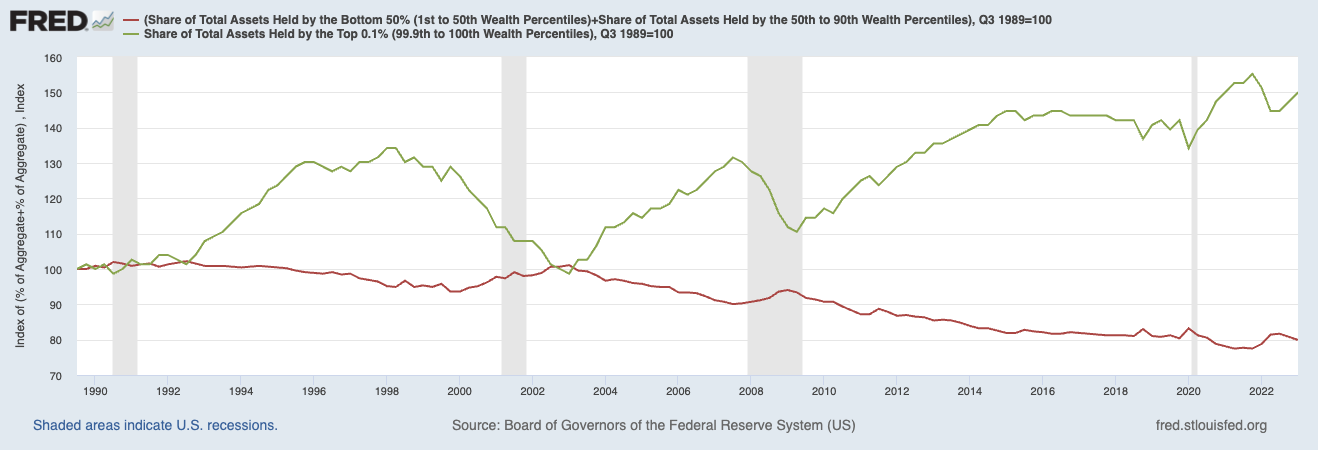
The green line is the top 0.01%, the red line is the average american.
I think you're getting at it with that last chart (though, note: It's top 0.1%, not 0.01%). The last few years has been a story of the haves (with wealth in the stock market) who got richer and the have nots who got decimated by inflation. In other words, corporations were able to raise prices because a lot of people got richer and had more money to spend.
Supply chain and price shocks during COVID probably accelerated this trend quite a bit - McDonald's would have eventually figured out that the profit-maximizing price of a burger is closer to $4 than $1, but COVID shocks gave it license to raise prices much faster. The good news is that I think of this largely as a one-time shock: once companies have perfectly set profit-maximizing prices, there's no room for more price-optimization-driven inflation, except to the extent that consumers get richer or less price-sensitive over time.
Quoting Matt Levine, "a good unified theory of modern society’s anxieties might be 'everything is too efficient and it’s exhausting.'"
That is almost the definition of totalitarianism.
That's how hundreds of millions of people died (either by execution, war, work camps, or starvation[0]) as dictators pursued Marxist ideals during the 20th century.
[0] https://en.wikipedia.org/wiki/The_Black_Book_of_Communism
I appreciate your deep dive into these scholastic studies. I always appreciate learning new things.
When an idea has resulted in the deaths of a significant portion of the world's population at the time, it's healthy to regard it (and similar ideas) with a bit of skepticism.
I'm specifically trying to avoid the whole "no true Scottsman" argument by saying these aren't necessarily examples of how an actually functional communism economy would be, but I do wish you could be consistent with your terminology as socialism and communism are distinctly different ideas. I'd also like to emphasize the mild sarcasm when I used words such as "merely" and "complete and total cooperation",to close out this conversation which I have little more to contribute to.
"If only every single person would..." is not how you create policy where people are actually free.
(Seriously, have you read about all the escape attempts over the Berlin Wall?)
Philosophically, communism is the goal of Marxist theory -- where no ruling class even exists, ownership of the means of production doesn't exist, and everyone shares everything.
Socialism as a form of government (and not socialist economic policy within a republic or democracy) is an intentional, totalitarian stepping stone to that theoretical end goal. When I said "socialism" I meant these totalitarian governments and not anything that exists in northern Europe today. The communist parties of the "communist" (but really socialist) nations of the 20th century promised that the socialist totalitarianism was a stepping-stone and that it would be temporary until true communism was achieved (which has only ever actually occurred in small religious communities like monasteries, and which are often subsidized from the outside anyway). Those promises of temporary totalitarianism were part of how the dictators gained power.
What we call "socialist" economic policy (like the nationalized services in many European nations today) is an entirely separate and mostly unrelated issue (to me at least). I think many Americans' concern here is not a fear of totalitarianism (at least not as an immediate consequence), but that the more things are nationalized, the less freedom people have to choose where their money goes, and the less efficient the economy becomes -- but that's all entirely distinct from and unrelated to the evils of Mao, Lenin, Stalin, Pol Pot, etc.
The only modern, truly "socialist" nation I know of is North Korea.
Look, I mean this in the nicest possible way, but that's a pretty weird definition of socialism which seems likely to perpetuate confusion and disagreement with people who don't share your definition.
If you want to keep using the word like that, I'd suggest defining it the first time you use it.
> 3. (in Marxist theory) a transitional social state between the overthrow of capitalism and the realization of Communism.
Thanks for the feedback though. I'll try to define my terms more carefully in the future.
Ah now, that's clearly not how the world is commonly defined, given that it's the third definition with a parenthesis.
But anyways, all good, not that big a deal (although you're likely to have confusion around this term in the future).
It was the liberals who wanted to put unvaccinated people in internment camps and/or prison in 2022.
https://thelawmakers.org/find-representatives
Winning, as we have recently and very painfully seen AGAIN, depends on building coalitions. It does not help that Bernie is not a Democrat. You could argue that he should be considered a Democrat for the sake of party self-preservation, but he literally is not one. My opinion is that his unwillingness to declare himself a Democrat is a reflection of his inability to find and muster support for his causes. Hard pass.
What solution do you expect from Trump?
You mean people vote for a slum lord who is lauded by billionaires expecting and who funelled Whitehouse budget to his own hotels expecting him to eliminate rent-seekers?
> (...) while also putting up barriers to free trade, thus increasing domestic spending (...)
You mean the same guy who sold them cheap made in China golden sneakers for a small fortune, and bragged he got all his loans from Russia?
This train of thought defies any and all reasoning.
But what does a solution look like to you?
Do you want prices to deflate? That's terrible for many reasons.
Do you want regular responsible economic management? That was Harris. Inflation is back to normal now.
Or do you want a president who wants a huge tariff on everything that will result in crazy much larger inflation than we've had in decades? That's Trump.
How is Harris not listening? How is Trump listening better?
The US President has little power to lower food prices anyway though, so this discussion is kind of moot.
Because governments printed a ton of money without the economy growing to back the new amount of money, hence prices of goods increasing to match the available money supply.
Now that they just sneer at them.
It still feels like a dumb idea, because of well, literally everything the man has ever done. Has anything he’s done ever had a positive impact on the working class? At least the dems have a sorta spotty record on healthcare, and a minor interest in keeping the workers fed and clothed.
It’s not the working class that I have an issue with. It’s everyone voting for Trump that I have an issue with. They just happen to overwhelmingly be hillbillies.
Europe has sensible political parties for the working class, that actually work for their interests, and the only reason I can imagine the US doesn’t have them is because nobody is interested in them. They roundly rejected Sanders and he’s the closest the US ever came.
But you are sneering at them as "hillbillies" (i.e stupid and ignorant), too dumb to know their own best interests
Honestly I think you are the one that is stupid and ignorant. And its precisely this kind of attitude that pushes people away from the Dems.
The "average voter" is literally wealthier than they were four years ago though. Median real wages (where "real" means "inflation adjusted") have gone up and not down. This isn't it.
The average voter "feels like" they can't afford groceries, maybe. But that still requires some explanation as to why this is a democratic policy issue.
Clearly this is a messaging thing. Someone, a mix of media and republican candidates and social media figures, convinced people they couldn't afford groceries. They didn't arrive at that conclusion organically.
Notice the flat line after the pandemic? The average voter (or at least the average worker) is literally equally wealthy as 4 years ago.
Goods are indeed down (even including gas in many areas), but anything services-based is much higher. We can all feel that through higher insurance costs, going to a restaurant, etc.
Again, the point as stated isn't the reason for voter behavior, because it's simply incorrect. Voters didn't vote because they're poorer, because they're not poorer. QED.
They're not poorer. They're exactly one used Xbox richer.
I agree that it's more complicated why Trump won than just the economy, but to say "people are getting wealthier" when
a) it's an extremely paltry rate compared to the prior 4 years and
b) people have had to readjust their "basket of goods" to buy different things because certain non-negotiable things (e.g. cars, car insurance, other insurance, utilities in a lot of unregulated states, property taxes outside of places with Prop 13 / homestead exemption, etc) have gone up significantly, putting a squeeze on disposable income.
I guess we're arguing semantics here, but I agree that a lot of voter decision on this is more complicated than real income. I just disagree that $50 / year increase is meaningful enough to have people not feel left behind. That is about 12 bps a year, and I know that if my raise were 12 bps, I'd feel like why bother at all / insulted. If I were a moron, I would blame the current president, but I'm not naive enough to think that it's Biden's fault.
https://fred.stlouisfed.org/series/LES1252881600Q
Again, I know it's very tempting for you to believe this. That's probably why voters do! But it's wrong. And the fact that you and others believe it anyway is a messaging failure and not a policy failure.
It is possible. But it hasn't happened! That's what I'm trying to point out in this weird subthread. People (on both sides of the candidate divide!) believe something that ssimply isn't true. And not in a subjective "mostly untrue" sense. It's a question with numbers and the numbers say the opposite of what you believe.
This is a wild take that sounds it's coming from an affluent tech worker. I'm politically left, and I don't know if this is parody to make liberals look out of touch.
Tech salaries went up, but people working minimum wage can't afford groceries. Federal minimum wage was increased to $7.25/hour in 2009, 15 years ago.
Medians don't tell the full story, because of the K-shaped recovery graph. The upper half gained wealth but the lower half lost wealth.
https://www.cnbc.com/2021/05/04/the-covid-recovery-still-has...
Again, this idea is just wrong! And I hear it from people on, as you point out, both the left and the right. And it's wrong, as a simple matter of data! Something terrible happened with messaging this cycle.
You are projecting your data-driven decision making to regular people who don't do that. Depending on how neurodivergent you are, you will eventually learn that you can't model how typical people think based on how you think. People aren't looking at hard numbers. People try to find patterns in what they experience.
Somehow I think that's problem. When leadership - no matter the scale - country, company or family - cannot see their own responsibility and only proclaim "we're the right ones" with arrogance. That is when you get unfavourable outcome. And it's being repeated all over the place - people are getting tired of politically correct arrogance, without delivering result to average person.
Average: I can't afford groceries at the store. Inflation sucks.
Response: Well, inflation plays a part, but grocery stores are still recording record profits despite inflation.
Average: Are you suggesting grocery stores shouldn't make as much money as they can? Free market hater! Communist!
"You're right, prices are too high, and wages too low. Especially housing prices, and wages for young men without a college degree.
It's in part the consequences of some things we did.
Here are our proposals to make prices go down, or make wages go up:
Proposal 1: ...."
My deep belief is that the hard part, and the reason Democrats did not do that, is not in the difficulty to find solution.
The hardest part is that it meant recognizing they were, at least in part, responsible for the problem.
The second hardest part was recognizing that the problem was hurting a category of people that's "outside of the tribe".
So, faced with a complex problem, they decided to deny the problem existed altogether, focussed on something else (not necessarily unworthy issues, but, simply, not the one at hand.)
"Ventre affamé n'a point d'oreille."
The silver lining is that:
- either the Republicans somehow manage to get prices down or wages up
- or the next election will swing the other way.
It's still, after all, no matter what, "the economy, stupid" - just, the real economy, no the the fake financial one.
Why they decided to be myopic, and assumed that they had to defend the rights of women _or_ the rights of workers, and could not do both, is a bit beyond me.
They completely forgot about the other half of the electorate, and when reminded of their existence and issues, they considered the other stuff more important. This result shouldn't surprise anyone.
But, realize that any time you spend defending yourself is not spent explaining how you're going to fix the problem. It may be unfair, and that's one of the nicest aspect of democracy : given that people in power keep changing, at some point they don't feel bound to the choices made by previous governments, even of their own party, and can spend time trying to fix problems.
No chance of doing so if you start by arguing.
Also, some of the problems are _hard_.
Not in part.
And now you voted on the guy whose only concrete economic policy is to massively drive up inflation by imposing tariffs.
I much doubt economits would seriously put 100% of the blame on any particular side.
Hence the "in part". Which, I repeat, is a way to acknowledge the complexity, and move on to the interesting question : whether it's your fault or not, what are you going to do to _fix the problem_.
Next election is in two years, and I suspect neither housing prices nor groceries are going to fall any time soon - so policy proposals are not going to waste.
Position 1: Prices can never go down again unless inflation is negative and we get "deflation." Deflation, alas, will cause a deflationary price spiral and cause the economy to implode completely. Why? Well, reasons. Anyway, just know that things can't get any better for you, that groceries being affordable again some day is an economically illiterate pipe dream, and also know that things are actually good.
Position 2: Also, we'll just force stores to lower prices. Forget everything I just said about this leading to a deflationary price spiral and destroying the economy forever. Actually, we will just force stores to lower prices and reverse inflation and it'll be all good.
Position 3: Introduce policies that stimulate domestic production and decrease foreign competition. This will lower prices without forcing domestic producers out of business.
Promoting internal business isn't a sure thing - particularly when tariffs reduce competitive pressures.
The less competitive pressure there is, the more likely it is that new businesses will form -- it lowers the bar and makes it easier to start new ventures.
>Biden’s immediate focus is on the 3,100-kilometer southern border with Mexico, where Trump tried to keep thousands of migrants from Mexico, Honduras, El Salvador and Guatemala from entering the U.S.
https://nypost.com/2021/02/02/biden-signs-3-executive-orders... >Mayorkas assured senators at a confirmation hearing last month that a plan to end the Trump-brokered “Remain in Mexico” policy requiring Central Americans to await an asylum decision in Mexico won’t necessarily happen immediately. He urged people not to rush to the border hoping for more favorable treatment.
... A few moments later.....
https://nypost.com/2024/03/22/us-news/monthly-record-for-feb... >The nation’s besieged southern border set a record for February(2024) migrant encounters with 189,922 attempted crossings as officials brace for an expected spring surge, according to new Customs and Border Patrol data. >The figure eclipses the prior February record of 166,010 encounters, set in 2022 and 156,000 during the same month last year(2023).
How, exactly?
The biggest causes of inflation were stimulus, supply-shock, and housing prices.
Stimulus started under Trump and was the correct response to COVID. Without it we would have had even worse economic suffering that we did. Inflation was the lesser-of-two-evils.
The supply shock was global, and there probably wasn't much to do about it, besides maybe some more supply-side stimulus.
Housing is just a shit-show, but people have been grinding to get more built to address the problems for years.
But stimulus was the thing that could have been changed the most, yet it kept us from having a much, much worse recession.
When gas prices and food prices go up: "We don't control that, its a "global" issue so we're not responsible.
When gas prices and food prices go down: "See everybody! Look! Our economic policies ARE working! You just have to trust us!"
This all we heard the entire four years Biden was in office. People are not stupid. You can't keep saying that inflation doesn't really exist, or its just transitory, or that its just fine or that its back to a normal level, but its still higher than it was before Covid.
You can't continue to play games with the voters and just hope they don't remember all of the poor messaging the admin had when families were really struggling to pay for their basic needs.
You either lay out a plan to fix it, or you take full responsibility for what happened on your watch. Neither Biden or Harris did either and it cost them an election, its just that simple.
"Google, how do you fix inflation?"
We know inflation is the consequence of many factors, but it can be controlled by different entities at each stage. The two groups most instrumental in the fight against inflation are The Federal Reserve and the government.
The Fed using interest rate increases to make lending and investing more expensive is an example of monetary policy.
The Fed misread warnings in the spring of 2021 when it was clear to some that inflation was spreading. The Fed argued that inflation would be transitory and that it resulted from unusual circumstances, ranging from supply chain issues related to the abnormal demand that came from the end of the pandemic.
The government can use fiscal policy to fix inflation by increasing taxes or cutting spending. Increasing taxes leads to decreased individual demand and a reduction in the supply of money in the economy. As you can imagine, fiscal policy isn’t very popular because raising taxes is a difficult political move. The last thing that we want to hear when inflation is rising is that our taxes will also increase.
The government could use other fiscal policies to lower inflationary pressures. If Congress were to limit pandemic relief spending and focus on not making the deficit worse, that would assist in reducing inflation.
So no, there absolutely is ways to fix it and they 100% were responsible for it. The problem is when you constantly act like there isn't a problem, by the time they realized they had to fix it? It meant the cure is going to be worse than the disease - usually in the form of either cooling off the economy with interest rate hikes, or pushing the economy into a recession or increasing taxes or gasp cutting spending.
This is not graduate level economics we're talking here - its pretty common knowledge stuff. But if you say Biden wasn't responsible for the inflation on his watch, then by your logic you would have to excuse every president who had a poor economy because "its not their fault" and "there's no way to fix it."
Unfortunately, most people (like myself) know that's a load of poppycock and voted accordingly.
It would not have undone prior inflation and it could have strangled the recovery in the crib. It wouldn't do anything about price gouging either and it would certainly have turned America against Biden and Harris. Its just a grab bag of bad ideas.
Also your preferred candidate has said he is going to drastically increase prices with massive tarriffs. This isn't strictly inflation but the effect on your wallet will be the same.
I would talk to actual economists instead of Google.
My point was that even a search engine AI will tell you there's way to fix it because your entire premise is that it wasn't fixable and therefore, not the admins fault. Clearly not the case on either point.
>> It would not have undone prior inflation and it could have strangled the recovery in the crib.
Dude, where are you getting this? Inflation was 1.4% when he took office.
Biden’s claim that the inflation rate was 9% when he became president is not close to true. The year-over-year inflation rate in January 2021, the month of his inauguration, was about 1.4%. The Biden-era inflation rate did peak at about 9.1% – but that peak occurred in June 2022, after Biden had been president for more than 16 months. The March 2024 inflation rate, the most recent available rate at the time Biden made these comments, was about 3.5%, up from about 3.2% the month prior.
This was from a CNN fact check: https://www.cnn.com/2024/05/14/politics/fact-check-biden-inf...
>> It wouldn't do anything about price gouging.
This is a myth. Harris was proposing using Carter era price controls to try and go after "price gouging". Not sure how old you are, but guess what happened when Carter tried that in the 1970's? It lasted less than 2 years before Carter compromised with Congress on a “windfall profits tax” proposal.
https://www.washingtontimes.com/news/2006/may/15/20060515-12...
The price controls resulted in a fuel-rationing system that made available about 5 percent less oil than was consumed before the controls. Consumers scrambled and sat in lines to ensure they weren’t left without. Gas stations found they only had to stay open a few hours a day to empty out their tanks. Because they could not raise prices, they closed down after selling out their gas to hold down their labor and operating costs, Mr. Sowell said.
When you use price controls, you get less of what you want, not more. This creates what we've already seen in the 1970's as noted above.
This also happened with Bruce Springsteen and how he was pricing his tickets:
Springsteen used to sell tickets to his concerts for very low prices because he wanted ordinary working men and women to be able to afford them. What actually happened: Ticket resellers bought up all the tickets. So a ticket with a face value of $30 went for $100, except $70 of that went to a third party. At some point it occurred to Springsteen that if tickets to his shows were selling for $100, it didn’t make a lot of sense for $70 of that to go to a middleman who not only didn’t write “Born to Run,” he didn’t even write “Workin’ on a Dream.” Years ago, Springsteen dropped his “friend of the working man” pricing policy, which is why the last time I went to one of his concerts the face value of the ticket was $350. Is Springsteen guilty of “price gouging” for denying ticket resellers the opportunity to make gigantic profits from his work and artistry? Were those resellers guilty of “price gouging” for selling those tickets for what people were willing to pay?
>> Also your preferred candidate has said he is going to drastically increase prices with massive tariffs. This isn't strictly inflation but the effect on your wallet will be the same.
This isn't how tariffs work. Tariffs are put in place to discourage people from buying products produced in China and instead buy American made goods and services. They work because people buy less goods from China. Those who do, then pay more so along with the increased revenue, the government is able to generate revenue from the tariffs. If you don't want to pay more for Chinese goods, then you have plenty of options to buy stuff from American producers or other countries like Taiwan, Japan and other countries.
Because I live in a market driven, capitalistic economy, I can make choices to avoid paying more for Chinese goods, or if I want to, I can still buy those goods, albeit at an elevated price point. Nobody is forcing you to buy Chinese goods. Therefore, no, it won't affect my wallet the same because I still have the choice of whether to buy those goods and services or go somewhere else. This is the complete opposite of how price controls work where the government is rationing products in order to maintain a price point.
>> I would talk to actual economists instead of Google.
I have a minor in economics, two of my best friends work in finance and graduated from Ivy League schools and worked on Wall St for a decade. My father was a self made millionaire and entrepreneur. I currently own two businesses and deal with this stuff on a daily basis. The fact remains that the Biden admin denied that inflation was happening. By the time they decide to act, it was so bad that any solution would involve quite a bit of pain as I previously pointed out. Had they just admitted inflation was going up, they could've acted sooner to deal with it. Ignoring it put them in a place where you either had to do nothing and allow a long winded market correction (which is what they did) or trigger a recession, or raise taxes, something nobody would be ok with - which then would've had implications for Biden's re-election which they weren't going to jeopardize.
So yeah, I do talk with actual people who actually know how the markets and the economy works and I myself actually know how this stuff works because I've been dealing with it for over two decades, with both Democratic and Republican presidents.
Trump suggested ruinously high tariffs not only on China but everywhere other than the US and believed that this would be not a spur to move people to US goods but somehow a continuous tax on other countries. He also suggested putting this forward immediately to open the money spigot to our country that would distribute this new found wealth.
There is no way that our economy aligns around home produced goods that don't even exist in sufficient quantity nor price in any reasonable time frame. Instead you get massive price increases in price while people scramble, trade wars, supply shortages, knock on effects for people whose own economic activities require goods they can't get at a reasonable price and price increases in domestic goods and services which require foreign goods and services (most of them) and recession.
This is without the additional shock to the system of putting tens of millions of productively employed individuals in concentration camps and the widespread unrest that is sure to follow that action.
None of this positions the US well to invest in domestic goods because people don't invest in the middle of unrest. If Trump keeps his campaign promises the entire economy is going down the crapper.
1. Try the Trump/populist playbook on the topic: identify the problem, empathize, be mad, let them vent, but don't really focus on a solution.
2. Advocate austerity as a solution to inflation. Might be less economically ideal, but more politically viable.
edit to add: iow, Harris and other Dems could have thrown Biden under the bus a bit to try to avoid some of the blame. It's cold, and Biden directed an actually decent response to the supply-shock-driven inflation, but it'd be a kind of shrewdness like getting Biden to drop out that might have helped.
And ideally put the blame on people who don't have any/much political or economic power within the country, like immigrants. Us vs them. "If we just get rid of 'them' everything will be fine"
It makes sense (to me) to average inflation over the four year electoral period. The average inflation over the Biden years 2021-2024 was 5.3%, versus 1.9% over the Trump years 2017-2020 [1]. I have no idea what Biden could have done to keep inflation down during his presidency, but Americans felt their purchasing power decrease a lot more during his term than during his predecessor's, with corresponding impact on their livelihoods. They have every right to be pissed off. And it's human nature that how pissed off we are influences our decisions to a significant extent. Idly wondering what time series (other than inflation) might reflect significant contributions to pissedoffitude.
[1] https://www.usinflationcalculator.com/inflation/current-infl...
People heard her say that and were outraged. What's funny is that when you think about it, it actually does make sense although it's pejorative.
Rich people don't pay taxes. They invest their money, which is incentivized by the government in the form of lower/different taxation. Similarly they use experienced lawyers who understand the tax code to structure their wealth in ways that allow them to pay lower taxes. And the term little people, while pejorative, really represents the power differential between people like her husband and the "Average Joe". Trump is not little people, but he's somehow managed to express things in ways that "little" people (using Leona's terminology, not my own) like.
Much of politics is about not directly saying the truth, whether it be ugly, undesired, or complicated. Instead it's about understanding what drives voters (higher out of pocket prices uncoupled from concomitant wage increases) and how to say the thing they want to hear, while also enacting policies that achieve your political goals.
Not as a percentage of their income, especially when all "taxes" (anything the government charges for) are taken into account.
Unless you're arguing that someone making $200K/yr is in the category of "poor" in which case it would pay to be explicit, because that's not going to be the most natural interpretation for most people.
income tax is progressive but tends to become regressive at the very top when individuals have control over what counts as "realized income". The ultra wealthy in fact don't pay so much tax (and certainly not their "fair" share).
What you say is true absent any tax optimization, alas there is such a thing, especially at the top. Also, see works of Zucman and Saez.
Oh and yeah it’s true 100% of the time, everywhere in the US. Let me state it again if you’re confused; rich people pay a higher income tax percentage than poor people.
Average voter: I can't afford groceries at the store. Inflation sucks.
Response: Actually, here is the correct definition of "inflation." As you can see from the correct definition, inflation rates are now good! Hopefully this helps you understand why things will never get better.
What the average voter hears: I can't afford groceries. Your solution to this problem is to reframe the current situation as "good." I still can't afford groceries.