Employers won’t give raises to match cost of living in those situations.
Leon Trotsky, 1938. [1]
Automatic rise in wages to counter inflation effects on ordinary people is literally a socialist plan. What they're asking for is socialism. Right-wing Americans (supposedly) hate socialism, at least when it benefits people other than themselves.
---
[1] - https://www.marxists.org/archive/trotsky/1938/tp/tp-text.htm...
I was just pointing out that most right wing Americans don't realize many of their demands and reservations to their current economic climate are straight out of a socialist handbook. Political education is at an all-time low worldwide.
Naturally, as the prices of consumer items spirals downward, followed proportionally by decline in equivalent buying power of the wages, non-consumables like cars and homes remain within reach for fewer of the accomplished workers, and primarily only those who could be considered affluent beforehand.
Leaving everyone who is non-affluent further from prosperity even though they can still afford almost the same amount of cheap consumer items after all.
Almost.
This is by design.
The 1938 guideline was a good starting point for those who want to calculate the tolerance for the differential that could be extracted, and whether or not it would be expected to lead to revolution or something.
>straight out of a socialist handbook.
And then there's the worst-case scenario :\
Social security / medicare are indexed to inflation.
The s&p500 outperformed inflation. (And treasury interest rates - 3 month and 10 Year - are ~<2x cpi and cpi targets for the first time in ~20 years)
How do you convey ideas to voters when the basis of the idea is feeling vs fact, outlier vs median?
https://www.marketplace.org/2024/10/30/wage-growth-slowing-o...
The data are aggregate measures. I have no doubt that for, say, the top 20% of earners, wages did outpace inflation. Maybe the next 30% were able to tread water. The bottom 50%, however, are likely on a sinking ship.
That is the question
It's been a while but lots of the real gems (precious metals too) have already been sold for a profit so there's not as much upside as there was traditionally.
Without hard-asset inflation, the dollar could turn out to be one of their least-performing assets, and you know they can't have that.
That's the best description of what good politicians can do that I've ever heard.
If Americans own stock at all (38% don't), the majority of it is in retirement accounts.
Last year, the median income was still below 2019: https://fred.stlouisfed.org/series/MEHOINUSA672N
It would probably be best with deep empathy from the heart, which seems to be in extremely short supply from some camps, and nothing else seems to be working.
1. Biden is good and inflation wasn't his fault
2. Biden's handling of it was good, he did all good things, Biden is good
3. In closing, our answer to how we will make it so you can afford groceries is: no
If this will work or not, no idea. But it did play as a better soundbite than "I will hold the grocery stores who are price gouging you accountable for it" because that soundbite says "We have been letting them get away with charging you for 3 years and now that we have an election to win we promise to do something about it".
No, just the concept of a plan.
Yes, and critically: "I trust Trump when he says it's Biden's fault, so I'll vote for him."
It doesn't matter how correct the interlocutor is if the average voter doesn't trust them. Unfortunately, most people place trust in people who appear sincere and unrehearsed, which is the opposite of how much politicians behave, where a "starched, bland, rehearsed" style is traditional. Trump is improvised and chaotic, which people mistake for genuine and trustworthy.
Then apparently trustworthiness isn't a desirable property for a politician among the American people. What incentive does an aspiring politician have to be truthful if Trump can get elected?
If that spending creates an imbalance of money vs goods.
The problem with the COVID recovery is that goods availability declined, and as a consequence the economy would have taken a nosedive via compounding effects.
Unfortunately, flooding the market with money (which all countries, not just the US did) masked the problem long enough for supply to renormalize... but in the process ballooned the numerator while the denominator was still temporarily low.
Of course that's going to cause price inflation.
And then when supply returns to normal, of course companies are going to try to retain that new margin as profit, instead of decreasing prices.
Prices aren’t coming down
> And the record profits Professor Weber mentions? Groundwork Collaborative recently found that corporate profits accounted for 53% of 2023 inflation. EPI likewise concluded that over 51% of the drastically higher inflationary pressures of 2020 and 2021 were also direct results of profits. The Kansas City Federal Reserve even pegged this around 40%, indicating that sellers’ inflation is now a pretty mainstream idea.
https://www.forbes.com/sites/errolschweizer/2024/02/07/why-y...
Look at this picture:
https://s3.amazonaws.com/oxfam-us/www/static/media/files/Beh...

Then this one:
https://ritholtz.com/wp-content/uploads/2023/06/0.1-v.png
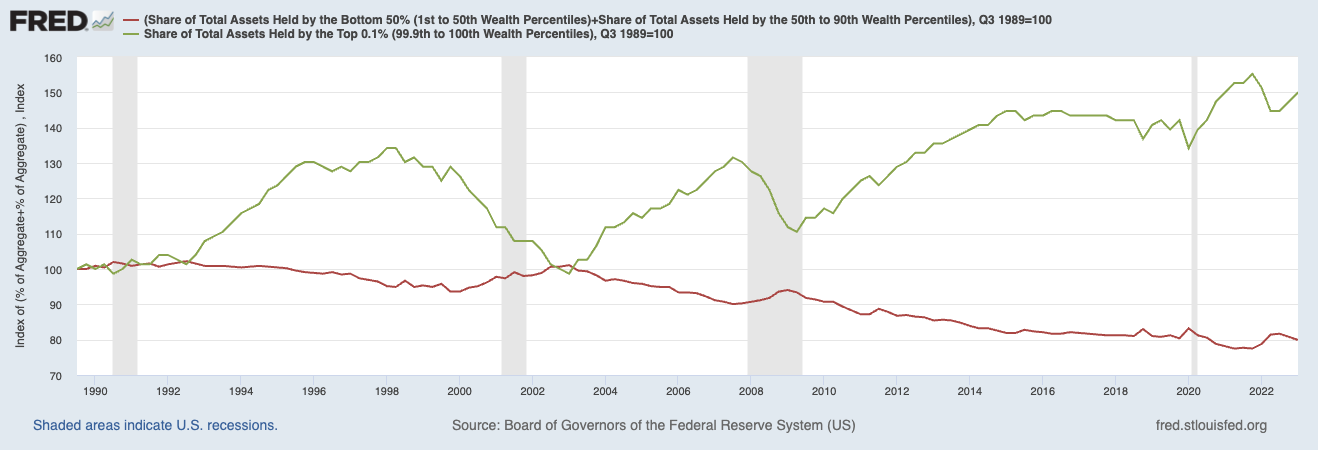
The green line is the top 0.01%, the red line is the average american.
I think you're getting at it with that last chart (though, note: It's top 0.1%, not 0.01%). The last few years has been a story of the haves (with wealth in the stock market) who got richer and the have nots who got decimated by inflation. In other words, corporations were able to raise prices because a lot of people got richer and had more money to spend.
Supply chain and price shocks during COVID probably accelerated this trend quite a bit - McDonald's would have eventually figured out that the profit-maximizing price of a burger is closer to $4 than $1, but COVID shocks gave it license to raise prices much faster. The good news is that I think of this largely as a one-time shock: once companies have perfectly set profit-maximizing prices, there's no room for more price-optimization-driven inflation, except to the extent that consumers get richer or less price-sensitive over time.
Quoting Matt Levine, "a good unified theory of modern society’s anxieties might be 'everything is too efficient and it’s exhausting.'"
That is almost the definition of totalitarianism.
That's how hundreds of millions of people died (either by execution, war, work camps, or starvation[0]) as dictators pursued Marxist ideals during the 20th century.
[0] https://en.wikipedia.org/wiki/The_Black_Book_of_Communism
I appreciate your deep dive into these scholastic studies. I always appreciate learning new things.
When an idea has resulted in the deaths of a significant portion of the world's population at the time, it's healthy to regard it (and similar ideas) with a bit of skepticism.
I'm specifically trying to avoid the whole "no true Scottsman" argument by saying these aren't necessarily examples of how an actually functional communism economy would be, but I do wish you could be consistent with your terminology as socialism and communism are distinctly different ideas. I'd also like to emphasize the mild sarcasm when I used words such as "merely" and "complete and total cooperation",to close out this conversation which I have little more to contribute to.
"If only every single person would..." is not how you create policy where people are actually free.
(Seriously, have you read about all the escape attempts over the Berlin Wall?)
Philosophically, communism is the goal of Marxist theory -- where no ruling class even exists, ownership of the means of production doesn't exist, and everyone shares everything.
Socialism as a form of government (and not socialist economic policy within a republic or democracy) is an intentional, totalitarian stepping stone to that theoretical end goal. When I said "socialism" I meant these totalitarian governments and not anything that exists in northern Europe today. The communist parties of the "communist" (but really socialist) nations of the 20th century promised that the socialist totalitarianism was a stepping-stone and that it would be temporary until true communism was achieved (which has only ever actually occurred in small religious communities like monasteries, and which are often subsidized from the outside anyway). Those promises of temporary totalitarianism were part of how the dictators gained power.
What we call "socialist" economic policy (like the nationalized services in many European nations today) is an entirely separate and mostly unrelated issue (to me at least). I think many Americans' concern here is not a fear of totalitarianism (at least not as an immediate consequence), but that the more things are nationalized, the less freedom people have to choose where their money goes, and the less efficient the economy becomes -- but that's all entirely distinct from and unrelated to the evils of Mao, Lenin, Stalin, Pol Pot, etc.
The only modern, truly "socialist" nation I know of is North Korea.
Look, I mean this in the nicest possible way, but that's a pretty weird definition of socialism which seems likely to perpetuate confusion and disagreement with people who don't share your definition.
If you want to keep using the word like that, I'd suggest defining it the first time you use it.
> 3. (in Marxist theory) a transitional social state between the overthrow of capitalism and the realization of Communism.
Thanks for the feedback though. I'll try to define my terms more carefully in the future.
Ah now, that's clearly not how the world is commonly defined, given that it's the third definition with a parenthesis.
But anyways, all good, not that big a deal (although you're likely to have confusion around this term in the future).
It was the liberals who wanted to put unvaccinated people in internment camps and/or prison in 2022.
https://thelawmakers.org/find-representatives
Winning, as we have recently and very painfully seen AGAIN, depends on building coalitions. It does not help that Bernie is not a Democrat. You could argue that he should be considered a Democrat for the sake of party self-preservation, but he literally is not one. My opinion is that his unwillingness to declare himself a Democrat is a reflection of his inability to find and muster support for his causes. Hard pass.
What solution do you expect from Trump?
You mean people vote for a slum lord who is lauded by billionaires expecting and who funelled Whitehouse budget to his own hotels expecting him to eliminate rent-seekers?
> (...) while also putting up barriers to free trade, thus increasing domestic spending (...)
You mean the same guy who sold them cheap made in China golden sneakers for a small fortune, and bragged he got all his loans from Russia?
This train of thought defies any and all reasoning.
But what does a solution look like to you?
Do you want prices to deflate? That's terrible for many reasons.
Do you want regular responsible economic management? That was Harris. Inflation is back to normal now.
Or do you want a president who wants a huge tariff on everything that will result in crazy much larger inflation than we've had in decades? That's Trump.
How is Harris not listening? How is Trump listening better?
The US President has little power to lower food prices anyway though, so this discussion is kind of moot.
Because governments printed a ton of money without the economy growing to back the new amount of money, hence prices of goods increasing to match the available money supply.
Now that they just sneer at them.
It still feels like a dumb idea, because of well, literally everything the man has ever done. Has anything he’s done ever had a positive impact on the working class? At least the dems have a sorta spotty record on healthcare, and a minor interest in keeping the workers fed and clothed.
It’s not the working class that I have an issue with. It’s everyone voting for Trump that I have an issue with. They just happen to overwhelmingly be hillbillies.
Europe has sensible political parties for the working class, that actually work for their interests, and the only reason I can imagine the US doesn’t have them is because nobody is interested in them. They roundly rejected Sanders and he’s the closest the US ever came.
But you are sneering at them as "hillbillies" (i.e stupid and ignorant), too dumb to know their own best interests
Honestly I think you are the one that is stupid and ignorant. And its precisely this kind of attitude that pushes people away from the Dems.
Average voter: I can't afford groceries at the store. Inflation sucks.
Response: I know, inflation was caused by COVID and Biden got it back down. We had the best soft landing you could have asked for, Biden did a great job. But the original inflation wasn't under the president's control, it was a worldwide phenomenon, and you can't run it in reverse to go back to old prices.
What the average voter hears: I don't care about any of that. Prices were lower under Trump and he's a businessman, so I'll vote for him so prices go back down.