Seems unreasonable. You are afraid because marketing gurus like Altman made you believe that a frog that can make bigger leap than before will be able to fly.
- Arthur C. Clarke
Geoffrey Hinton is a 76 year old Turing Award* winner. What more do you want?
*Corrected by kranner
Turing Award, not Nobel Prize
I don't know the details of Hinton's probability distribution. If his prediction is normally distributed with a mean of 20 years and a SD of 15, which is reasonable for such a difficult and contentious prediction, that puts over 10% of the probability in the next 3 years.
Is 10% a lot? For sports betting, not really. For Mankind's Last Invention, I would argue that it is.
Surely this time it's going to be different, AGI is just around a corner. /s
On a side note, I find this type of critique of what future of tech might look like the most uninteresting one. Since tech by nature inspiries people about the future, all tech get hyped up. all you gotta do then is pick any tech, point out people have been wrong, and ask how likely is it that this time it is different.
Now, chain of breakthroughs happening in a small timeframe? Good luck with that.
Just to make it clear, I see only 1 breakthrough [0]. Everything that happened afterwards is just application of this breakthrough with different training sets / to different domains / etc.
[0]: https://en.wikipedia.org/wiki/Attention_Is_All_You_Need
Sometimes this is masked by people spending more due to the industry becoming more important, but it tends to be obvious over the longer term.
I'm not saying this as someone cheering this on; I'm alarmed by it. But I can't pretend that it's running out of steam. It's possible it will run out of money, but even if so, only for a while.
For example, why hire any call center workers? They already outsourced the jobs to the lowest bidder and their customers absolutely hate it. Fire those people and get some AI in there so it can provide shitty service for even cheaper.
In other words, it will just make things a bit worse for everyone but those at the very top. usual shit.
You could have seen this exact kind of thing written 5 years ago in a thread about blockchains.
For example, transaction costs/latency/throughput.
I realize the conversation is about blockchain, but I say my point still stands.
With blockchain the main problem was always "why do I need this?" and that's why it died without being the world changing zero trust amazing technology we were promised and constantly told we need.
With LLMs the problem is they don't actually know anything.
So in that sense, if we're playing reference class tennis, this looks a lot more like a project to break the sound barrier than a project to break the light barrier. Is there a stronger case you can make that these people, who are demonstrating quite tangible progress every month (if you follow the literature rather than just product launches), are working on a hopelessly unsolvable problem?
We've been trying to build a knowledge representation system powerful enough to capture the world for decades, but this is something that goes more into the foundations of mathematics and philosophy that it has to do with the majority of engineering research. You need a literal genius to figure that out. The majority of those "talented" people and funding aren't doing that.
Not sure if that same pace applies to the physical realm where costs are high (resources, energy, pollution, etc), and the risk of getting it wrong could mean a lot of negative consequences. e.g. I'm handling construction materials, and the robot trips on a barely noticeable rock leaking paint, petrol, etc onto the ground costing more than just the initial cost of materials but cleanup as well.
This creates a potential future outcome (if I can be so bold as to extrapolate with the dangers that has) that this "frenzy of talent" as you put it will innovate themselves out of a job with some may cash out in the short term closing the gate behind them. What's left is ironically the people that can sell, convince, manipulate and work in the physical world at least for the short and medium term. AI can't fix the scarcity of the physical that easily (e.g. land, nutrients, etc). Those people who still command scarcity will get the main rewards of AI in our capital system as value/economic surplus moves to the resources that are scarce and have advantage via relative price adjustments.
Typically people had three different strengths - physical (strength and dexterity), emotional IQ, and intelligence/problem solving. The new world of AI at least in the medium term (10-20 years) will tilt the value away from the latter into the former (physical) - IMO a reversal of the last century of change. May make more sense to get good at gym class and get a trade rather than study math in the future for example. Intelligence will be in abundance, and become a commodity. This potential outcome does alarm me not just from a job perspective, but in terms of fake content, lack of human connection, lack of value of intelligence in general (you will find people with high IQ's lose respect from society in general), social mobility, etc. I can see a potential to the old world where lords that command scarcity (e.g. landlords) command peasants again - reversing the gains of the industrial revolution as an extreme case depending on general AI progress (not LLMs). For people who's value is more in capital or land vs labor, AI seems like a dream future IMO.
There's potential good here, but sadly I'm alarmed because the likelihood that the human race aligns to achieve it is low (the tragedy of the commons problem). It is much easier, and more likely, certain groups use it and target people of value economically now, but with little power (i.e the middle class). The chance of new weapons, economic displacement, fake news, etc for me trumps a voice/chat bot and a fancy image generator. The "adjustment period" is critical to manage; and I think climate change, and other broader issues tells us sadly IMO our likely success in doing this.
Seems like the base case here is for the exponential growth to continue, and you'd need a convincing argument to say otherwise.
Without specifics all I can say is that I don't acknowledge any measurable benefits of AI (in its' current state) in real world applications. So I'd say I am leaning towards latter.
Refining technology is easier than the original breakthrough, but it doesn't usually lead to a great leap forward.
LLMs were the result of breakthroughs, but refining them isn't guaranteed to lead to AGI. It's not guaranteed (or likely) to improve at an exponential rate.
They can be useful tools ro be sure, but it seems more and more clear that they will not reach AGI.
In reality, AI progress and capabilities are not so reducible to singular quantities. For example, it’s not clear that we will ever get rid of the model’s tendencies to just produce garbage or nonsense sometimes. It’s entirely possible that we remain stuck at more incremental improvements now, and I think the bogeyman of “superintelligence” needs to be much more clearly defined rather than by extrapolation of some imagined quantity. Or maybe we reach a somewhat human-like level, but not this imagined “extra” level of superintelligence.
Basically the argument is something to the effect of “big will become bigger and bigger, and then it will become like SUPER big and destroy us all”.
A thousand years ago we hadn't invented electricity, democracy, or science. I really don't think we're a thousand years away from AI. If intelligence is really that hard to build, I'd take it as proof that someone else must have created us humans.
Not saying we're in necessarily the same situation. But it remains difficult to evaluate effort required for actual progress.
[1]: https://www-formal.stanford.edu/jmc/history/dartmouth/dartmo...
Another analogy is breeding and racial biology which used to be all the hype (including in academia). The fact that humans could create dogs from wolves, looked almost limitless with the right (wrong) glasses. What we didn’t know is that wolf had a ton of genes that played a magic trick where a diversity we couldn’t perceive was there all along, in the genetic material, and it we just helped make it visible. Ie a game of diminishing returns.
Concretely for AI, it has shown us that pattern matching and generation are closely related (well I have a feeling this wasn’t surprising to neuro-scientists). And also that they’re more or less domain agnostic. However, we don’t know whether pattern matching alone is “sufficient”, and if not, what exactly and how hard “the rest” is. Ai to me feels like a person who had a stroke, concussion or some severe brain injury, it can appear impressively able in a local context, but they forgot their name and how they got there. They’re just absent.
Additionally, when you're talking with certainty about whether transformative AI is a few years away or not, that's the only way to be wrong. Nobody is or can be certain, we can only have estimations of various confidence levels. So when you say "Seems unreasonable", that's being unreasonable.
Wow, in that case I'm convinced. Such an unbiased group with nothing at all to gain from massive AI hype.
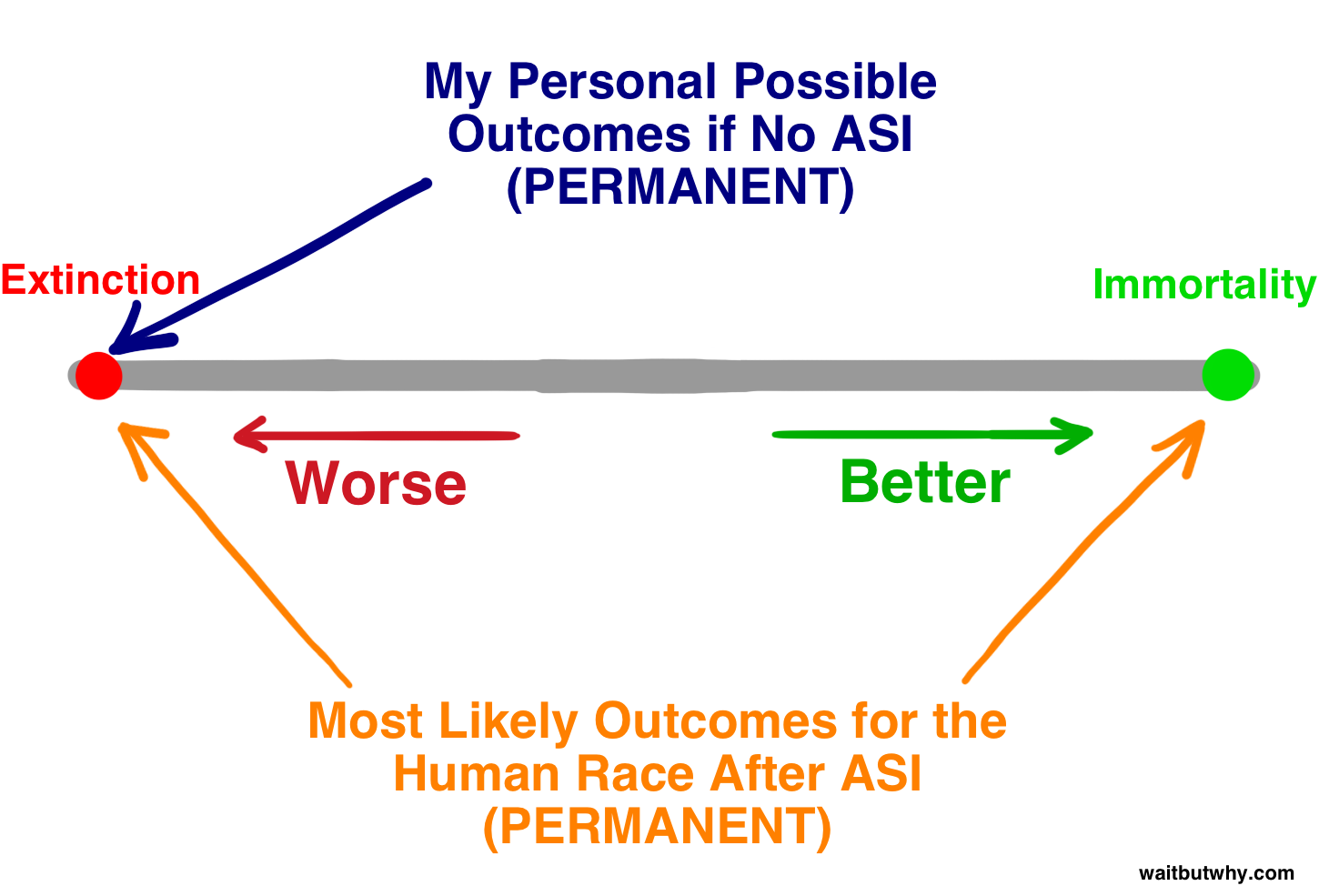
A highly white-collar perspective. The great irony of technologist-led industrial revolution is that we set out to automate the mundane, physical labor, but instead cannibalised the creative jobs first. It's a wonderful example of Conway's law, as the creators modelled the solution after themselves. However, even with a lot of programmers and lawyers and architects going out of business, the majority of the population working in factories, building houses, cutting people's hair, or tending to gardens, is still in business—and will not be replaced any time soon.
The contenders for "superhuman AI", for now, are glorified approximations of what a random Redditor might utter next.
Why on earth would anyone invest in that when you have an infinite amount of human work available?
> the problems a robot faces when, say laying bricks, are prohibitively complex to solve.
That's what we thought about Go, and all the other things. I'm not saying bricklayers will all be out of work by 2027. But the "prohibitively complex" barrier is not going to prove durable for as long as it used to seem like it would.
Have you ever seen the inside of a modern car factory?
No matter how much you ”solve“ robotics, you’re not going to compete with the result of millions of years of brutal natural selection, the incredible layering of synergies in organisms, the efficiency of the biomass to energy conversion, and the billions of other sophisticated biological systems. It’s all just science fiction and propaganda.
AI employing all humans does not sound like a wonderful society in which to live. Basically Amazon/Walmart scaled up to the whole population level.
For a true superhuman AI, what you or me think is irrelevant and probably wrong.
Cars are still faster than humans, besides evolution.
The crappy jobs are left for humans.
That is an interesting statement. Wouldn't you say this is inevitable? Humans, in our current form, are incapable of being that "advanced intelligence". We're limited by our biology primarily with regards to how much we can learn, how far we can travel, where we can travel, etc. We could invest in advancing our biotech to make humans more resilient to these things, but I think that would be such a shift from what it means to be human that I think that would also be more a of new type of intelligence. So it seems like our fate will always be to be forgotten as individuals and only be remembered by our descendants. But this is in a way the most human thing of all, living, dying, and creating descendants to carry the torch of life, and perhaps more generally the torch of intelligence, forward.
I think everything you've said are valid concerns, but I'll raise a positive angle I sometimes thing about. One of the things I find most exciting about AI, is that it's the product of almost all human expression that has ever existed. Or at least everything that's been recorded and wound up online. But that's still more than any other human endeavour. A building might be the by-product of maybe hundreds or even thousands of hands, but an AI model has been touched by probably millions, maybe billions of human hands and minds! Humans have created so much data online that's impossible for one person, or even a team to read it all and make any sense of it. But an AI sort of can. And in a way that you can then ask questions of it all. Like you, there are definitely things I'm uncertain about with the future as a result, but I find the tech absolutely awe-inspiring.
My biggest worry is that we end up with a dangerous superintelligence that everybody loves, because it knows exactly how to make every despotic and divisive choice it makes sympathetic.
This jab was uncalled for. The rest of your argument, agree or disagree, didn’t need that and was only weakened by that sentence. Remember to “Be kind. Don't be snarky. Converse curiously; don't cross-examine. Edit out swipes.”
They are made of a fraction of human reports. Specifically what humans wrote and has been made available on the web. The human experience is much larger than text available through a computer.
Behind either the fear or the hope, is necessarily some utter faith that a certain kind of future will happen. And I think thats the most interesting thing.
Because here is the thing, in this particular case you are afraid something inhuman will take control, will assert its meta-Darwinian power on humanity, leaving you and all of us totally at their whim. But how is this situation already not the case? Do look upon the earth right now and see something like benefits of autonomy or agency? Do you feel like you have power right now that will be taken away? Do you think the mechanism of statecraft and economy are somehow more "in our control" now then when the bad robot comes?
Does it not, when you lay it out, all feel kind of religious? Like that its a source, driver of the various ways you are thinking and going about your life, underlayed by a kernel of conviction we can at this point only call faith (faith in Moores law, faith that the planet wont burn up before, faith that consciousness is the kind of thing that can be stuffed in a GPU). Perhaps just a strong family resemblance? You've got an eschatology, various scavenged philosophies of the self and community, a certain but unknowable future time...
Just to say, take a page from Nietzsche. Don't be afraid of the gods, we killed them once, we can again!
It's more likely the superintelligent machine god(s) will kill us!
(Expressed at length here): https://slatestarcodex.com/2015/03/25/is-everything-a-religi...
I am not saying "this is religion, you should be an atheist," I respect the force of this whole thing in people's minds too much. Rather, we should consider seriously how to navigate a future where this is all at play, even if its only in our heads and slide decks. I am not saying "lol, you believe in a god," I am genuinely saying, "kill your god without mercy, it is the only way you and all of us will find some happiness, inspiration, and love."
Ah, well. If only killing god was so easy!
To quote George RR Martin: "In a heartbeat, a thousand voices took up the chant. King Joffrey and King Robb and King Stannis were forgotten, and King Bread ruled alone. 'Bread.' They clamputed. 'Bread, bread!' "
Replace Joffrey, Robb and Stannis with whatever lofty philosophical ideas you might have to make people feel better about their disempowerment. They won't care.
The GRRM quote is an interesting choice here though. It implies that what is most important is dynamic. First Joffrey et al, now bread. But one could go even farther in this line: ideas, ideology, and, in GoT's case, those who peddle them can only ever form ideas within their context. Philosopher's are no more than fancy pundits, telling people what they want to here, or even sustaining a structural status quo that is otherwise not in their control. In a funny paradoxical way, there are certainly a lot of philosophers who would agree with something like this picture.
And just honestly, yes, maybe killing god is killing the philosopher too. I don't think Nietzsche would disagree at least...
This was never the case in the past.
The displaced workers of yesteryear were never at all considered, and were in fact dismissed outright as "Luddites", even up until the present day, all for daring to express the social and financial losses they experienced as a result of automation. There was never any "it's going to be okay, they can just go work in a factory, lol". The difference between then and now is that back then, it was lower class workers who suffered.
Today, now it's middle class workers who are threatened by automation. The middle is sighing loudly because it fears it will cease to be the middle. Middles fear they'll soon have to join the ranks of the untouchables - the bricklayers, gravediggers, and meatpackers. And they can't stomach the notion. They like to believe they're above all that.
China is very different. Their economy is very much dependent on trade with the U.S. and they know that trying to have "world domination" would also crash their economy completely. China would much rather engage in economic warfare than military.
If you wouldn't mind reviewing https://news.ycombinator.com/newsguidelines.html and taking the intended spirit of the site more to heart, we'd be grateful.
And Putin threating the western world with nuclear war because they are losing a war they didn't need to start is not more insufferable? Come on.
>The US is the one that kept couping and ruining my country along with UK/Western Europe.
Okay, what country, [name redacted]?
>My example is one of tons and tons.
Definte "a ton" in terms of geopolitics, and maybe we can continue, but I feel like it's really not worth it for either of us.
>Keep telling yourself Russia is somehow worse
I don't have to, Putin keeps proving it every single day.
>The Russian empire colonies are far fewer than the West.
That isn't because they are benevolent or kind. You're mixing up quite a bit of stuff in your head to arrive at a dubious world view. Russia is nobody's friend.
>Your example of Mexico is so bad.
Russia is attacking their neighbor because they are opportunistic, and a bunch of thugs and liars. If the US ever wanted to take over Mexico or Canada, that would have already easily happened, but there's plenty of peace over here.
https://hn.algolia.com/?dateRange=all&page=0&prefix=false&so...
I've redacted the name now. If you wouldn't mind reviewing https://news.ycombinator.com/newsguidelines.html and taking the intended spirit of the site more to heart, we'd be grateful.
I am too but not for the same reason. I know for a fact that a huge swath of jobs are basically meaningless. This "AI" is going to start giving execs the cost cutting excuses they need to mass remove jobs of that type. The job will still be meaningless but done but by a computer.
We will start seeing all kinds of disastrously anti-human decisions made and justified by these automated actors that are tuned to decide or "prove" things that just happen to always make certain people more money. Basically the same way "AI" destroys social media. The difference is people will really be affected by this in consequential real world ways, it's already happening.
I believe they believe their claims . I think they are mistaken about the empirical side of things if they were actually put to an objective test.
Take an expert prompter and the best LLM for the job and someone who believes they can always tell if something is written by AI and I'm >50% sure they will fail a blind test most of the time after you repeat the test enough.
That wasn't even true in the past; or at least, may true in theory but not in practice. A subsistence farmer in a rural area in Asia or Africa finds the martket flooded with cheap agri-products from mechanized farms in industrialized countries. Is anybody offering to finance his family and send him off to trade school? And build a commercial and industrial infrastructure for him to have a job? Very often the answer is no. And that's just one example (Though rather common over the past century).
What I really believe is that we'll get crazier. A step further than our status quo. Slop content makes my brain fry already. Our society will become more insane and useless, while an even smaller percent of the elite will keep studying, sleeping well and avoiding all this social media and AI psychosis.
I deleted my instagram a month ago. It was just feeding images of beautiful women, personally enjoy looking at those photos but it was super distracting to my life. I found it a distracting and unhealthy.
Anyway I logged in the other day after a month off it and I couldn’t believe I spent anytime on there at all. What a cesspool of insanity. Add well the fake AI images and it’s just hard to believe the thing exists at all.
Elon musk is another story, I’m not sure if it was drugs an underlying psychological or Twitter addiction but he seems like another “victim of social media”.the guy has lost it.
On the Elon front, you're not alone in thinking that he has essentially OD'ed on Twitter, which has scrambled his brain. Jaron Lanier called it "Twitter poisoning":
https://www.nytimes.com/2022/11/11/opinion/trump-musk-kanye-...
First, I'm afraid of technological unemployment.
In the past, automation meant that workers could move into non-automated jobs, if they were skilled enough. But superhuman AI seems now only few years away. It will be our last invention, it will mean total automation. There will be hardly any, if any, jobs left only a human can do.
Many countries will likely move away from a job-based market economy. But technological progress will not stop. The US, owning all the major AI labs, will leave all other societies behind. Except China perhaps. Everyone else in the world will be poor by comparison, even if they will have access to technology we can only dream of today.
Second, I'm afraid of war. An AI arms race between the US and China seems already inevitable. A hot war with superintelligent AI weapons could be disastrous for the whole biosphere.
Finally, I'm afraid that we may forever lose control to superintelligence.
In nature we rarely see less intelligent species controlling more intelligent ones. It is unclear whether we can sufficiently align superintelligence to have only humanity's best interests in mind, like a parent cares for their children. Superintelligent AI might conclude that humans are no more important in the grand scheme of things than bugs are to us.
And if AI will let us live, but continue to pursue its own goals, humanity will from then on only be a small footnote in the history of intelligence. That relatively unintelligent species from the planet "Earth" that gave rise to advanced intelligence in the cosmos.