If your transmission line to your nuclear power station trips, you need reserve capacity elsewhere to serve the load.
Gas and coal generation all need storage to run reliably.
If you are going to be an armchair power system designer and you want to ‘gross up’ the cost of capacity and storage into the cost of renewable generation, then be consistent.
Solar cannot act as the backup to a nuclear power plant. Whereas a nuclear power plant can (and does) act as the backup to solar.
I'm grossing up to make the point that after about 60-70% solar penetration, the circle cannot be squared without massive investment either in batteries or in distribution, a fact which seems to never quite fully make it into cost comparisons between nuclear and solar such as those being made in this thread.
But AFAIK you can't just turn nuclear plants on and off again based on demand like you can do with gas. So it's not really a backup.
But batteries are not the ideal storage technology for all storage use cases. It turns out that e-fuels like hydrogen are much, MUCH better for some cases, like seasonal leveling, even though the round trip efficiency isn't great.
It will likely be the case that a 100% RE grid ends up being considerably cheaper than a nuclear powered grid.
Nuclear backing up solar is a completely stupid idea, btw. The economics don't work at all.
Even though I don't like natural gas for energy generation, let's say an area is currently being served by a natural gas plant. But now everyone wants electric cars and more power is needed. You can deploy a whole boatload of solar and use rate structuring to incentivize consumption in the day time (you charge your car at work). Now the gas plant spins up at night but it is only running half the time, and all day long people are using emission-free solar energy. And they aren't burning gasoline for their cars anymore. Plus if there is a power outage they can use their car as a home battery backup.
So yeah, I don't think it really makes any sense to say "we have 78 seconds of battery backup so solar is pointless". You can make a HUGE dent in people's energy-related carbon emissions if you install solar tomorrow. Or you can pay much more and install nuclear in 15 years. Maybe we should start building out nuclear now but it would absolutely not be to the exclusion of solar! Even if we built 1000 new nuclear power plants in the US we would still need lots of solar and wind energy.
Anyway, don't know where I was going with this but those are my two cents.
the heavy investment that goes into those plants incentives operators to drive (and staff) them 24/7, but there are hidden social costs (negative externalities) of having so many people out of diurnal rhythm. maybe massive solar power buildout, with sharply cheaper daytime electricity, would relieve people from working “graveyard shifts” – and maybe that’d be a good thing
That said, the companies aren't going to just stop, they'll just charge higher prices. To stop producing in the third shift, they'll need to:
    - add more daytime production lines, which means buying more floor space, possibly in a different location with new logistics to work out

    - new capex for the new lines

    - higher overhead because your newly expanded production lines are idle 30% of the time

    - higher overhead from daily startup and shutdown times
Even places like hospitals don't exactly get to choose to just turn off all the life support and lights at night.
I thought the opposite was proven. E.g. When Germany produced a lot of variable output electricity they varied aluminum smelting rates accordingly. That was highly effective and not generally expected.
There's tons of low hanging fruit like that but if you listen to carbon or nuclear lobby propaganda theyre insistent that the only thing that can solve the problem is more lithium than exists in the entire world.
We always need electricity available, but the demand is not constant and there are quite a few discretionary loads which can be run preferentially in the day time. We can expand our electrical capacity with clean solar energy in the day time, reducing the total need for existing polluting sources. Even if industrial factories run off of natural gas at night, a large installed base of solar will allow discretionary loads (home appliances, EV charging, etc) to run off of zero emissions solar when available. And even the industrial plants can utilize solar during the daytime, cutting their CO2 emissions related to energy use in half.
In the age of renewables, things have changed. If you have enough renewables to cover large parts of the electricity demand on average, then you will frequently produce 100% more of the maximum grid demand. In this situation, "base load" power plants don't make any sense at all. The new term is "residual load". This refers to the load at a point of time which cannot be delivered by renewables at that time. This can also vary between 0 and 100%. Which obviously requires different power plants, like gas, water.
If you had a predominantly renewable grid, this would generally be 80-100%, because low generation could coincide with peak load. Which is extremely bad, because then you have to duplicate that proportion of generation capacity via some alternative even though it's only rarely needed. Or worse, it's needed a lot but it's fossil fuels.
Meanwhile you want some degree of energy storage, because if you have times when renewable generation is more than 100% of the load, you want to be able to use that power later and not just throw it away.
But then you're back to base load sources making sense. They reduce the amount of storage or peaker plants you need at night and the amount of renewable generation you need during the day.
They just don't make sense as more of the grid than there is "base load" for the same reason as always. Otherwise you'd have times where there is surplus "base load" generation and have to put that into energy storage, when it'd have been cheaper for that part of generation capacity to be renewables.
Even China regularly spends 7+ years to build nuclear from the point where construction actually starts and even longer when you include planning.
What if they don’t? There’s no assurances there will be magic battery tech
There is a reason China India Russia and others are still building nuclear plants
China is building nuclear because they are building everything, but they are effectively building 3x as much solar and 7x as much wind because nuclear just costs more than any other option.
From 2020-2022 China increased generation power by:
   51,600 GWh/year Nuclear
  156,600 GWh/year Solar
  357,500 GWh/year Wind
Adding more capacity is an all hands on deck situation for the China they are throwing everything at it. Nuclear is simply achieving the smallest gains because the ROI is low.
On the surface, that sounds logic. In reality so, that is exactly what happens: as short notice reaction by big consumers (reducing or increasing consumption as needed), planning in accordance with electricity exchanges... And that behaviour is actually pretty profitable, it contributes to grid stability, enables more flexibility on the consumption side and is technically possible in a surprising number of high consumption industries (paper, chemicals, graphite, steel...).
So then what. You could overbuild solar, build distribution, build battery banks. I'm not wild about that. Mining for batteries is nasty business and we need all of the Lion we can get for electric mobility. Distribution? It's alright, but you run into problems -- like, what do you do when the sun goes down on the west coast? What do you do when a line goes down? Your system is larger, more centralized, more vulnerable.
Nuclear under the current regulatory regime is clearly a nonstarter. But the capex of nuclear is almost entirely artificial. Something much closer to "too cheap to meter" could be a reality. All it takes is a cultural willingness.
By the way, nuclear having an extraordinary capex makes it even tougher to compete with solar in the mix. Because your capacity factor goes way down if you are only generating at night. This is why we build oil and gas plants -- they're cheap. What we need is for nuclear to favorably compete with oil and gas. It does not need to compete with solar.
I also think that electricity grids are very complex and powering any large grid with 100% of any one source is impossible. As each energy source has different pros and cons, you'll generally always have a mix of different sources.
A similar project is being constructed in the Southwest United States:
https://news.ycombinator.com/item?id=38801943
3,500 MW of wind+ HVDC transmission for 11 billion dollars.
With respect to electricity generation then, Ireland is in the middle with 39% renewable electricity generation for 2022[0]. 2022 was "less windy" than average by about 2%, and 2021 lower again by about 6%[1]. The grid currently can sustain 75% renewables, substantial upgrades are in progress (capacity and ROCOF related) to get that up to 95%. This year (2023) was substantially better, in the first 10 months the average contribution from wind alone was 33%[2], this month the wind generation record was broken also[3] (~4.6GW). Hydro and other sources top renewables up by another ~6% [4].
[0] https://www.consilium.europa.eu/en/infographics/how-is-eu-el... [1] https://www.dnv.com/article/uk-and-ireland-windiness-2022-24... [2] https://windenergyireland.com/latest-news/7615-31-per-cent-o... [3] https://electroroute.com/new-record-for-irish-wind-generatio... [4] https://www.seai.ie/data-and-insights/seai-statistics/key-st...
Natural gas is neither renewable nor emission-free when burning, albeit less than burning coal, for instance. About 117 pounds of CO2 are produced per million British thermal units (MMBtu) equivalent of natural gas compared with more than 200 pounds of CO2 per MMBtu of coal and more than 160 pounds per MMBtu of distillate fuel oil. Source: https://www.eia.gov/energyexplained/natural-gas/natural-gas-...
So while using natural gas is better than using coal, in the longer term we likely needs to reduce its usage and substitute with renewables too.
It takes about 1/10 or 1/20th the amount of time and 1/5th the cost to build equivalent solar production. It's better to start with that and let pumped storage, batteries and hydrogen play catch up than pay 5x more and wait 10-20x longer for equivalent levels of nuclear power production.
Right now we use so much natural gas that a GWh of solar or nuclear produced energy is essentially just a GWh of natural gas that never gets burned.
That GWh can be produced in two years less consistently or twenty years more consistently. Which do you choose?
Id take two years. Storage and demand shaping infrastructure will catch up.
Both.
Intermittent generation methods are more problematic the more of the grid you try to replace with them. You have solar generation during the day, you run your natural gas plants less during the day but still run them at night, great. Keep building solar until you can stop running them during the day at all. Installing that much capacity could take 20 years.
At that point you'd have to contend with what to do at night. But hey, by then the nuclear plants you started building today are online. You might also look into ways of speeding up the process, because it shouldn't take 20 years to do that.
We need to stop building new natural gas power plants and existing ones need to have a planned obsolescence so that investors know when their investment will no longer be worth anything.
In Ireland they are actually building natural gas power plants with the assumption they will be stop operation as little as 5 years and only used for emergency purposes from then on. This is because they are using OCGT gas turbines which were invented for use in 3rd world countries and are much cheaper than conventional CCGT gas turbines.
Also don't forget that nuclear power plants have to go offline for maintenance like everything else, and I'm not sure it will ever be financially viable to have redundant nuclear power plants. France recently had to take 50% of their power plants offline for a few months to fix cracks and Japan had to take all of them offline for a few years after Fukushima. Thats why it's necessary to have emergency backup power plants and right now these are typically gas.
Side note: The France story is much more complicated. It doesn't sell narratives well, but what can I say, truth is complicated. It's not going to fit into this comment, but it has to do with regulations, covid, Ukraine, Germany, lack of European self-sufficiency, economics, and so much more. It's best to not bring up France's recent nuclear fiasco unless you're willing to get into the weeds, because otherwise you'll just start a fight by anyone who knows a bit more but still not the full story (which means multiple people will argue confidently and a clusterfuck ensues). With no doubt, France has blame to play. But to give just a push to find more info, remember that inspections and maintenance are scheduled quite far in advance. That many had been pushed off because of a global pandemic, and then war broke out. One could say this was quite a series of unfortunate events. Yes, blame France, but placing all blame on France is like destroying all farms except for one and then blaming that farm for famine when it got overrun by pests (even if it was entirely that farmer's fault, was it?)
You may find this site useful strictly for the electricity and subsequent emissions side. It'll be insufficient for total emissions though (as that includes many things beyond electricity) and certainly isn't adequate for understanding geopolitics or other things. I suggest poking around, using the emission tab per region (defaults on production) and also changing the time scale to at least 30 days to be a more accurate view of this specific question we're addressing.
Unfortunately, you've done just that in this last comment.
One detail that I see too often with people advancing similar arguments than you here is that they just take two countries and compare them if it was two lab experiments done within the same conditions and repeated sufficiently to bring conclusive results.
There are plenty of elements about that: the way France and Germany are industrialised is pretty different so what worked/did not work for one does not mean it would have worked or not for the other, maybe if Germany would have followed the same path as France the German specificity would have made Germany emitting 8x more instead of 6x (or not, of course), maybe the German way had 60% chance of success and bad luck failed while the France way had 40% chance of success and lucky then they did not failed (not saying it's the case, just that it's tricky to pretend getting lessons from what happened), maybe one country had pushed itself in a corner and will struggle on the last few yards while the other had a worst initial score because they were paving the road (again, not saying it's the case), maybe the success of France relied on having Germany going that way (who knows how the French nuclear park would have evolved if they had Germany that would have provided electricity with exactly the same characteristics and fulfilling the same needs on the same market but having the same drawbacks on the same market), ...
It does not mean we cannot get lessons, but the lessons you bring (or the method itself) are just invalid: no, looking at the electricity map today is just not a way to conclude which strategy is the best. And everyone who reasons like that is just muddying the water rather than being helpful.
I think you're reading into my comment too much. I was just explaining some of (certainly not all) absurd amounts of complexity. I was very careful to frequently stress that there are many valid metrics to use to compare, and that none of them are complete. Even my statement is just some complexity and no conclusions.
Certainly I don't think France and Germany should have taken the same path. This is the specialization I was discussing.
> looking at the electricity map today is just not a way to conclude which strategy is the best.
Definitely not something I claimed. I even was careful to stress that this is a very limited metric. And of course not, because they're different countries. Specialization requires complementary strategies, coalitions. So I'm not sure why we'd measure at that abstract of a level (country to country with industry, energy, economics, and such) because you just can't. You can only compare parts at a time and even adding several dozen more metrics you won't be even remotely whole.
You also said "we should still criticize them [germany] for their emission levels and inability to actually match what others have done ", which seems to be exactly what I was talking about: "inability to actually match what others have done" is pretty much saying that if 2 countries spend as much effort and goes into the same strategy, they will match.
Maybe you don't think like that (in which case, my bad), but a lot of people do and your previous comment is very not well written to not amplify this way of thinking by implying this logic is sound.
But I think we need context, as that's likely where things got lost. C0llusion's comment above my "fun fact" comment was the critical aspect. They got causality wrong in their final point. Last year (2022) France's output was ~70% of their 10 year average. I think they confused 50% with their goal for only 50% dependence on nuclear power. The cracks is also a bit weird because while not wrong, it isn't complete and not the causal issue since all nuclear power plants have cracks in the same way all damns do. Here's a "short" writeup by world nuclear[0]. It also briefly mentions how France wanted to be energy independent post oil crisis. But for complexity sake, we can't say counterfactually that Germany made the "wrong" move (or "right") one because you can make an argument about geopolitics and Germany's strategy. If their actions did starve off war then that's a better climate strategy. To complex for me to speculate tbh, just recognizing that it's part of the equation.
I think a big difference in our framing is that you're putting things as if there is a universally optimal strategy by a single nation. Even strictly just on the energy domain. The world is just too complex and it is a multi-agent system that isn't zero sum. Strategies don't work like that when there's so much coalition building. And it is hard for me to properly explain what I'm thinking in just a few comments. I think unfortunately I have a different view than most are used to and so I'm still trying to figure out how to handle the inference gap. I do sincerely appreciate the reinforcement and if you have any additional advice in how I can better communicate. I truly take this idea of complexity to heart, it is a core belief of mine. And if we're being honest, climate is one of the most complicated existential crises that humans have faced. Certainly no single person is able to understand even a relatively complete story except from orbit. But details matter so much that I think we do a great disservice ignoring the complexities (not just around climate). What I can't figure out how to communicate correctly yet is how to discuss a metric but not imply that it is the only thing we should look at. If you have any suggestions I'd really appreciate it. Not sure how to juggle a ton of things but pause to talk about one because talking about everything all at once is fucking chaotic and I'm already verbose as it is. I'm not sure how well this came off but I hope you can see that there's a communication breakdown (admittedly I'm not doing a great job).
[0] https://world-nuclear.org/information-library/country-profil...
That's exactly the opposite of my point. I explicitly say that nation A going into direction X may lead to nation B failing when going into direction Y while it would have succeed if nation A would not have gone into direction X.
As advice, I would say that you should not provide any "counterfactuals" to not-deep-details-enough, because those counterfactuals are also not-deep-details-enough. For example, in C0llusion's comments, you react on the causality error, which is just too simplistic anyway. But you react by opposing their not-deep-details-enough argument with a not-deep-details-enough argument. Both of these arguments are not useful. What you need to do is to show the complexity and why concluding while not having a deep enough overview is stupid. What you have done here in part of your comment is stepping down to their level and arguing with a similarly not-deep-details-enough argument as if this argument is somewhat not as bad. At least you could have added a lot of disclaimer around it, such as "please don't use this argument to jump to the opposite conclusion, as it is as bad, but as a naive example contradicting your logic ..."
I guess I'm confused then because this still reads to me as if you're suggesting there's strictly competing strategies. I get that you are discussing different strategies but to me this reads as optimizing for independent strategies rather than optimizing for dependent ones (which is the usual common way people frame things: look at x country, copy their model; no other nuance needed).
> I would say that you should not provide any "counterfactuals"
I'm also confused because I don't know where I presented any counterfactuals. I know where I said we can't place counterfactuals with insufficient information, but not where I claimed a counterfactual.
Really I'm a bit confused because I didn't claim anything that isn't simply fact, the rest is just mentioning of variables not considered and that this is still an even incomplete picture.
> But you react by opposing their not-deep-details-enough argument with a not-deep-details-enough argument.
Yes. We're still operating from orbit. I'm responding to "look at this island" with "but consider the archipelago." I'm not sure what more you expect, as this is HN. We can get some nuance but even just saying to look in a broader sense (which we haven't even seen everything that's still highly important) takes so much writing. Compression is useful, but not when we don't agree we're working in compression or localized discussions. But abstract discussions can also be useful. The "detail" you're criticizing is different from the one I was: words are overloaded.
> What you need to do is to show the complexity and why concluding while not having a deep enough overview is stupid.
I simply do not have time to write a novel, and even if I wanted to could not do so on HN. I'm sorry, we can only discuss at high levels and specifics can only be localized. But resolution will always be fairly low. I am only trying to increase the scope of the discussion because I have faith in my fellow users to increase resolution on their own time.
Storage in particular could be MUCH cheaper. (And still be centralized to conserve public-utility oversight and dangers from all those saboteurs out there somewhere.)
Battery storage is VERY expensive and hard on the environment. I continue to see little attention being paid to merely simple gravity storage.
Yes, traditional large-scale pumped hydro exists (usually using expensive turbines to pump water uphill, like the plants used in the UK for decades to get past tea-time. There are many more in the U.S.) They're usually expensive (good for getting tax-payer dollars into constructor pockets) ... time-consuming as well ... and need a hill for a reservoir and a water-source. (Of course we have -all the time in the world- right?)
But on a large scale, electricity can also be stored much more simply and economically by moving VERY heavy weights uphill ... or lifting VERY heavy weights out of a hole. Already existing and proven steel cables can lift 'barrels' containing hundreds or thousands of tons of (very cheap) rocks. Construction times and $/MW cost savings over high-tech 'solutions'? might be 10-1000 times lower.
Yes you are correct, in fact I actually addressed that in the later part of my comment
>From 2030 onwards the focus will be on decarbonising the remaining ~20% of electricity generation that is gas. How that will be done will depend mostly on how the technology matures in the meantime, but it will likely be replacing natural gas with hydrogen and biogas. Another option could be carbon capture. Or batteries if there is some technological breakthrough and the price of stored energy drops way below it's current 200euro/MWh price.
When picking fruit from a tree, It's usually best to start at the lower branches.
No, when picking fruit its best to pick it in the order it ripens, and as it does so, irrespective of position on the tree.
It is generally easier and requires less special equipment to pick fruit from the lower branches, hence the metaphorical description of simple tasks as low-hanging fruit. The metaphor (while it may also indicate optimal ordering for some other tasks) is not about optimal ordering for picking fruit from a tree.
I was looking at this paper
https://www.eia.gov/analysis/studies/powerplants/capitalcost...
where solar is quoted at $1300/kwh and adding a battery that can store a little more than an hour of output brings that to around $1800/kwh. I see people quoting that one like it is gospel but that doesn’t seem to be enough storage. If you assume the system needs 12 hours of storage to get through the night you need 10 of those batteries and the cost is getting into the $3500/kwh range.
They quote the AP-1000 and NuScale around $6000. Solar looks cheaper now and maybe it is in the tropics but in the Northeast you are going to get a lot less power in the winter than summer so to keep the lights on all year you might need two of those solar installations (though I think the battery stays the same) and now you are getting around $5000/kwh so that gap with nuclear is getting smaller.
That estimate may be a bit pessimistic, but renewable advocates right now sound like the people who were saying nuclear would be “too cheap to meter.”
Now if you have excess capacity in the summer you could in principle use it for something but that is not trivial. If you use something half he year you basically double the capital cost. Do you hire workers to do nothing in the winter or do you lay them off? “Free” excess solar energy might be “free as in puppy” not “free as in beer.”
From the article, this new reactor is "estimated to cost more than $30 Billion." (Let's call it 30) & It generates 1,114 Mega Watts.
This article [1] says solar panels cost between $0.90 and $1.50 per watt. Let's go with $1/watt to keep the math easy, though I bet it's much cheaper by now, and especially at the scale we'll be buying them at.
So for $30 billion dollars, we can have 30 billion watts of solar, which is 30,000 mega watts, or 27x the amount of power of the new nuke. Obviously solar doesn't produce at night and it's seasonal.
So let's make it more useful.
I saw elsewhere in this thread to get an actual output number from solar you have to divide by 6 to account for night and seasonality. So that means to equal the 1,114 mega watts from the nuke, we need 6,6684 mega watts of solar. call it 7mW to keep the math easy.
So we use 7 billion dollars buying 7mW of solar.
We have a tidy $23 billion dollars left over to spend on storage.
This site [2] says grid scale storage costs something like $300/kWh. (I bet it's cheaper now, and cheaper at massive scale, but we'll go with that.)
So with our $23 billion left over dollars we go and buy 76.6 million kWh of storage (which is 76,666 MWh). So even when there is no sun coming in, our storage can maintain the 1,114 mega watts of output for something around 68 hours. That sounds like overkill, so it probably makes sense to spend more of the money on solar and less on storage, but you get the idea.
Also note for the same $30 billion dollars our solar + storage setup now has no running costs, no refuelling costs, no downtime due to refuelling and maintenance and no radioactive waste disposal problem.
Also note the $30 billion nuke plant is a single point of failure, and needs big lossy power transmission lines coming in/out to go useful places. I would be interested to see the numbers on how much of that 1,114 mW of nuke power winds up lost in transmission. The solar setup can be distributed all over, and can generate and store the power right where it's needed - on factories, houses, schools and where ever else needs power. Transmission loss of close to zero.
Nukes are awesome, but they're not even in the realm of making sense financially. Year after year the price of solar and storage will go down again, then again, then again.
This is not a fair fight.
[1] https://www.forbes.com/home-improvement/solar/cost-of-solar-...
[2] https://thundersaidenergy.com/downloads/battery-storage-cost...
(Please point out any holes / problems in my math)
EDIT: as pointed out below the cost for grid scale storage is more like $500/kWh. So for our $23 billion we can buy 46 million kWh of storage (46,000 mWh). So we can equal the nukes 1,114 mW output for about 41 hours. Still plenty
LCOE (total, incl. CAPEX, in USD per MWh):
coal 82.6, combined cycle 39.9, advanced nuclear 81.7, geothermal 37.6, biomass 90.1, onshore wind 40, offshore wind (that one was a surprise, since offshore wind should be quite cheap, mainly driven by capital cost of 104 USD per MWh) 105, solar 33.8, solar hybrid 49 and hydro 64.
Variable cost (same as above):
coal 23.7, combined cycle 27.7, adv. nuclear 10.3, geothermal 1.2, biomass 30, onshore wind 0, offshore wind 0, solar 0, solar hybrid 0, hydro 4.1
All number from here:
https://www.eia.gov/outlooks/aeo/pdf/electricity_generation...., page 9.
Edit: Just realized the link is broken for some reason... This one should work:
https://www.eia.gov/outlooks/aeo/pdf/electricity_generation....
Korea has built 5.6 GW Barakah NPP for about 25B dollars. It took less than 8 years. Russia is building its standard VVER-1200 reactors at about 10-15B for 2.4 GW
China is building its reactors at about 5B per 1.2 GW reactor.
These costs might fall further if standardized designs get deployed at larger scales, just like with solar.
Given steady and predictable generation regardless of weather and location that nuclear can provide, your numbers don’t look that impressive now, do they?
It's a shame that Vogtle NPP is now made to be a poster child of "nuclear is inviably expensive organizational mess" argument whereas none of its problems are the technology's fault.
If we truly want to decarbonize, nuclear power is absolutely a part of the solution, together with renewables. Given the climate emergency that we are facing, ignoring nuclear’s massive benefits and not removing unnecessary obstacles from its way is almost criminal at this point.
We had 5 Nuclear power plants (one each in ME, MA, NH, CT and VT) of which the last to be commissioned was in New Hampshire (Seabrook) in 1990. This took from the late 1960’s to 1990 to be commissioned with similar regulatory obstacles.
Since 1990 Maine Yankee shut down in 1997 due to NRC safety concerns and additional money required to fix them. The plant operated from 1972 to 1997. Vermont Yankee shut down in 2014 due to overwhelming public support for not renewing it’s license to operate. The plant operated from 1972 to 2014. Pilgrim in Plymouth Mass shut down in 2019 due to the cost of safety upgrades. The plant operated from 1972 to 2019. Two Nuclear plants remain at Seabrook NH and Waterford CT.
The New England energy market was deregulated in 1998 moving to a wholesale market run by New England ISO. Since 2000 older oil fired and coal fired generation plants have largely been replaced with Natural Gas. Recently renewables and net imports from other areas are trending higher. We have almost no coal or oil fired generation in the entire region today.
The stated plan for NE ISO is to continue to pursue renewables. No new Nuclear projects are on the horizon. The current remaining reactors make up approx. 20-30% of the regions baseload power and are nearing end of life.
The Nuclear plants require bailouts to continue to function. In 2019 CT mandated that half of the Waterford plants output was purchased for 10 years at 4.9 cents/kWh. While this increased customer bills initally, it recently saved money when Nat Gas spiked last year. It also saved a 25% spike in the regions total emissions if the plant were to close and be replaced by Nat Gas.
A summary of some of the risks is explained here:
https://www.iso-ne.com/about/what-we-do/in-depth/power-plant...
What would be required is:
* A concerted effort to develop advanced nuclear reactor designs, such as small modular reactors (SMRs).
* Streamlining the regulatory process and adjusting its risk tolerances to more reasonable levels.
* Subsidizing the deployment of advanced reactor types (e.g., SMRs) to create larger economies of scale.
This would all be an extremely expensive endeavor, but the payoff would be robust market for small modular nuclear reactors that provide energy at increasingly competitive costs as manufacturing scales up.
Keep in mind that with nuclear, the overriding cost is manufacturing.
The fuel costs are almost zero the land use is negligible, and the pollution is minimal. And of course as a base load source, there is no need for storage.
We did have a chance to be like France in the early 1970’s and we were trending that way as I outlined for the NE region.
For now the focus is all on renewables [wind, solar and lithium based storage]. Technology development is moving quickly and capital is being deployed.
The aging Nuclear, Oil and Coal plants continue to shut down or be propped up for a few years until renewables fully take over.
[1] 413 million dollars for 800,000 kWh = $516.25/kWh installed price.
https://carboncredits.com/tesla-413m-megapacks-revolutionize...
Now compare to batteries. There are thousands of companies working on new technology development.
It’s just a matter of brain power and capital working on the problems.
I don’t see a viable path forward for Nuclear at the current costs and with how dramatic the rise of renewables and battery storage is increasing.
> risk factors of a meltdown (however small) to tackle which are always working against you. Technology development in the Nuclear area is SLOW.
True, then again these really aren't a big deal. Burning coal is about the same as having a Chernobyl size disaster every few year (even when we 100% ignore climate change) and most people don't seem to mind that much.
In contrast, something like a solar field, while it has lots of parts, doesn't depend on all those parts working for the field to work. It's by its nature highly redundant and fault tolerant. It also doesn't require supervision anywhere near the same extent as a nuclear plant.
Also FFS were comparing a nuclear reactor to residential solar?! In what world is it a safe assumption that those figures scale? What happens when we start running out of rare earth metals?
Let’s just step away from this poorly thought out hypothetical…ask yourself why solar is barely producing any power. Theres a massive financial incentive here. Is everyone stupid? Are you a genius that noticed something everyone else missed?
Our nuclear fleet is ancient, and still produces ~8% of domestic supply. Solar is ~1.6%: https://www.eia.gov/energyexplained/us-energy-facts/
With a renewed investment and more efficient regulatory practices, we could be like france who produces >70% of their domestic supply with nuclear: https://en.m.wikipedia.org/wiki/Electricity_sector_in_France
As a small example of how renewables can change I would examine wind power in the UK.
https://www.theecoexperts.co.uk/solar-panels/biggest-solar-f...
Here's the National Renewable Energy Laboratory site saying large solar farms are $1.06 per watt, fully installed and operational. [1]
Also the 2,245 mW solar farm of Bhadla Solar Park cost $2.175 billion [2]. Less that $1/watt. Let's just build three of those and we're good for our 7mW of solar, proven very doable.
> Also FFS were comparing a nuclear reactor to residential solar
No, we're comparing it to solar farms.
> Let’s just step away from this poorly thought out hypothetical…ask yourself why solar is barely producing any power. Theres a massive financial incentive here. Is everyone stupid? Are you a genius that noticed something everyone else missed?
The nuke we're talking about started construction more than 20 years ago. Obviously back then the calculation was very different. The value proposition for solar + storage is changing much, much faster than almost everyone realizes, and will continue to do so.
Also it would be good if you didn't resort to ad hominem attacks. If my "napkin math" is grossly wrong, please correct it. There is no need to attack me.
[1] https://www.nrel.gov/solar/market-research-analysis/solar-in...
Also why do we pretend that we can just magically clone 3x of the Bhadla plant from pakistan to the US for identical costs? Why do we assume we have infinite rare earth metals for panel/battery production?
Im down to have a discussion, but youre leaving so much out that its hard to take the argument seriously.
I'm using that as an illustration of what is possible. You know, be inspired to do new and better things. The National Renewable Energy Laboratory (in the US) says solar is $1.06/watt installed, today. Go with that if you don't want to believe the US can do things that other countries have already done.
> You’re forgetting that solar plants are not able to produce anywhere near their nameplate capacity (and the fraction they do produce is not reliable).
No I'm not. I very clearly show the fact that the nameplate number of solar needs to be divided by 6 to account for night and seasonality. Read the numbers again. I proposed installing 7mW of solar to "equal" 1,114 mW of nuke.
> You misunderstood that the $30B figure is for two reactors, only one of which is operational atm.
OK, so let's say it's $30 billion for 2,228mW of nuke capacity (even though the article clearly says it's more than $30 billion... but it doesn't say how much more).
So now we need 13,368 mW of Solar to allow for our nameplate capacity thing of 6 for solar, leaving only $16.7 billion for storage.
At $500 kWh as pointed out by another comment from a real installation that has happened, we can buy 33,400,000 kWh of storage (33,400 mWh), or enough to output the required 13,368 mW for about two and a half hours.
> Solar farms have much shorter lifespans
This [1] says most plants were designed for a thirty year lifespan, while new plants are more like 40-60. I couldn't find real-world numbers on the nuke being discussed in the article.
> the solar panels are toxic and non recyclable.
... ahh, are they as toxic and non recyclable as nuclear waste and the entire nuclear facility and the land it's built on? Also how much of that is recyclable?
Remember we're comparing the nuke to solar+storage here, so it is the comparison that is relevant.
> Also why do we pretend that we can just magically clone 3x of the Bhadla plant from pakistan to the US for identical costs?
The National Renewable Energy Laboratory (that is .gov in the US) says installed solar farms are $1.06/watt installed, today. So we're not magically assuming anything.
> Why do we assume we have infinite rare earth metals for panel/battery production?
From this article [2] "A new report by the French Environment and Energy Management Agency (Ademe) shows that rare earth minerals are not widely used in solar energy and battery storage technologies. And despite their name, they aren't actually that rare at all."
Do you know something the French Environment and Energy Management Agency doesn't?
Please enlighten us.
> Im down to have a discussion, but youre leaving so much out that its hard to take the argument seriously.
I'm not leaving anything out, you're just conveniently ignoring parts of what I'm saying.
I understand nukes have made a lot of sense for a lot of years, and if we had built a ton of them in the 80s and 90s we'd be in a better position today. We didn't do that, and we shouldn't start building hundreds of billions of dollars worth of things in 2024 using assumptions and numbers from the 80s and 90s. We need to realize the equation has shifted DRASTICALLY in those years, and it's going to continue to do so.
Look at the price of installed solar and installed storage capacity prices by year [3]. Where do you think they'll be in just five years before a single nuke is even approved? Where do you think they'll be in 10 years before a single nuke is even built?
What do you think that will do to all my calculations above?
It feels like you want to spend decades building out new regular trains when other countries have tens of thousands of miles of bullet trains operating TODAY.
Skate to where the puck is going, not where it is now.
[1] https://world-nuclear.org/information-library/nuclear-fuel-c...
[2] https://www.pv-magazine.com/2019/11/28/are-rare-earths-used-...
[3] https://www.nrel.gov/solar/market-research-analysis/solar-in...
So 7mW of solar is "equal" to 1,114 mW of nuke.
https://cleantechnica.com/2023/12/28/scatecs-540mw-pv-1140mw...
With enough storage and onsite renewables you can mimic the stable baseload that Nuclear provides.
With an installed solar capacity of 540 MW of PV, and a battery storage capacity of 225MW/1,140MWh (BYD ESS), the plant is designed to deliver 150 MW of dispatchable power from 5 am to 9.30 pm year-round to the national grid under a 20-year power purchase agreement with South Africa’s national power utility company, Eskom.
That is not mimicing the stable baseload that nuclear (or a hydro electric pupmped storage dam) provides.
I'm not anti solar but a project such as your example has a long way to go to met the demands of a European country.
It's worth looking into how much of a dent it makes in South African energy demands.
We’re likely to see another halving of battery costs within the next decade which will shift the economics further.
It certainly looks like a worthy competitor. It only took 18 months to build!
There are thousands of companies working on battery advancements within the entire stack right now.
Raw material mining, refinement of materials, recycling, cell chemistry, longevity, density improvements, pack improvements, battery managament systems, thermal systems, safety, packaging, kW scale home batteries, GW scale utility batteries, cars, trucks, buses, planes, trains, automobiles, ships. The amount of capital deployed is in the trillions of dollars.
"True cost of using wind and solar to meet demand was $272 and $472 per MWh [pdf]"
source:
https://web.archive.org/web/20220916003958/https://files.ame...
It cost about 35 billion USD (total cost during build, no maintenance, no fuel) At current potential earning rates of eg. max 10ct/kWh (Georgia) and 1100 MW peak continuous operation it will take 36 years to make the money back.
That is without just investing that 35 billion into something else or even adding maintenance and fuel cost which makes the entire project never return a profit.
Now in general I like machines, and nuclear reactors are fantastic engineering feats. I dislike the potential for a meltdown of course no matter how 'unlikely'
Why? A meltdown is really not a big deal at all. If we're fine with burning coal we should be perfectly with a having a meltdown or two every few years (even if we 100% ignored climate change the degree of damage caused by either of those is not that different)
A meltdown essentially means an expensive remediation.
A Chernobyl style event in the west is extremely unlikely due to reactor design as well as the containment buildings. The closest western equivalent, Fukushima, did have a core meltdown. But the spread of radiation was actually caused by the spent fuel no longer able to be cooled, causing the rods to be exposed to air, which generated hydrogen, that then exploded. While a disaster, it wasn't Chernobyl style where the open reactor pumped out radiation continuously until it could be contained.
The first nuclear reactor was built in 1942. We have more than 50 YEARS of technological advancement in nuclear design gained after any one of those reactors.
Modern reactors have made radical improvements. Imagine comparing the safety of a car from the 1960-70s to the safety of a modern car. They are NOT equivalent.
> The Funded Decommissioning Programme (FDP) ensures that the developer will meet the costs of decommissioning the plant and managing and disposing of its waste so that the taxpayer does not to bear the burden of these costs in future.
> Under the Energy Act 2008 operators of new nuclear power stations are required to have secure financing arrangements in place to meet the full costs of decommissioning and their full share of waste management and disposal costs. These arrangements are set out in a FDP.
https://www.gov.uk/government/publications/hinkley-point-c-f...
> In the USA, utilities are collecting 0.1 to 0.2 cents/kWh to fund decommissioning. They must then report regularly to the NRC on the status of their decommissioning funds. About two-thirds of the total estimated cost of decommissioning all US nuclear power reactors has already been collected, leaving a liability of about $9 billion to be covered over the remaining operating lives of about 100 reactors (on the basis of an average of $320 million per unit). NRC data for the end of 2018 indicated that there was a combined total of $64.7 billion held in the decommissioning trust funds covering the 119 operational and retired US nuclear power reactors.
That total cost is for 2 reactors, not one. Vogtle 3 just started operating and Vogtle 4 will start in a few months. If you divide your 36 years by 2, you get 18 years.
The reason they're built it is because its worth it. Nuclear has always been worth it, sensationalism has always been the problem
Nobody is saying we have grid sufficient storage right now, but in terms of energy storage we’re a well over 30 minutes when you look at just existing capacity (25GWh not 10Gwh) + existing EV’s and that number is growing rapidly ~50% year over year.
So, manufacturing several hours of electricity storage over the next ~15 years is a completely reasonable goal. Further that’s all that’s required, we have carbon free dams supplying 7% of total electricity demand and days worth of total grid demand in energy storage, just time shifting that covers ~16% of nighttime demand. Similarly Solar can be shifted east/west to cover more of the duck curve.
People will bring storage online when it’s needed, but we don’t need it thus we don’t build it. So keep building Solar/Wind and soon enough storage will come online.
And thus solar has been coming for decades. How long after we have an abundance of solar can we wait for good storage?
How many decades can we wait for that to ramp up? (we didn't exactly start our solar journey yesterday).
I feel storage is of immediate urgency, as of yesterday. We don't have a plan and scaling will be a huge challenge.
Using EVs is really tempting though.
As to solar it’s only 2.8% of total supply right now but it’s growing fast. That can ramp to ~20-40% without significant storage depending on how cheap solar becomes and how expensive storage stays and how much transmission capacity is available. The tipping point where daily rates are cheaper than nighttime rates will shift a lot of nighttime demand.
Solar and storage were coming forever, because they cost too much and were rolled out too little. But eventually a tipping point is reached and suddenly prices collapse and deployment explodes. It's not that nothing was happening the long incubation period; the technology was working its way down the experience curve.
Solar has already passed the tipping point and battery storage is doing it right now.
https://pv-magazine-usa.com/wp-content/uploads/sites/2/2023/...
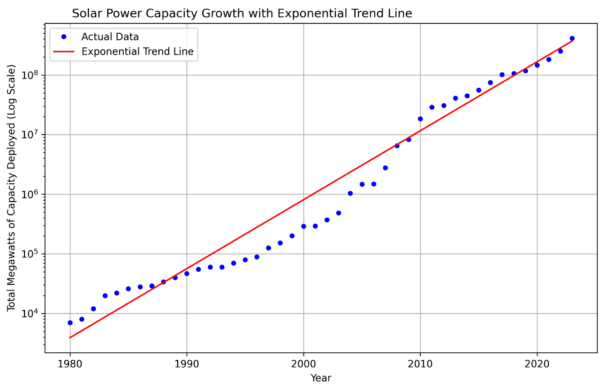
( https://pv-magazine-usa.com/2023/12/25/all-i-want-for-christ... )
How do you compare storage to that? What storage btw? Because all we have kind of suck for the grid usecase. So there is of course a ton of research for better suited batteries. But we haven't even started production on those.
Are you not underestimating the time to ramp up production? Exponential growth is not gonna save you short to mid term. Especially not compared to solar and wind which of course have huge storage implications.
Li-Ion production rates have also been growing exponentially since at least 2010[0].
> Especially not compared to solar and wind which of course have huge storage implications.
Not so: the absolute worst case for renewables is wasting some of their output when they produce more than needed and using the existing dispatchable power plants when they don't produce enough. This can be transitioned gradually or quickly as more storage comes online.
[0] possibly even longer, but the infographics I've found are annoyingly limited to 2010-${production date} at best, so here's one ending in 2020: https://www.freeingenergy.com/facts/learning-lithium-ion-bat...
And this figure for 2023 is nearly 3.5 times that figure for 2020: https://www.statista.com/statistics/1419540/global-lithium-i...
The worst case is an unbalanced grid that leads to blackouts and/or disruptions. Not that we waste energy.
As the old gas plants don't magically cease to exist after N years, while this is technically correct it's about as important as pointing out the non-zero risk of a supervolcano blocking out 80% of sunlight worldwide for a decade.
Also depends on where you live.
Energy consumption is always strictly limited by energy supply.
> And other sources that we do intend to shut down.
"We" "intend" many things, but if there's a danger of blackouts or brownouts, we find ways to keep power plants running longer because (despite appearances) the people in charge mostly aren't idiots, and the few exceptions (in this context, Texas) provide ample evidence to everyone else.
> Also depends on where you live.
Unless you mean the imminent danger of airstrikes to Ukrainian, Gazan, etc. power stations, that sentence fragment is too vague to communicate anything. And if you do, sure, but that's still an issue for literally all possible power plants given no structures are safe in war zones.
Anyway, I'm comforted to know that the magic hand of the market will solve this problem in the most efficient way and with a proper focus on the climate, as it always has.
It will fix it, but it is only aligned to profit, which just happens to currently be aligned with climate, and that might well be mere luck.
Right now California only wastes ~5% of its solar output per year but most days don’t have a surplus. That’s not enough capacity for nighttime storage to be worth it, you need consistent daily oversupply before charging becomes “free”.
However, because of the demand curve batteries are viable for peaking power. Which is why some farms are built with “4h” aka 50% of daily output worth of battery storage. Thus we are past the initial tipping point of occasional viability where sometimes it’s a good idea. The big one is at roughly 5c/kWh where natural gas is no longer economically viable and the grid isn’t dependent on fossil fuels.
5c/kWh * 3,000 full discharge cycles ~= 150$/kWh total instillation cost including labor etc. Increase or decrease based on specific battery technology and it’s lifespan.
It's amusing going back to HN threads from a few years ago and see people arguing that batteries are ruled out because we don't have enough battery building capacity.
I'm not sure what could lead a person to believe that new factories cannot be built.
Cars alone could handle about an hour of the national grid, assuming that Energie intensive industries would not shut down temporary whenever the price of electricity is high/ predicted to be high.
And there is every reason to think that we at the start of similar curve with battery storage right now (batteries are currently manufactured at a relatively small scale, with no major technological barriers to scaling up). Seasonal storage is another matter, but hourly/daily is well within reach.
Using powerwall as the price of stationary battery storage is like using the running cost of gas/petrol household generators as the cost of generating power at fossil fueled power plants. Powerwalls is not how industrial battery storage is done anywhere on the planet.
Powerwalls are expensive even by battery standards.
Well of course. Look at the cost of a home generator unit versus how much power it generates.
The more apt battery comparison would be something like megapacks, and megapacks bought in bulk.
Let's do some math.
There is a total of around 10 GWh of deployed grid storage in the US.
The US consumed about 4,000 TWh of electricity in 2022.
(10GWh/ 4000TWh) * (31,536,000 seconds) == 78 seconds.
So, net, there is about a minute and a half of energy storage across the entire grid. (Most, about 90%, is pumped hydro, not battery). Of course, not really. Most regional areas have roughly 10-30 seconds until the gas peakers absolutely unequivocally must be turned on before brownouts occur.
Hours? Minutes? We are not talking about hours and minutes. We are talking about seconds.
Look at the price of a powerwall. That's for the energy needs of a residential home. What happens to your AWS bill if us-east-1 was to buy a powerwall? Let alone steel, chemical, paper, mineral processing industries. What would happen to our economy if capacity for every one of those was cut by 1/3rd (or more depending on local climate)? Never mind your power bill.
This is the problem that I have with these solar capacity discussions. The number on the tin misrepresents things in just such a fundamental way that these cost discussions don't make sense. The reason, of course, is because fossil fuels are the big batteries we turn on at night when solar is not working.
If you actually care about making the grid green, you must solve this problem. Either with transmission, with battery manufacturing (the cost and environment friendliness curve on that is a bit less rosy compared to solar power...), or with nuclear. There is simply no other way.