People will bring storage online when it’s needed, but we don’t need it thus we don’t build it. So keep building Solar/Wind and soon enough storage will come online.
And thus solar has been coming for decades. How long after we have an abundance of solar can we wait for good storage?
How many decades can we wait for that to ramp up? (we didn't exactly start our solar journey yesterday).
I feel storage is of immediate urgency, as of yesterday. We don't have a plan and scaling will be a huge challenge.
Using EVs is really tempting though.
As to solar it’s only 2.8% of total supply right now but it’s growing fast. That can ramp to ~20-40% without significant storage depending on how cheap solar becomes and how expensive storage stays and how much transmission capacity is available. The tipping point where daily rates are cheaper than nighttime rates will shift a lot of nighttime demand.
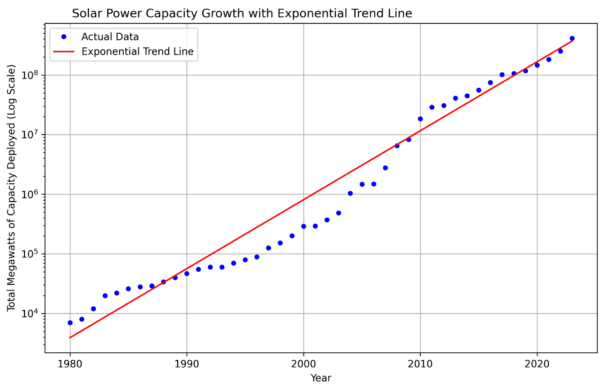
Solar and storage were coming forever, because they cost too much and were rolled out too little. But eventually a tipping point is reached and suddenly prices collapse and deployment explodes. It's not that nothing was happening the long incubation period; the technology was working its way down the experience curve.
Solar has already passed the tipping point and battery storage is doing it right now.
https://pv-magazine-usa.com/wp-content/uploads/sites/2/2023/...
( https://pv-magazine-usa.com/2023/12/25/all-i-want-for-christ... )
How do you compare storage to that? What storage btw? Because all we have kind of suck for the grid usecase. So there is of course a ton of research for better suited batteries. But we haven't even started production on those.
Are you not underestimating the time to ramp up production? Exponential growth is not gonna save you short to mid term. Especially not compared to solar and wind which of course have huge storage implications.
Li-Ion production rates have also been growing exponentially since at least 2010[0].
> Especially not compared to solar and wind which of course have huge storage implications.
Not so: the absolute worst case for renewables is wasting some of their output when they produce more than needed and using the existing dispatchable power plants when they don't produce enough. This can be transitioned gradually or quickly as more storage comes online.
[0] possibly even longer, but the infographics I've found are annoyingly limited to 2010-${production date} at best, so here's one ending in 2020: https://www.freeingenergy.com/facts/learning-lithium-ion-bat...
And this figure for 2023 is nearly 3.5 times that figure for 2020: https://www.statista.com/statistics/1419540/global-lithium-i...
The worst case is an unbalanced grid that leads to blackouts and/or disruptions. Not that we waste energy.
As the old gas plants don't magically cease to exist after N years, while this is technically correct it's about as important as pointing out the non-zero risk of a supervolcano blocking out 80% of sunlight worldwide for a decade.
Also depends on where you live.
Energy consumption is always strictly limited by energy supply.
> And other sources that we do intend to shut down.
"We" "intend" many things, but if there's a danger of blackouts or brownouts, we find ways to keep power plants running longer because (despite appearances) the people in charge mostly aren't idiots, and the few exceptions (in this context, Texas) provide ample evidence to everyone else.
> Also depends on where you live.
Unless you mean the imminent danger of airstrikes to Ukrainian, Gazan, etc. power stations, that sentence fragment is too vague to communicate anything. And if you do, sure, but that's still an issue for literally all possible power plants given no structures are safe in war zones.
Anyway, I'm comforted to know that the magic hand of the market will solve this problem in the most efficient way and with a proper focus on the climate, as it always has.
It will fix it, but it is only aligned to profit, which just happens to currently be aligned with climate, and that might well be mere luck.
Right now California only wastes ~5% of its solar output per year but most days don’t have a surplus. That’s not enough capacity for nighttime storage to be worth it, you need consistent daily oversupply before charging becomes “free”.
However, because of the demand curve batteries are viable for peaking power. Which is why some farms are built with “4h” aka 50% of daily output worth of battery storage. Thus we are past the initial tipping point of occasional viability where sometimes it’s a good idea. The big one is at roughly 5c/kWh where natural gas is no longer economically viable and the grid isn’t dependent on fossil fuels.
5c/kWh * 3,000 full discharge cycles ~= 150$/kWh total instillation cost including labor etc. Increase or decrease based on specific battery technology and it’s lifespan.
It's amusing going back to HN threads from a few years ago and see people arguing that batteries are ruled out because we don't have enough battery building capacity.
I'm not sure what could lead a person to believe that new factories cannot be built.