People aren't buying two homes in the same city alternate between them while keeping young homeowners out.
We are incentivized by our greed nothing else.
Which generation exactly?
> AirBnBs
It's unfortunate that sometimes vacation destinations also can be places where lots of people want to live but the PP was not wrong.
Also consider that someone with 5 houses may not even have all that much of their net worth in the houses; the could largely be financed.
Renting a home out is still productive.
Keeping it empty is not. I was pointing out that people aren't buying two homes in the same city to keep one empty.
Sorry capitalism, but you’re just a hallucination of less civilized and less educated, long dead meat suits
If you all think 200 million-ish are going to coddle the dyings social norms, this forums audience isn’t as intelligent as the reputation might suggest
The aggregate will bin philosophy for direct confrontation if philosophy manufacturers too many vacuous excuses that over burden biology
I try (and sometimes fail, but I try) not to judge people for what they choose to spend their money on. Wealth inequality is a thing, to be sure, and we can argue that perhaps there just should not be that many people who can afford 2 (or 3 or 4) homes. But that aside...
If people want to buy more houses, that's fine. If there are people who can't find an affordable home, that means we have a shortage, and building more will tend to alleviate that problem.
> It’s just greed.
These people whom I know personally, they are not greedy. They're not even selfish. They're not the bad guys.
Why don't the rich rent their vacant homes to the poor? At least we can answer this question objectively: if you're poor, you have less to spend, you can't fix your stuff, you will have more occupants, you will pay late more frequently, you will not be able to pay rent increases, you will not be able to adapt to extraordinary events like fires and layoffs, you have higher legal risks like tenant lawsuits, you will...
The crazy thing is, in every sector, sellers are less interested in poor buyers.
What if we made it a law that no one could own a second home before everyone owned a first home?
> Greed is an insatiable desire for material gain (be it food, money, land, or animate/inanimate possessions) or social value, such as status, or power.
Keyword: Insatiable. Lots of the people in the Bay Area are simply looking for a secure future for their children. Why is this unreasonable?
Edit: Thanks Podgajski, I like your definition below better.
intense and selfish desire for something, especially wealth, power, or food.
It’s not the job of individuals to fix our global economic system by changing their individual (legal) behavior. This is a regulatory problem.
One resource America has is a lot of space and we had many generations of easy money and government policy that encouraged such behavior.
I can surely blame people for taking what’s in front of them when people who are also in front of them have nothing.
When young people get hold of a home, then later sell it, none of them will be giving a "social" discount on the price.
Private property is private.
I believe for instance that property is theft, as Prodhoun proclaimed.
The fact that we see housing as an investment is part, no, probably most of the problem.
But should you genuinely believe that and walk the talk, fair enough. I'm more of a pragmatist myself.
By "property", Proudhon referred to a concept regarding land property that originated in Roman law: the sovereign right of property, the right of the proprietor to do with his property as he pleases, "to use and [to] abuse," so long as in the end he submits to state-sanctioned title. Proudhon contrasts the supposed right of property with the rights (which he considered valid) of liberty, equality, and security. Proudhon was clear that his opposition to property did not extend to exclusive possession of labor-made wealth.
It's a social norm we maintain, with some limitations, because it's useful. It's not sacred.
That's what you fail to understand.
/someone who has been homeless and has also bought a home.
By the way, I’m homeless because I have a serious mental illness. Not all of us are equipped to jump back in the workforce.
If you're presented with abundance, everyone is taking a similar share and there isn't counterpressure from your peers (e.g., laws that we vote for), then there is no selfishness and thus no greed. To define greed you need a feedback loop.
We're simple dumb animals. We take what's available. If you want to talk about defining arbitrary limits on consumption that are disconnected from circumstances then you're basically out here preaching religion.
When boomers bought all of these second/vacation homes cheaply in the 80s it wasn't in places with huge demand from underhoused people.
These arguments need a little more consideration of facts rather than appeals to emotion.
https://www.coalitionforthehomeless.org/wp-content/uploads/2...
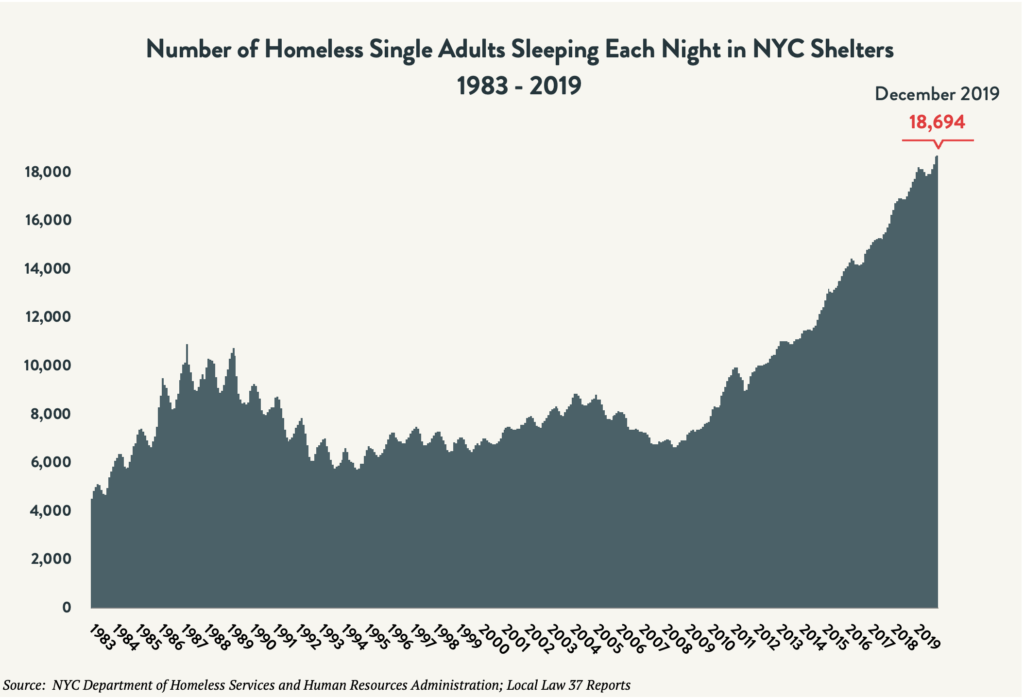
Nobody was buying second apartments in NYC in the 80s. Nobody was buying apartments period. I knew people with brownstones for sale in spanish harlem that they couldn't get $10k for in the late 80s. 80% of _storefront_ space in midtown was vacant.
People buying vacation homes in Florida or Vermont aren't responsible for homelessness in major cities.
To me, it is indeed greed. Some things are more sacred than money and housing is one of those things
I suspect a great deal of people buy a second home while maintaining the first one as a rental, if they can swing it.
with all of the "free" money out there over the past few years, it was insanely easy to pull equity of your home to buy investment properties. I don't have numbers but I can't imagine this is a small amount.
The overwhelming majority of second homes are vacation homes. _Landlords_ aren't keeping people out of housing -- quite the opposite.
Home ownership is kind of an endless money pit anyway. Most people are better off renting in any of the markets we're talking about homeless populations anyway.
Ideally landlords should be able to get better pricing for maintenance.
Unfortunately our dumb FREE MONEY monetary policy has absolutely wrecked the trades and saddled generations with bad debt chasing worthless credentials.
...YOU ARE PERFECT! https://www.youtube.com/watch?v=4p8vqoIVESc
"We" are not a rich country, unless by "we" you mean the 10% of the population that is rich. I feel well compensated, I'm well within the middle class and consider myself lucky. I cannot afford a home, in the current market, in a location with the services and locality of my industry. I live in Florida. Vrbo, Airbnb, and properties purchased by institutional investors have directly increased my housing costs. That is objective, not subjective. Call it anecdotal all you want, the populated parts of the state have seen their housing options obliterated.
If we're going to use statistics for anything, let's look at it in the affirmative instead. How many homes are owned by the family living in them? The most recent data for Florida is for 2015-2019. Here are the owner-occupied housing for the most populated counties, starting with the one I live in.
Hillsborough County - 58.6% Miami-Dade County - 51.2% Orange County - 55.4% Broward County - 62.1% Palm Beach County - 68.9% Duval County - 56.7% Pinellas County - 67%
The National Average is 64.8%. In my county nearly half of the housing is not owner-occupied. As a nation, nearly a 3rd of available housing is not owner-occupied. I bet this is worse now, as this information is pre-pandemic and from the very beginning of the most recent housing rush.
https://www.census.gov/quickfacts/fact/note/US/HSG445222#:~:.... https://www.census.gov/quickfacts/fact/table/US/HSG445222 https://www.florida-demographics.com/counties_by_population https://www.census.gov/library/visualizations/interactive/ac...
Edit to add some relevant information: https://cdn.nar.realtor//sites/default/files/documents/2023-...
Also, to be quite honest, your allusions about shadowy Asians has the whiff of racist tendencies.
And what affordable rental housing exists is increasingly being purchased by investment groups who then squeeze them for every dime, squeezing out the very people who need that housing in the process.
The housing crisis really looks to me like an aspect of the serious wealth inequality problem we have.
This has been dramatically demonstrated in Berkeley, where I live. We have added tons of 0- and 1-bedroom apartments recently. These are very expensive, $3000/mo+. This building boom has caused the price of rent-regulated older apartments to plunge. What had been renting for $2252/mo in November 2018 is now renting for $1688/mo in November 2023. That is a significant increase in affordability of studio and 1-bedroom apartment, effected by building newer, expensive ones.
Edited to add sources:
The discussion is too long for me to recapitulate here, but all of my data in various forms and some visualizations are available here:
https://observablehq.com/@jwb/berkeley-rent-board-data
Also in random tweets such as:
https://twitter.com/Jeffinatorator/status/172890293692602402...
I believe these are visible to non-account holders.
Edit: I think I see where a lot of our disconnect is coming from. We have no rent control here, rent very rarely decreases and is mostly pegged to comparative sq.ft. rentals in the area. Age of the property does not factor as much as location.
Do enough of it and rents will begin to fall below loan maintenance, causing even more sales and more price drops.
Think about this in the context of any other good. No one worries that if we build more cars, they'll all be purchased by rich car collectors. Yes, when more cars are built, a few very rich people with many cars will buy more. But the increased supply also make it more economical for everyone to buy more cars.
As I said, at other times in this thread, the only incentive we have as an and an economy in the United States, is agreed.
As I said, at other times in this thread, the only incentive we have in this economy and in the United States, is greed.
Houses are built by developers whom by definition only build a project when it's a sound investment. They immediately stop building when this isn't the case.
What people who buy homes are told, though, is to essentially 'buy and hold' because it's a "good investment" that will gain value over time, even if they are not building anything or adding any value to the dwelling they inhabit.
Where I live, during the recent runup in prices, the median home gained something like $100,000 of value in a year, which is significantly more than the median household income.
https://oregoneconomicanalysis.com/2021/03/16/who-benefits-f...
Ideally, I think, home prices would be fairly stable - neither appreciating a lot, nor dropping in value. Boring. That would also make them a 'bad' investment for corporations looking to make a buck by buying and holding.
Do you expect people to buy and sell their home? It’s their home, why would selling (in the short term measured in decades) be the goal?
People primarily buy homes to live in. Any benefits of price appreciation, and/or political interests of those nearing their end of life and want to downsize/die are secondary.
And now the Fed can’t even get the guts to lower inflation by raising interest rates because of what it’s done to the housing market.
This kind of thing happens over and over and over again, all across the US and it adds up.
The problem is that it's not legal in most parts of most cities.
Just stating that Americans love their yards/privacy and it's not so simple to fix.
Well, ok then - we want affordable housing, let's build affordable housing. Nothing's perfect. Some people prefer denser housing in a more desirable place, and some prefer more space in Cyanide Springs, Oklahoma. Both should be a choice, but currently, we limit the denser housing options way too much.
Secondly if a person owns a home and rents it to a second person, I'm fine with it.
If the capital appreciation is zero, then it's just the rental income, which is offset against the cost of maintaining the property and the opportunity cost from the capital outlay on the property. That's not a major problem though, as the rental price won't be able to get too high as people will simply rent or buy elsewhere (as you've reduced the other barriers to building more property)
Of course you can get rid of the appreciation by simply taxing the land (which is the thing that mainly appreciates -- the building itself typically depreciates), and get most of the way there.
How do you know?
More housing starts means more affordable homes. We've seen what zoning reform has done for cities. We don't build enough.
Investors collectively do purchase a good amount of new housing starts (like 18%?) but that's also spurred by interest rates and confidence that demand will grow. It's neither here nor there, build more and houses become more affordable.
If we make the (extremely crude) assumption that the capital expended on that 2nd home could be moved elsewhere, we could have built more housing in cities instead of building and maintaining that home.
[0]https://www.google.com/amp/s/www.statista.com/chart/amp/1963...
Supposing everyone had more money in their hands (all else remaining equal), that would just be reflected in the market. Houses would increase in cost. Now you're where you started.
Housing supply is just too inelastic in most US cities.
At any rate, the point is that qua "second homes", they represent a drop in the bucket compared to the overall market. Home ownership rate is around 63%, for a population of 334 million. The inelasticity of housing construction whilst demand is steadily climbing due to immigration has far more impact on average housing prices than cases of the ultra-wealthy constructing or purchasing a mansion upstate.
Those mansions also tend to be built far away from city cores, with large lots to maintain (with paid labor), more taxes to be spent for infrastructure cost, requiring a vehicle, etc. It would still be too expensive and unhelpful for average people.
WE don't build enough. Look at what zoning reform has done for Minneapolis.
It's not the individuals owning the houses. It's corporations.
https://finance.yahoo.com/news/two-thirds-wealthy-americans-...
It’s not that we don’t have enough housing, the issue is that we have people that want too many houses for themselves. It’s just greed. I can’t even count on my hands How many people I know that own more than one house and I am homeless. So I’m sure wealthy people pretty much don’t know anyone that doesn’t own a single house.