The Netherlands had a similar population to Canada in 1950, but today's population is dramatically smaller. Combine that with a historical higher tax rate and investment in infrastructure, this is not something that can be replicated...
These are all things that lower taxes and kicking out foreigners can't solve, because that just opens up more property for investors to swoop in and buy. You stop investors from speculating on property and make it illegal for property to go unused and you solve a good chunk of the issue right there.
And of course, the reporting always calls out the non-native buyers, largely ignoring that wealthy Americans, Canadians, and Brits also own multiple homes spanning many nations, and can't inhabit them all at the same time.
40% of Canadian Federal MPs are landlords.
Is canada's vacancy rate significantly higher than other developed countries?
I've lived in both and worked outside in -40C and +40C, and both are rough. I'd rather be in Virginia and 4 actual seasons. Or San Diego, where there is just one.
I can’t speak for Canada, but in the case of Australia - there are heaps of small towns in Australia with affordable housing, it is just few people want to live in them. The median house price in Hay, NSW, is only AU$237K (US$157K). Hay is “liveable” - its climate is mild (mean min is 10 deg C, mean max is 24.3 deg C, 368.3 mm annual rainfall). It is on a major river. But, who wants to live in a town of 2500 people which is 5 hours drive from the nearest major city?
This is -I think- (one of) the main reasons people voted PVV. We (the Dutch people) can't even make their own decisions! And when things fall apart (and they are: housing, inflation, too much environmentalism, declining healthcare, etc) this is exactly what we need: make decisions to fix this. But we 'can't' because of EU. This is extremely angering and fueled the rise of PVV. And don't get me wrong: I'm one of them. And no, I'm not 'far right'. I just want to fix things. If you can't take care of yourself, you can't help others.
The UK along with Norway export gas to EU during summer which is stored for use in winter. UK does not have expensive gas/electricity because of Brexit, it is because of Ukraine war. The rest of EU is just as bad or worse when it comes to energy prices. The economy in Germany is worse than UK this year. The latest data regarding budget deficit from France is just as bad as UK.
Not sure what food chain issues, the UK needs cheap labour to work the fields, UK people won't accept that work, so cheap labour is brought over from Asia for seasonal work. The new young generation Polish/Eastern Europe people are no longer are interested in such work either.
Sure, but that freedom means not doing any trade with your neighbours, not letting people from your country visit the EU (and vice versa), not importing any energy, etc.
No. A big point in favor of the EU is that countries do not negotiate individually but as a single block. This is an advantage because it gives them more power and the ability of getting better deals (in aggregate). Which is exactly the sort of "bullying" that you are complaining about: by deciding to go alone, the UK is weaker and gets worse deals.
In fact, a well-functioning EU is one of the only ways in which European countries can hope to count anything in a world dominated by much larger economies (US, China, India, ...)
To defend (y)our interests against other economic blocks that are more powerful and not necessarily nice to you. With ASML you are well covered for now, but China is catching up. And how can 18 million people compete against 1.4 billion? The Dutch GDP is just a bit higher than Beijing'!
I'm not gonna defend every EU policy and I am not arguing that the current state of the EU is satisfactory. All I am saying is that European countries are better off together; there is a reason why "divide and conquer" is a thing.
My whole point is: there should never have bin a EU. What was wrong with the agreement between countries?
Why is it baffling that they need a deal when that's exactly what they wanted? It sounds like you want the ability for a country to leave the EU, but then not have to negotiate all of the benefits that came with being in the EU. Which, isn't exactly how it works.
As a similar analogy, it would be like if one of the states here in the US successfully seceded. The US would be under no obligation to make deals with said state, they would have to negotiate as two separate countries and all of the geopolitical stuff that comes with it.
A more likely cause of some problems is the lack of people in the working age, that is, a demographic problem. The US has solved (historically) and is solving this via immigration, which is exactly the thing that Wilders wants to stop. Put differently, who is gonna build the houses? Many Dutch youths have completed a bachelor or master degree, so are not interested in that line of work.
This is definitely untrue as countries like Poland show well enough. You do not need to stick to every EU rule, you just need to be well off enough to pay off your fines.
I agree with you, even worse is when some mayor candidate comes with that and we all know that in the city level, you have have almost no change to influence who comes.
However EU, has nothing set in stone and it is democratic. NL don't have to leave EU, but join the (increasing) block doing lobby to change those rules.
Is there a documented case in history where this has been beneficial ? Not attacking you btw, I'm actually wondering if anyone has known this to be effective?
Immigrants seem like a token thing to get angry about when the chips are down and the country is mismanaged.
> Immigrants seem like a token thing to get angry about when the chips are down and the country is mismanaged.
This has been the primary opinion of center to leftleaning parties for a decade now. There are very real problems with immigration, even more so if a large part of immigration consists of migrations of cultures that are incompatible with western ideas.
[1] https://apnews.com/article/poland-government-admit-muslim-mi...
Poland never stopped immigration. In fact, it received roughly double the amount of immigrants in 2021 im comparison to 2 decades prior.
https://www.statista.com/statistics/957100/poland-immigratio...
> PVV proposes to stop all immigration
The PVV proposes a "freeze on asylum" and "a generally more restrictive immigration policy".
As an example the Australian immigration restriction act created some of the best conditions for workers, due to a high value of labour leading to high wages, increased negotiation power, and investment in labour saving innovation.
It was good for the nation and individual workers, but to use terminology familiar here, a single generation decided to enshitify the country and cash in, extracting all the present and future value of existing institutions.
Part of this is a massive propaganda campaign to try and convince you that every measure to restrict migration is racist or misguided... However migration is the most important and significant policy for a long term outcomes in a nation, we have millenia of history to show this.
And that's what's causing the crisis. Fertility rates define not only the population in a region, but also the age distribution. Low fertility rates result in a population that will have many times more elderly people than youthful people, and will start shrinking far more rapidly than most realize. It will lead to both economic and social catastrophe. Trying to use mass immigration as a means of solving this problem is an inherently modern idea, because the problem did not exist in the past.
And IMO this isn't just an issue of management of a nation. Trying to create a stable economy and healthy society with a collapsing fertility rate may well just not be possible. On top of cultural conflicts there's also the fact you'll have to tax the death out of the youth in order to subsidize the elderly, at the same time those youth will find ever shrinking economic opportunities as your economy itself also naturally shrinks.
[1] - https://fred.stlouisfed.org/series/SPDYNTFRTINUSA
[2] - https://www.macrotrends.net/countries/NLD/netherlands/fertil...
We somehow managed that without any Somalians.
While you can debate the causation of that correlation, there are many objectively awful outcomes for indigenous Europeans due to non-White immigration. For one, and I can't believe this is controversial but it is, a lot fewer Dutch children would experience r@pe (and gang r@pe) if isolated from ethnic strangers.
But not without taking away resources through overseas colonial possessions.
> would experience r@pe (and gang r@pe) if isolated from ethnic strangers.
Nice fearmongering there. Yes, Netherlands is a hellhole of gang rape, I couldn't even bike my way to the Jumbo down the road without dodging all the gang rape on the streets.
I'm really not sure what you hoped to achieve with that. The stats don't lie. People are noticing.
It's not immigrants that I'm afraid of where I live. They are typically hard working people, doing all sorts of jobs. From food-delivery to software engineering.
It's the people "noticing" bullshit that I am really wary of.
There is a burning building. One group just stands there taking pictures. Another group tosses gasoline into the fire. These are the two choices voters have…
It is possible. Don't give them money and only provide basic shelter. Do you wonder why the migrants don't stay in Eastern Europe? Because here we offer accomodation in tents. There isn't enough social housing for citizens (largely Roma), let alone migrants.
We have friends and neighbours from Germany who want retire early and to move back to Eastern Europe because they are unhappy with the federal government taxing them nearly ~500€ in order to house and feed migrants. These neighbours are working class people of retirement age, who left to Germany during the communist regime, leaving everything behind. There they were housed in a Lager common social housing with shared toilets and showers and they had to work to support themselves. Now they see how migrants are treated and view them as freeloaders. The fact that they're muslim and also cause problems doesn't help either.
So I'm not at all surprised the Dutch voted with Wilders.
In the EU you would have to reduce your welfare state to that level for your own citizens as well. The ECJ says[0]:
> It follows that the level of social security benefits paid to refugees by the Member State which granted that status, whether temporary or permanent, must be the same as that offered to nationals of that Member State
[0] https://curia.europa.eu/juris/document/document.jsf?text=&do...
Hungary and Poland have repeatedly boycotted and vetoed the EU's migration policies. If this gets support from a country like NL, there is hope to change the EU's ill suited Merkel/Juncker policies on migration.
The alternative is right wing populists like Wilders winning elections in more EU states. Consider LePen's FN winning the French elections for instance. In the German government there is already consensus on a stricter migration policy in order to stem support for the far right.
Russia is also using migrants to put pressure on Polish, the Baltics' and Finnish borders. We shouldn't allow this.
Also, quite a few cars (and big SUV's, and even quite a few full-size American pickup trucks, bafflingly). Biking to school with my kids is frustrating and sometimes feels dangerous. Though maybe that's just Hilversum. They seem really eager to rely on supposed woonerfs instead of actually providing separated infrastructure.
I feel like "I generally favour immigration but understand that having a substantial influx of a population that does not integrate well, regardless of their background" is a hard stance to take. I don't really align with any party so far as I can tell (not that it matters, I can't vote). I'm originally American and if there were large groups of people moving here from Texas, not learning Dutch, and bringing Texan values I'd be pretty worried.
Yes there definitely are possibilities to make more out the existing urban area's. But wherever someone has an idea for building more houses, there always are others that are against it. In your case, building 4-5 story buildings would be seen by some as disturbing the skyline of the city. They'd rather keep their current small city atmosphere.
Sure just replace the rowhouses with skyscrapers and burn the cars.. looking the results of the last elections sounds like your Californian and not Texan values are what worries the Dutch people.. unbelievable
Anyway, this is a gross mischaracterization of my comment. Wanting my child to be able to bike to school safely doesn't mean burning cars. And I explicitly noted Paris since it's an example of a dense city with surprisingly low building heights.
You know what "replace a lot of" means right? Concretely, you are saying that people should leave their homes to make more place for new people..I can imagine why people won't like it.
> I'm originally American and if there were large groups of people moving here from Texas, not learning Dutch, and bringing Texan values I'd be pretty worried.
I think you did a mischaracterization of the Texan values in the first place.. no?
Texas values libertarianism, individualism, the right to bear arms, etc which might be fine but seems out of place here.
They have. But arguably it's hard to move the needle a huge amount by piecemeal replacing 2 story buildings as they come onto the market with 4 story ones.
Where? I remember staying in a 19 century house in Utrecht, which still there... I lived in Germany until some years ago in a 1910 building, which I don't think they will rebuild it that early. I think you came to Europe with a different expectation maybe?
Wealthy. That probably explains some of it.
As a foreigner living in the Netherlands for many years it baffles me how successful are the Dutch politicians on using the EU as a scapegoat for their own wrongdoings. In my opinion the main issue is the complexity and the lack of understanding of the general population of the European legislative process.
The "regulation that comes from the EU" was redacted and implemented by the Dutch government including the nitrogen limits that you talk about [1]. the areas where nitrogen is a problem where proposed and designated by the Dutch government [2] (which, by the way, together with the farmers have been receiving EU subsidies for their conservation for many years).
How the housing crisis relates (in a tiny part), with this specific environmental regulation is not that there is no free space to build on, but that the Dutch government botched the regulation that allowed for construction of housing near to the designated areas, leading to the Dutch judiciary to annul it [3].
In the meantime, the agricultural sector that represents 1.6% of the GDP and employs 2% of the population causes 46% of the nitrogen emissions in the country. This is not normal[4], and it's the reason why the nitrogen limitation was introduced in the Dutch implementation of the directive and it's not present in the regulation of most of the other countries.
Who knows, maybe if instead of the farmers party, it was a housing party who got the support of 20% of the population in the last provincial elections we would be talking differently about this topic and people would have better informed opinions.
[1] https://business.gov.nl/regulation/code-conduct-nature-conse...
[2] https://www.government.nl/topics/nature-and-biodiversity/nat...
[3] https://www.nautadutilh.com/en/information-centre/news/the-c...
[4] https://upload.wikimedia.org/wikipedia/commons/f/fb/Europe_G...
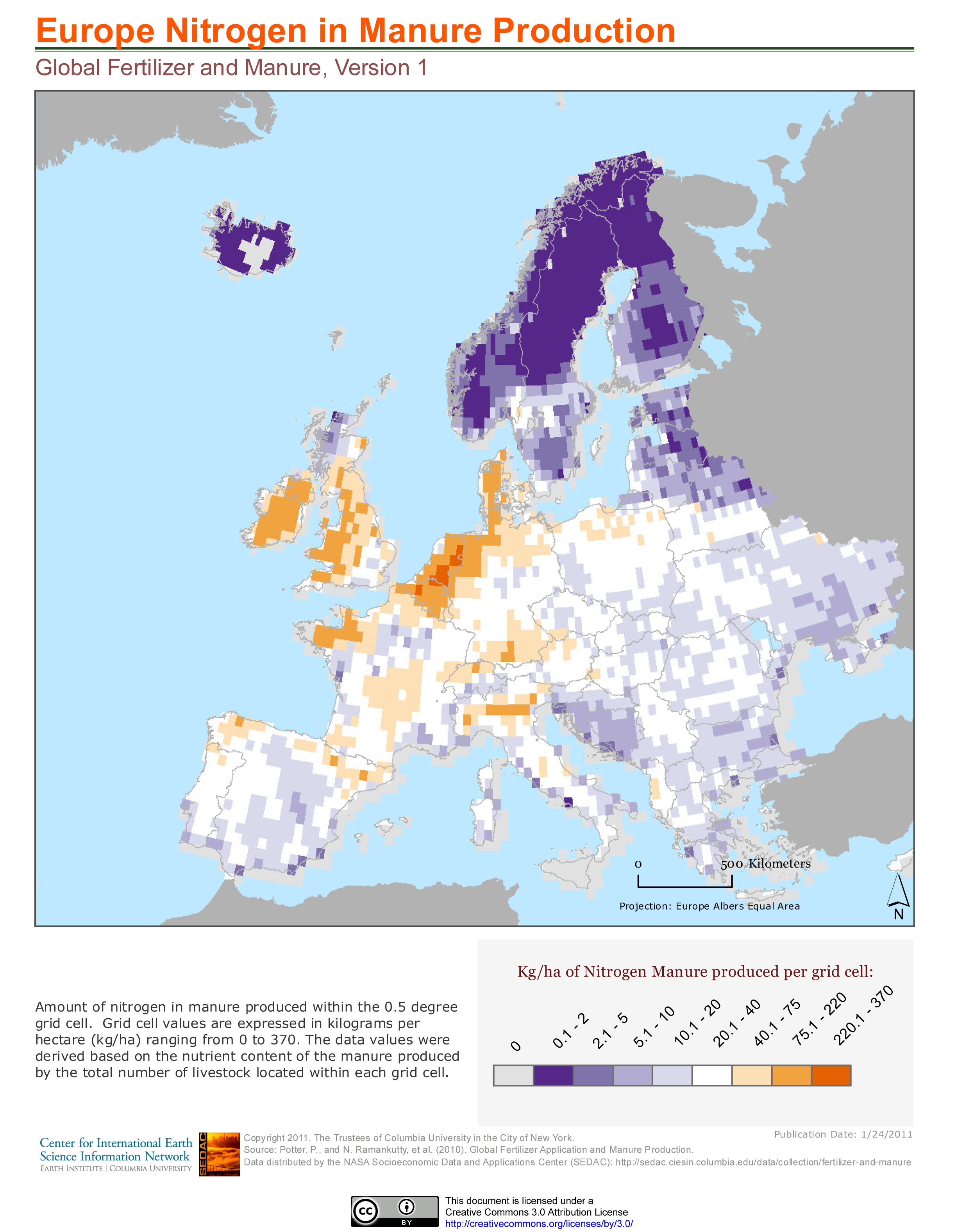
This is partially true. The directive of the regulation came from the EU, the concrete implementation from NL. And at that point it was not clear to anybody that nitrogen deposit restriction would be such an important part of it. But, in that way, the Dutch are responsible for the problems that this regulation currently causes. However, if it would have been purely a Dutch regulation, the Dutch could simply amend it or drop it altogether. Since the regulation comes from the EU, this is not an option.
> ... the nitrogen limitation was introduced in the Dutch implementation of the directive and it's not present in the regulation of most of the other countries.
The nitrogen limitation was not specifically mentioned in the initial Dutch implementation, nor was it in the EU directive. It followed from the principle in the EU directive; that nature in the Natura 2000 area's is not allowed to deteriorate. The reason it is on the Dutch agenda at all, is that Dutch environmental organisations realized that nitrogen was a threat and even took the Dutch government to court to act on it.
> How the housing crisis relates (in a tiny part), with this specific environmental regulation ...
When the Dutch government lost the case about handling nitrogen in 2019, 18000 building projects had to be halted. That's no tiny part.
You are right in that they cannot drop it, but they can amend it. The issue is that if they want to drop the nitrogen requirement they would have to come with scientific arguments on how the nitrogen limits doesn't hurt the protected areas, or alternative means to protect those areas from the nitrogen.
> The reason it is on the Dutch agenda at all, is that Dutch environmental organisations realized that nitrogen was a threat and even took the Dutch government to court to act on it
I fully agree with your point
> 18000 building projects had to be halted. That's no tiny part
I'm sorry I wasn't clear in my comment, it's definitively not a tiny part of the total building projects (for context, currently in NL there are like 75k ongoing), but of the housing crisis as a whole.
In my opinion there are many issues with housing in this country. ie. Empty houses due to investors not wanting to rent, cultural tendency for low population density projects, lack of labor, massive (badly implemented) intervention from the government, etc.
> Around 20 million people are feed by their agriculture
This is a nice political slogan, however I don't think it's true. Just go to your local supermarket and try to find anything of Dutch origin besides tomatoes, meat, eggs and milk.
By the way, I support the idea of each country having their own strategies resources guaranteed, and this includes food.
The issue here in my opinion is the way they grow the produce. They could grow less, export less and pollute less. As an example: From all the EU exports, eggs of NL origin represented 42%, while poultry meat represented 23% [1] (2013 data) This makes absolutely no sense in a country of the size of the Netherlands and it makes even less sense considering they are selling them very cheap, as you can see by the low GDP impact of the whole industry.
[1] https://zootecnicainternational.com/focus-on/netherlands-lea...
This well documented in many places:
https://www.washingtonpost.com/business/interactive/2022/net... technology/
https://agriculture.ec.europa.eu/system/files/2021-12/agri-s...
I think in since the COVID pandemic and with War in Europe is clear how important is for every single country to have food security for its population. Every country is responsible for themselves. Nobody is coming to help them. So to have a good and effective Agriculture is a geopolitical advantage today.
> They could grow less, export less and pollute less.
Maybe, but it just make sense if you first reduce your costs and pressure in the housing market. Sounds like thats what the Dutch people is asking for and what the new government is saying they are going to do. If that's what really going to happen. Just the time will tell us.
I think it's time for a populist progressive left wing party in The Netherlands as a counterweight to the havoc the parties on the right are causing.
Whether the PVV can turn things in their favor is questionable, it's easy to shout things from the sideline but many of the current problems are still there because they are inherently difficult to solve. For instance, PVV proposes to stop all immigration. Apart from the economic problems that this might cause, it is simply not possible due to EU legislation. For which he has a solution as well; NL should step out of the EU. Being primarily an export country, the consequences would be disastrous for the Netherlands.
The housing crisis is another example of an ongoing problem. A major cause is the fact that NL is a very crowded country, it's just very difficult to find any fee space to build on. What makes this even more difficult is certain environmental regulation that forbids any project that increases nitrogen deposition. Again this regulation comes from the EU so NL can't just change it.