Person A in Situation X can say and do things that are perfectly acceptable that would be deplorable and disgusting if Person B in Situation Y did precisely, exactly, identically the same thing. You can grab your lover's ass, but try that on a random stranger.
Which makes telling people what they can and can't do supremely difficult. There are no objective rules for acceptable human behavior, nor can there be. Which is why feedback is so important.
It's "lighten up!" That translates roughly to: "what I was doing that bothered you is so important to me that I refuse to stop, so get over it." I think that is the core problem.
It is a lack of communication issue. In that article, many of the "lighten up's" are assumed based on past experiences. For example, she did not even address the guy for fear of interrupting the meeting.
Certainly the latter is not a demand and is even a question, but I would argue that even barring that, it's far more of a problem.
> frankly, I don't know how I can help it.
Two things you can do are practice and self-education. Subscribe to http://geekfeminism.org and http://feministing.com. Reading those posts will give you the stories and information you need to understand the effects of your actions.
Then practice. You won't immediately be able to catch everything, so just focus on the things that make you hesitate. Those moments when I think "maybe I shouldn't say this", I almost always learn later that I was right. Use at hesitation to do a little analysis of what the effect of your words might be.
You can also practice in your head, or in conversation. When you're on the bus, think about things you said recently, and analyze them. Look for things that might've hurt people. When you're having conversations with people, think about what you would've said in that situation. Practice the analysis, and practice saying the right things.
You'll never be perfect, but you can TOTALLY get to the point where you're mostly not harming people. Which is an awesome place to get from the default for men, which is harming people over all day without having any clue.
At the risk of revealing myself to be a chauvinistic jerk, is this kind of response sexist and demeaning, or just inappropriate for the workplace? Why do women wear low-cut dresses if not to attract male attention (in the majority of cases)? Would it be sexist and demeaning for me to notice and comment on a low-cut dress in another context (like a bar)? What about with my wife? Is it sexist and demeaning to find her sexually attractive?
I'm not disagreeing that the statement is offensive and inappropriate, but I'm not sure it's sexist.
Yes, Virginia, this is sexist. Holy hell, is it sexist.
You are characterizing a woman's behavior in terms of how it makes you, as a man, feel. There are many reasons that a human might dress a particular way, but by characterizing it as a gender-based, "she wore that to make me do this" kind of transaction you have incorrectly emphasized a single way. This woman wore it for no other reason than to attract male attention? Really? Are you sure? Her decision is entirely based on how it would make a man feel?
  I'm a heterosexual man and I wear certain jeans because I
  like to show off my butt. That's fine. But am I doing it
  because I want to attract "female attention"? Not exactly.
  This turns on a subtle point, but it's very important: I
  wore them for me, not for anyone else. Feeling attractive
  is not the same as receiving attention. I don't want to be
  honked at, felt up, leered at, or even commented on. But I
  do want to look good. Does that make sense?
This situation is only exacerbated when you bring in gender dynamics: men and women are equal, yes, but women are the ones who've been oppressed for centuries and are struggling up the slope to reach equality. What a man says to a woman exists within this context, so simply reversing the roles and pointing out that it's okay HERE but not THERE is not sufficient.
Check out: http://en.wikipedia.org/wiki/Gaze The section about feminism and the male gaze applies here, too.
Of course I'm not sure. But when you hear hoofbeats, think horses, not zebras. Why do all the waitresses in Hooters wear low-cut tops? Is it for comfort? Is it because they couldn't afford the other 30% of the shirt? Or is it because that's proven to be very effective at gaining male attention?
I wore them for me, not for anyone else.
This makes no sense. In a post-apocolyptic world where you're the only person on earth, would you dress the same way you do now? Would the last woman on earth wear low-cut dresses and mini-skirts? I doubt it. Being "attractive" specifically refers to other peoples' attention and emotions towards you.
I'm not saying that it's ok to leer at women, to verbally or physically harass them, etc. But it's incredibly ludicrous to me to think that someone dressed in a manner usually considered "provocative" probably did so without any intention, or that anyone responding to that mode of dress is automatically sexist.
Would it be appropriate for a woman to start coming into the office topless? Would it be sexist of me to find that sexually arousing? If so, I guess I'm a sexist. My only consolation is knowing that I'm not alone and that you (if you're a heterosexual male) are almost certainly right there with me :)
Seriously, stop right there. Read what you just wrote. You're comparing a professional developer who chose to dress comfortably to women chosen for sex appeal by a restaurant which is only a step away from a strip club.
There is something seriously wrong with the way you are approaching this issue.
To answer your last question-- I'm a straight guy, and no, I wouldn't find it sexually arousing if a co-worker came in to work topless. Probably because I'm not fifteen, and I've seen boobs before.
Okay, I would be surprised at first, probably a little more so than if it was a male co-worker, but if it's what either of them wanted to be comfortable in their office I would get over it. And if a male co-worker couldn't restrain himself from making sexually suggestive comments, I would be pretty disgusted by his behavior.
(Don't forget, by the way, it's perfectly legal for women to be topless in public in both NYC and San Francisco, so this is certainly a possibility.)
You're arguing a straw man. I didn't say anything remotely close to that; my point was just that wearing low-cut tops and dressing for sex appeal are usually correlated.
I'm a straight guy, and no, I wouldn't find it sexually arousing if a co-worker came in to work topless.
Can you expand on this a little? It makes sense if the person was someone you didn't find attractive at all, but what if you did find that person attractive in normal work dress? Would you seriously not be aroused if they came into work topless? Or do you magically turn off your sense of attraction at work? I'm not sure I believe you, but even if that's true, it's clearly not for the vast majority of male society. Hence the plethora of advertising and marketing aimed at men that features scantily-clad attractive women.
Finally, it's obviously completely inappropriate to make those comments at work. But I don't think it's sexist.
Oh, did I get that quote wrong? Let's play the tape:
> Why do all the waitresses in Hooters wear low-cut tops?
Huh. It sounds like you're saying there that, because women selected for their sex appeal by a restaurant which is only a step away from a strip club wear low-cut tops as part of their required work uniform, it is reasonable to assume that a professional developer who chooses to wear a low-cut top is doing so to attract male attention.
Which part did I get wrong?
> Can you expand on this a little?
Here is a picture of an infant eating: http://www.breastfeedingchild.com/images/lying%20down.jpg

Here is a picture of a procedure which detects cancer: http://www.sciencephoto.com/image/271974/530wm/M4150542-Mamm...

Here is a picture of some people who aren't wearing shirts: http://gothamist.com/upload/2011/08/toplessdaya0811.jpg?882

Which of these pictures (if not all) causes you sexual arousal? Am I really so bizarre in my ability to look at these images, think "That is an uncovered female breast," and have my next thought not be "I would like to have sex with that person"? Because, you know, breasts (like the women who own them) don't exist for my sexual pleasure? Because context matters?
(For the record, my next thoughts, in order: "Awww!", "Oh man, that looks like it sucks," and "Wait, do I know that guy?")
Lastly, if you make inappropriate sexual comments about women, and not men, you are being sexist full stop. You are treating people differently, in a damaging way, solely on the basis of their sex. That is the definition of sexism. The justification is not relevant; in fact a lot of sexist behavior stems ultimately from insufficiently mediated sexual desire. (If you make inappropriate comments about both men and women equally, you are excused from the charge of sexism, though not from that of being a creep.)
Alright, look...those are pictures of people who are topless and are taken in non-sexual environments. Biologically speaking, there is nothing more sexual about those photographs than photographs of the same people wearing shirts.
Physiologically speaking, though, there is a difference. For most of us, chemicals in our brain respond instantaneously to those pictures, virtually shouting, "this is a naked woman". And its not just a male response, either (http://list.msu.edu/cgi-bin/wa?A3=ind9710B&L=AEJMC&E...). Nudity sells, and not because naked people look different. It's because our brains are tuned into paying attention to them, both by nature and by nurture.
The point of what I'm saying is that anyone wearing things that make you look good will ALSO make those who would otherwise be attracted to you pay more attention. It's not a choice, it is literally hard wired into our brains. Our brains respond chemically (http://jn.physiology.org/content/98/3/1374.abstract) to the pleasant, attractive things that we see. You have to understand that although you wear your jeans for yourself, anyone who is chemically predispositioned to do so will ALSO have their brains respond chemically.
This is no excuse for anyone who acts improperly in response to something that they see. We're all fully capable of controlling ourselves. Some of us have more practice in it than others, but society couldn't function if we couldn't control these reactions. The chemical response doesn't go away, though, it's just mitigated by other chemical responses.
We can (and most of us do) control our responses, but it doesn't get us anywhere to pretend that it doesn't happen. .
I'm sure there was a time in my adolescence when the mere appearance of a square inch of uncovered skin would have provoked a sudden involuntary orgasm like some Victorian gentleman, but I have seen enough breasts in enough contexts to realize that very rarely do they imply anything sexual.
For what it's worth, your sources do not support your point. They refer to sexual, erotic and romantic images, which I hope you would agree none of those pictures would be considered.
But if the article being posted is about the sexist treatment of a woman in the workplace, eventually the discussion will get to the absurd point where many of the men essentially claim that these biological sexual impulses literally don't even exist.
If treating people differently because of their gender is wrong, does it apply to both positive and negative treatment? Because judging by the comment count whenever this subject comes up, nothing seems to fire up the HN crowd more than sexual discrimination. Other more serious injustices in life never invoke this much passioned discussion.
I don't know if it's the case, but I imagine the more serious injustices are more black and white, where as sexism is almost all gray. One person's "I can't believe he said that" is another person's "You should have heard my daddy talk to my momma".
As a man I dress well because I want to be attractive. No, it doesn't mean women should feel free to whistle at me at work, but it's not outrageous to explore the boundaries and decision making process on this forum.
Look at the original quote: "Oop, Katie's got the low cut dress on today! I know where I'm sitting!" A clear statement of sexual interest, which Katie clearly did not wish to receive.
The hypothesis we are being asked to entertain is that she probably was wearing the low-cut dress because she wanted to attract male attention, but that this comment was in some other way offensive. That is, she wanted this guy to think that, just not say it. Because women are touchy, or something. What an absurdly insulting proposal!
Is it really so hard to imagine that she might want to dress in a way which is gratifying to her, without intending to be the object of men's sexual fantasies?
Suppose that Katie is a very large, very unattractive woman, and the meaning behind the statement isn't, "I'm going to sit where I can take advantage of the low cut dress", but "I'm going to sit as far away from her as possible", is it still sexist?
One can imagine such comments causing Katie distress or stress. Employers have a legal duty (which has been tested in courts many times) to protect their employees from harm (and that includes stress) in the workplace.
It is quite possibly sexist; there's not enough information to say.
Sorry about the downvotes, it's a legitimate question to me.
Is it clearly not treating her the same as everyone else? Yes. But is it sexism?
It's pretty obvious if you take it apart a little.
You're singling out the one woman in the room, commenting on her physical characteristics, and saying that (presumably because of those physical attributes) you're going to sit next to her.
Now, why would you want to do that? Sit next to this person purely based on her gender and physical attractiveness?
Well, obviously you're not singling her out as the most expert person in the room, or anything else remotely related to your actual purpose for being there (I'm imagining this in a work environment).
Nope, you're sitting there to hit on her. You've already started, with the compliment. Possibly only very politely, but will she trust you to stop there? And will she now have to assume you're casting sidelong glances at her breasts when she points up at the whiteboard during the discussion?
And since this is a work situation (not a social one), she doesn't even have the option to excuse herself and go talk with other people if your advances are unwelcome.
Hope this helps make it a bit more clear.
Why would it make me uncomfortable? It would subtly remind everyone in the room, including me, that I'm different. And it would place an (unintended, I'm sure) emphasis on my physical attributes, which have nothing to do with my ability to design or program software.
I didn't start wearing low-cut tops and dresses until I started breast-feeding because they make it easier to pull out your boobs.
Which is why I sometimes wish for a nudist society, exposing clothes can be much more distracting than none at all.
> Probably because I'm not fifteen, and I've seen boobs before.
I'm neither fifteen nor in dire need of breasts, and a mini skirt in summer can still be enough to keep me from thinking straight (I won't comment on it though). Some of us can't be fixed, looking down on me won't help.
I actually agree with both of you, you simply sound as if you had different women in mind all the time. There are girls in all environments that dress up with intentions. It sucks, they cause prejudice, but the OP really doesn't sound like it.
This has always sort of baffled me. That is, the fact that there has to be a specific law/rule allowing women to appear in public without some form of upper-body garment.
Obviously, regardless of gender, it's all about context. I wouldn't consider it appropriate for someone to get around without a shirt on while at work (I suppose there could be exceptions, eg. certain manual labour jobs where employees are comfortable shedding clothing in an effort to stay cool etc.).
But in a situation where its natural to take ones shirt off, such as swimming, I don't see why women shouldn't be allowed the same 'privilege' just because they may have visible deposits of fat and muscle on their chest.
I know there are all sorts of longstanding social preconceptions that a lot of people would hold on this sort of issue, but isn't that something most people would expect to change over time?
Because they work in an industry that is primarily based on looks. Just like it's "okay" to stare at fashion models, it's "okay" to stare at waitresses at Hooters. Seeing as you don't work at Hooters (I'm guessing, ( ; ) then this doesn't apply here.
> In a post-apocolyptic world where you're the only person on earth, would you dress the same way you do now?
I'm not sure this hypothetical adds to the conversation. I also wouldn't dress the way I do now if the gender dynamics in Western culture were different. What's your point?
> Being "attractive" specifically refers to other peoples' attention and emotions towards you.
I would argue that being "attractive" is more a question of self-esteem than perception by others; see any interview with Megan Fox where she admits to not feeling attractive. It's not about how others feel about you, but about how you feel about yourself. How you feel about yourself is, partly, a product of the culture that contextualizes you, but that's more about the cultural aggregate than specific individuals (the hypothetical woman who is commenting about my great butt).
> I'm not saying that it's ok to leer at women, to verbally or physically harass them, etc. But it's incredibly ludicrous to me to think that someone dressed in a manner usually considered "provocative" probably did so without any intention, or that anyone responding to that mode of dress is automatically sexist.
Totally. I know you're not advocating horrible behavior, but sexism is not a flipped bit; it's a complex spectrum with multiple dimensions that is hard to quantify as "on" or "off". I tend to think that most people (me included) are sexist, and it's not categorically Bad and Evil, just something that I consider in my responses to certain situations and issues. It's okay to be sexist; it's not okay to make unwelcome remarks about a woman's appearance.
But you're asking the wrong question here: why is someone wearing a low-cut dress "provocative" at all? Provocative to whom? Why does how I dress necessarily have anything to do with anyone else? Every woman who wants to wear tight clothing wants to be looked at, otherwise they would wear burqas? It's incredibly ludicrous to me that you seem to be putting forth that supposition. It seems to lead to, "I'm sorry she was offended, but if she didn't want to be offended then she should've dressed differently." Which is a form of victim blaming: http://en.wikipedia.org/wiki/Victim_blaming
As to coming to work topless: no one is questioning whether or not being attracted to women is sexist. Of course not. But commenting about a female colleague's cleavage at work is sexist and demeaning. Be attracted all you want, fine. But don't cross the line.
We would not call it sexism, as that's reserved for unwanted attention between the sexes, usually male-to-female, but sometimes reversed... but it would still be just as wrong.
I think we don't have more cases like that because LGTM people are in a minority, but that doesn't mean that an LGTM person can't make unwelcome advances upon another person; why would it? Of course they can.
Can you name something inappropriate from one gender to another that isn't sexist? Consensual sex with your wife is appropriate. Getting slapped on the ass by your SO is appropriate. Getting fondled at a concert by a member of the opposite sex..? Did you want that to happen? You did? Great! Appropriate. You didn't? Inappropriate. Clean and simple.
What else do you feel is sexual harassment but not sexist? Where is your line?
That's harassment. Sexism is believing or acting as though one sex is intrinsically better than the other, as racism is the same with race. Sexism is not directly related to sexuality in the "having sex" sense, any more than racism has to do with sprinting.
The negative effects of this form of racism & sexism are fairly well documented.
http://blogsallie.4cforchildren.org/2012/02/13/census-bureau...
Do you not think there are grey areas? Areas where a comment might seem harmless but end up insulting someone?
To me the only way addressing this is to speak up when it happens. If you don't then the grey area remains grey and it is likely a behavior to be repeated.
From the post:
> ... Start wearing sweaters, even though my breasts feel like they're boiling in there (yup, that's one reason women like low tops, guys)? ...
Comfort is her reason for wearing low cut tops. No need to speculate further than that.
To flip this around to me, I know that at times, I've done the bare minimum in the clothing department. Sometimes this means getting into my clubbing attire when I'm low on laundry. Do I own this shirt for a certain kind of attention? Yes. Am I looking for that attention at work? No, it's just getting close to laundry day
Intended on my part? No. (That was my point)
In a post-apocalyptic world where there aren't enough men, would you allow women to vote? They aren't as educated, surely doing this would bring about yet another apocalypse. Imagine who they'd vote for!
What would happen if a woman were voted into congress? Surely her sexual appeal would distract the entire group of men there, lowering the overall quality of work.
The problem is that this is a problem, and that people don't yet see it. Say, in time, it becomes OK for a woman to come into an office topless. Imagine the reaction of people then who hear of our behavior now. Now think of your reaction when you think of the historical debates about whether or not black people had souls, which made it OK to use them as slaves because they weren't really human.
I'm a heterosexual man and I wear certain jeans because I
like to show off my butt. That's fine. But am I doing it
because I want to attract "female attention"? Not exactly.
This turns on a subtle point, but it's very important: I
wore them for me, not for anyone else. Feeling attractive
is not the same as receiving attention. I don't want to be
honked at, felt up, leered at, or even commented on. But I
do want to look good. Does that make sense?
And as for 'being commented on': the only reason you even know it looks good, is because people have commented on it, in whatever way.
Everything we do, everything, is infused with a desire to mate. You can try to deny that, but that doesn't make it go away. That is exactly what leads to the "lighten up" attitude: trying to defend you acting out on your desire to mate. The only way to reduce the influence of that desire is by acknowledging it and actively attempting to diminish its influence.
Personally, I would enjoy getting compliments about my ass. Being grabbed/honked at, not so much. But plain compliments, sure! Even at the workplace. At least, I believe that getting compliments beats not getting compliments, and I tend to believe that most people, men and women, would agree.
Otherwise, though, yeah, I like getting compliments about my hair, eyes, whatever, sure. But commenting about sexual characteristics, specifically, is a line that one shouldn't cross. Just like complimenting someone every single day for weeks on end is another line.
If the other person indicates that the compliments are welcome, then you're probably good. If they give no indication in any way, then they're probably not welcome.
Besides, a single compliment isn't the issue: a whole system of behaviors taken across a wide sample size of more than just one man, is.
And I'm not sure what your first paragraph means. 'Splain? ( =
But it misses the point. Context matters. In a utopian environment where women felt equally respected, sure, a sideways/slightly-inappropriate comment would be fine. In some workplaces today that might even be true. But it's not the norm, and in the real world people feel disrespected by this kind of treatment. Not everyone (but some, sure, as I'm sure someone will point out needlessly) likes the fact that their perfectly "normal" clothing choice can make them "attractive" in one context but the butt of a joke in another. Men, on the whole, don't deal with that.
Contrast: if you're the only man in a room of women, and the boss is a woman, would you dare speak up with your "nice dress" type comment? That's what it feels like to be on the downside of a power gap.
Please (please!) try this. And bring a camera. I suspect you'll be very surprised at the results.
See the point? These are critical details, and they change the moral calculus. You can't wave away an incident like this just because you can imagine something similar which wasn't a problem.
Like I said way up-thread: someone (you) is going to point out that not all women would react like Katie did. So what? Context matters!
Deal with them professionally. Judge them with only on performance, nothing else.
Or do you mean adult women?
A young or relatively young woman
A young woman of a specified kind or having a specified job - a career girl
Women who mix socially or belong to a particular group, team, or profession - I look forward to having lunch with the girls
Perhaps this is a language issue, but it's just as common for me to call my male friends 'boys' as my female friends 'girls', even though all are adults. Not sure what the issue here is.
There is a long history of society downplaying women's contributions in the workforce by using cutesy terms like "girls", and some of the definitions you've cited here reflect that. But just because a term like "career girl" was once in wide use doesn't mean that it's still appropriate today. (Or for that matter that it ever was: can you imagine anyone ever having used the term "career boy"?) Much like the ridiculous term "co-ed" for "woman who we decided to allow into college", its time has thankfully come and gone.
"Boy" vs "Girl" is an interesting one. It's not uncommon, as you pointed out, to call adult women "girl". However you rarely in the straight male world do people refer to adult men as "boy". However in the gay male world, sometimes "boy" is used (e.g. this collection of gay short films 'Boys on Film': http://www.amazon.co.uk/Boys-Film-Hard-Love-DVD/dp/B001L5JMQ... ). This shows that "boy" (and hence "girl") is a slightly sexualised way to talk about someone. Should you be using sexualised terms in a professional environment? No, so say "women".
(BTW: Just because your google search found some results that back up what you say, but might be a bit misogynistic doesn't mean google is right. "Jew Watch" still shows up above the fold if I search for "Jew", but it would be wrong of me to excuse anti-Semitism based on that reasoning)
Um, yes - geeks want objective rules which allow us to figure out that an activity is either legitimate or not. This principle is called the "rule of law".
Are you advocating that we should abandon the rule of law in cases of sexism?
Not all good behaviour can be written down as clear-cut rules. I sure wish you could, but you can't. It's a bit like the story of what happens if you try to measure programmer productivity: whatever measurement you use (eg. lines of code), someone will find a way to game the system. Yet people can still be "obviously" more productive even if we don't have a numerical way to prove it.
So, right. Imagine that you're a woman. You're told from a very young age that you have to watch what you wear, and where you wear it, and how you walk in it, how well-lit it is -- you don't want that sort of Attention. And wear high heels, they make you more attractive -- but don't wear high heels because they might be clumsy if you have to flee from Unwanted Attention.
The problem isn't the clothes. The problem is the Unwanted Attention. As a man, your defenses against sexual assault -- at least the ones that you're taught by the culture -- are chiefly, "don't go to jail." That's because that's the only major place you have to worry about Unwanted Attention. There are maybe some Bad Neighborhoods which you're asked to memorize and route around in addition.
"I know where I'm sitting!" paints women as the objects of your sexual indulgence, and commits to undressing them with your eyes. That's probably Unwanted Attention, but it is not the Problem.
The Problem is "Why do women wear low-cut dresses if not to attract male attention?" -- where you imply that the woman is ultimately responsible for the sad state of affairs culminating in the Unwanted Attention, rather than the males thus attendant and the culture thus pervasive.
"I can't wear anything too revealing, because I'm perceived as easy or slutty. I can't wear anything too modest, because it makes me seem prudish or not fun. I have to find that perfect middle ground -- between professional and cute. Every single day."
At work, as a male, I can't wear anything too casual because it's unprofessional or might mark me as a hipster, but I also can't suit up every day unless I want to be seen as a corporate drone. I have to find that perfect middle ground -- between professional and hip. Every single day.
Most of this pressure is self-inflicted. These problems won't go away until women stop listening to the idiotic fashion industry; if they don't, it's because their issues are less rational than they make them out to be.
I imagine that being marked as 'hipster' has very different consequences for you than being marked as a 'slut' would have.
Why do we have dress standards in the first place? Why not just wear a speedo to work if that's what you find comfortable?
The question is, how are you going to react to it?
Because one person dresses inappropriately, do you have to react to it like a 14-year-old boy? Are you going to comment on it in a way that implies that women are there for your personal entertainment? Are you, by opening your mouth, going to encourage others to get even cruder? And what about all the other women you work with, or will potentially work with (who probably resent the woman who overdoes the cleavage too)?
I understand that you feel that it's unrealistic to ban sexuality from the workplace. But it's not prudishness that is called for, but judgment. Consider that your actions take place in an existing context. In 2012, it doesn't take too many comments like that before your workplace or your open source project or whatever turns into a hostile space for women.
Now, I've worked on volunteer projects with people who knew each other really well, and things are considerably looser with regards to sexual humor.
The point is, you have to create an environment where women have a secure status. In the typical workplace, people barely know each other, and women are just barely holding onto whatever status they've earned. This probably means refraining from the more puerile jokes and observations.
P.S. In the interests of full disclosure, I've failed at this sometimes myself. I had a colleague who was a great programmer, but I was distracted by her body. She wore shapeless t-shirts covered in shapeless hoodies most of the time, in part, I'm sure, to hide this. But more's the pity that she basically has to dress in a tent in order to have her colleagues look her in the eye.
But more to the point, doesn't this suggest a desire on one hand to seem cute, feminine, and romantically attractive, but not to get too much attention? If this is the case, then are there bright lines at all in this area?
Power doesn't have to pervade the society, and it's a bit bizarre how it does. Only last year I joined up with an Ultimate club in Delft, after a childhood in the US. I hated sports in the US because it was cutthroat and antisocial. In the Netherlands there is a big difference, "what sport do you play?" is actually, like, an everyday question. You're expected to have one. And I liked Ultimate here, at least, because people were immediately giving me tips on how to throw cleaner, how to run better, how to stop faster, how to jump higher. It isn't about someone being Team Captain and you wondering whether you'll get Picked Last. I don't know where we learned that as children, but it was part of this bizarre Culture of Power.
And it's the same Power Culture which Joel Spolsky warns entrepreneurs about: don't try to dictate what your artists do; instead try to facilitate, let them express themselves as artists.
Power Culture might have "subtle advantages" as you say. It probably means that we can hire fewer teachers for larger classrooms, because kids are scared that they might be sent to The Principal's Office. But the social repercussions are pretty amazing. In a couple centuries I wonder whether this sort of culture will seem as foreign to them as owning slaves seems to us.
So, before there was "pwned" there was "ownership." You "owned at the game" rather than "owning the other players." The ownership was to entitle that your mastery of the game was so complete that you transcended mere "participation" in the game and instead cultivated "belonging."
Unfortunately, etymology is something of a footnote in real life.
If I heard you going on and on about how it's unfair that your expected to hid fear and put the safety of all the women-folk before your own, I wouldn't think you were a whiner, I'd think you have a damned screw loose.
Read what you wrote, man. We're not talking about the wilderness of Afghanistan, we're talking about a cube farm. Your macho baggage has no place in that setting. If you can't get rid of it, at least suppress it long enough to not burden your co-workers with it.
That is to say, if you tell a woman she looks good, it will be a compliment if she likes you, a sexist remark if she doesn't.
Whereas an ugly looking guy who makes eye contact or smiles at them is regarded as a creep or potential rapist.
In fact I remember reading somewhere that a persons physical attractiveness had a fairly significant affect on the likely verdict where they to be the defendant in a trial.
   1. Be attractive.
   2. Don't be unattractive.
It's naive but I did expect at least a little pragmatism from this group.
At the workplace, the label looser is just switched for the label creepy/sexist.
I guess because of a positive or negative feedback cycle.
You could look like a literal Ryan Gosling clone and I'd still be offended if you told me the second statement at work.
It's a factor, but lots of women have stories about attractive creeps.
this. nailed it. it depends way more on how she feels and what she thinks of you, than on whether the words/act itself is somehow inherently wrong or sexist. that doesn't mean it's wise to say things or do things like that in the workplace: it isn't. but based on decades of actual experience on this planet this, your observation, rings true to me.
Some people might consider scoop neck to be "low cut" (because the collar bones are visible--something generally not accepted/expected of men) while others might not call something "low cut" til cleavage is visible.
Now, a button-up shirt does a nice job of leaving space for your throat so you don't feel like you're choking, but in case you haven't noticed, it can be difficult these days to find button-up shirts for women that have all the buttons. It has become extremely common to manufacture women's blouses without the second button, or rather, with the second button roughly 6 inches below the first one. I suspect this is due to rules in schools and workplaces allowing for the top button to be left unbuttoned. That way, you're following the rule and showing some decolletage. I once went through every button-up blouse I could find at Target. I came away with having found one rack that had shirts with an upper-chest button. (Oh, and if you button all the buttons on one that's missing that upper-chest one, it just gapes open)
If the shirt itself is not quite wide enough to accommodate being well-endowed, a lower neckline can allow the fabric to move horizontally to better fit around the girth involved by opening up a bit wider. On the one hand, you could get a bigger size (if that's even available--there are limits), but if you've got a small waist, there's a tailoring problem for you. And if you've got shoulders that are narrow but a chest that isn't, that's a much more difficult tailoring problem.
---
Re: bar. I'd rather be asked "read any good books lately?" than told "that dress makes your boobs look good." But then I'm someone commenting on Hacker News, so that might be to be expected.
---
Re: your wife. I suspect there's a standing agreement with her regarding how you interact in terms of expressing your sexuality. I doubt you'd comment to a male coworker on how his trousers make his lower half look, but if you were married to a man, you might to him.
With regard to button-up shirts, tailoring is a much bigger problem for women's shirt than men's shirt. Ready-made men's shirts are measured in collar size in 1/2" increments and sleeve length in 2" increments. This allow for much better fit, as men's shoulder and chest measurements tend to correlate with these two numbers.
For women's shirts, you're at the whim of the mythical "sizes" running usually in increments of 2 from 0 to 14 (larger if you're at the "plus" section). Each size up is usually scaled up at all measurements: chest, shoulder, waist, collar, shirt length and sleeve length.
In other words, even though there's a much wider variety in women's body shapes than in men's, men's shirts' come in much finer increments in terms of sizing.
In addition to the problems you've describe, I have a few more gripes regarding button-up shirts:
There's the problem of large gaps opening up in between buttons for the well-endowed, thus offering others glimpses of your undergarment (read: bra). Opting for a larger size would make the shirt too loose ("not fit") at the shoulders.
Another common problem with button-up shirts for women is, they tend to run much shorter than men's shirts, as they are intended to be worn not tugged in. Depending on body shape and the cut of the bottom garment, certain movements (such as raising the entire arm) may expose skin along and possible above the waistline.
Unfortunately, button-up shirts are part of the de facto business casual attire. Depending on the physical environment, adding a vest, cardigan, or jacket for cover-up may not be suitable or desirable. (Female jackets tend to hang above the hip bones anyway, so they're not offering much help in the regard of protecting skin from being exposed.)
In other words, no, I don't want to expose my skin or cleavage in the office, but sometimes it's unavoidable.
Because it's more comfortable.
So, maybe it's possible that a woman might wear a low cut dress because it's more comfortable?
And no, I'm not presenting an absurd example as contrast. My hobbies are strength training and jiu jitsu. I have large arms. I also know what women with large breasts must feel like, because the first few times I wore short-sleeved polo shirts to work, I could literally watch people's eyes track my arms. I understood why - I had only previously worn long sleeve shirts, and my arms are larger than most, so they stand out. And I got no comments, but I would have felt uncomfortable if I had.
Or to air out his armpits !
I'm not saying that it's their fault, but there certainly are ways to prevent what they're experiencing. We men have to deal with another type of assault, physical assault. Most of my male friends were assaulted in one way or another (in clubs, on the street, ...) before the age of 20, in Slovenia. Yes, we could blame other people, but a matter of fact is that we are more likely targets than women, and it pays off to avoid situations that could result in physical violence.
Because there are a lot of things she could do. She could flap her arms and make chicken noises. She could read a newspaper. She could tazer somebody. She could fold everybody paper hats. There are pretty much an infinite number of things she could do, and we all know that. So when you focus on some small set of those, you're not just saying "could".
When you say, "Oh gosh, if only those women could learn from my youth and just avoid situations where people might be sexist (say, by staying home and making babies)," then you're shifting the burden of action from the culprit to the victim. It's bullshit. Everybody has the right to go to work without having to deal with sexual, sexist crap like this.
But suppose she followed your advice and wore only turtlenecks. Golly, then we've eliminated one symptom. But as she remarks in the article, she's just gone from "slut" to "ice queen". What do you recommend she wear to fix that? And what outfit keeps people from seeing her as the person to organize a potluck or take notes?
Some companies choose to introduce uniforms...
Am I seeing this?
Are you saying that if she didn't want to hear inappropriate comments, she shouldn't have dressed that way?
If she wore a bikini to work, is it really fair to expect every guy to not say something? Now, that "something" should be closer to "you should change your outfit" than "I'd hit that", but still, the responsibility for the dress and generally accepted code of conduct falls on the woman in that case.
I don't see this stance as sexist because, as others have noted, we expect similar conduct from men.
How is it judged that a man's pants are too tight to be professional, or a woman's dress is too short, and what are the reasons? The reasons are sexual, and I might be wrong in this, but I would guess the line exists where people of either gender would begin commenting.
I think you might not be fully aware of the extent of body-related comments that women get. I know women with breasts of such a size that they ALWAYS get comments, regardless of what they're wearing.
We can, and I do. There are very different showing-chest expectations from us, we can even show our nipples in non-work public.
...yes?
Of course it matters!
Would you say it's "complete account of my reasoning" if I wore t-shirts to work because they are comfortable?
But I wear a dress shirt and tie because my company is trying to project just that type of stuffy image. The tie is uncomfortable... but that's life.
The breast-comment in this story wasn't the appropriate way to tell her if she was dressing unprofessionally... but most of us sacrifice comfort to dress professionally every day we go to work.
Are you suggesting that she is an exception, and she should wear whatever is most comfortable?
Yes
Why do women wear low-cut dresses if not to attract male attention (in the majority of cases)?
Because they think it looks good or is comfortable or is fashionable or they didn't have anything clean or their sister bought it for them and they are seeing them for lunch.
Have you heard of the Bechdel Test[1]? It's a simple way of seeing gender bias in a movie: It has to have at least two women in it, Who talk to each other, About something other than a man.
By thinking the way a woman dresses is about men your comment shows the same bias.
Turn it around: why do men buy Ferraris if not attract female attention?
[1] http://en.wikipedia.org/wiki/Dykes_to_Watch_Out_For#Bechdel_...
Shirts don't cause adrenaline responses like that by wearing them.
Many people think men choose a Ferrari to impress women. That just isn't the case.
Nor can one generalize why women wear anything.
So, great example!
Low cut dress can be functional (as described by Katie). Or maybe she's out for a date after work (in which case there's feminism is appropriate, encouraged, and even sometimes needed for the benefit of the relationship). Or she just like that dress or the way the dress looks on her (in much the same way some really rip guys love to wear tight tops).
Most women do realize when they wear low cut dresses, she will attract attention, both positive and negative. At the same time, it doesn't give her coworkers free rein to make comments like that -- the comment was made to other male in the room but was directed at and objectified her.
And, yes, if you make a sexually charged comment on a co-worker, it is sexist. Context matters.
Women wear low cut dresses because they feel good in them, because they feel they look good in them. Showing off your breasts, if you consider them an attractive part of you, is like showing off your face, or arms, or legs. This question is like asking, "Why do women brush their hair, if not to attract male attention?" Feeling good gives you confidence, and that confidence occurs internally, not because a man can give you external validation of sexual appeal. (My cleavage may turn you on, but it doesn't turn me on, or make me feel sexual just because it's there.)
Women rarely get dressed with men in mind, and it's fascinating to me that men think otherwise.
And similarly, feeling good about oneself is not equivalent to feeling sexually attractive. And having someone point out my sexuality all day long, when it's not even on my mind, is extremely uncomfortable, invasive, and (for lack of a less cliched term, apologies in advance) objectifying.
Their concept of "looking good" is shaped by magazines and tv shows (still much more so that men, on average); and if you look at your average magazine, you'll see oozes of sex emanating from advertising and content. The concept of "looking good" in western society is equivalent to "looking sexy/desiderable to the opposite sex". Why would women's skirts emphasize one's ass otherwise? When in a suit/tailleur (pardon me, I'm not a tailor), it's among the most professional attires a woman can wear, and it's been sexualized to high heaven. Why? Because it makes women feel powerful. And why do they feel powerful? Because they can attract men, and that's what society tells them their power should be.
So whoever tells herself that she wants to look good "to feel better" is, unconsciously, accepting sexism in society almost as much as one who'd crack a joke about it; she's just doing at a much deeper level, one which women still refuse to deal with (it would mean dropping the whole "fashion" industry like a hot potato).
See, that's the problem. You're sexualizing a woman's ass. A woman doesn't automatically consider her ass to be something sexual. Straight men do. An ass is an ass, and the fact that a man finds my ass sexual is not my concern. Nor do I want to be told about it. But I do like how that skirt looks on my ass. For me. My comfort is the focus, not somebody else's hard-on.
I clearly don't deny there's sexism ingrained in most aspects of society, but fashion was not the greatest one to cite on your part. Most high fashion is where risks are taken to challenge what "sexy" (heterosexual man's version of sexy) is, and has less to do with being "attractive" and more about being "artistically beautiful." Does this turn you on? http://2.bp.blogspot.com/_YPLSyaja5vU/R7Xqwvpw1YI/AAAAAAAAAh...
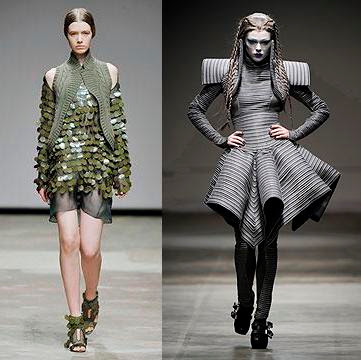
And lastly, to say that caring about your appearance for self-confidence's sake is really just latent sexism, and that women are unthinking enough to not know they do everything for men anyway is... well, first silly, second, offensive, and third, incorrect. We really need to get away from men telling women that their behavior is "ingrained."
It's none of your concern why a woman dresses the way she does. As long as she isn't violating company policy, she is under no obligation to justify her wardrobe to anyone else. And if she is violating company policy, that's between her and HR, not you.
Well since the quote essentially boils down to "damn look at dem titties" then yes it is very demeaning & disrespectful!
It's also sexist. Why? Because it's self-absorbed. Whoever spoke that quote wasn't thinking about how their words might make Katie feel in a room-full of people. "I'm a man I like titties and anyone else's thoughts and feelings don't matter." That's sexism in a nutshell: that the default and correct perspective is the male perspective. That anyone who doesn't hold this perspective just needs to "chill out".
I would say for the most part it's not all that conscious. We buy the dress if we like it. In some cases we might not buy it if it looks too revealing, or buy it because it's especially sexy, but for the most part dresses are cut to the style of the day and it has little to do with the intentions of the woman wearing them.
Personally I've started consciously looking for low-cut tops and dresses for the first time in my life, because they're easier to breastfeed in. Most of my dresses and tops are cut too high to do that easily so I need to expand my wardrobe. So sorry, all that cleavage is not for you, it's for my baby :).
So, I'm not going to agree or disagree with you, since I don't really know exactly what you're saying.
I will say this, though: there is professional attire for women. Generally speaking, this doesn't involve form-hugging clothing. A fitted women's dress shirt is not form-hugging, by the way.
Personally, I recognize that I have an unfortunate automatic physiological response to breasts. I've discussed this with female friends whom I've respected and liked strictly as friends. If exposed to low-cut tops, I find my eyes darting to them, particularly when I'm distracted or concentrating on some thought. If I were in a position where a well-endowed female coworker were wearing very snug or revealing clothing, I'm honestly not sure how I would handle the situation.
You've been programmed to think this is bad, unhealthy or unnatural by people with an agenda. There's another school of thought that says it's ok, normal, natural, and healthy. Humans are hard-wired for sex and we've been having sex like rabbits for millions of years otherwise we wouldn't be here. There are many situations and places and modes where we pretend it doesn't exist, but it's a lie, at best a convenient intellectual abstraction in order to focus on productive matters. But it's always there, lurking. Again, for most healthy people it is anyway.
Now, if anything, I over-correct when I'm talking to someone who I find attractive and is wearing a very low cut shirt. Eyes. glued. to. eyes.
No I haven't. I don't think it's the least bit bad or unhealthy. I simply want to engage my friend as a friend, not glance at her tits every ten seconds. Performing physical actions that imply attraction would introduce a power balance that I don't want in a friendship.
I have been in that situation years ago, and I remember it to this day. It didn't help that I was much younger then.
Anyway, I found it incredibly hard to concentrate on what she was saying, because I was concentrating on keeping my eyes away. It didn't help that she was absolutely gorgeous, well-endowed and was wearing a dress with a cleavage probably modeled after the Grand Canyon. Thankfully, she was not a coworker. But even worse, she was a potential client.
I don't want to be too quick to blame it on instinct, but it is there. I wonder if I were (proportionally) as well-endowed as she was, and wore tight shorts. Some female friends told me that they do look - but women seem to be more discreet, on average.
Is this sexism? Or just normal human behavior?
Sexism would be if your attraction influenced your professional behavior towards your prospective client in any way, negatively or positively.
As you hinted, being able to be less distracted by an attractive figure is a matter of self-mastery, which often comes more easily with maturity, and to some degree familiarity. But a modern gentleman knows to treat others as persons first, not as sexual beings, especially in a professional context.
Why would you make sexual comments at work? Making jokes is fine, commenting on clothes is fine, telling a joke involving sex is probably fine (depending on the joke...). Having a conversation (two-way) about sex is fine.
Making a specific comment about a colleague's sex appeal is inappropriate. I don't see how you can't see that someone might be offended by it.
I think "I can imagine myself saying" implies he thought it was "reasonable".
I certainly don't think that's reasonable think to say. That part was more like "Fuck, I could actually say something like this, and this is BAD.". It comes from teenage-and-trying-to-get-group-approval-me saying things before slightly-more-adult-and-trying-to-not-be-an-asshole-me has chance to suppress those thoughts or words.
I don't mean to imply in any way that was "reasonable", just something I could at first glance recognize as harmless and say, whereas when you just think about it for a second, it totally isn't and you shouldn't.
In that case the point I made is fairly moot, as it basically agrees with you in that it's a "BAD" thing to say.
Before I continue, how often have you said a line or phrase to a friend or someone you have had a long term relationship with (without defining that relationship) that could be viewed as "bad" out of context? I have seen blacks call each other the N word, people call each other homosexuals, all in their comfort zones of understanding that the other person was not saying anything to be offensive. It is called understanding each other.
She rants on about how "guys" think and how the "guys" push roles upon her. It has nothing to do with roles. Pot luck? There is a very good chance that no one wanted that job regardless of gender. I'm a programmer. I don't have time to do a pot luck. It doesn't matter if I am a man or woman, I am going to try to get out of it. You didn't and you got stuck with it.
I have said comments not unlike the one in the article to a woman before. I didn't do it because I felt beneath her, or that she was weaker, or didn't belong there. I knew her for a long time, and felt comfortable that she would not be offended, and that she would get a laugh about it. If she didn't like something I said, she would likely jab me in the gut or tell me to clean up my mouth, and I would oblige.
The problem is she never addressed the issue, and instead let it go even though it was eating her up inside to the point where it did serious damage to her career. Why? Because she caved in to her own assumptions and did not address it. The guy could be a complete douche, or he could have believed that he was giving her a compliment (albeit a lame one) about her dress and the effect it had on him. No one knows from what place his comment came from except for him and she didn't try to find out.
True to tell someone to "lighten up" is a remark that disallows someones point of view. That is horribly wrong. But it is wrong to force everyone to make assumptions about everyone else without discussing it with them. If someone steps over the line, it is your responsibility to address it to them. She did not do that. Instead she went on a blog and lambasted every male coder in the business. Strange. I find that horribly inappropriate.
Also, I misread that as "censor", my mistake.
No, it doesn't.
I can imagine myself saying all kinds patently disturbing and offensive things — things which, to a certainty, are not remotely "reasonable" — but I would never actually say, let alone mean, them.
By analogy, I can imagine pulling my Leatherman out of its sheath and sticking the blade between someone's ribs. Doesn't mean it's reasonable, or that I'd ever do it, especially not in jest.
At what point did we become okay with excluding sexuality from human lives, or a large portion of them -- the time we spend working? Sexuality is every bit as much a "human" endeavor as, say, eating -- and we don't (currently) say: never eat at work, work is for work only (despite the fact that food does separate people from each other, and accentuates differences).
Anyway, a random rambling, but I thought I'd share anyway...
I think the point where it happened was when we, collectively, noticed that people were exploiting professional power asymmetry for their own sexual gain. Often at the cost of another human's dignity and self-respect – not to mention career prospects.
However, the difference is that in those cases, it is always the woman's choice to participate in it. Since they are the marginalized demographic in this matter, the choice should be theirs to indicate what is and isn't acceptable commentary, discussion or behavior in the workplace.
Today's environment is one where it’s _men_ who overwhelmingly decide, by way of majority-reinforcement, what other people should consider to be acceptable or not.
It all comes down to marginalization: we don't marginalize or trivialize people—or their accomplishments—based on the fact that they eat. However, our society does tend to do those things to people based on their gender; specifically, to women based on their gender.
Once we eradicate the culture in which that happens, people can express themselves sexually more freely and without hesitation, in the safe and sound knowledge that doing so won't instantly label them in a certain way that would dramatically (in a negative way) impact their professional and/or social lives—or worse.
More here: http://www.amazon.com/Civilizing-Process-Sociogenetic-Psycho...
Eating doesn't affect anyone around you (though tuna sandwiches are definitely an issue to get HR involved in...) Sexuality, violence, religious conversion and the stench/filth of defecation affect people around you whether they want to deal with them or not. Ergo, it is rude to make "working" contingent on dealing with your literal or metaphorical shit.
Absolutely.
One of the first jobs I worked was doing admin & tech support in a small office - full of women. Worst 6 months of my life, and my experience was much the same as this bloggers.
Which has really helped me avoid this sort of problematic behaviour now I am working in a mostly-male industry/workplace.
That's a very difficult sort of scenario to cope with. You're fresh from school where you adapt, rather than complain, to the environment. You have no experience of work, office politics or whether this is actually how it happens in the real world! You have no peers who understand your perspective.
And if you make a major scene? Everyone starts tiptoeing round you for fear of causing offence.
That, more than the comments themselves, is what is upsetting. The knowledge you can't actually get them to treat you as they treat each other.
Asking her to take notes (as in, not asking anyone else), though, is a completely different story. However, I believe that some women handle it in a not very effective way. I might be a sexist too! If you tell me in a nice way (simply saying that you think what is going on is wrong/unfair) I will reflect, and most likely change my behaviour in the future. However, if you attack me, or even worse, say nothing but rant on the internet, I will take it personally, as an attack on my identity, and I might refuse to change, out of principle.
What we're trying to do here is enlighten a certain aspect of our society that is wrong/unjust, and I believe that should be done by teaching people, not attacking them.
(I'm not saying that the OP definitely took the wrong path. She might have told her boss, and they did nothing different, they didn't learn. In that case, I see no better option but to attack, shame them...)
And yes, I do not want people at work to say such things about me, regardless of gender.
There are differing opinions here. Why is one opinion more justified than the other in the work place? For example: Why should I not be able to give a genuine complement about let say a woman's shoes? The work place is so filled with terror to the point where some companies policies are that a member of the same sex must be present to do simple coaching tasks. Is this not absolutely ridiculous?
Would you feel the same if someone said, "nice haircut" vs. "you look cute with your new haircut"? I highly doubt it. And further, try imagining it coming from differing genders, and differing sexualities.
One of the compliments objectifies, and that is why it doesn't belong in the workplace.
However, in the same social setting, when a man compliments a woman's appearance, the implied meaning is "I am pursuing you romantically." And this is fine in social settings, otherwise our species would die off.
But it's not fine in the work place. You feel that a woman at work giving you such a compliment is "harmless fun" because if it was a normal social situation, you would have the power: it's up to you to pursue. But for many women it is not "harmless fun" because it's similar to the social situation, and they feel romantically pursued, which is not okay at work.
[1] Please note I do not consider this a promise, so let's not confuse this with "asking for it." Human communication is subtle, and such implications are how consensual "courtship" happen. Of course, once there is a rejection, whatever implications one thought were there don't matter.
Why is it that straight guys have to state the obvious whenever they talk about other men? I tell ya, being a gay nerd, in a company full of "straight" nerds, is like being in the gym; watching the bodybuilders do cartwheels, trying to convince their "buds" they aren't gay for checking out that guy who walked by.
I hear borderline homophobic remarks all day. Like the ever popular, "Gay" or "That's gay". Which applies to practically anything that doesn't go their way ("Gay" has replaced the 80's term "weak").
I was in the Army for 10 years (Ranger for 6 of those years). I have a picture of me sitting on a tank, eating MRE's. Sometimes I turn it facing out. A gentle reminder to anyone walking into my office, who the "real" man is. ;)
What about if a man has a nice bulge in his pants? Will you compliment him on that too? Because a reference to a low cut top is a reference to what lies under the top, and I'm not talking biceps. The male equivalent would be a not so subtle compliment on his penis.
As a man who values fitness, I would be really freaked out if you, as a coworker, complimented my biceps.
If you merely asked about fitness, it would be fine. Commenting on my appearance (beyond, "hey, you have a piece of toilet paper stuck to your face") isn't what I consider appropriate to the workplace.
Why?
It was merely an example. I have, at various times, had a variety of substances accidentally adhered to my face, head, or clothing. Pointing out something which is obviously unintentionally out of place is much appreciated. Making value judgments on appearance is not.
BTW, you don't have a problem with posts like this, or if you do, you didn't state it clearly. From what I can tell, posts like this have a problem with you.
And I'd say the "person-first" rule goes for how to treat other men, too.
i'd write more but it's too tortuous on my iphone. if you you've got other questions or need advice, feel free to shoot me an email.
Not at work.
(Humanity is defined by emotions, particularly physical attraction. But it's also defined by rational thought; not doing whatever you think your emotions want you to do. So if you're in a meeting with some attractive coworkers, use your rational mind to keep your comments to yourself. There are lots of people on Earth and there will be other opportunities for reproduction.)
Also, who says that I want to work as a "programming drone" - why do you get to tell me what a professional has to be like? What if I don't like it? I am not arguing for the right to leer at breasts at work, but I don't like the other extreme of being a completely rational machine that you describe either. I am not a robot. (OK, I am a robot, but a very advanced biological one).
So while it sounds like good advice on the surface to not date colleagues, it just isn't realistic.
I am aware that many people will choose to misunderstand me. I am not saying sexism at work should be tolerated so that couples can form. I am saying that attraction at the workplace is real and people need help learning how to deal with it. The "leary guy" might have been sexist, or simply socially inept.
If the definition of sexism includes "acknowledging the existence of boobs" then there is no hope, though.
>If the definition of sexism includes "acknowledging the existence of boobs" then there is no hope, though.
"Hey, look at the boobs on our sole female co-worker!" is sexism. So I guess there's no hope.
Like you would talk to men. Simple.
"Oh come on, my grandma/dog/goldfish would write better code!!!"
This would be a totally acceptable jab among guys, yet saying this to a female coworker would immediately be misinterpreted as "woman are bad at coding" promptly followed by the full wrath of the HR gender equality team.
You don't have a solid grasp on male-to-male communication in the US workplace. Please keep in mind that perhaps your culture is different.
Cheeky insults, (which "my goldfish codes better than you" OBVIOUSLY is) are not attempts to "undermine your male colleague's confidence in their ability". If you think that is not the case, then you are obviously completely out of touch with male to male interaction in the US.
What I am going on about is that the "I want to stare at your tits guy" might not be sexist so much as simply inept at dealing with attraction and dating. Calling him a sexist jerk is not going to resolve the issue.
It is not excusing the behavior, but seeking understanding and solutions.
Of course sexist jerks also do exists and have to be dealt with in another way. Also, believe it or not, but if such things go on at a work place, it might make men feel uncomfortable, too. Personally I don't enjoy sexist jokes.
I grew up in a small, all-white community where jokes about blacks were common and accepted.
when I grew up and moved away, I learned how bad that was. so I stopped.
I don't ever, ever slip up, because I don't think that way any more.
"I try, I really try, but sometimes I forget myself."? No, you just THINK you are really trying.
If someone grew up in a racist environment, the goal is for them to stop thinking that way, period.
If someone grew up in an environment where they mistakenly believed it was always appropriate to verbally acknowledge your sexual attraction to someone, the goal is simply for them to get better at recognizing situations in which they need to self-censor.
There is no shame in being sexually attracted to women, but verbally acknowledging it is inappropriate in some situations.
But it's a load of BS. I have close relatives who grew up in that environment who are not racist at all. If you think for yourself, there is little chance of social pressures influencing your behavior - at the risk of ostracism, of course (hello High School!).
Regardless of past influences, I believe that we, as rational beings, can overcome any behavior w/ practice and effort. To not do so is a character flaw that should be worked on.
No pain, no gain.
Most male dominated fields of work behave like this - it's a reflection of subtle rules society that we're taught at a young age. We can try to patch it over but it might cut deeper than just culture, it maybe simply inherently biological the behavior of men around a single female.
If you find that you have difficulty doing this, then you are literally a part of the problem with our community that we are discussing, and you should be spending a non-trivial amount of your time learning to manage your disability.
And I mean that-- it's something that you grew up with, it's a problem, we're all here together to help you through it. But first you need to admit that it's something you have to fix.
That's because there is nothing wrong with you, and yet everyone around you is telling you you're a problem. Kinda like the OP feels at work.
Unfortunately those who can't get over the guilt you feel via this association, are far more likely to defend the same behaviour in others in order to make that feeling go away. This is only going to stop when we stop feeling guilty and choose to act differently.
If there's hope for you, there's hope for all of us.
Without endorsing any specific views on female vs male promiscuity, I don't see what's so bad about seeing a distinction between them. The fact is, men and women are different from each other, and male and female promiscuity are different phenomena.
You can substitute many other things in there, and it will make equally bad argument. 80 years ago one could similarly argue about black vs white people, and it wouldn't be considered wrong or racist back then.
It's just less obvious after years of cultural conditioning.
You might say things like this aren't a big deal, but it still serves as a concrete example of how male and female promiscuity are different from one another and affect people's lives differently -- and frankly it's far from the only one. It's silly to deny the subtleties of human sexuality in the name of some egalitarian ideal. By insisting on viewing women exactly the same as you would view men, you are discarding useful information about the world.
I'm having flashbacks now to the video on Reddit yesterday where the black female college student went psycho apeshit in class when the professor was lecturing about evolution. She seemed to think there was some kind of persecution going on involving evolution and black people, and became violently angry at both the professor and the other students, interpreting things seemingly 180 degrees opposite, almost hallucination-like, compared to everybody else. Compared to the sane, healthy, objective people. They recorded it on many cellphones too. The point I'm making, in relation to the OA, is that yes there is sexism and sometimes inappropriate things are said. But yes it is also true that sometimes some people are wacked in the mind and/or misinterpret things. And without really knowing the specific person directly or seeing the events directly with our own eyes, we can't really know which it is.
I'll just close with the observation that there are probably at least 10's of millions of Americans, if not 100 million plus, that believe the Christian God exists, lightning bolts and all, angry man in the clouds, all the miracles, etc. Some of those folks also work in offices and post on the web. Some program. Some are "scientists" even. So take everything you read with a dose of skepticism.
I'm also having flashbacks to all the times I've been asked to take notes in meetings. I'm pretty sure I'm male too.
First I'm like - "Woah, I can't imagine someone would be so insensitive to make joke like this!" and get all fed up and upset.
But then... then I freeze, because next example is something that I can imagine myself saying.
I... I'm at loss of words. I was trained during my teenage years, that it's cool to say things like that. As I'm getting older, I see how sexist and demeaning this is. But it's really hard to break this habit, and this "Hey, it's just meaningless joke, right?!" line of thought. I try, I really try, but sometimes I forget myself.On a similar note - I have exact same problem with how I perceive woman and man having multiple sexual partners. "Good key opens many locks, but good lock is opened by only one key" and all that bullshit - I know that it's ridiculous to hold woman and men to different standard in this regard, and I mostly learned to don't do that, but my... instinct that was ingrained in me by society tells me otherwise.
I find myself struggling to suppress my subconscious mind in this regard, and frankly, I don't know how I can help it.
Edit for clarity: I don't have problem with such posts being written and upvoted, quite opposite actually, I'm glad they are written and read. I have problem with how posts like this make me feel.