At least scouting taught me to leave a place better than I found it. (Not that I always succeed, but it's worth trying to keep doing better.)
If aliens exist, their values and morals would likely be very alien to us.
I happen to agree with this one. But there is no universal truth either. So if you combine this, you get that universal morality doesn't exist either.
Morals are being decided and dictated by those who can get most people to agree on something being moral. It's a purely man-made thing that only distracts from what everyone's born with: Actual empathy.
Morals are for people who need moral guidelines, because they lack the sense that enables them to feel what another person feels.
Shared morals are among the top features of every culture. It's not something that's dictated, many try, but don't be fooled. And it's not a distraction either. People have a varying amount of empathy, emotional energy to operate empathy, and a different emotional intelligence and experience. So even if someone doesn't have the capacity to process a situation and act with complete empathy (the existence of which is debatable), they can still manage it well with morality "mechanically". In fact it's one of the ways to train yourself to feel actual empathy.
That would make it pretty tough to define. Perhaps that is the point.
He did say something stupid about them years ago, particularly when taken out of context. If you think DQ and Coca Cola are bad for society I can see that, but you should also be able to see that plenty of people disagree with your view.
Thanks to them our oceans look like this:
https://www.reddit.com/r/Damnthatsinteresting/comments/1449d...
https://www.theguardian.com/environment/2020/dec/07/coca-col...
Coca-Cola, Pepsi and Nestlé named top plastic polluters for third year in a row
Companies accused of “zero progress” on reducing plastic waste, with Coca-Cola ranked No 1 for most littered products
https://www.theguardian.com/business/2021/aug/11/coca-cola-m...
Coca-Cola most common littered brand on UK beaches, says study
They as well could.
They choose to profit from producing the stuff.
They could as well use glass as they did for decades, or sell reusable bottles and refill those. They choose to operate in countries without proper waste management knowing where that trash will end up, and are operating there anyway.
They know the damage they're causing, they've been influencing policies for decades with "reuse, recycle, reduce", even if they knew that recycling doesn't work and that just 8% of plastic ever made was recycled.
The (microplasti) pollution problem is huge, and damage they're causing is immense.
They are the (major) symptom of the problem that needs solving.
Yes, governments are among those responsible.
https://www.nature.com/articles/s41598-020-61146-4
Microplastics generated when opening plastic packaging
https://www.newscientist.com/article/2237900-just-opening-a-...
Just opening a plastic bottle can release thousands of microplastics
https://www.theguardian.com/environment/2018/mar/15/micropla...
WHO launches health review after microplastics found in 90% of bottled water This article is more than 5 years old
Researchers find levels of plastic fibres in popular bottled water brands could be twice as high as those found in tap water
Sending plastic bottles to recycling is pointless and doesn't work, anywhere.
Weird. This source[1] claims that the majority of ocean plastic pollution is from fishing equipment.
>https://www.theguardian.com/environment/2020/dec/07/coca-col...
>Companies accused of “zero progress” on reducing plastic waste, with Coca-Cola ranked No 1 for most littered products
>https://www.theguardian.com/business/2021/aug/11/coca-cola-m...
Both of these are methodologically flawed because they only sample litter that can be identified. Plastic bottles are readily identifiable and can be attributed to a company. The same can't be said for tires or cigarette butts.
[1] https://ourworldindata.org/uploads/2018/08/Great-Pacific-Gar...
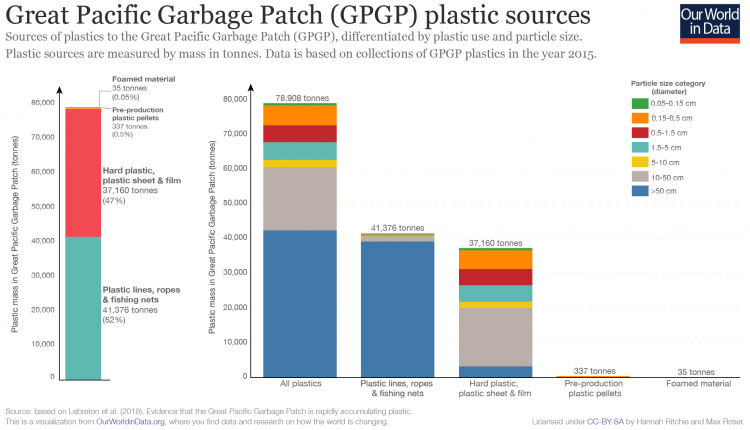
You're right. One is plastic on the beaches in the US, the second is great pacific garbage patch.
> Both of these are methodologically flawed because they only sample litter that can be identified.
They don't mask that (from the first article):
"The annual audit, undertaken by 15,000 volunteers around the world, identifies the largest number of plastic products from global brands found in the highest number of countries. This year they collected 346,494 pieces of plastic waste, 63% of which was marked clearly with a consumer brand."
It's flawed and not complete, but it's data. We don't have better data yet, AFAIK.
It's also the most popular soda brands in the country. Maybe there is a correlation?
In the unlikely event that you're correct about Coca-Cola products being the main polluters, is it their responsibility to make sure customers don't litter?
However, being a manufacturer of these products is not the same thing as being a polluter. The polluters are the people doing the actual polluting, by throwing the products into the rivers and oceans.
The vast majority of plastic in the ocean comes from rivers, and a small number of rivers are responsible for the vast majority of river-borne plastic.[0]
The top 10 most polluted rivers do the lion's share of the work, and 8 of them are located in Asia. None are in the west. Even if you look at the top 1000 most pollution-causing rivers, only 1 is in the US and only a few are in Europe.[1]
These disparate results come despite the fact that the US is one of the highest consumers of Coca-Cola products. This suggests that pollution has more to do with societies than companies.
As fashionable as it is to hate on corporations and place the blame at their feet, it's not their job to police pollution, nor or they incentivized to do so. Shaming them will be ineffective, and if we truly care about the planet, we should try to be effective.
Luckily, there is an appropriate target for our ire and suggestions, a target which is both richer and more powerful than every corporation combined, and which is responsible for keeping things clean, and which is accountable to public opinion, and that target is called government.
Societies that are clean are societies that hold their governments accountable to holding polluters accountable, whether they're corporations or individuals. So, in my opinion, our efforts are best directed at governments.
Warren Buffett is not the villain here, and nor is Coca-Cola. Even in a world without Coca-Cola, we'd likely have another behemoth in its place, or (worse) a million little distributors contributing equally (likely more) to pollution, but without a single name by which we can identify them, nor a single entity by which we can effectively police them.
[0] https://www.scientificamerican.com/article/stemming-the-plas...
Production costs are almost zero, health and environmental impacts are extreme.
Warren Buffett is the villain. Coca-Cola too. Governments as well. The system as well.
I hope that shaming works. Nothing else has brought any change yet.
I don't think that it did. And I don't care about what the humanity is consuming, as long as it doesn't pollute the world excessively.
Your rights end where my rights begin, etc.
It's laws. It's society. It's government. It's mobilization by citizens to get the government to regulate waste disposal -- to make improper disposal of waste illegal, and to fund the creation of easily-accessible environmentally-friendly waste disposal mechanisms.
Consuming soft drinks does not pollute the environment. Throwing bottles into rivers does. Your disdain for soft drinks has you mistaking these for the same thing.
I'm not against soft drinks, again. I'm against plastic pollution, be it from plastic bottles or from textiles or packaging materials or whatever.
Producing plastic causes plastic pollution, no matter how it's disposed of.
Milk literally has more sodium.
As you said ... it's not much, you won't even notice it. So the reason it's there is to increase consumption (to keep you thirsty and to tolerate more sugar) and addiction.
https://www.healthline.com/nutrition/soda-addiction
Because soda contains several potentially habit-forming substances like caffeine, sodium, and sugar or artificial sweeteners, it’s easier to become dependent on soda than you might think
Because it makes the final product taste better. You can reframe that to mean something nefarious (ie. "it's there is to increase [...] addiction"), but fundamentally it's not any different than you adding salt when you're cooking.
>it's not much, you won't even notice it
>Because soda contains several potentially habit-forming substances like [...] sodium
Let me get this straight. You're claiming that "you won't even notice it" yet it's also "habit-forming"? What's the mechanism by which drinking 0.2g of salt per 20oz bottle gets you addicted?
https://pubmed.ncbi.nlm.nih.gov/24829986/
A Classic Innate Behavior, Sodium Appetite, Is Driven by Hypothalamic Gene-Regulatory Programs Previously Linked to Addiction and Reward
https://pubmed.ncbi.nlm.nih.gov/29673924/
Food additives, food and the concept of 'food addiction': Is stimulation of the brain reward circuit by food sufficient to trigger addiction?
I don't doubt that salty foods in general are delicious and make people want to eat more. I'm doubting whether the effect applies specifically for coke, which only has 0.2g it per 20oz bottle. What you're doing is like looking at a car crash and concluding that it's caused by alcohol because the driver ate some bread[1] before driving.
[1] https://www.scienceabc.com/pure-sciences/does-your-bread-con...
I'm not pretending I'm the expert.
> What you're doing
I'm cited the source.
> it's caused by alcohol because the driver ate some bread
Don't tell our politicians ... we have 0% limit.
A source that fails to list what the dosage is, and I highly suspect isn't in the range of 0.2g/20oz.
>Don't tell our politicians ... we have 0% limit.
https://en.wikipedia.org/wiki/Blood_alcohol_content#0%
>It is illegal to have any measurable alcohol in the blood while driving in these countries. Most jurisdictions have a tolerance slightly higher than zero to account for false positives and naturally occurring alcohol in the body.
https://laborrights.org/in-the-news/2005-list-14-worst-corpo...
Not any more than the bakery down the street is "doing nefarious stuff" by adding salt to their bread.
Coca Cola (etc.) has 2.37-3.10pH, and the acidity is from phosphoric acid.
https://www.foodchamps.org/is-coca-cola-acidic/
"Due to their high sugar and acid content, over-consumption of these drinks is bad for your health and can aggravate symptoms of acid reflux."
"It can also cause bones and tooth enamel to erode, creating the perfect conditions for the development of cavities."
Obviously they don't put it in to destroy your teeth, and despite what the other replier said, it _does_ matter why, which is _why_ they went through the effort of wrongly attributing why it's done
p.s., phosphoric acid is delicious, that's why people like products with it in it. Back in the days of soda fountains, they'd add it in! Now it's mixed into cocktails, sometimes with various other acids (citric, tartaric, etc)
Often, tea has far more. eg Coke Classic 2.8 to Black Tea 5.2
Make it from plants and it's another story, but until then ...
Ben & Jerry makes very tasty vegan ice cream, for example. Cow milk is not a necessity for ice cream, same way as dog milk, rat milk, giraffe milk, hippo milk, or cat milk isn't.
What you appreciate is fat content, not some magical taste ingredient from milk. So you could your ice cream from coconut milk or soya milk or hemp milk or almond milk and it would taste good too.
> converts otherwise inedible biomass into human food
It's also a leading driver of deforestation, one of the biggest polluters (greenhouse gases & eutrophication), responsible for soil erosion and collapsing biodiversity, etc. etc.
We could afforest and rewild those pastures and store entire 1.5C carbon budget in those forests (thus stopping climate change and biodiversity loss).
> would the industry that would take its place if it didn't exist be just as polluting to provide all those calories
Not at all. https://ourworldindata.org/land-use-diets
> no dairy, no pizza. and who would want to live in a reality without pizza
Pizza base is vegan. Do you know vegans have cheese, and for some (carnists and vegetarians) it tastes even better than the "real thing"?
And as bonus it's sustainable and not destroying the earth for our descendants.
There are lots of sad people out there that will criticize people for all sorts of things.
If ice cream brings you happiness, eat ice cream :)
However, there is another side to this... Who are you (not you personally, but anyone) to decide how others should live their lives? If someone wants to drink soda, smoke and eat fast food, why wouldn't they? If selling what people want is somehow bad, then I guess restricting it should be good, so we should just take all these people we have decided are too stupid to know what's good for them, and regiment their life until we are satisfied? As much as I dislike and disagree with their choices, this line of thinking seems abhorrent to me, at most I'd argue we have some say on what they are doing if they use taxpayer-funded healthcare and such, but for me that is an argument against the latter, not the former. And in any case it has no bearing on the morality of the seller - he didn't ask or force anyone other than the buyer to deal with the 2nd order effects.
Viewed from that perspective, there's nothing wrong with selling cigarettes.
I think it would do good to just internalize what's happening - the desire for personal gain, and the indifference on the ways that are employed. There is no shame in not caring about other people on a societal level, I don't think most of us do, and I do think that many who say they do, don't really actually. Calling them names like stupid or gullible, just to defend contributing to the harm of them is not successful coping attempt however. It just says that these things do bother who's saying them, and that they feel something that's not desirable to them, like shame, or fear of retribution, or something else that's negative. There's no need to do any of this, it's okay to just not care.
What I'm saying is that the GP says "selling cigarettes is bad, because cigarettes are bad for the buyer". Who are you to decide that? You are implicitly saying "the buyer of cigarettes is stupid and doesn't know what's good for them [and therefore enabling them is bad; in which case the reverse, preventing them from acting, must be good]"
I say they make a choice to buy cigarettes, and while I personally think that's dumb, it's just, like, my opinion, man.
The fact that they are unable to stop makes the decision to smoke involuntary, and that’s what makes tobacco sales bad.
Someone who wants to socialize your health.
Does that mean that socialized medicine justifies restricting health choices? To me, that is an argument against socialized medicine, and also the point I was trying to make is, where do we stop? We could force people to exercise and monitor them via a little camera built into a device with a screen ;)
"But people want it" is not a valid argument.
There's a quote about propaganda which says that the goal is to make everyone feel that forced-fed choices are their own spontaneous decisions.
There are entire industries devoted to making sure that those choices - often self-harming - are not spontaneous. At all.
Get rid of those and you may have a point. While they still operate, you don't.
Same for fast food and soda, to a lesser degree... they seem to be frowned upon - yet people like them anyway.
The only thing bad about Dairy Queen is the quality of the food has dropped over the decades, and there aren't enough of them.
Also, the drive through lines are a bit long during peak hours and I don’t really need to see the employer hold the Blizzard upside down. It’s just dumb theatrics.