They as well could.
They choose to profit from producing the stuff.
They could as well use glass as they did for decades, or sell reusable bottles and refill those. They choose to operate in countries without proper waste management knowing where that trash will end up, and are operating there anyway.
They know the damage they're causing, they've been influencing policies for decades with "reuse, recycle, reduce", even if they knew that recycling doesn't work and that just 8% of plastic ever made was recycled.
The (microplasti) pollution problem is huge, and damage they're causing is immense.
They are the (major) symptom of the problem that needs solving.
Yes, governments are among those responsible.
https://www.nature.com/articles/s41598-020-61146-4
Microplastics generated when opening plastic packaging
https://www.newscientist.com/article/2237900-just-opening-a-...
Just opening a plastic bottle can release thousands of microplastics
https://www.theguardian.com/environment/2018/mar/15/micropla...
WHO launches health review after microplastics found in 90% of bottled water This article is more than 5 years old
Researchers find levels of plastic fibres in popular bottled water brands could be twice as high as those found in tap water
Sending plastic bottles to recycling is pointless and doesn't work, anywhere.
Weird. This source[1] claims that the majority of ocean plastic pollution is from fishing equipment.
>https://www.theguardian.com/environment/2020/dec/07/coca-col...
>Companies accused of “zero progress” on reducing plastic waste, with Coca-Cola ranked No 1 for most littered products
>https://www.theguardian.com/business/2021/aug/11/coca-cola-m...
Both of these are methodologically flawed because they only sample litter that can be identified. Plastic bottles are readily identifiable and can be attributed to a company. The same can't be said for tires or cigarette butts.
[1] https://ourworldindata.org/uploads/2018/08/Great-Pacific-Gar...
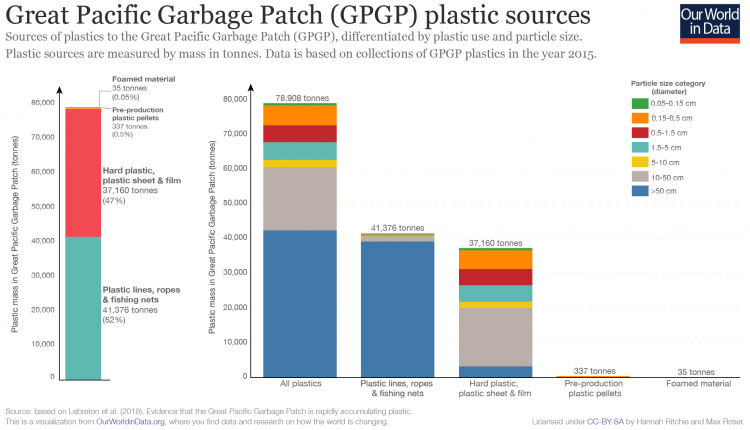
You're right. One is plastic on the beaches in the US, the second is great pacific garbage patch.
> Both of these are methodologically flawed because they only sample litter that can be identified.
They don't mask that (from the first article):
"The annual audit, undertaken by 15,000 volunteers around the world, identifies the largest number of plastic products from global brands found in the highest number of countries. This year they collected 346,494 pieces of plastic waste, 63% of which was marked clearly with a consumer brand."
It's flawed and not complete, but it's data. We don't have better data yet, AFAIK.
It's also the most popular soda brands in the country. Maybe there is a correlation?
In the unlikely event that you're correct about Coca-Cola products being the main polluters, is it their responsibility to make sure customers don't litter?
However, being a manufacturer of these products is not the same thing as being a polluter. The polluters are the people doing the actual polluting, by throwing the products into the rivers and oceans.
The vast majority of plastic in the ocean comes from rivers, and a small number of rivers are responsible for the vast majority of river-borne plastic.[0]
The top 10 most polluted rivers do the lion's share of the work, and 8 of them are located in Asia. None are in the west. Even if you look at the top 1000 most pollution-causing rivers, only 1 is in the US and only a few are in Europe.[1]
These disparate results come despite the fact that the US is one of the highest consumers of Coca-Cola products. This suggests that pollution has more to do with societies than companies.
As fashionable as it is to hate on corporations and place the blame at their feet, it's not their job to police pollution, nor or they incentivized to do so. Shaming them will be ineffective, and if we truly care about the planet, we should try to be effective.
Luckily, there is an appropriate target for our ire and suggestions, a target which is both richer and more powerful than every corporation combined, and which is responsible for keeping things clean, and which is accountable to public opinion, and that target is called government.
Societies that are clean are societies that hold their governments accountable to holding polluters accountable, whether they're corporations or individuals. So, in my opinion, our efforts are best directed at governments.
Warren Buffett is not the villain here, and nor is Coca-Cola. Even in a world without Coca-Cola, we'd likely have another behemoth in its place, or (worse) a million little distributors contributing equally (likely more) to pollution, but without a single name by which we can identify them, nor a single entity by which we can effectively police them.
[0] https://www.scientificamerican.com/article/stemming-the-plas...
Production costs are almost zero, health and environmental impacts are extreme.
Warren Buffett is the villain. Coca-Cola too. Governments as well. The system as well.
I hope that shaming works. Nothing else has brought any change yet.
I don't think that it did. And I don't care about what the humanity is consuming, as long as it doesn't pollute the world excessively.
Your rights end where my rights begin, etc.
It's laws. It's society. It's government. It's mobilization by citizens to get the government to regulate waste disposal -- to make improper disposal of waste illegal, and to fund the creation of easily-accessible environmentally-friendly waste disposal mechanisms.
Consuming soft drinks does not pollute the environment. Throwing bottles into rivers does. Your disdain for soft drinks has you mistaking these for the same thing.
I'm not against soft drinks, again. I'm against plastic pollution, be it from plastic bottles or from textiles or packaging materials or whatever.
Producing plastic causes plastic pollution, no matter how it's disposed of.
Thanks to them our oceans look like this:
https://www.reddit.com/r/Damnthatsinteresting/comments/1449d...
https://www.theguardian.com/environment/2020/dec/07/coca-col...
Coca-Cola, Pepsi and Nestlé named top plastic polluters for third year in a row
Companies accused of “zero progress” on reducing plastic waste, with Coca-Cola ranked No 1 for most littered products
https://www.theguardian.com/business/2021/aug/11/coca-cola-m...
Coca-Cola most common littered brand on UK beaches, says study