This would happen imports or not. So long as wheat exports are allowed, the local price will settle on the world price as the product is able to flow to the highest bidder. An event like the Ukraine war will impact someone and that will drive the world price up.
One of reason why food inflation in Brazil rise in the latest years is exactly because of CONAB stopped stocking it.
Even milk and peanut they stocked before.
About wheat, yeah, nobody ever place any priority on being self-sustaining. That's because it's not really important. Brazil has a couple of neighbors that produce enough wheat for supplying it, and need quite a bunch of stuff Brazil produces. The only reason anybody is going for self-sustainance now is because it's profitable, and things will change once it's not.
On fertilizers, well, Brazil can not produce enough of the material for the fertilizers it imports.
No, it means you can’t take a position without paying a cost. A lot of countries used to depend on Russia for various things, and they have paid a price to change this.
Ukraine is/was the world's bread basket. Supporting Russia jeopardizes the world's access to food. Brazil's actions don't exist in a vacuum.
Sure, even the poorest countries in the EU are significantly richer than Brazil, but it's not like we didn't get significant food price inflation either.
https://en.wikipedia.org/wiki/List_of_countries_by_GDP_(PPP)...
I don't get your point. Where do you see this fundamental difference between Brazil and Europe? Europe was highly dependant on Russia for it's energy supply, to the point that Putin was hoping to leverage that to conduct his genocide of Ukraine unopposed, and Europe successfully shed that dependence on a dime.
In your opinion, what stops Brazil from finding alternatives to Russia imports?
There are some recent photos that show the result of accumulated inflation and unemployment during the pandemic:
People scavenging bones to eat: https://f.i.uol.com.br/fotografia/2021/09/29/16329448496154c...
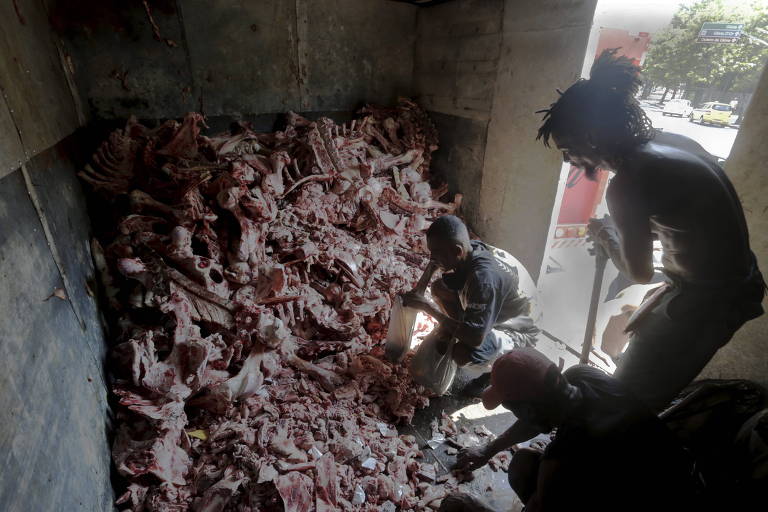
People scavenging garbage to eat: https://publisher-publish.s3.eu-central-1.amazonaws.com/pb-b...

Alternative fertilizer suppliers might not be available.
And now they depend on US for the same things paying a much bigger price.
Some countries never learn.
What? Germany is now reporting record drops in it's energy prices.
https://www.cleanenergywire.org/news/energy-costs-german-hou...
It's the other way around.
Brazil and Argentina especially should be rich, what's lacking is coherent social organization from top to bottom. Obviously it matters more at the top, but it has to be borne by regular people as well.
Same could be said of other Central/South American nations, but geographic factors and natural resources do give a material advantage that can be leveraged into a lot.
Consider that Canada, unlike most other so called 'advanced nations' - does not actually have lot of advanced industry. Research, yes, but 'applied' - no. And yet, because it has a 'free export card' with natural resources, it can import the equipment and materials necessary to support the rest of the regular domestic economy, which benefits from ultra boring politics, 'functional' bureaucracy, low levels of corruption.
Innovations can only be leveraged by organizations that have the coherent ability to make use if them.
The 'low hanging fruit' in Brazil is governance, though I hope this Wheat helps.
South American is already mature. The countries there have different political situations and relationships. Trying to bring them into one federal republic is a non-starter -- it ain't gonna happen.
A better model would be the EU where you have mature countries removing trade barriers between them, allowing free immigration, and a single currency. This was anchored by a few large countries that had relatively low corruption, peaceful relations and strong economies.
South America... doesn't quite have a strong set of low corruption and strong economies. There are regular coups and a number of ongoing civil wars that would make trying even for a loose coalition of countries in South America difficult.
I misremembered it as San Martin's opinion while old and dying in France, but it appears to be the description given by Karl Marx to Engels (apparently on a letter sent on 1858-02-14, though I can't find that letter right now). This article [0] on the Metapedia explains a bit of the history on why Marz was talking about Bolivar, but also says that modern marxists don't share this view.
[0] https://es.metapedia.org/wiki/Karl_Marx_contra_Sim%C3%B3n_Bo...
On the cultural level, they have some similarity but not to the extent that they view each other as part of the same “nation” or “people”. One shouldn’t exaggerate the effect of speaking the same language: consider the fact that the US, Singapore, and Zimbabwe are all English-speaking officially (or de facto officially in the case of the US). Also Brazil does not even speak the same language as the rest.
Some differences do of course exist between the various US states but to a much, much lesser extent.
Germany and France (and the UK at the time) dominate. Poor nations like Poland and Greece with rich ones like Norway. Conservative countries like Hungary alongside progressive social democracies like France and Sweden.
I doubt there will ever be even an EU-like structure encompassing Latin America, but even if there is, that would be a far cry from becoming a united sovereign state.
Again - internal self sufficiency is not the basis of development.
S. America has relatively free trade for things they need, and there are no hugely relevant issues there.
The wheat innovation is going to be nice for Brazil, but more as a function of expansion of industry, not really on the basis of 'self sufficiency'.
Brazil's path to wealth lies through the reform of civic and social institutions, not through some kind of magic grain.
The same could be said of most places.
It’s hard to bring people together when they speak different languages and have to take a plane or cross difficult terrain to meet each other.
Every country in the world is dependent on trade, which is saves a lot of money over self-sufficiency. North Korea is the only country that tries self-sufficiency.
If it costs you $100/bushel to produce wheat and you can buy it for $60/bushel (I'm fabricating numbers), why produce it?
Its nice when you can buy $60/bushel wheat. Its not so nice when your dealer cuts you off.
The extra $40/bushel you pay to produce in-house, thats your insurance policy against having your supplies cut off. In a world where geopolitical lines are shifting, it's a matter of national security and optionality to have your own food production capacity. Risk management.
Nationalism makes you poor.
Your solution is the short-term one, maybe not even that. In the long run, your community is much better off producing what it does best and trading with others for what they produce best, rather than everyone trying to do everything at some mediocre level.
Your solution is like Microsoft building its own furniture and cars and flying its own planes, rather than making software and buying the furniture, cars, and air travel from those who are expert in it.
Let's use your example, Microsoft. Companies have different incentives than communities or countries, but I think we can make this work.
For many years, Microsoft only sold software, and let others who were experts in hardware make the hardware and install microsoft on it. Later, they realised that it was strategically important to manufacture their own consumer hardware, and now you have the Surface lineup. Maybe in the near future, they will decide they need to start manufacturing their own chips. If they do that, it's not going to be cheap, especially in the short term. But it might be what they need to do to keep their dominant position in the market.
What a bizarre things to say. First of all, are you an economist who can comment on other people's sophistication? Second, who cares? The merits are what matters, and you agree it's "broady speaking, correct".
The world is three meals away from anarchy, being dependent on the caprice of global markets for food is a great recipe for getting regime-changed by starving people.
The evidence shows that vastly overstates the risks: It hasn't happened or even come close to happening yet. In fact, name any place that has turned anarachic due to food shortages.
The modern global markets are not capricious, but the most efficient, effective distributors of resources in the history of the world.
Though they were able to find alternative foreign sources to make up the difference and redevelop domestic production.
“Certain countries” are well known for subsidizing domestic grain production and dumping it on overseas markets which ends up hurting the local farmers as they can’t compete on prices. Given enough time these countries become totally dependent on the imported grains and their entire farming industry goes away.
You make the choice on if you’re comfortable depending entirely on foreign production of foodstuffs.
—edit—
Actually, you don’t get to make the choice…
What? Source? Just some rough Google search results seem to consistently show China as #1 in production and the US being #1 in exports (and in the top 3 for production.) The first result I found showed Brazil as #4.
Maybe you're ultimately correct, but you should show a source when making those claims (I'm not trying to make a claim.)
> Brazil is
> the largest country in terms of arable land
> a top-5 producer of 34 agricultural commodities
> the largest agricultural net exporter
With regards to "largest food exporter", I stand corrected. The correct is "the largest net exporter in the world" [2] of "of agricultural commodities and related food products".
[1] - "Brasil produziu comida para 1,6 bilhão" - https://brazillab.org.br/noticias/brasil-produziu-comida-par...
[2] - https://www.ers.usda.gov/amber-waves/2022/september/brazil-s...
Watch this space.. Green Ammonia is going to be a big new development for Brazil soon... or at least there are a couple of green hydrogen companies that trying very hard to get that up and running in Brazil right now.
I’d thought refineries would be hungry for oil when opec decreases production and therefore be a net benefit for oil producers outside opec.
Not at all. President Lula sided with China and Russia already. Dude loves communists. He even had Venezuelan dictator Maduro over for lunch.
It's seriously tiresome having to say this stuff over and over every single time.
We can go through the wikipedia article: https://en.wikipedia.org/wiki/Communism
"Variants of communism have been developed throughout history, including anarcho-communism, Marxist schools of thought, and religious communism, among others. Communism includes a variety of schools of thought, which broadly include Marxism, Leninism, and libertarian communism, as well as the political ideologies grouped around those."
So I'm confident the South America Communism/Socialism is as Communism as your Life-style left, where you support 300 genders and drug abuse. They are all communism, which as wikipedia describes: "Communism (from Latin communis, 'common, universal')[1][2] is a left-wing to far-left sociopolitical, philosophical, and economic ideology within the socialist movement"
That he even mentions this marxist class bullshit is bad enough.
> Lula is against the idea of a revolution, with makes him a social democrat on the left spectrum, at most.
If you actually watch the decades old videos where he explains why he's against it, you'd realize it's because he thinks they don't work as a communist regime installation strategy.
His plan is to do it small bits at a time so that nobody notices. Boil the frog slowly so it doesn't jump, as they say. Since he's a cancerous old guy, he's been accelerating his schedule as of late so it's become a lot more obvious.
Please, don't use drugs.
Why do you think he is right? Raised and Educated in the Soviet Union, he tries to revive the soviet union, a socialist/communist dream.
> Aleksander Dugin
The guy that created the National Bolshevik Party, which historically defended Stalinism?
> Please, don't use drugs.
I don't do it, that's for communists ;)
>That's for... Yeah, as cocaine for CEO's in the 70's, very commie like.
These were Capitalists. A progressive capitalist, yes, but Right leaned economically. There's nothing Leftie on being a poshy Californian with the pockets full of bucks even if you don't give a shit on any religion or Conservativism.
The same way you can't call yourself a vegetarian when you eat a weekly BBQ in a Texan rancho.
There's the liberal left, the tankie left, the conservative left (which in the end it's 99% close to the Italian/Spanish Fascism), and the libertarian communism, also known as Anarchist comunes, but you need highly educated people there. No, not rich, educated.
Check this out: " LGBT themes and issues faced increasing official government censorship and a uniformly harsher policy across the entire Soviet Union. Homosexuality was officially labelled a disease and a mental disorder in the late 1920s (specifically over a period from 1927 to 1930)." https://en.wikipedia.org/wiki/LGBT_history_in_Russia. People keep trying to avoid call Left by their name. You cannot simply start to call everything bad Right and the Heaven Left. Its absurd.
As of today, Russia is no longer even superficially left-wing in its state ideology, but the old personal and political ties to the far left in the rest of the world are still there. That is one of the reasons why "tankies" support the invasion of Ukraine and even cloak their support in the same "peace movement" jargon recycled straight from the Cold War era. That is also why countries such as Cuba, Venezuela and Nicaragua are sympathetic to the Russian imperial project.
Another reason is shared anti-Americanism, of course. The US has a much worse record track in Latin America than in Europe, no wonder that systemic competitors try to exploit it.
I liked your explanation, but this part - I agree with you, thats the sentiment there - BUT it just doesnt make sense at all. Europe exploited much more the Latin America, than US did. US was actually one of the first countries that fought this exploitation.
Russia still represents itself as the successor of the Soviet Union, and hardline communist parties still hold onto the (whitewashed) history of the Soviet Union to validate their existence. Russia's armed forces in Ukraine still fly the Soviet union flag, and Putin's propaganda still holds onto Soviet leaders like Lenin to push their propaganda.
To the eyes of hardline communist parties throughout the world, Russia represents the heir of the Soviet Union thus communism, and that's by Putin's design.
Are we there yet? My assumption was the political climate of Brazil was primarily pushing oil dependence
Thus their move will likely be to somehow dictate prices to Petrobras, profitability be damned. Petrobras stock has already taken several nosedives since this guy took office.
I also find the take on decoupling from russia weak and cowardly.
Fossil fuels: Currently, Brazil is self-sufficient in oil, but we export petrol to buy back refined fuels (gasoline and diesel). If we were self-sufficient in fossil fuels we would be much more immune to inflation every time OPEC decides to reduce oil output.
Wheat: We are the top of the world exporting foods. We produce 6x our current need. Nevertheless, we still need imported wheat. Ukraine war and dollar variations literary affect our bread.
Fertilizers: The largest world food producer needs imported fertilizers. The irony: our main supplier is Russia. This basically prevents Brazil taking any side in the conflict and affects our (and our buyers) food prices as much as wheat.
Achieving self-sufficiency in these three areas would be like a second independence for us (first was when we got free from Portugal).