I think problem is that many of high speed roads are also very "interfering"; highway circling a city is not really a problem and can be decently isolated, but high speed road full of streets flowing into it just makes for many more chances for accidents.
A fancy 10GBe switch without any flow control or collision detection is basically useless.
> A fancy 10GBe switch without any flow control or collision detection is basically useless.
basic 10Gbit switch works far better than fancy 1Gbit switch in vast majority of cases. Only if you need single digit ms jitter while running storage loads on same switch does it start to matter.
It's also absolutely terrible comparision at every level because
* now even lower end switches can sustain max speed between every port at once, while traffic often have clear bottlenecks
* pentalty for stopping traffic (by congestion) for 10ms is 10ms delay. Stopping car traffic (with say red light) means multiple second delay till everyone gets up to speed. Even single car acting badly can make massive traffic wave slowing down people behind them for minute or more.
That's because Ethernet has flow control, while car traffic doesn't. That's why my example was about a very fast switch with no flow control or collision detection. Basically, a fast but otherwise terrible hub.
We can't solve the inherent problems of hubs by making them faster, but somehow we think it's okay to solve inherent problems of bad road design by adding more lanes or increasing speed limits.
While I agree with the sentiment, I don't think this is possible.
The first layer of the many problems is that people don't have unlimited funds to purchase multiple vehicles. Remember that every vehicle must also be insured.
This means they must make a selection based on life's realities. For a family, in most urban areas in the US, that means highway travel to go just-about everywhere, including shopping for food, school and work. A relatively small percentage of people in most towns have the luxury of living so close to work, school, stores, church, whatever, to be able to use this type of vehicle.
And then you have the issues you alude to: Speed and size. My street, which is in a nice neighborhood, is supposed to have a 25 mph speed limit. I can't tell you how many people who live here fly down this street doing 40 to 50 mph. It's mind blowing, really. If you can't be considerate in your own neighborhood, I hate to think what someone might be like on the highway.
I have almost been hit a few times in the 25 years I've lived here just coming out of my driveway. People are moving so fast that you look right and left, it's clear and, when you are on the road someone suddenly is right on your ass. It's terrible.
We've had multiple neighbors call the police for some enforcement. They put on a bit of a show and nothing happens (those signs showing your speed). They don't want to write dozens of tickets on a neighborhood street. They have more important things to look after, I guess.
And so, most people look at a car like this and think "That would be nice, but...".
I suppose there might be a potential future where self driving cars might be software-limited to maximum speeds based on where they might be and actually cooperate to increase safety (the car coming down the street knows my car is pulling out onto the street and plans appropriately, etc.).
I think that's the only hope really. Which means it is at least 25 years away.
Certainly software limits on self-driving cars would solve the speed issue, but I don't think that is the only hope---nor do I think it (or self driving cars in general) is the best answer.
[1]: https://pdfs.semanticscholar.org/9354/17c4dca8e52a2a4920bd9e... [2]: https://www.mdpi.com/2071-1050/12/19/8143
The vehicles in the OP aren't in the same vehicle class as cars. For example, you aren't required to get insurance or have a license to ride a bike. These are basically just e-bikes with a passenger seat (or alternatively, electric mopeds), which may or may not require insurance based on your jurisdiction (usually maximum speed is the determining factor).
The bottom line is you could be a serious financial trouble if you are not insured. You can also be sued if you hit someone or cause injury. In the US, it simply isn't smart to expose yourself by not having insurance for activities where injury or liability could be a factor. An unrelated example: I have been flying model airplanes and helicopters for decades. I have a million dollars insurance to cover that activity.
We have the technology to enforce speed limits on a per-street basis if everyone is diving an EV (even non EV for that matter).
This would make it impossible for people to drive 50MPH through a residential neighborhood.
Seems like a good idea no?
I am seriously wondering if we just need to setup camera speed traps and red light cameras to solve this and fund better human scaled infrastructure. Imagine trying to cross one of these streets where there isn’t a crosswalk for a half mile
Gated neighborhoods are already a thing. You don't need geofencing technology to do that.
however I suspect there are various large political roadblocks, not the least of which it would eliminate the jobs of cops who sit on roadsides and make money giving out tickets but I'm sure also including car manufacturers, consumers, maybe DMVs for some reason I can't think of, etc.
you know it's one of those things that would be commonplace in an imaginary "imagine we traveled 50 years into the future" things, but how it actually happens is not at all clear.
I feel like this is the missing piece for me for the car-less life I dream of: what to do when I want to take a few-day trip to any of the beautiful places in easy driving distance of my dense urban core?
Car sharing is an option, but it's quite expensive. If I take a zipcar for 1 drive out to a campground on a Friday, then 1 drive back on a Sunday, I'm spending $240 or more.
You can argue that the cost of car rental is way less than the amortized cost of an actual car, but a $5k used vehicle pays for itself after 20 such trips.
I don't know a great solution here. Trains + long-distance buses only work if you're going exactly where they're going, or if you're headed to another city with good post-train transit options. Rent other people's unused cars (à la Getaround)? Prices for that seem to be barely better than Zipcar. Maybe rentable driverless cars, eventually: they can drive me to the campground, then drive themselves to the nearest town and rent themselves out to other people for the weekend until I need them again? I dunno.
First of all, the days of getting a decent car for $5k in the US ended with the pandemic and the supply chain insanity. But even if you could do that, you also need to factor in:
* Gas
* Insurance
* Registration and taxes
* Maintenance
If you don't use a car as part of your commute or regular errands, it's likely cheaper to rent.
Honestly, the best compromise solution is usually to share a single car for a household. Not helpful if you're single, but if you have a partner, then you can usually get by fairly well with just one car and now your individual costs are cut in half.
Another way to balance the trade-offs is to own a car that's smaller and more cost efficient but doesn't cover all your needs. Then rent on the infrequent times when you're traveling, camping, bringing a bunch of kids to a party, hauling lumber, etc. and you need the extra storage or passenger space.
Regarding the sub-$5k car: it depends on your definition of "decent used car." Most people are unwilling to accept a used vehicle with a slightly broken interior or other minor issues. Just today, I was looking for comparative prices for a 2003 F-150 that I've got, and I found multiple in the $2-3k range in my area that are in good condition (running motor, A/C works, non-necessary repairs required). And that's a pickup truck: if you want a coupe or sedan, there are even more options below $3,000. You just need to be willing to accept some flaws: right now I've got several tabs open of good "A-to-B" cars with under 200k miles.
And at $250ish to rent a vehicle for the weekend it only takes a couple weekends to pay for the insurance, registration, and taxes (or is it just that much more expensive on the coasts? I'm in the midwest). There's a reason people own instead of rent, and it isn't because renting never occurred to them.
The only difference is that Zipcar has a much stronger market position than an individual consumer, and thus can get better contracts & economies of scale for things like purchasing, financing, maintenance and insurance.
And there's no reason to think profits are a very significant part of the pricing. It's a competitive market and Zipcar has never turned a profit in the past 20 years.
There's overhead both for Zipcar and for consumers, e.g. to arrange for repairs on cars. Consumers are just doing 'unpaid labour' by arranging a car to get repairs for example and pay in 'opportunity costs', while Zipcar will pay staff to arrange such repairs, and charge the customer ultimately to pay their staff. But economically there's no difference, opportunity costs are still costs. And again, I'd expect Zipcar to get economies of scale, dedicated professionals working with optimised processes and tightly negotiated contracts on the overhead, to do better than an average joe having to arrange the same repairs.
So while I won't argue the $240 bill you referenced, or calculate exactly the equivalent costs of a personal car, I hope you'd agree there's no fundamental reason equivalent use of a car via a sharing service should be more expensive.
I do hope you agree that it should be as cheap, or cheaper for two reasons. One the economies of scale & professional approach to car ownership, being more efficient. But two, that some of the costs (like manufacturing the car) don't scale with usage, and thus become way cheaper when spread over multiple users. If you only use a car 1 out of 10 days, there's no way I can see how a personal car can get close to as cheap as a shared car.
So apart from personal convenience & psychology around personal ownership, I think car sharing wins as an economic model long-term. Just like we share airplanes, hotels etc. Now convenience wins because there's not a car available everywhere and always. But as soon as every car has self-driving tech, given the amount of cars I see around me in a city that are just sitting there, I think in urban centres car sharing will become the norm. In less dense places personal cars will likely remain.
I don't think people arguing this have ever actually run the numbers and realize just how expensive rentals get. Every year my wife and I plan a week long road trip. If I price out this years trip from the midwest to Utah in a full size suv or truck (need 4wd and space for climbing/camping gear):
Base rental: $970
mileage fees: $350 (1400 miles at 25 cents a mile)
Tow fees: $180 (optional, but I like to bring my small teardrop so $20 a day for the tow package fees)
We're now close to $1500. At this price I can buy a truck, title it, insure it, and then sell it at a slight loss when I get home and still come out ahead of the rental. In just one trip.
*edit - formatting
I've lived car free in multiple us cities and the whole rent a car for a road trip thing was always a huge pain.
Want to pack the car the night before the trip so you can leave right after work on Friday? That'll cost extra.
There are just too many little pain points to make this something we would do very often.
You're supposed to buy a second car just for long trips? Even if you live in a dense city, America is inescapably huge and requires highway travel unless you never want to leave your neighborhood. We don't have a functioning passenger rail network like China etc.
Even if this were remotely feasible, which it's not, this kind of tiny car is a total death trap for your family when everyone else is driving large vehicles. I would love to see a crash test video of this against an F-150.
Finally, let's say you do live in a city and you are already a two car household. Try telling your wife that she has to buy this ugly toy-sized car that she looks ridiculous in while you get to drive a Tesla or Rivian. Like it or not, cars are lifestyle status symbols where the aesthetics matter.
At that point, the entire production and marketing of the major car companies shifted towards SUV form factors, since they didn't count against their fuel mileage standards. Now, the behemoths are the norm, but what is really selling is the "Crossover", which is in fact indistinguishable from the old station wagon format.
Yes, this thing won't likely do well when run over by an F150 or Yukon. Which is why standards should be set such that the larger vehicles are not such a hazard to pedestrians, cyclists, and smaller cars (eliminating the front "wall" would be a start). It's likely you can do just fine with a station-wagon/crossover format, although this is obviously small for a bunch of kids and dogs. No car is not made for every purpose, and I wonder why the mere existence of this thing seems to annoy you so much?
The actual solution to this short trips problem is better mass transit and cycling infrastructure, with cars reserved for highway travel and other long trips or cargo hauling. Good pre-car suburban neighborhoods existed on a network of walking and electric streetcars. That is the future of urban design, not cars designed for Oompa Loompas.
Exclude people who never have multiple kids, and those you have yet to have kids or whose kids have left home and large vehicles simply don’t fit most people’s lifestyles.
Which is why pickup trucks can be so popular cars just don’t have many passengers on average.
Where I live they mostly drive enormous, 4-door "pickup trucks" which can seat 5 grown adults very comfortably. While it's not quite a 7-passenger full-sized SUV, I just want to make sure you're picturing the most popular size and shape of truck when you think about pickups :D
The breakdown is somewhat vague but Regular, Extended, Crew, Quad are noticeably different cab sizes.
At the other end 3rd row pickups are coming…
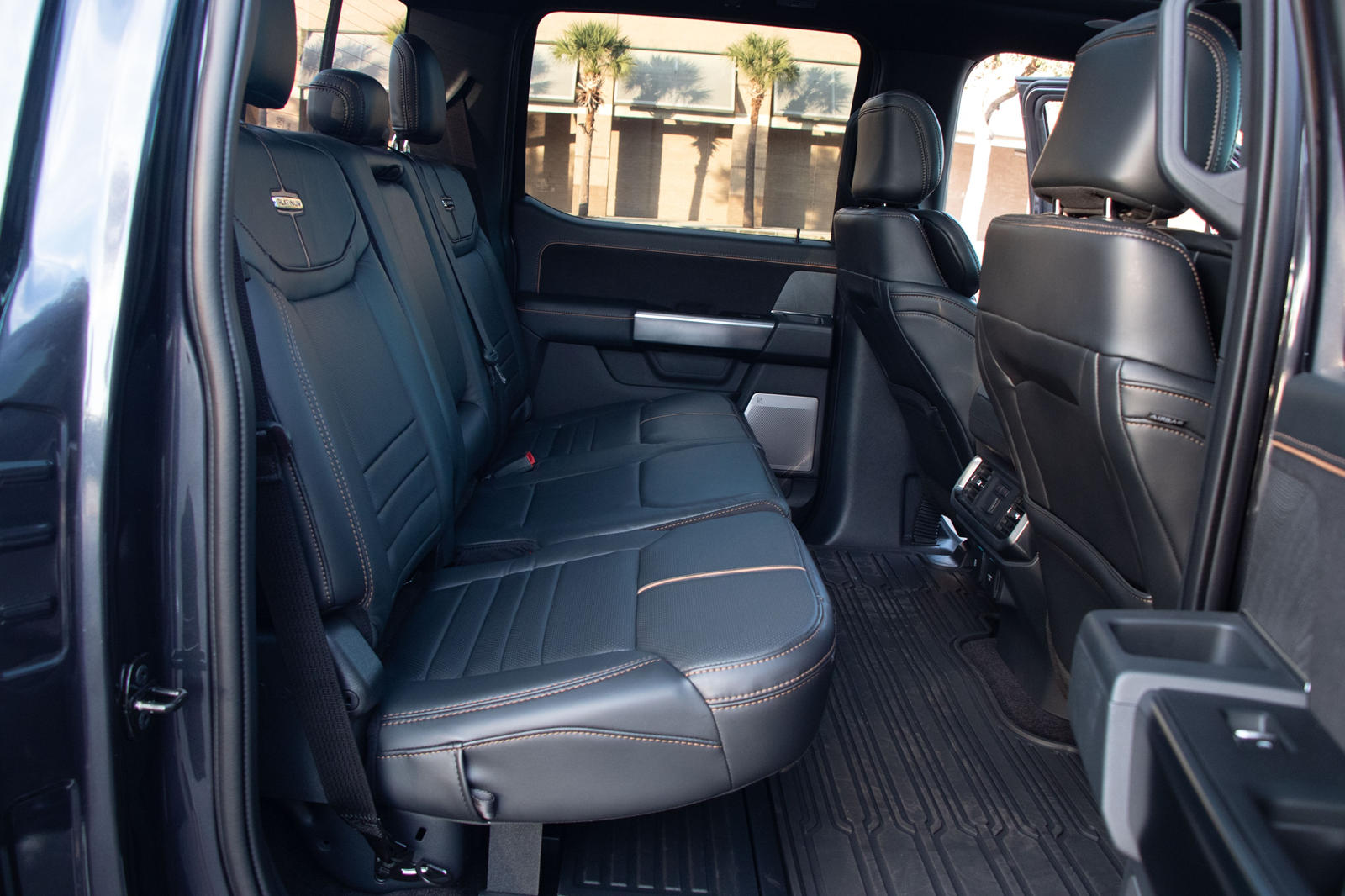
Something like a $65,000 truck. LOL
Eh... we have to thank CAFE for SUVization of the world... the stupid trend is slowly trickling over the pond and it's getting more and more annoying... I do hope that either US will fix CAFE or UE will regulate to have smaller cars (usually hatchback is enough and wagon for bigger families)... or ideally both.
That being said, I'm sure these cars will see some adoption in dense/regulated historic neighborhoods. Manhattan has had tolling debates for the last decade - on current trajectory I'd expect lower manhattan to be restricted access by the end of the decade.
Don't buy a small car, don't walk, don't bike, don't use a scooter, because everyone else is driving large vehicles. Awesome.
Agreed, there's a place for all forms of transit. I think the argument that the parent commenter was making was that we already have the density in many places for vehicles of this type make sense for residents, but the barrier is that road infrastructure is built to prioritize larger vehicles, making these vehicles unsafe.
In places where safe infrastructure exists, families frequently plan their lives differently, and I know many (with the means to choose freely) who get by with carshare, good transit, cargo bikes, etc...
The viable solutions are 100% to encourage the kind of alternatives you listed to give people meaningful tools to decrease overall single family car use of any kind.
I read their comment as encouraging city-specific measures. They specifically reference "urban living", "human-scale living", or slowing down vehicles for "in-town trips". I agree that use-cases exist for larger vehicles, as even in the densest city centers delivery vehicles continue to need access. IMO larger vehicles need not be the vehicles we optimize for, or even allow at all times, in city centers, where such vehicles aren't needed by most residents.
> [...] 100% to encourage the kind of alternatives you listed to decrease overall single family car use, not try to force everyone to change car designs [...]
Honestly I'm thinking of this more like a large cargo bike, and less like a car. It's like a Canta (https://en.wikipedia.org/wiki/Canta_(vehicle)) in the Netherlands. It's not meant to serve the same purpose as today's cars, and we probably both agree it would feel unsafe to drive one amongst fast-moving traffic. It fills a gap in the transportation spectrum that's well-suited to certain areas, and I believe we should devote more infrastructure to vehicles which match the needs of an area, which I don't believe is always full-sized passenger vehicles.
Meanwhile, cargo bike sales are climbing steadily.
I’m not arguing that the US style suburb is the best we can do, but you’re not going to come up with anything better that really sticks without understanding why it’s built the way it is.
For people who don’t have kids I don’t feel like I can even explain it to you. Nothing can prepare you. You have to experience it.
It’s also important to note that not all cities are kid friendly. Some are places I’d never allow a kid to go, with open air psychiatric hospitals on the street and people passed out everywhere on drugs. Of course this is a different problem that has more to do with incompetence and corruption in government and non-profits.
A 30mph crash entails order(s) of magnitude less force. Could look like a tram. Smaller seats with less padding become practical.
If we do decide we need a second car as the kids get older, this is _exactly_ what I want. No gas stations. Super easy parking. Low capex and opex. Awesome on all fronts. (But as a second car.)
Most modern cars are very quiet. There is an alley behind my house, I mostly hear the stupid whirring noises that electric cars make and large trucks, I don't even hear modern ICE cars go through the alley. The safety systems for blind people in electric cars are much much louder than the exhaust of a modern car.
I would love to see small cars like these come into more widespread use in the the U.S., with carsharing programs providing cars as needed for highway driving. This change could come much more quickly than the large-scale urban design improvements we will eventually need to totally reduce reliance on cars in cities.
As it is, many city streets are too fast for these cars to be comfortable. I would love to see a general slowing-down of vehicles in US cities and towns that makes city vehicles like these practical, and, on top of the obvious safety benefits for all the cities that claim to have “vision zero”, I don’t think it would come with many downsides. Even outside of a city center for in-town trips of a few miles, 28mph is really quite fast—a matter of a few extra minutes compared to current dangerous city speeds.