Sadly, they very much are left/right specific (unless you topologist consider that you can turn one of them inside out to flip its handedness, but then the stitching seams are now on the outside!).
They are a little on the thin side and though I bought like 10 pair, they slowly but steadily wear through and need to be tossed. I wish I could say the lefts wear as often as the rights but I appear to walk in an asymmetric way.
Further, finding replacements that match has been difficult (I would like them all to match so that left/right is the only factor in pairing them). Though I have bought the same brand, trying to get the matching length has been surprisingly hard. I'm not sure why.
When I find them again though, I'll order at least 20 pair this time.
i think it's the brick and mortar retailers that never caught onto the idea.
RIP strangely named store that carried emergency mothers day gifts for all these years.
First, Americans are mostly coffee drinkers, not tea drinkers. The coffeedrinkers are mostly using coffee machines that heat the water for you, so you don't need a kettle to do it. This is true from the low-end $30 drip machine to multi-thousand-dollar espresso machines.
Second, America is on 110, not 220. Kettles in the UK do boil CRAZY FAST, but the electric kettles I've used in the US aren't really any faster than using a stovetop kettle. American tea-drinkers often have those.
Most people in the US don't make tea much, and just use an automatic drip machine or a keurig for coffee, so of course they don't have a kettle.
We have one, but it's because we drink more tea than most Americans, and since we have it for that, it's space-saving for me to also use it for pourover coffee (rather than having a drip machine).
At least, I can totally see how it would seem as such to anyone from the UK (and most of the world).
For my part, despite working at it for years, I still don't really like cheap tea (the stuff I could actually afford to drink every day, and that can be found without seeking out rare-in-the-US tea shops or ordering online), though higher-end tea is really good.
We drink a ton of iced tea, but that's easily made on the stovetop in a large pot, and can be bought in gallon-quantities at the grocery store. Having a kettle doesn't improve iced-tea-making very much.
[EDIT] Part of it may be that we drink on-the-go more than other countries. Just a guess, but might be true. Iced tea and coffee (hot or cold) are both much better for that than hot tea—one doesn't usually make a thermos-full of hot tea and drink it straight from the thermos, I'd expect (but maybe I'm wrong?) but that's normal for coffee.
I forgot about iced tea, but I'm under the impression that how popular it is depends on the region of the US you're talking about. I don't see a lot of people drinking iced tea in my area, and I don't think I've ever seen anyone make it for themselves.
Sweet tea is quite regional (the South).
Iced tea's popular in much of the country, but I think making it at home has dropped off just like making many other things at home has (how many people make their own stock or broth anymore?). These days, a gallon of store-brand iced tea is just about the cheapest drink most grocery stores stock—barely more expensive than making it at home, really, so why bother?
Old-school restaurants, and especially diners, may have a mid-sized glass jar[0] of sugar with a metal lid and little metal flap on it (that flips up if you tip it, allowing some sugar out) left on the table, mainly used to sweeten coffee and iced tea. This is getting less common, in favor of little trays of sweetener packets, but you still see it sometimes. Used to be very common, 1990s and earlier.
True sweet tea (huge in the South, i.e. the part of the country that seceded during the Civil War, but much less ubiquitous outside it) is incredibly unhealthy. It contains more dissolved sugar than is easily achievable in room-temp-or-lower water/tea, by adding it during the boil, same as how you can super-concentrate sugar in water when making simple syrup (though it doesn't go that far) and it retains that sugar even when it's refrigerated. Sweetened iced tea has a much broader range of sugar levels, and may be relatively healthy, with only a little sugar, or very sugary.
Outside of the South, you'll often get sweetened iced tea if you ask for "sweet tea". It's fairly uncommon to see the real thing in Northern or Western restaurants. This sometimes leads to confusion, with non-Southerners going to the South and ordering sweet tea and getting something offensively sweet compared to what they're used to, or Southerners ordering it elsewhere and being disappointed with what they're served.
[0] Diner-syle sugar pourer: https://img1.etsystatic.com/040/0/6766475/il_570xN.635748831...
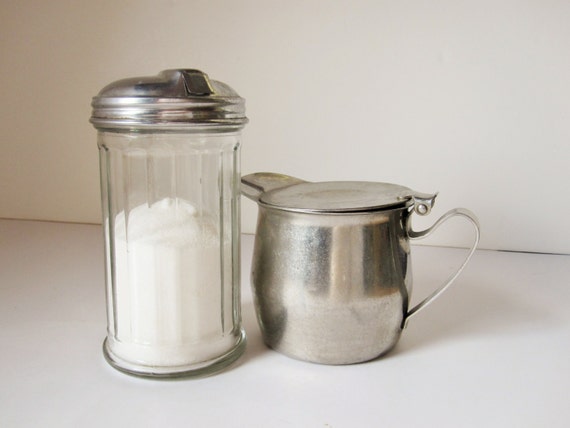
Note: this does not apply to bottled/canned teas, which are usually close to "half and half" in sweetness.
Most restaurants here serve soft drinks from a fountain rather than individual cans/bottles, so refills are free. If a restaurant uses individual containers for service, you will have to pay for refills. However, iced tea has free refills everywhere I've ever seen.
Men drink (black or lightly sweetened/dairied) coffee or "energy drinks", women drink espresso-based mostly-milk drinks that don't taste like coffee, or tea (often green or herbal, and also often mixed with a bunch of milk or sugar, unless herbal). Not that there isn't plenty of overlap, but that's how the landscape looks to me, to call out the two big bubbles on this particular Venn diagram.
I call those "milkshakes".
Curiosity got the better of me and I had to look this up. The US is the 35th most tea-drinking nation! And overall, there are slightly more male tea-drinkers than female. At least according to this site:
https://teahow.com/is-tea-popular-in-america-what-tea-they-d...
Also, looking at the age breakdown of US tea drinker perhaps explains the difference in our experiences. 18.5% of people in my age group (50+) drink tea. 46.2% of those in the 25-49 year age group drink tea.
I think you're right. There is a table showing the popularity breakdown of the different types of tea, including herbal, but I think that's the global breakdown, not US.
It didn't provide a stat for it, but the page does remark that the majority of black tea consumed in the US goes to making iced tea.
It sort of feels like a generational flip-flop thing to me between tea and coffee.
They're easier to find these days but still rare. If you ask for a hot tea at a restaurant, you'll often get a suspicious-looking teabag that has spent at least 6 months in the cupboard (iced is more available). I'm sure you can guess at the quality of most of the teas in an American grocery store; I usually wind up ordering from specialty tea shops instead.
("sun tea" is made by sticking a big glass pitcher or jar outside on a warm sunny day, with water and teabags and maybe some citrus slices in it, and waiting for it to become something resembling tea, which you may drink at its natural somewhat-warm temperature, drink over ice, or refrigerate).
Elsewhere in the thread voltage difference are brought up—that's probably what does it, typical US wall service is far lower-voltage than in Europe. That, and I've definitely had electric ranges in the US that were incredibly slow to boil water, so that might be a factor. Gas, though? At least as fast, depending on the quantity. (I hear induction electric is even faster, but have only used those a very little bit at a couple AirBnBs, so don't really know, first-hand)
The origin story for the boiling water tap is powdered instant soup, which isn't quite instant without instant boiling water... :)
There is no way an electric stove is quicker than a gas stove. I did a quick google search and a standard gas stove on high is 12,000-18,000 BTU, which is 3.5-5.4kw.
It's a one-hour-plus video of someone literally boiling water, so there may be issues with the testing setup that I skipped over.
Don't know where the heat is being lost, but an electric kettle is significantly faster despite its lower energy.
On gas? Around the sides of the vessel, bound for the ceiling.
Kind of: 240V is fed into homes (along with a neutral), and gets split in half.
Most receptacles are 120V for most appliances, because it gets the job done. There aren't many appliances that need more than that. The two main ones that do have 220V plugs are clothes dryers and kitchen ranges (hobs/ovens).
If you want a kettle that boils faster change your NEMA 5 socket (and breaker) that does 120V (at 15A or 20A) for a NEMA 6, and get an UK/EU kettle and change the plug.
* https://en.wikipedia.org/wiki/NEMA_connector#Nomenclature
(Not sure how up to code any of the above would be.)
What's not relatable to me is European (I assume?) reports of boiling water in an electric kettle, then transferring to the stovetop. My kettle's not meaningfully faster than the stovetop, and is a lot slower for quantities past a liter or so—it's only worth having for the other features. I assume that's the voltage difference making itself known.
It wouldn't be the same wattage: it would be double the wattage.
The wiring can handle 15 or 20A, and at 120V that's a practical limit of 1800W. You keep the amperage limit (no cabling replacement needed), but 240V would allow 3600W.
As a weird American I have a 1970's electric water boiler I still use that is incredibly fast at boiling water. Passed down to me from my grandparents because I enjoy tea and hate coffee. I really hope it never dies because it works way better than the plastic modern one I had in college.
But on the topic of socks: Hitting my 30's pushed me to finally invest in nice longer lasting socks. Spending $120 over the last few years on bundles of various wool socks until I found ones I like was completely worth it. Although learning to properly care for wool socks was a process. They probably aren't for everyone, but for people that like thick longer songs I love my People Socks. [https://www.peoplesocks.com/]
There can be. Typically fancy athletic socks with more fitted toe areas than normal.
I've tried all kinds of socks.
long journey got me: Darn Tough socks style 1403
https://amazon.com/dp/B000XG34G8
Cushioned, no blisters, no bunching. You get warm, dry feet on hot and cold days. They last a long time.
I’ll leave the kettles alone because that ground has been well trod (hopefully, using the best socks).
However I am concerned that you did all this sock research and somehow did not end up with toe-socks, which of course have left and right socks (unless you are the kind of maniac who would wear a sock inside out, which I gather from your studies that you are not).
Might be one of those regional thing.
In the mean time, try searching for Darn Tough, Silverlight Socks or Smartwool for boot socks.
The longstanding English manufacturer Bridgedale must have been taken over by MBAs recently because it is being marketed heavily. Their socks may be fine; I don't know.
Then there is Injinji, and other two-layer (inner and outer) and toe-separated sock systems more generally. I like Injinji's sport sock (once I got over the look of my feet in socks with five separate toes). Injinji has a range of socks made from different textiles.
All of these use wool/synthetic blends, with the synthetic usually some form of nylon. Silverlight's nylon is coated with silver for antimicrobial properties (reduced stink). I have just placed an order for a five-pack. (I also spend up to 10.5 hours a day on my feet in boots.)
For non-wool, thinner socks I use Drymax, which are aimed at the running/athletics crowd. I've found them very durable (used them quite a bit for tramping (NZ-ish for bushwalking/hiking) and very easy-care. They are not left-right differentiated though.
I got fed up with poor socks a few years ago and embarked on a project to try to find the best, or at least consistently decent, work socks. That's work in the sense of stomping around in the workshop or outdoors, in heavy duty boots, spending most of my day standing up or moving around -- not work as in sitting at a chair for 8h while wearing mildly uncomfortable but aesthetically appropriate footwear, occasionally shuffling around a carpeted floor, etc.
Anyway, that was basically a despairing effort. Unsurprisingly, everyone claiming to have the best socks did not, in fact, have the best socks.
I did end up with a stack of hard-yakka bamboo socks, which were surprisingly comfortable when worn with big heavy blundstone boots, but about a year after discovering (and building up quite a large collection) I moved to hard-yakka boots, and then found out that the combination of their bamboo socks with their boots would result in a very uncomfortable bunching of sock around the ankle.
Bonds - very popular purveyors of socks and daks and other necessities here in Straya - have some work socks that I've since settled on, though a top-up purchase made a few months ago suggest they've changed their recipe from ~18 months back, feels like a higher ratio of nylon to cotton, but alas no record was maintained of the first tranche, so I am wary, but so far satisfied.
(For actual day-job work socks, Bonds here also do a range of basic-black that come in 3-pair sets, which have tiny lines of primary colours along the toes, red, green, blue, etc - originally I thought that was quite twee as it would help maintain pairs, but in practice it just feels like a way to shift more product - as there's no reason, beyond obsession, to match 'miscoloured stripe' pairs, but when one of a pair inevitably expires, you're then left with the difficult decision of committing fully to going pairless in the sock drawer, or throwing away a perfectly fine sock out of sympathy.)