2. Filibusters are not in the Constitution, weren't possible for decades after it was signed, weren't used for half a century after it was signed, and didn't become the "sixty votes required for anything" tool they are today until 10-15 years ago. The founders had nothing to do with it.
https://en.wikipedia.org/wiki/Filibuster_in_the_United_State...
IMO it all comes down to the insight that the opposition party has nothing to gain from cooperating. If something good gets passed, the majority party gets the credit. If nothing gets passed, the majority party gets the blame, regardless details how that outcome was achieved and what role the minority party played. So blocking everything is the best strategy. IMO, it's disgusting to have politicians put party over country, but here we are.
The ones who represent me are highly skilled, very experienced, and have the seniority to ensure my hometown gets it’s fair share,
The ones who represent you are lazy, entitled scammers who should be prevented from fleecing my hometown by the imposition of term limits.
"The ones who represent me give me feelings of schadenfreude over how they deal with the other party and people"
"The ones who represent you give me feelings of angst over how my party is treated"
Now legislators are accountable to corporate donors, not their constituents. It's easy to track which legislators provide a good ROI. There's more to it than that, but those are the major causal events that lead to the change in legislator incentives.
A chart of filibuster usage over the past ~century speaks for itself: https://bit.ly/3mL6IOU
And that's not even fully up to date: the 2019-20 session ended with 298 cloture votes and the 2021-22 session with 289, per https://www.senate.gov/legislative/cloture/clotureCounts.htm .
> the first filibuster was 11 years after the Constitution was ratified
Sure, whatever - your citation is "wikipedia.org/wiki/Filibuster_in_the_United States_Senate" and mine is "wikipedia.org/wiki/Filibuster#Senate". The exact details don't matter: the relevant points are that it's not a mechanism created by the Constitution, was not common in the lifetime of the Constitution's drafters, and has massively different effects on the governance of the country now than it did in the 20th century, much less the 19th or 18th.
It's really a bipartisan agreement to defer to Senate Republicans on everything controversial, and to let them take both the blame and credit for it. Democrats are happy with that because when their votes don't count, they can pretend to support anything. When Democrats lose, it energizes their base. Republicans are happy to take credit for economically liberal and nationalistic legislation. And for the legislation that just rewards the wealthy for being wealthy (say, bailouts), movement right-wing and libertarian Republicans can vote against it (and they're mostly in the House) while small consistent groups of Democrats can cross over to make sure it passes anyway.
This is friends cooperating.
Yes true, but it didn't feel widespread then. It was mostly just people who follow politics closely. Now it's nearly everyone.
People forget how quickly Carter screwed up the economy.
Most of the journalists who remain popular tend to be those who are more radical/on the edge of cultural which is how they remained relevant beyond their era so it's easy to assume those people are representative of the population or even the educated class.
The oil shock and stagflation began under Nixon/Ford, and stagflation itself was spurred by Nixonian policy. People seem to forget this quite often. Carter was only president during the last 3 years of the 70s.
Volcker was appointed by Carter and made things really bad for a brief time, but those 20% interest rates ended stagflation, leading to Volcker's reappointment by Reagan.
Biden Abruptly Pulling out of an Afghanistan, was a complete utter disaster. Let’s blame someone else!
Carter made mistakes. His major economic political mistake was to tell everyone that they'd have to basically take one for the team. And we had 12 years of Republican presidents after because of it.
Nixon was just a major chump in many ways. Moreso than almost any other president.
Even a simple look at the timeline shows that is wrong. It doesn't even stand up to a cursory look at the evidence.
Reagan massively escalated the Cold War. There is literally a heading on his wikipedia page entitled "Escalation of the Cold War".
The Soviet Union fell after Reagan left the oval office! The 1989 Revolutions all happened after Reagan left. The breakup of the Soviet Union itself happened well over a year later.
Reagan left the US in bad shape. He slowed down inflation but massively expanded public debt. He left Bush such a crappy economy that it immediately entered a recession that resulted in him losing his reelection run.
Not only that, he started the decline of the US economy. https://www.piie.com/sites/default/files/styles/slimmed_natu... Before Reagan nominal GDP growth was high, after the US turned hardcore conservative, GDP growth has been poor.

I have no idea how Republicans managed to brainwash people so badly that they don't even look at the most basic evidence.
It can really be no other way, short of stuffing all the parliamentary rules like that into the Constitution.
Simply on the basis of accomplishments, whether for good or bad, the founders rank amongst the greatest people to ever exist.
But the writers of the constitution in 1788 wanted a strong one because the existing weak one sucked.
One could squint and say states matter today, but that's just admitting a need for glasses. They are ghosts of what they were, and increasingly need to be retired.
It will be nice when we put to pasture the policy-as-experiments across states for things that are clearly universally demanded: finance, health insurance, women's medical care, education, defense, gun control, decreased corporate control of the food supply, transportation, environmental regulation, and so forth. It's amazing how much the modern GOP has pushed folks towards this, may they continue their business Republican-led shenanigans to unite the country and encourage progress when otherwise we would be slovenly.
Why is this the case? Duplication of fixed costs are expensive.
Let's get rid of these crufty overindulgent home-owners-associations-on-steriods and federalize already.
(paragraphs 1, 4 serious, the rest in jest)
There's ~150 million people that think the opposite should be done.
The problem is that there are too few representatives and so they can build collations that explicitly exclude your interests while still representing you.
I think it would be much better to have some dual-system to send representatives to congress where you could either Vote or Petition to get a representative. If you Vote its basically the same as currently. But if you Petition you and ~150k other people do not get to Vote but the person you're petitioning for is your representative.
Modern capitalists prefer seasonal labor for agriculture. They don't have to feed/clothe/house people year round, and have no personal investment. Seasonal migrant agriculture labor cheap and easily exploited, with little legal protection. Slaves, like domestic a nimals (reprehensible as that simily is), must be treated well enough to keep working productively. There is no such need with migrant labor. If they are abused or killed it is easy to sweep under the rug. There'll be new migrants available next year.
NOTE: I'm not saying slavery is good, or even better than migrant labor. They are both highly unethical if you consider how corporations treat migrant labor today.
…except slavery still exists all over the place in industrialized countries? There’s nothing incompatible between industrialization and slavery, as myriad historic and contemporary examples have shown.
https://www.walkfree.org/reports/global-estimates-of-modern-...
2) Migrant labor is the replacement for slave labor in the USA. These are workers who do not legally exist and thus are subject to the worst of exploitations by employers and criminal concerns.
3) Human beings of all races have a pretty bad record of how they may treat other races/tribes/outgroups. Genghis Kahn killed and raped so many people that he altered the genetic profile of humans. African tribes routinely enslaved each other. Arabs took white slaves. People can be dicks. The list goes on and on: cruelty is a part of the universal human condition.
As bad as the USA, it's the only country to go to civil war to free slaves of another race, even if that wasn't the complete reason for the Civil war.
Even at that, the steam engine was in the process of replacing slaves for many tasks. There were just a lot of tasks left that the steam engine wasn't yet practical to replace slaves - but that would have happened anyway.
"free slaves of another race"? Some of those going to war were people of that race. On both sides.
This is also a bit ahistorical as Lincoln was willing to allow slavery in order to keep the union. It was really the south who chose to go to war in order to guarantee slavery would stay; the north chose to go to war in order to keep the union. The slavery issue was used by the north, initially, to keep the anti-slavery UK from siding with the south.
Of course there was some lead up to that but the actual flashpoint is that the south started it and they didn't do so to free northern slaves. Northern congressmen were not pushing for any bills that removed slavery from the south and etc; there wasn't an imminent (i.e. during Lincoln's presidency) existential threat that the North would end slavery in the South except the one the South manufactured.
Yeah, that's even better than what I stated.
And I forgot to mention that some of those slaves were blonde-haired and blue-eyed with skin lighter than most Caucasians. Maternal inheritance of slavery rule. https://rarehistoricalphotos.com/white-slave-children-photog...
It's weird that you think that they had it better than migrant laborers.
An (immigrant) worker gets none of that and might barely be able to get by even without counting the healthcare (in the US).
Sounds to me like a slave might indeed be cheaper in some/many situations than a minimum wage worker. I'm not convinced either way.
A slave also needs more management. Migrants and free workers will get themselves to the job and in general work. A slave has no motivation to work harder so you need some form of "slave driver" to keep them working. If you try to move your slaves around like migrants move, then you need a manager to go with the slaves to keep them working - migrants manage themselves.
A slave is cheaper if you have a lot of repetitive, low-skill, year round work that must be done by hand. However most of that type of labor is easy for the industrial revolution to automate.
And just notice how often the writers mention not having enough food, or basic clothing. Then get back to us on the idea that slave owners would have taken even minimal care of slaves.
You’ve written how you think it ought to have worked. But that’s not how it actually worked.
Many types of slaves existed and still exist in the history of humanity.
The slaves around Julias Ceasar probably had a different life than the average native Columbus slave (they where almost all quickly worked to death genocide style and he was a total sadist).
Fredrick Douglas didn't have motivation to treat slavery fairly either. (few writers of the day did - thus making it hard for historians to figure out the truth, though in this area there is a lot more data than historians studying something of several thousand years ago).
You might want to check on accounts from e.g. Haiti where slaves' lives were considered very cheap and that's precisely why they were used for the dangerous labour around sugar production.
> Fredrick Douglas didn't have motivation to treat slavery fairly either. (few writers of the day did - thus making it hard for historians to figure out the truth, though in this area there is a lot more data than historians studying something of several thousand years ago).
How does an ex-slave treat slavery "fairly"? He lived that shit, he knows how despicable it is. What other side is there to present? The economic interests of the slaveowners?
>How does an ex-slave treat slavery "fairly"? He lived that shit, he knows how despicable it is.
He can exaggerate how bad it was for one thing. It is well known that people's memories are not exact to what happened, and it is likely he would remember dramatic incidents and not the day to day reality.
Try reading "uncle tom's Cabin" - a book that was written with the intent to start the civil war to end slavery. Despite that intent to presents a picture of slavery that was in general much nicer for the slave owners.
Don't take anything of the above as statement that slavery was good. Only that it wasn't in general as bad as what you see on TV.
If they were too harsh with slaves they'd spend a lot more time and energy managing their behavior. Even in prison privileges are given so they can be taken away. Slave owners probably treated their slaves well enough, in aggregate, that they were capable to work productively and did not have immediate cause for revolt. The slave owners had to live in close proximity to their slaves after all.
The Hollywood portrayals of slavery as essentially unrelenting cruelty and sadism don't make sense, except for on TV. Any farmer would have known that you don't get the best work out of your horses or mules by abusing and starving them. There's a knee point of optimal treatment for all labor arrangements. The EVIL fact that slaves were property of their masters does not change this.
Read the history of the cotton gin and then how steam power made larger transportation easier and expanded populations to consume cotton and tobacco. Industrially produced guns and other tools helped "manage" slaves and later prisoners.
Post-civil war, industrial prison system instituted chain gangs to recreate "legal" slavery and forced prison labor still exists in many states.
The US south ended slavery with the civil war, but most places in the world had a peaceful end. It wouldn't have been peaceful if it was economical as the rich would have fought to keep it.
https://en.m.wikipedia.org/wiki/Confederation_period. "...could not accomplish anything independent of the states. It had no chief executive, and no court system. Congress lacked the power to levy taxes, regulate foreign or interstate commerce, or effectively negotiate with foreign powers. The weakness of Congress proved self-reinforcing, as the leading political figures of the day served in state governments or foreign posts. The failure of the national government to handle the challenges facing the United States led to calls for reform and frequent talk of secession".
The founders wrote reams upon reams discussing exactly what they wanted to do with the constitution and how they intended each and every bit of the constitution to work toward that goal. The intent was basically "we need just a little more centralization in order to deal with the truly national issues."
The government they created to replace the articles of confederation was weak by the standards of the time let alone modern ones.
There's a reason even we don't tend to push a US-style system on fledgling democracies, when setting them up. It's got well-known, grave, fundamental, and avoidable flaws.
The system is broken in ways that prevent fixing that very brokenness. We know exactly what's wrong, but can't do anything about it. You'd have to get a whole bunch of people whose personal power is tied up with the status quo, to, all at the same time, vote to weaken that power and the power of the organizations that put them where they are. Or you'd have to get at least some of the states that benefit from the brokenness to agree to weaken themselves. Neither is likely to ever happen—short of some very risky and probably-bad-rather-than-good developments that are more likely to end in authoritarianism than an improved democracy.
The supermajority of the electorate in the smaller states might be willing to exchange future political influence for sufficient wealth or some other compensation.
The vast majority of things the government touches turn to shit, including things with wide bipartisan support. How does making government able to do more, faster, fix that?
Overtime I've really begun to see this as propoganda that Reagan invented based on little to no empirical data. I'm not convinced that the government is anymore dysfunctional than any large corporation. The belief that the everything the government touches turns to shit does far more harm than good; and furthermore gets in the federal government's way of actually solving problems. The federal government may have a problem with incentives (like any corporation), but it's hard for me to believe they are inept. It ends up being a self fulfilling prophecy - the government tries to do something, a hundred road blocks are put up for fear of ineptitude, then when the government is slow due to said roadblocks, they are called inept. When those roadblocks are removed - for example in the vaccine distribution of 2020, it's clear that the government is capable of good outcomes. Millions of highly controlled and sensitive vaccines were deployed across the country in only a couple months under an administration that nearly became hostile to its deployment.
If you'd please review https://news.ycombinator.com/newsguidelines.html and stick to the rules when posting here, we'd appreciate it.
Robust systems are made up of interacting parts that tolerate partial failures. The reason the U.S. economy as a whole remains strong is because its least efficient businesses are continually failing, and their resources get reabsorbed by more competitive parts. When this ceases to happen (eg. the "too big to fail" banks in 2008, "what's good for GM is good for the country" in 1953), the economy as a whole becomes much weaker. There is no similar ablation process for the U.S. government - lately, there hasn't been an easy way to let parts of it fail while still preserving the government as a whole. This will likely lead to the collapse of the whole government, which is unfortunate. It can't avoid the dynamic common to all systems: the way to avoid total failure is to tolerate and adapt to partial failure.
All of this is to say is that even though large corporations and large governments are alike, the most efficient solution for a corporation (bankruptcy) is not a good solution for government and so despite the inefficiencies we are sort of forced to accept them as the engineering realities of the situation. I fully understand large governments have large government problems, I just don't agree with the notion that having a smaller government is a solution and that the small government meme has largely been toxic to the detriment of the middle class.
In theory democratic government is the check on this - if the government wastes too much money, the electorate is supposed to vote out their representatives and elect new ones that will cut the budget. (In this sense, Reagan-style conservatism is working as intended). In practice, this rarely happens, largely because the average voter is terrible about judging opportunity cost, and every expenditure seems worthwhile in a vacuum.
This is a bit like saying that the goal of government is GDP per capita. Yes, both are important, and both are indicators of doing a good job at something, but what a business does is the most important thing: how does it adapt to reality and make sure it is always doing something useful enough to pay for?
Government doesn't necessarily do things people want to pay for, as then it might do much less stuff, but people do want to feel as though they're getting value for money from their taxes, and that the government isn't spending so much that taxes go up vastly and their currency is inflated so much their careful savings are wiped out.
Why is the longevity of a nation more important than the values it stands for (as laid down in its constitution)? One could argue that it's better to have a great constitution that treats its citizens equally and fairly, even if the nation is short-lived and eventually disintegrates into smaller nations.
The interpersonal equivalent of this would be "It doesn't matter how great your relationship is if your marriage is dead". I'm not sure many would agree with keeping a marriage alive at any cost.
Relatedly, I'm not sure if the GP's Scalia speech actually gets the causality right. I think we could make a good case that the United State's dominance and longevity comes from two oceans, fertile cropland, and advanced technology, and form of governance is a mostly-irrelevant sideshow. You could plop a different government down in North America, and as long as it had adequate incentives for individual innovation, it'd still end up a superpower.
OSHA has no teeth (they are just a nuisance to the scofflaws)
FTC is underpowered
EPA needs shut down
FDA is on record for enabling very harmful medical devices
I remember something about Boeing colluding with regulators to put people in harms way.
I could hop on a search engine and dig up a tome-worth of completely unacceptable shit from the last 40 yrs in this regard.
Power abhors a vacuum. I would rather that power be in the hands of the citizen votes.
The fact is that all these government agencies are preventing specific harms. Throwing them out because of some vague “big government is bad because it might turn into a tyrrany later” isn’t an argument that the harms being prevented don’t exist. It’s a non-sequitor, like saying the sky is blue when someone complains about airplane noise.
>employed by American conservatives ... to deprive the federal government of revenue
which appears to refer to federal level. The general trend of federal receipts have been fairly flat above 15% for decades (except during great recession circa 2009), and the spending slightly different rising a bit above and funded by debt and/or inflationary effects.
My takeaway is here the beast has not been starved, although the beast is spending more of our children's future incomes in the form of increasing debt.
https://stats.areppim.com/ressources/us_spendxrevxgdp_29x10_...
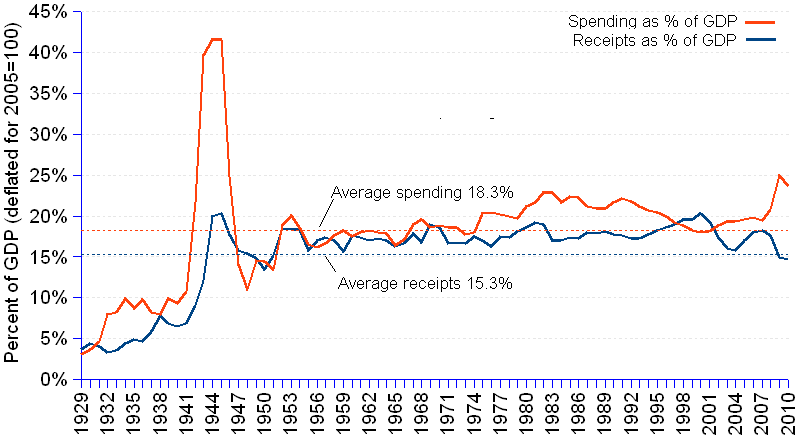
Spot on. Yet we continue to insist on using the system in a way (i.e., overly strong fed gov) that it's not good for. This isn't a Dem or Republican issue. It's history.
And the more taxes Uncle Sam collects, the stronger and more bloated he gets. At some level we need to come to terms with the fact that we're using a screwdriver as a hammer. That doesn't work well. Ever.
Yet nobody seems to be saying the answer is going back to horses and written mail in the name of making our government fit our lives better.
No one is suggesting horses or written email.
It's a simple understanding of history, and a practical and honest observation of how dysfunctional things continue to be. Yet we keep pushing that the answer is more of the same? That's naive. That's not sustainable.
I am not convinced in the "go back to the way it was designed" argument, since you either have to cherry pick the aspects you like, or advocate for reversing women's suffrage, emancipation of slaves, etc.
As soon as we agree that the founders got some things right and some things wrong, there is no more argument that they were prescient and we should revert to their designs.
IMO better to take stock of the current situation and seek changes based on their merits today, independently of whether they align to the ideas of 250 years ago.
Are they really - or are they pretty obvious to anyone who casually glances at the headline of the policy, but the consequences are a problem after the next election. If you win you can always just blame the other side and if you lose you can blame the other side as well.
Given how difficult it is to predict policy outcomes this is probably a good idea. Even if a collection of policies are good on the individual level there is no way to figure out if the interaction will be net positive, nor if the cost of remedy reverses the calculus.