The “vocal parts of the community” were not against the UI change. For the most part, being the ones who were charged with putting in effort to make this improvement for free, they were pointing out the significant technical challenges it involved, and they couldn’t find someone to volunteer their own personal time for free to take on this challenge.
As Gnome has made massive strides towards simplifying its codebase, these changes become far more achievable and reasonable (click through to the developer changes page and you will see GTK4 has deprecated something like 20 possible file picker classes, in favor of 3, which provide equivalent functionality).
Of course, the same people who complain but are unwilling to either put effort or money towards fixing these supposedly deal breaking problems, have also spent the last 2 years complaining about the code and architecture cleanup effort Gnome devs have made to make it possible to fix those problems.
Users like me who got annoyed by never being able to easily select the wanted image (when in a gtk app), for many many years now, had no insight into any architectural changes or code cleanups of gtk4. So there weren't any complains from this group there.
This is the typical "everyone is against us" you often hear from the gnome side. It's a shame to read this under such a nice release, which has only positive changes as far as I can see, it really seems to address a lot of the criticism in a good way.
I also saw some complaints of this form. If I recall correctly they were non-contributors complaining that Gnome devs were dedicating too much time to refactoring and deprecating APIs and not spending enough time implementing features that they wanted.
I'll give you that Gnome developer communication often comes off as defensive, but as an outsider I'm also shocked at the volume and tone of complaints they get -- I doubt I would be able to put up with such toxic users for very long.
Ever since that experience I’ve become highly sympathetic to open source devs of all stripes. The only partial exception are blatantly corporate projects making blatantly corporate decisions (eg React/Angular or VS Code telemetry)
But as part of searching for some contribution to make I went through a whole list of bug and feature requests.
And while it’s almost impossible to prove that the people are the same, what was very evident was the sense of entitlement displayed by both groups.
Frankly, even as someone who isn’t part of the Gnome community and was simply looking to maybe fix some language translations, the toxicity from the people who didn’t contribute anything was overwhelming. It’s fair enough to complain about something not being up to par. But that very quickly transforms into claims that the developers have an evil agenda.
The file picker bug situation and the bug report handling was just horrible (the quotes in the thread above show that quite well), the project has only itself to blame for the negative attitude it got from that. Let there be praise that this situation might improve now (will take ages until GTK4 is everywhere, probably never), not use this situation to bash the users that took the time and effort to give their feedback.
Look at the attitude shown towards the constant request for implementation [1]:
> Got patch? Share. Gotn't? Just CC and be silent.
Really facinating thread... I read it every year to remind myself that my brother was born that year and now, 18 years later he's an adult so he's allowed to have beer and use a filepicker in GNOME
Indeed. This hostile attitude towards criticism of lack of basic QOL features, is what's keeping Linux at ~2% market share, away from the average users, and we'll be perpetually stuck in "$CURRENT_YEAR is finally year of the Linux".
Hate Windows all you want kids but if you look at independent online tech related forums where people ask questions or problems on Windows, the answer is always a solution and never "RTFM!"
KDE should be commended for acknowledging and fixing some of the usability issues highlighted by the "Linus Tech Tips Gaming on Linux challenge" fiasco form 2021, when most of the Linux community went full neckbeard on him telling him he shouldn't use Linux if he doesn't know how to use the terminal.
Not so much with open source, where the one answering has (potentially) just came back home from work and is just taking the time and energy to do it from their own free time and goodwill while they sip a beer and think about what to make for dinner in a couple minutes.
Paid support guys from Microsoft on the other hand: No offence to them, but they're useless.
No they're not. Read my comment again. I wasn't referring to proprietary forums owned by the corporation who makes the platform, but to generic public tech forums that aren't owned by any company.
Windows users tend to be way more helpful than Linux users over there.
I guess one explanation is that Windows users are immensely many more, so the small portion of users who are generous enough to contribute in those kinds of forums will also be formed of more varied attitudes and skills.
In cases where I had ti seek forumn help in windows three common scenario were: 1. Well known bug with a simple fix that user has to make.
2. Well known bug that has a weird work around or hacky reg edit.
3. No idea what the cause is and you just reinstall and hope it doesnt reoccur.
And the ltt video was an obsolute joke because they made little to no effort to learn anything about Linux and operated it like they do windows. of course it was such a bad experience. that's what most reaction I saw was too. if you are great at driving automatic but decided to just drive a stick without putting any effort to learn its specific details or the different, that will end horribly. Cant blame the stick car is terrible.
The point of the video was to approach desktop Linux in a way similar to how your average layman might (which when considering the dominance of Windows probably means using it like it’s Windows) to see if it’s ready for the less-technical masses.
It might sound silly but this is the exact sort of test that desktop Linux needs to pass with flying colors if it’s to have any hope of gaining traction beyond the extremes of the technically capable minority and grandparent who only needs a box with a browser capable of checking their Yahoo email.
Get out of your techie bubble and go see how actual non-GNU humans use computers to get a sense of how poor some SW can be at communicating information to clueless users and how little interest clueless users have to learn the nitty gritty things about their machines. They just want to play games or whatever.
The non-techie folks are fun but they mostly just complain about their iPhones changing overnight and a bad Windows driver update. It's nice to just sorta be done with that rat race and focus on free software, if it's all the same to you.
That doesn't mean anything anymore. Such omenous warnings pop up everywhere, even when installing legitimate drivers and applications or updating your software, that at one point you desanitize yourself and just click Yes, Next and Accept to everything to finish the installation and start pwning some n00bs in your vidja games.
Blaming the user here is stupid, especially since Linus was following the instructions he found online, which is exactly what most users would do, even if one of the steps throws an omenous warning.
As a clueless user coming from Windows you don't expect that a Steam installation should lead to the uninstalling of your desktop environment and display server, since on Windows these are part of the core OS and no amount of fuckery can remove them. This is a massive barrier to entry for new users on Linux.
That's why Valve threw in the towel on convincing people to install Linux on their PCs and instead sold them a PC based console with Linux preinstalled and already configured to run games. Linux on the mainstream home PC is a dream that even Linus Torvalds said won't happen.
I'll happily blame Linus and his vidya-addled brain if that's what you want to blame it on. I suppose that's why kids ate the Tide pods, after all.
Case in point, Microsoft Excel throws a big scary warning every time you open a file and enable editing mode. For completely basic usage, Microsoft throws in the towel and claims that anything bad happens is on you. Why should anyone expect users to take these messages seriously?
If you need to grow a neckbeard to operate the computer, that is a terrible operating system.
If you took the same attitude towards other platforms, the result would be same.
Even Windows and MacOS are largely interchangable at the appliance level.
Linux and its desire to neckbeardify its users is its undoing.
Yes, sometime you have to adjust.
Except Linus wasn't trying to run steam.exe on Linux, but instead trying to install the official (borked) Linux Steam package shipped with his Pop_OS ISO, which happened to completely nuke the desktop environment and display server, landing him in a tty.
And of course the Pop_OS team was quick to blame Linus for being an idiot and not knowing he should first open a terminal and go `sudo apt-update && sudo apt-upgrade` before installing anything, instead of expecting packages shipped with the OS to just work(TM) and not nuke your system.
Linus was warned, that something wrong is going to happen and whether he really, really wants to proceed. He did. Without even reading what apt is complaining about.
The bug in Windows updater that wiped out users profile dirs with all documents inside didn't warn in a similar way. Yet, we are not harping about it all the time. We all understand that it was a bug, just like that borked steam package.
How many users switching from Windows do you think will read about apt when they've been sold the idea that Linux is now great for gaming?
Uh, no, because Linux isn't currently, nor was it ever in the past, successful or appealing because of how much it caters to normal users.
It's been successful and appealing based on how much it caters to techies (my earlier post).
That Steam decided to support gaming on Linux is why its market share among Steam users has fluctuated around 1% and why Linus Tech Tips did an exploration video about it, but if you're already measuring Linux's success based on how many "non-neckbeards" use it, it's already undone, and it was always undone (and, if anything, arguably getting slightly less undone, as its ease of use for and popularity among normal people has grown significantly over the last 10 years). :p
Linux is, and perhaps always will be, an engineering OS. It's much better for development and IT than Windows, and Windows is worse than Linux for development or IT, precisely because the trade off of designing for normal people vs. designing for techies.
The funny part comes out in the rare instances that Linux beats Windows in normal person terms: KDE is way better than Windows's DE, and Dolphin (the file manager made for free by like five Dutch guys) makes Explorer look like a joke. (That's because Microsoft doesn't prioritize those normal end user facets, ironically.)
But, in general, as a techie (neckbeard haver?) who prioritizes techie things more than non-techie consumer things, you'll be way happier by learning Linux (especially truly learning it -- we're talkin' Arch). Then, as frosting, you have the abstract, philosophical stuff like "I'm not slaved to a callous all-devouring corporation", "I'm using free software wow" etc.
No one makes this distinction because the conversation is de facto shifted over into the reductive premise that "Linux is worse than Windows" vs. the somewhat fantastical premise that you can dump enough GUIs on Linux to make it as good as Windows for normal end users. But we're in a thread titled "GNOME 44", so I guess that tracks. :D
And in regards to WebOS, ChromeOS and Android, who cares what Chrome and Java/Kotlin run on top of.
I know there is a lot of that, but doesn’t RH also fund a LOT of gnome development?
I mean, this is a worse argument. It’s saying “How dare you not volunteer your free time or paid time to meet my priorities even though it’s not your priority or the priority of the people who are paying you”.
XFCE and MATE are going to be slow on the uptick since GTK4 isn't a desktop toolkit at the moment. From what I understand, it has the potential to be, but the maintained haven't opened up certain APIs.
As for the desktop environments, okay, so Elementary uses Gtk4 too. That's GNOME and Elementary. 2 of them. And we're ignoring all the applications that still use gtk3 (or 2) and the very few of them that have ported to Gtk4 (since the docs aren't even finished for 4).
As for the docs, it was when I last checked about 5 months ago.
Silly tribal nonsense that applies to more than a few maintainers and software.
>@Federico: you are a gtk/gnome developer, is it? Then, can you start to make this enhancement? Thank you in advance.
>I am, but I don't have time to work on this. It's not a simple feature. I'll gladly mentor someone who wants to implement it, though.
He goes on to actually provide tips on how it could be implemented.
Maybe Gnome is a project to sabotage the FOSS desktop. Stranger conspiracies turned out to be true. Personally I'd recommend: Don't use their software. Don't contribute to their ecosystem. Don't go to their conferences. Don't ever give them any money.
This is exactly the toxicity that I was talking about.
I suspect most open source software projects would be thrilled to not have individuals like you not be their users.
The EEE practices of Microsoft were a conspiracy theory as well until everything about it got confirmed as true in the Halloween Documents.
By that logic, you could say KDE is doing the same thing by being such a buggy mess.
So yes, I will continue to view Mozilla with hostility until the day they die. Firefox (and Thunderbird) needs new management.
(/s)
Generally speaking, FireFox still retains most of the same features, it's just harder to configure it to be well-behaved (tab bar on the side was a native Firefox preference originally- now it is a real learning experience to set up). There is also a lot of stuff bundled and enabled with Firefox by default that ought not be included at all (WTF is a "pocket"?).
I see other people complain a lot, which makes me think I'm missing some big part/have some unusual usage for Firefox. Any hints what I may be missing/doing strange way?
This is false, GNOME devs were promoting the idea that you do not need the feature. So the GNOME devs/fans were telling everyone that they are doing thingd wrong, for example if you want to upload a image you should not use the Upload button and get the File Selector dialog, the GNOME way is to Drag and Drop the image from the file manager.
Question is how you explain other DEs have this feature? What makes it so hard to do it in GNOME, is the C language,t he tool, some missing fundamentals in the gnome core stuff ?
Yes. Policy fundamentals, though, not technical fundamentals.
He put his money to fix the deal breaking problems by buying MacOS.
gnome 2,X was great. My recollection was that almost everyone hated gnome 3
It was OK by about 2000, good by 2005-2006.
Then Microsoft threatened to sue, everyone panicked, all the big players did weird phone-like UIs or Mac-like UIs and the little independents who weren't worth suing went off and made half-assed Win9x clones.
Microsoft got what it wanted. It sowed discord, broke up a harmonic community, and drove it to the four winds.
If you've only seen it since 2010 or so, all you've seen is people trying to reassemble the wreckage.
Threatened to sue on the basis of what? Do you have links?
I remain amazed this is totally forgotten. Even for the people in their mid-twenties now, this was THE news when most of those folks were probably first discovering Linux and computers.
> this was THE news when most of those folks were probably first discovering Linux and computers.
The SCO case was much bigger
Interesting take.
It never seemed so to me.
I mean, yes, it got lots of press coverage, but nobody involved in the industry thought it really had any merit. In other words, nobody I ever heard of thought that there was any AT&T code in Linux.
For those outside of the industry, well, it may have seemed possible, and to those who don't know anything about computer program code, it would not be apparent that:
• it's hard to check;
• the volume of code involved is vast;
• it's hard to prove because different people often implement the same things the same way.
But to those in the trade, it was manifestly obvious it was false, but it would be a lot of slow, expensive work to prove it was false.
Whereas the MS thing is different.
There are only so many GUI designs in the world, and to those of us who used this stuff in the 1980s, paid some attention, and remember, it's easy.
Early 1980s GUIs were wildly diverse. Some had menus at the top of the screen, some at the side, some inside windows, some only appearing when you clicked. Of the ones that were on demand, some were a list, some were pie-shaped, etc.
Some OSes put drives on the desktop, some in a folder, some didn't show them.
Some had app launchers, some didn't and you used the file manager to find binaries and run them directly.
Some had a clock, some didn't, some it was optional. Some it was on the desktop, some it was in a window, some it was in a menu somewhere.
Some multitasked, some didn't. Of the ones that did, some had app switching tools of some form, such as a window of app icons, or a list, or a menu. Some had no graphical switcher at all: if you want a window, then click on it. Can't see it? That's your problem. Go find it.
Some kept files on the desktop. Some kept minimised windows on the desktop. Some kept a mixture. Some didn't use the desktop directly. Some didn't have any desktop metaphor at all. Some you couldn't see it.
The point being that there was almost no standardisation and nobody much felt that was missing or wanted. It was just how things were. For some this was a reason to prefer one vendor's offerings over another.
Then OS/2 1.1 and later set a look and feel that others copied: Microsoft in Windows 3, and Motif on Unix. CDE and other Unix "desktops" took some parts of it. OS/2 3 took some of CDE, and so on.
Then Windows 95 came along, and it was pretty good. It had a visual app launcher, as standard. Nothing else had one front and centre like that. It had a visual app switcher, again front and centre. It had a click and a standardised way to show system status icons.
It was for its time extremely good. Amazingly good, and it hurt OS/2 and classic MacOS.
MacOS 8 and 9 picked up some features. Small stuff: arrows on the corner of "aliases" (its version of "shortcuts", which were Microsoft's visible version of Unix symlinks -- something which Unix didn't distinguish from any other files), and an alt-tab style switcher, and stuff.
Every new desktop that came along after Win95 copied some parts of it. On Linux, KDE, GNOME 1, Xfce. QNX's Neutrino. OS/2 4. BeOS.
And everything else died, or went away to some tiny unimportant niche. OS/2 basically died, AmigaOS died, DR GEM died, Irix died. The handful of surviving graphical Unixes had CDE, based on Motif, which was licensed from MS anyway, and Solaris adopted GNOME 2.
Only two pre-Win95 GUIs survived: NeXTstep became Mac OS X, and Acorn's RISC OS survived Acorn and was updated by other companies. Now it's FOSS.
And you know what? Those are the only 2 that had visual app switchers, and one of the people that wrote RISC OS went to work for NeXT right before NeXTstep came out and the rest of the team swear blind he took his Archimedes with him to California and NeXT nicked the idea.
Source: I interviewed them. You can watch the interview: https://www.youtube.com/watch?v=P_SDL0IwbCc
Microsoft knew about NeXT -- everyone did -- and took the germ of the idea from NeXT.
If you were there, as I was, as a lot of people still in this industry that are not yet retired or dead, it's visible and obvious and clear that the Linux desktops did copy wholesale from Microsoft, specifically from Win95, and Microsoft being what it is, yes it would have patented all this, because it's highly litigious, it's got sued a lot, it often lost (e.g. against Apple, and against STAC, and against DR/Novell/Caldera).
So MS did have a case.
And lots of companies settled with MS, and those that didn't promptly redesigned their desktops and put something new out with a different design.
And they have to deny this because otherwise they would be admitting guilt.
But also, it's not directors and lawyers that design and implement GUIs, and it's not programmers that litigate against other corporations, so it's entirely possible that some of these people have no idea why management suddenly funded their project and they got to ship it.
This was my current employers on it, but long before I ever wrote for them even as a freelancer:
https://www.theregister.com/2006/11/20/microsoft_claims_linu...
Everyone covered it. It was THE big new story about MS versus Linux.
https://money.cnn.com/magazines/fortune/fortune_archive/2007...
https://www.engadget.com/2007-05-14-microsoft-linux-and-othe...
https://arstechnica.com/tech-policy/2007/05/microsoft-235-pa...
https://www.networkworld.com/article/2355239/microsoft-claim...
It was already a thing back in 2004:
Among the reasons are:
* https://en.wikipedia.org/wiki/Mandy_Rice-Davies#MRDA
* AFAIK, de Icaza was no longer involved by then
Additionally, FWIW, it's not "lots of times".
But the MS threats are a matter of widespread legal record. This is not some kooky opinion of mine. This happened, it's documented, and the responses are too.
For instance, Novell (owners of SUSE then) and Red Hat were specifically named:
https://www.linux-magazine.com/Online/News/Patent-Suit-Filed...
RH responded, denying the claims:
https://www.linux-magazine.com/Online/News/Red-Hat-Calls-Mic...
https://www.linux-magazine.com/Online/News/Red-Hat-Seeks-Def...
So did Canonical:
https://www.itnews.com.au/news/ubuntu-repels-microsoft-paten...
https://www.cyberciti.biz/tips/redhat-ubuntu-linux-rejected-...
Novell meanwhile signed a patent sharing deal:
https://www.cnet.com/tech/services-and-software/microsoft-ma...
Later extended:
https://www.zdnet.com/article/microsoft-and-suse-extend-micr...
The glacial pace of the whole Wayland vs. X12 situation has nearly put me off desktop Linux completely in the last few years.
I'm reminded of when people had to beg to get phones to have a "dark mode," i.e. something Windows 95 could do easily.
The correct answer is modularity, just let US pick the file-picker.
THAT is what Linux/Free/Open-Source, etc. SHOULD be all about, and this is why Gnome is more-or-less dead to me.
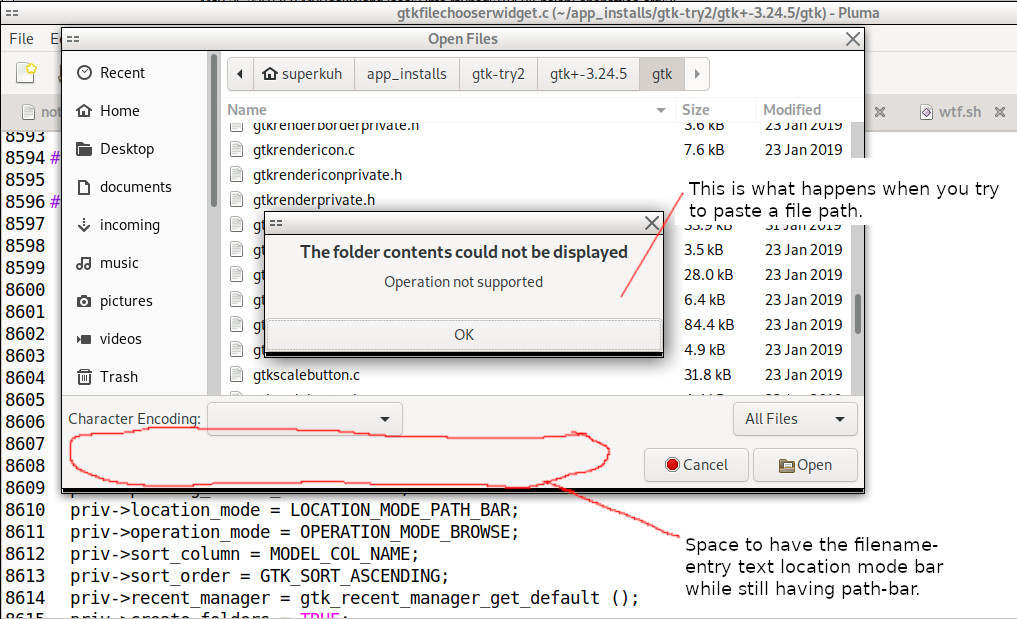
When hundreds of people asked about this bug he said,
>It is a private gtk setting, you don't really have any business tweaking it. It may disappear at any point. (ref: https://bugzilla.gnome.org/show_bug.cgi?id=788700)
and all attempts to get them to fix the bug since have failed. I continue to ask in #gtk on IRC at least once every year. Gtk3 is permanently frozen broken and the same bug actually still exists in Gtk4. If you open a file->open dialog and just paste a file path you get an error. I have attempted to re-write the relevant sections of gtkfilechooserwidget.c myself, just for my machines, but I have only succeeded in allowing typing/pasting in File->Open dialogs the first time they're activated in a program. Never the subsequent activation.
    Index: gtk+-3.24.5/gtk/gtkfilechooserwidget.c
    ===================================================================
    --- gtk+-3.24.5.orig/gtk/gtkfilechooserwidget.c
    +++ gtk+-3.24.5/gtk/gtkfilechooserwidget.c
    @@ -8607,8 +8607,8 @@ gtk_file_chooser_widget_init (GtkFileCho
       priv->load_state = LOAD_EMPTY;
       priv->reload_state = RELOAD_EMPTY;
       priv->pending_select_files = NULL;
    -  priv->location_mode = LOCATION_MODE_PATH_BAR;
    -  priv->operation_mode = OPERATION_MODE_BROWSE;
    +  priv->location_mode = LOCATION_MODE_FILENAME_ENTRY;
    +  priv->operation_mode = OPERATION_MODE_ENTER_LOCATION;
       priv->sort_column = MODEL_COL_NAME;
       priv->sort_order = GTK_SORT_ASCENDING;
       priv->recent_manager = gtk_recent_manager_get_default ();
This has always been the case with FOSS GUIs.
When everyone is happy CLIing everything and telling those who aren't to get bent, GUIs move at a snail's pace. I think it's amazing we even have stuff like GNOME, KDE, and xfce in the state they are in today.
Check out hyprland: hyprland.org
I also don't want a bloody great horizontal panel across the top of the screen wasting 1cm of vertical space on a widescreen display. No it does not help if it's visually broken up into separate islands: it's dead to me. Wasted space. Either use it, and you'd better find a remarkably good set of uses for it, or give it back.
That's a very naive take of tiling. For traditional tiling, maybe.
But unlike WM that do tiling only, hyprland does more: it supports my keystrokes and lets me configure how much of space each window get, while also letting me "float" the windows like a regular window manager
> I'm a big boy, I've been using WIMPs for 35 years,
Have you considered the possibility you are so set in your ways that you are neglecting new and useful tool? The tone of your comment reminds me of the summary dismissals of fzy.
> I also don't want a bloody great horizontal panel across the top of the screen wasting 1cm of vertical space on a widescreen display
Then make the panel vertical instead of horizontal, or just close it lol - all of which can be done with a few keystrokes
All dynamic tiling WMs do those things. Hyprland is not special in that way.
You know that there is basically a standard set, imposed by Windows in about 1986 or something and also supported in GNOME 2, MATE, Xfce, LXDE, etc etc.? I am more interested in if it supports them. I mean, I don't know what your set are, and I am not for a moment saying there's anything wrong with them, but there are standards for this stuff, used heavily by millions of blind computer users for example.
> Have you considered the possibility you are so set in your ways that you are neglecting new and useful tool?
Could be. I am a professional assessor of, and commentator on, this stuff, though.
I mainly use a desktop I switched to in 2011. :-) Before that, I changed in 2004, after a change in 2001, after a change in 1995, after a change in 1992, after one in 1989, etc. etc.
I mean I am an old pharte, fair call, but I am a reasonably adaptable one, I think. :-D
What is "fzy"?
https://github.com/jhawthorn/fzy
...?
> Then make the panel vertical instead of horizontal
Why don't any of the screenshots show that, then?
I see 6 horizontal panels in the screenies on the homepage and Github, and one with none. From that, I don't think it's unreasonable to conclude this is not a core feature or something.
Yes, and the terminal not copy pasting with ctrl-c infuriates me: it's long be remapped to ctrl-x (right next!) on mine to achieve consistency.
As for the general shortcuts, it seems to, and the extra ones I wanted because I'm used to them (ex: Win+Shift+S = snipping tool) I could add easily. Now it's effortless to do the same thing I did before (Win+L locks etc)
> > Then make the panel vertical instead of horizontal
> Why don't any of the screenshots show that, then?
A lot of the information is implicit to a domain: a video of bash not showing handling of say SIGTERM shouldn't be taken to mean it doesn't handle them, the good old absence of evidence is not evidence of absence
> From that, I don't think it's unreasonable to conclude this is not a core feature or something.
Core features are more like what most people tastes converge to. You are to pick app to achieve your desired end result: waybar for example is not part of hyprland, it's often used with it, because it's complementory like say bash and vi, even if there are other possible choices
Anyway, seriously give it a try- to the likes of fzf too. We have a lot of cool/better tech than existed in 2011, about 12 years ago
Your previous upgrade cycles were 3 years, so I think you're long overdue - might as well take the best there's now!
BTW check the discussion about fzf from a few days ago here it's another great set of recent-ish tools https://news.ycombinator.com/item?id=35248098
If you do upgrade, I suggest not trying to take any of your old tools if they are not wayland native it's often not the effort: there's a replacement somewhere, you just may not know about it, but it will certainly do a better job once you find it
I say all that super seriously: I really love my new stack, it gives me leves of productivity I had only been able to reach in Windows (the UI is wonderful if you know how to use it with the right keystrokes)
File chooser grid view (ie thumbnails) - that's nice, but I'm so jaded at this point to care anymore. I've been using ubuntu on and off as my personal system for the past 15 years, it sure beats windows in many respects (typing this on MacOS). But I'm just too old to be excited by UI features that should've been here long ago and that were the standard in the software of the late 90s and early 2000s. There has also been a vocal part of the community defending the lack of thumbnails in the file picker, so this whole story has a bitter taste to it. One more thing, it feels like open source systems and UIs are developing at a glacial pace these days, either the tools used to develop open source software are sub-par or maybe there is a lack of people working on it and effort put into it. So glacial that in the age of AI, a grid view is somehow a notable feature. There seems to be less to be excited about these days and I have given up expecting great things.