While it's important to know what tweets a user is interacting with, the personalization option can surface more things as "You might like", "You follow x, and he liked", "Interesting tweet on the topics you follow/might like" and so on. Whether or not you choose to interact with anyone or more of those is a signal, and helps with advertising (if advertising is a question of "What tweet/content you are likely to interact with?"). Other than brands, most twitter influencers, or would-be influencers end up spending money on twitter ads to gain followers.
With a reverse chronological timeline, it's hard to surface those tweets from outside the network without a jarring experience. They also realize the power of defaults and hence they decided to take away the default option.
... when they are created.
Social networks are inherently evil, that's their business model: manipulate users into addiction and serve ads.
How do non-evil social networks look like? They're forums, plain old forums.
But you don't become an ultra trillionaire with PhpBB.
Nowadays they are an evil manipulation mess, but I don't think it is an inherit property of social networks.
Phase 2: profit (through using and abusing their users).
Both steps are written in stone in their business plan on day 1, you just don't know it.
As a user you were still in phase 1.
Similar story with image hosting websites. First they don't have ads and load fast and don't really have image restrictions. Then they start adding restrictions and ads.
Before this, we had centuries of businesses who were sustainable by just charging a fair premium on the goods they sold to their customers, and both sides were happy enough with the transaction to continue.
You'll never get enough traction to break through to the mainstream, unless something radical changes.
What's evil about Mastodon, Matrix, Pleroma, diaspora, etc?
I don't know anyone using any of those networks.
Nothing wrong with showing me, and clearly denoting, a tweet that I might like in between other tweets I browse.
Don't understand this black and white thinking.
Whether or not they show topic data for a particular tweet, they generally have it. I only use the chronological timeline, and I cleared out the interests list a year or two back, but they have built up a profile of hundreds of interests for me.
I suspect forcing the ranked timeline on people is all about a small portion of Twitter juicing their engagement metrics, with no grand cross-team strategy in play.
Grocery stores put common items like milk way in the back, in order to have you traverse the whole store and get exposed to as many meters of shelf as possible. They generally also like to change placement of product, to make sure you don't learn the layout and get too efficient at navigating.
Malls try to balance enabling people to find what they are looking for, but also make sure they don't find it too easily so that people can wonder about and be exposed to as many stores as possible.
If you enter the Dubai Mall from the metro, there's a big sign that points to the left and says "Food Court". You'd get to the food court much faster if you turn right.
I went the other day just to look at a dining table. It was only in the 3rd or 4th showroom. Of course, to get out I had to wander through the majority of like 13 or 14 other showrooms because you pretty much can only take the linear path to get to an exit.
You need to know the name of what you're looking for and then use their kiosks to find where the thing is in the warehouse and just pick it up directly.
This trick turns 1 hour trips through Ikea into 5 minute trips.
The value proposition of the long Ikea walks is the set up rooms showing how the products look in use, allowing you to visualise before you buy. I take a friend and a coffee and take my time at Ikea.
So I went up to a couple salespeople and asked why. They couldn't say why, just that they did have it in stock at this warehouse and they themselves could ship it for X fee.
I don't really get it. They said maybe they were out of stock at the factory or online order fulfillment center. But the pages said they were available.
I doubt it. They are even marked on in store navigation. Example, https://miro.medium.com/max/1400/1*ZSJ1cE-FjFzNjIVz8l0a4Q.jp...
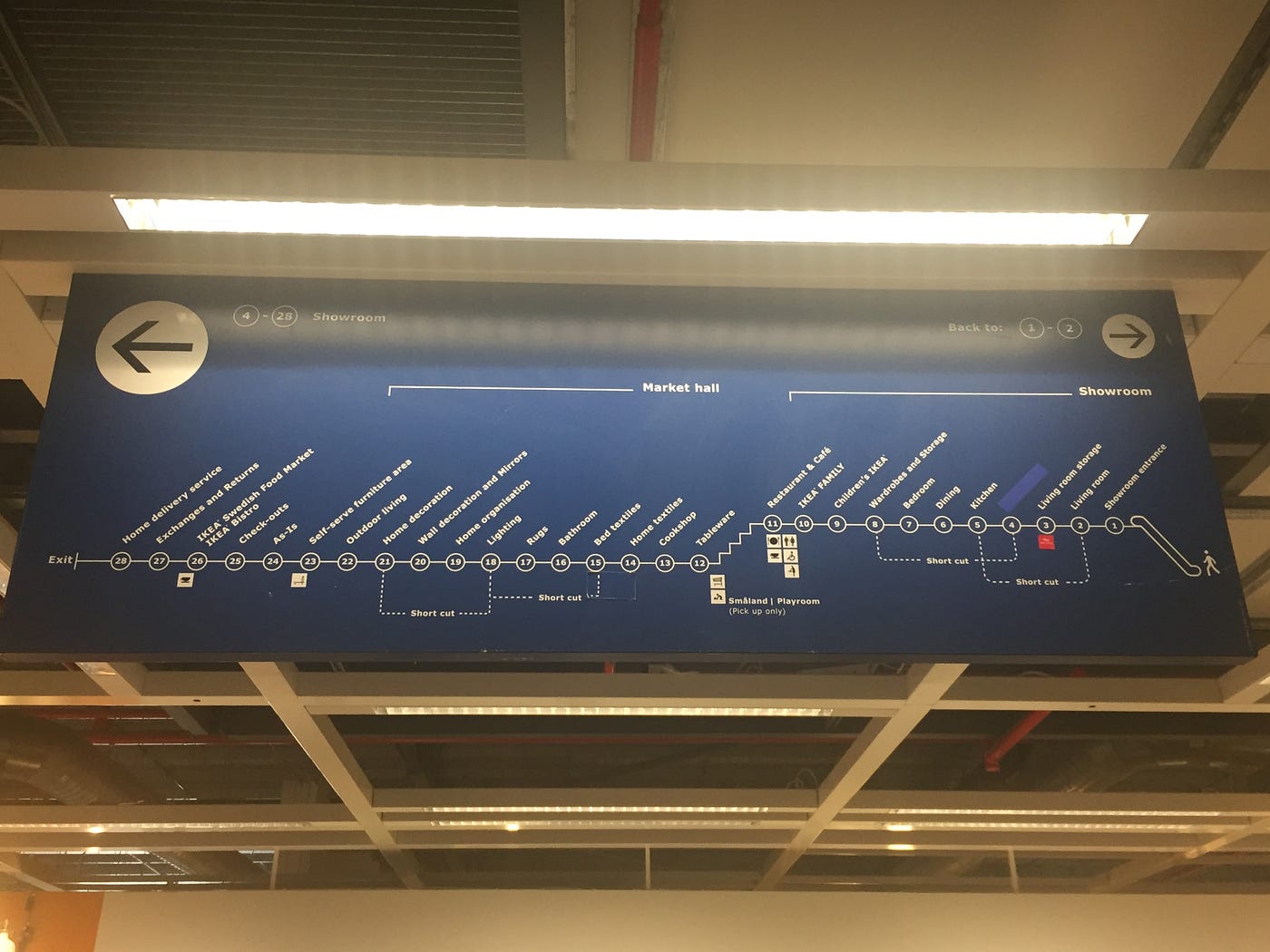
Wonder if the covid-catalyzed uptake on grocery pickup options will change this in any way. I certainly discovered the joys of making grocery errands much more efficient, to the point where the decided majority of my store runs are pickup-only: I don't waste time navigating the store.
(And hey, the store can show me random products based off ML analysis of my purchase history, win-win.)
There's a reason why refrigerated items are usually at the back: fridges usually face a wall. You can have a shelf at the back sometimes but that's not always possible
Also, for those quick purchases you can always go to somewhere closer, a gas station, etc.
In fact in Europe some places do have the quick purchases right in front of the store so you don't need to go around (Tesco as an example).
Also, why would your eggs be in the dairy section?
I dont know if this is really happening. Grocery stores where I go are fairly static. They change layout once in years and larger one have big signs that tell you where what roughly is.
There was a case a few years ago where a Marriott got fined for blocking outside wifi.
https://www.theguardian.com/us-news/2014/oct/03/marriott-fin...
No, them renting the room to you - when you'll usually be out of it most of the day - is absolutely how they make money. Maybe in Las Vegas the room rate is a loss leader but your average business hotel is 100% making their profit on the room.
I once stayed at a place that had super, super cheap refreshment rates on the mini-fridge. Cheaper if you got them at a store obviously, but not punishing like most other hotels, less than double the supermarket rate. Guess what? I made them tons of money, it was super convenient, I didn't go out of my way to avoid them.
They would just show me random shit basically irregardless of date.. and that's not at all what I wanted. I found it to be an new source- of sorts. I'm not saying a good one, but at least it was somewhat interesting to may see peoples perspective on some topic. But what I found is it would just show me stuff that could be months old, days old etc instead of prioritizing like.. top day things.
I haven't used it during the russia/ukraine time.. but I can't imagine how wildly inaccurate of a picture you would get if you are viewing stuff completely out of date order. Yeah they put the date on the video.. but that doesn't really help, everything is still all over the place.
For all Reddit's faults- I can at least go there, take a look at some of the top headlines in some subreddits.. and know if I see something it's recent unless I am looking otherwise.
The issue for them I imagine is retention: with chronological, it's likely that when you visit Twitter the first few messages you see are not interesting and you leave. But if they put a tweet that's popular among your social group in front of you? Odds are that's interesting to you and you stick around a bit longer.
I dislike that, to be clear, but I imagine this is the human behavior for >90% of people.