I went the other day just to look at a dining table. It was only in the 3rd or 4th showroom. Of course, to get out I had to wander through the majority of like 13 or 14 other showrooms because you pretty much can only take the linear path to get to an exit.
You need to know the name of what you're looking for and then use their kiosks to find where the thing is in the warehouse and just pick it up directly.
This trick turns 1 hour trips through Ikea into 5 minute trips.
The value proposition of the long Ikea walks is the set up rooms showing how the products look in use, allowing you to visualise before you buy. I take a friend and a coffee and take my time at Ikea.
So I went up to a couple salespeople and asked why. They couldn't say why, just that they did have it in stock at this warehouse and they themselves could ship it for X fee.
I don't really get it. They said maybe they were out of stock at the factory or online order fulfillment center. But the pages said they were available.
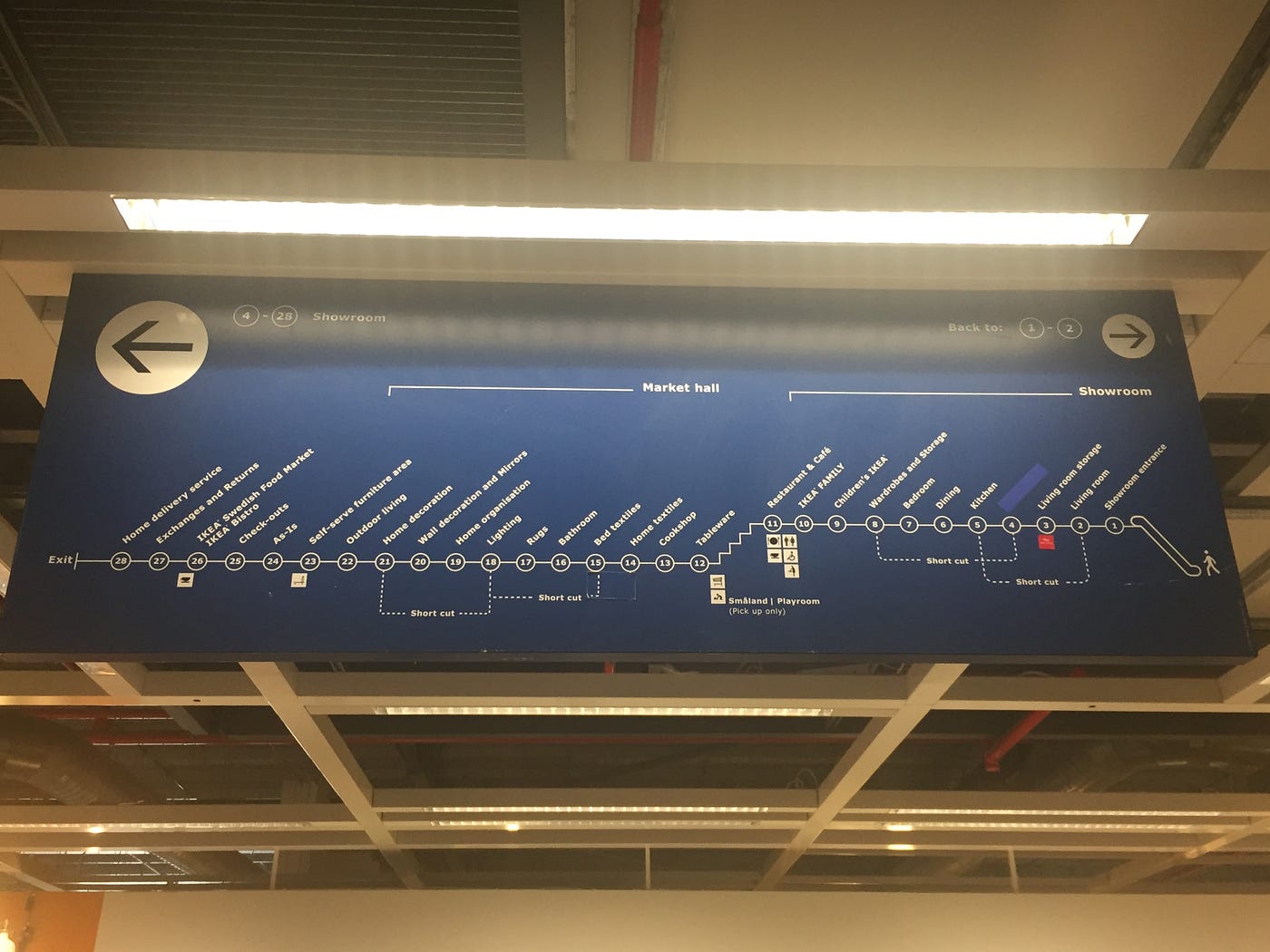
I doubt it. They are even marked on in store navigation. Example, https://miro.medium.com/max/1400/1*ZSJ1cE-FjFzNjIVz8l0a4Q.jp...
Wonder if the covid-catalyzed uptake on grocery pickup options will change this in any way. I certainly discovered the joys of making grocery errands much more efficient, to the point where the decided majority of my store runs are pickup-only: I don't waste time navigating the store.
(And hey, the store can show me random products based off ML analysis of my purchase history, win-win.)
There's a reason why refrigerated items are usually at the back: fridges usually face a wall. You can have a shelf at the back sometimes but that's not always possible
Also, for those quick purchases you can always go to somewhere closer, a gas station, etc.
In fact in Europe some places do have the quick purchases right in front of the store so you don't need to go around (Tesco as an example).
Also, why would your eggs be in the dairy section?
I dont know if this is really happening. Grocery stores where I go are fairly static. They change layout once in years and larger one have big signs that tell you where what roughly is.
Grocery stores put common items like milk way in the back, in order to have you traverse the whole store and get exposed to as many meters of shelf as possible. They generally also like to change placement of product, to make sure you don't learn the layout and get too efficient at navigating.
Malls try to balance enabling people to find what they are looking for, but also make sure they don't find it too easily so that people can wonder about and be exposed to as many stores as possible.
If you enter the Dubai Mall from the metro, there's a big sign that points to the left and says "Food Court". You'd get to the food court much faster if you turn right.