News for hackers. Stuff that matters.
Re:The cold hard truth about electric vehicles in winter by jillesvangurp on Friday March 04, 2022 @08:49AM (#30554660)
Performance degrades of course, but modern EVs are quite popular in e.g. Norway where they drive them well inside arctic conditions. It's not like they stop working under conditions where ICE vehicles definitely face challenges with both range and reliability. Unless your ICE vehicle is plugged in to keep the engine warm when it is parked, it might not even start at all. Those same systems are great for keeping your EV topped up of course.

Anything liquid might end up freezing. In an EV that's electrolytes, cooling liquid, brake fluids, etc. Of course, batteries can be heated in an EV and that helps. Simply using them heats them up. That's why many EVs have battery cooling. Also many owners might want to turn up the heat remotely so they enter a nicely warmed car instead of an ice box. That costs energy and range of course.

So, it's not all that black and white. But overall, it seems EVs can do well under arctic conditions. All the big vendors test under those conditions. The cold hard reality (to paraphrase the alarmist title) is that it isn't that big of a deal.

Re:The cold hard truth about electric vehicles in winter by rr808 on Friday March 04, 2022 @08:54AM (#30554724)
Most of Norway like Oslo isn't really arctic cold though. Big continental cities away from the coast are much more frigid.

eg Oslo this January was above freezing every day, and only below freezing a few nights. https://www.accuweather.com/en/no/oslo/254946/january-weathe.... Compare that to Chicago https://www.accuweather.com/en/us/chicago/60608/january-weat...

Re:The cold hard truth about electric vehicles in winter by rco8786 on Friday March 04, 2022 @09:02AM (#30554819)
> Most of Norway like Oslo isn't really arctic cold though

Oslo is colder than like 90% of the inhabited parts of the planet...it's probably fine to use it as an example when talking about cold weather performance of EVs

Re:The cold hard truth about electric vehicles in winter by thow-58d4e8b on Friday March 04, 2022 @09:29AM (#30555246)
Average temperature in Oslo is colder than 90% of the planet - but average winter temperature in Oslo is a fairly normal winter temperature for nearly half the planet, especially for the more affluent parts of it. The hottest large city on Earth - Ahvaz, Iran - with a record high of 54C, still recorded a record low of -7C
Re:The cold hard truth about electric vehicles in winter by lm28469 on Friday March 04, 2022 @09:37AM (#30555367)
Re:The cold hard truth about electric vehicles in winter by gzer0 on Friday March 04, 2022 @09:47AM (#30555519)
When comparing Norway's mean average temperature to the rest of the world, it is clear that it is significantly cooler.

[1] https://worldpopulationreview.com/country-rankings/hottest-c...

Re:The cold hard truth about electric vehicles in winter by rr808 on Friday March 04, 2022 @09:53AM (#30555628)
Yeah much of Norway is very cold, esp in the arctic circle - however very few people live there. In the South it isn't so cold.
Re:The cold hard truth about electric vehicles in winter by mikepurvis on Friday March 04, 2022 @11:39AM (#30557023)
This is like saying Canada is cold because Yellowknife, when in reality 90% of the population lives within 100 miles of the US border. Like yeah, we can still get a decently cold winter in southern Ontario, but it's not remotely comparable to the actual arctic, or even places like Saskatoon and Edmonton.
Re:The cold hard truth about electric vehicles in winter by shagie on Friday March 04, 2022 @12:17PM (#30557500)

               Average Low (°C)          || Record Low (°C)
             | Dec  | Jan  | Feb  | Mar  || Dec   | Jan   | Feb   | Mar
    Oslo     | -3.9 | -4.7 | -4.7 | -2.1 || -19.7 | -20.5 | -20.7 | -16.9
    Toronto  | -3.1 | -6.7 | -5.6 | -1.9 || -30.0 | -32.8 | -31.7 | -26.7
The winter in Oslo starts earlier and lasts longer... but isn't as extreme as Toronto's winter.

The record low for Feb in Oslo (1991 - 2020 data) is -5.3°F. That's an average winter night for me. https://www.aos.wisc.edu/~sco/clim-history/stations/msn/msn-...

Another way of looking at this... heating degree days.

https://www.weatherbase.com/weather/weatherall-print.php3?s=... vs https://www.weatherbase.com/weather/weatherall-print.php3?s=...

Oslo has 6286.8 heating degree days. Toronto, Ontario has 7342.8.

Toronto is substantially colder than Oslo (edit...) when it comes to the extremes of weather.

(edit: correction) - Oslo's is https://www.weatherbase.com/weather/weatherall.php3?s=88410&...

which has the heating degree days as 7787.8 which is now comparable to Toronto.

Re:The cold hard truth about electric vehicles in winter by shagie on Friday March 04, 2022 @09:59AM (#30555721)
Oslo is on the ocean. While the arctic ocean is cold, it's still water. If the air temperature drops below the temperature of the water, the ocean will release heat and warm up the air.

It is very difficult to get it colder than the water. Note also that Oslo is on a warm current - https://upload.wikimedia.org/wikipedia/commons/9/9b/Corrient... - the Norwegian current is a continuation of the Gulf Stream (compare the California current which is a cold one)
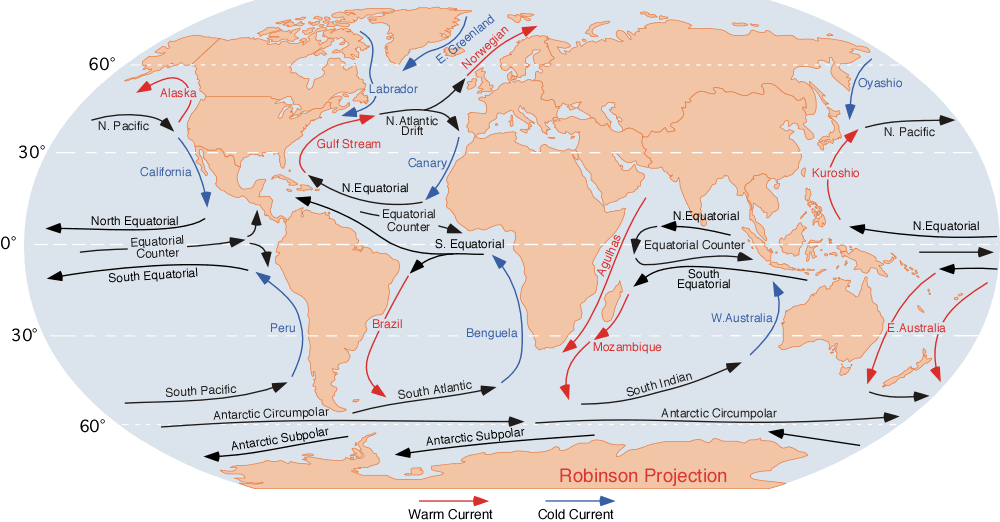
https://en.wikipedia.org/wiki/Oslo

> Oslo has a humid continental climate (Köppen climate classification: Dfb)[48] or, if the original Köppen winter threshold −3 °C (27 °F) is used, an oceanic climate (Cfb) in the 1991–2020 base period.

https://en.wikipedia.org/wiki/Oceanic_climate

> Examples of oceanic climates are found in Glasgow, London, Bergen, Amsterdam, Dublin, Berlin, Hamburg, Vienna, Bilbao, Oviedo, Biarritz, A Coruña, Bayonne, Zürich, Copenhagen, Prague, Skagen, and Paris. With decreasing distance to the Mediterranean Sea, the oceanic climate of northwest Europe gradually changes to the subtropical dry-summer or Mediterranean climate of southern Europe

> The oceanic climate exists in an arc spreading across the north-western coast of North America from the Alaskan panhandle to northern California, in general the coastal areas of the Pacific Northwest. It includes the western parts of Washington and Oregon, the Alaskan panhandle, western portions of British Columbia, and north-western California.

Compare this to the continental climates.

https://en.wikipedia.org/wiki/Minneapolis#Climate

https://en.wikipedia.org/wiki/Boulder,_Colorado#Climate

https://en.wikipedia.org/wiki/St._Louis#Climate

https://en.wikipedia.org/wiki/Chicago#Climate (has the population of 1/2 of all of Norway)

With no large bodies of open water, the air temperature is not moderated by the release of heat from the water and can go further to extremes on both ends.

Re:The cold hard truth about electric vehicles in winter by scythe on Friday March 04, 2022 @09:11AM (#30554943)
To put some numbers to this:

Oslo, Norway:

Average low, coldest month: -5.3 C

Record low, all time: -26 C

versus

Indianapolis, Indiana, United States:

Average low, coldest month: -6.2 C

Record low, all time: -33 C

Re:The cold hard truth about electric vehicles in winter by rr808 on Friday March 04, 2022 @10:53AM (#30556423)
> Average low, coldest month: -5.3 C

Crazy thing is this January there looks to be only one night where it went below zero.

Re:The cold hard truth about electric vehicles in winter by hammock on Friday March 04, 2022 @09:13AM (#30554988)
Never would have guessed this. Thanks
Re:The cold hard truth about electric vehicles in winter by robscallsign on Friday March 04, 2022 @02:03PM (#30558925)
I've been wondering how the EV adoption will play out in Canada. For example, the city I live in with a population of 162k had a record all time low of -48.3 C, and average lows in January of −17.9C, and 4 of months of the year have average lows below -10C.
Re:The cold hard truth about electric vehicles in winter by reaperducer on Friday March 04, 2022 @09:48AM (#30555539)
Why did you choose Indianapolis for the comparison?

Why not Minneapolis, or Cheyenne, or some other North American city that is also away from the coasts? Why not Regina?

I think part of the problem is that because EVs are still new, people are going to expect or demand reliability. It's only better if it's better in every way.

When I worked in a cold city, you would occasionally hear people say, "Sorry I'm late for work, boss. Car wouldn't start, and I had to get a jump."

Because it's new, saying, "Sorry I'm late for work, boss. It's cold, so my car had less range and I had to stop at the Slurp-n-Burp to recharge" isn't going to be met with the same level of sympathy.

Re:The cold hard truth about electric vehicles in winter by scythe on Friday March 04, 2022 @10:14AM (#30555934)
Indianapolis is a decently large city, and it's not that far north nor in an obviously cold mountainous region. Most people wouldn't recognize it as exceptionally cold for the US. It's also south of several large Midwestern cities. So, it was a good way to show that a large fraction of the US (and of course Canada) gets colder than Oslo.
Re:The cold hard truth about electric vehicles in winter by Someone on Friday March 04, 2022 @10:55AM (#30556444)
For reference: Indianapolis is about 40 degrees north of the equator, Oslo about 60, so it’s over 2,000 km more closer to the equator. Indianapolis is at about the latitude of Madrid.

The Gulf Stream really works.

Re:The cold hard truth about electric vehicles in winter by oh_sigh on Friday March 04, 2022 @01:28PM (#30558464)
Not only the Gulf Stream, but also the polar jet stream, which frequently dips down into the American midwest in winter, making the temperature in Indianapolis about as cold as it is much further north in Canada. Sometimes even colder.

e.g. https://cms.accuweather.com/wp-content/uploads/2017/12/stati...

Re:The cold hard truth about electric vehicles in winter by dylan604 on Friday March 04, 2022 @11:12AM (#30556682)
If they had used Minneapolis or Cheyenne, someone else would have posted why did you choose Minneapolis or Cheyenne.
Re:The cold hard truth about electric vehicles in winter by walnutclosefarm on Friday March 04, 2022 @10:29AM (#30556119)
> It's not like they stop working under conditions where ICE vehicles definitely face challenges with both range and reliability. Unless your ICE vehicle is plugged in to keep the engine warm when it is parked, it might not even start at all.

ICE are way less affected by cold than battery vehicles. It's been 2 decades since I even had a block heater for any of my cars or pickups - modern electronic fuel injected engines are very good at properly metering and vaporizing fuel to start at low temps. And yes, they do get reduced mpg, but it's not that much, and given the ubiquity of gas stations, hardly can be talked about as a range limitation.

And for the record, they keep the cabin much more comfortable than a lot of electrics can afford to do. Turning those precious kWHs in your battery into heat is brutal on the battery.

I think electric vehicles are the future, and I like ours. But no way the article here is wrong: most are not really yet as ready for cold climates as modern ICE are. You get trade-offs).

(For the record: I drive (drove, actually, don't drive much at since I retired) mostly in Minnesota. Subzero driving has been part of my life for 50 years.)

Re:The cold hard truth about electric vehicles in winter by MontyCarloHall on Friday March 04, 2022 @09:25AM (#30555171)
> The cold hard reality (to paraphrase the alarmist title) is that it isn't that big of a deal.

For people who use their EV solely for commuting, it’s not a big deal, since a commute distance is still well below the reduced range in cold temperatures.

It is a huge deal for people who take winter road trips. The range reductions cited in the article could easily spell the difference between getting to the destination in one shot, versus having to take a >30 minute stop to recharge midway. 30 minutes is an absolute minimum figure that assumes there’s an available fast charger conveniently close to the route. If not, detours+slow charging could easily add an hour or more to travel time.

Re:The cold hard truth about electric vehicles in winter by reaperducer on Friday March 04, 2022 @09:52AM (#30555607)
For people who use their EV solely for commuting, it’s not a big deal

It depends on how long your "commute" is.

A dozen miles across San Francisco? Not a big deal.

There are plenty of people who commute long distances every day. There are thousands of people who commute to New York City every day from Pennsylvania.

Re:The cold hard truth about electric vehicles in winter by lallysingh on Friday March 04, 2022 @12:53PM (#30557991)
The cost savings on fuel vs recharging makes long distance commuters (like me, NJ to NYC) look more at EVs.
[dead]
Re:The cold hard truth about electric vehicles in winter by MontyCarloHall on Friday March 04, 2022 @09:36AM (#30555358)
It takes 5 minutes to refuel a gas car, and gas stations are ubiquitous. Most EVs take about 30 minutes to gain an appreciable amount of range at a level 3 charger, which are far from common, thus necessitating a long detour. They also often have long lines—you can easily spend at least as much time waiting for a charger to become available as you will actually charging the car.
Re:The cold hard truth about electric vehicles in winter by meragrin_ on Friday March 04, 2022 @09:40AM (#30555421)
Let me know when you charge an EV in under 5 minutes.
Re:The cold hard truth about electric vehicles in winter by thesuitonym on Friday March 04, 2022 @09:39AM (#30555414)
If only there were a way to take a trip without driving. It would be so nice if there were some kind of large vehicle that multiple people could get in, that had a dedicate right-of-way for long-haul trips, so individuals didn't have to worry about fuel. These hypothetical vehicles could go to multiple high-traffic destinations, so a person could get close to where they wanted to be, and then drive a personal vehicle the rest of the distance, but sleep for most of the trip, or just relax.

Unfortunately, no such method of travel ever has or ever will be invented, so I guess we'll just have to rely on internal combustion engines for the rest of eternity.

Re:The cold hard truth about electric vehicles in winter by ghaff on Friday March 04, 2022 @09:52AM (#30555598)
Because it is totally reasonable to expect there to be a bus or train from some arbitrary location (even a city) to a random mountain trailhead or ski area.
Re:The cold hard truth about electric vehicles in winter by hnaccount_rng on Friday March 04, 2022 @10:50AM (#30556397)
You just described Switzerland xD
Re:The cold hard truth about electric vehicles in winter by ghaff on Friday March 04, 2022 @11:17AM (#30556737)
Even Switzerland doesn't have complete public transportation coverage but it probably comes closer than just about anyplace else.
Re:The cold hard truth about electric vehicles in winter by nradov on Friday March 04, 2022 @11:38AM (#30557013)
If you want to get from the Bay Area to Lake Tahoe area ski resorts it's almost impossible to do that via mass transit. Best case scenario would be an all-day ordeal with at least 5 transfers, and no easy way to carry bulky, heavy ski equipment. No one is going to put up with that when they can just drive their personal vehicle in half the time with greater comfort.

There used to be a private ski bus charter service on weekends but that shut down due to the pandemic.

Re:The cold hard truth about electric vehicles in winter by thesuitonym on Friday March 04, 2022 @02:14PM (#30559059)
It's amazing that people will say something like this. We don't have this infrastructure now, so we can't even think about building it.
Re:The cold hard truth about electric vehicles in winter by MontyCarloHall on Friday March 04, 2022 @09:51AM (#30555589)
While I agree in principle, pragmatically (in the US at least) it would be orders of magnitude easier to build out our EV charging network and increase the all-season range of EVs than to build out a massive rail network on par with both our interstate road network and local highway networks.
Re:The cold hard truth about electric vehicles in winter by zdragnar on Friday March 04, 2022 @09:44AM (#30555484)
Such vehicles certainly don't exist for 90% of the long haul trips I take (busses and trains). Planes could get me there, but they also would actually take longer than just driving because where I need to go isn't serviced by national lines, only regional planes.
Re:The cold hard truth about electric vehicles in winter by giantg2 on Friday March 04, 2022 @08:59AM (#30554784)
I found the brake fluid freezing comment interesting. Quite a bit conflicting info on it when I do a search.

Some places say the fluid doesn't actually freeze but becomes too viscous to function properly. Others say it's condensation in the vacuum booster line, effectively making them non-power brakes. And still others say the fluid itself won't freeze, but the water it absorbed will.

Re:The cold hard truth about electric vehicles in winter by verisimilitude on Friday March 04, 2022 @09:22AM (#30555133)
Anecdata: I live in Minnesota. It is cold here ( https://en.wikipedia.org/wiki/List_of_Minnesota_weather_reco... ) -- and here in my fourth decade of life, never had an issue with brake fluid. I've seen issues in the cold with: electronics, radiator fluid, washer fluid, ignitions, batteries, tire pressure, bushings, plastics, even fuel back when EFI was less common, but never issues with brake fluid.

Road salt is our big problem here, but that's true for everyone who has winter.

FWIW my neighbor has a Tesla and loves it...

Re:The cold hard truth about electric vehicles in winter by giantg2 on Friday March 04, 2022 @09:28AM (#30555221)
I think the colder areas don't use salt, right? Like some areas of Alaska are too cold for salt to work.
Re:The cold hard truth about electric vehicles in winter by zdragnar on Friday March 04, 2022 @09:47AM (#30555534)
In the context of minnesota, road salt is used on most flat or heavily trafficked roads. Steep inclines and intersections all use grit or small gravel instead or or in addition to salt.
Re:The cold hard truth about electric vehicles in winter by giantg2 on Friday March 04, 2022 @10:38AM (#30556231)
True, but the second half of the sentence was that it was true for everywhere with winter weather. I was just pointing out that it isn't necessarily the case.

Edit: and also, some areas are not using salt for environmental reasons, like Portland.

Re:The cold hard truth about electric vehicles in winter by zdragnar on Friday March 04, 2022 @12:03PM (#30557333)
Yeah, outer portions of Minnesota avoid using salt near wetlands as well- most states do, I think. You have to get pretty far into northern latitudes before salt stops working well enough to abandon it, though. Mixing sand or grit helps warm it up in direct sunlight enough that it can still be beneficial below zero F.
Re:The cold hard truth about electric vehicles in winter by SketchySeaBeast on Friday March 04, 2022 @10:45AM (#30556315)
Once you get below -20 C (-4 F) salt loses a lot of effectiveness. Here in Edmonton we had a few weeks of ~-30 C and the roads were polished to an icy shine, there was no getting away from it and no amount of sand or salt helped for any amount of time.
Re:The cold hard truth about electric vehicles in winter by duxup on Friday March 04, 2022 @10:29AM (#30556113)
>Road salt is our big problem here

Road salt problems always makes me wonder how much the vehicle plays into that.

I've driven 20+ year old cars without a spot of rust while there are vehicles that are 5 years old with rust problems.

I think the real variable when it comes to road salt issue is vehicle quality.

Re:The cold hard truth about electric vehicles in winter by throwaway0a5e on Friday March 04, 2022 @01:19PM (#30558355)
>I think the real variable when it comes to road salt issue is vehicle quality.

It depends on how much the OEM wants to spend on fancy paint and coatings, how much the vehicle's use degrades that coating, how much salt the vehicle is exposed to, what kind of salt (liquid stuff gets everywhere much more effectively) and what if any steps the owner takes to mitigate the salt.

You can make generalizations like "Volvo loves to galvanize stuff and Toyota DGAF" but without controlling for the life the vehicle will have that doesn't really let you make predictions about a specific vehicle.

Re:The cold hard truth about electric vehicles in winter by duxup on Friday March 04, 2022 @01:24PM (#30558427)
I feel like your two paragraphs conflict.
Re:The cold hard truth about electric vehicles in winter by ChoGGi on Friday March 04, 2022 @09:28AM (#30555226)
> Road salt is our big problem here, but that's true for everyone who has winter.

Not if your municipality uses grit instead of salt.

Re:The cold hard truth about electric vehicles in winter by mhb on Friday March 04, 2022 @09:30AM (#30555269)
So they have two problems.
Re:The cold hard truth about electric vehicles in winter by actionfromafar on Friday March 04, 2022 @09:22AM (#30555135)
To add to the confusion, there are two main kinds of brake fluid:

The classic, pro: works well even under high temperatures resulting from prolonged braking. Con: absorbs water over time and must be replaced fairly often even if not stressed.

New kind, pro: does not absorb water and does not degrade as much on its own. Con: braking action gets "spongy" when the fluid heats up from prolonged braking.

Re:The cold hard truth about electric vehicles in winter by giantg2 on Friday March 04, 2022 @09:37AM (#30555362)
Doesn't DOT 5 also have the issue of not working as well with ABS due to compressible nature of the fluid?
Re:The cold hard truth about electric vehicles in winter by throwaway0a5e on Friday March 04, 2022 @11:09AM (#30556637)
The amount of brake fluid that actually moves when you press the brake is trivial and with the forces involved it could be as thick as grease and still work mostly fine.

Unless you actively mix it with water (like you do antifreeze) you are going to have a hell of a time getting glycol based brake fluid to absorb enough water to freeze at any earthly temperature. Maybe if you ran a system without the cap on the reservoir for decades in a very humid climate you could do it but even then I think the odds are long at best.

I vote condensation.

Re:The cold hard truth about electric vehicles in winter by giantg2 on Friday March 04, 2022 @11:26AM (#30556854)
My understanding is that the water contaminated fluid tends to concentrate at the bottom of the systems. With 20% of cars having systems with 5% water, that seems like the concentration could be higher in parts of the system. So I agree that it's probably unlikely (and only even possible in artic condidtions).
Re:The cold hard truth about electric vehicles in winter by bombcar on Friday March 04, 2022 @09:15AM (#30555019)
All may be true - DOT 5 brake fluid is silicon based and will not absorb water at all, the others will. Which is why DOT 5 is often found in military trucks.
Re:The cold hard truth about electric vehicles in winter by giantg2 on Friday March 04, 2022 @09:31AM (#30555272)
Yeah, but the claims I saw were including DOT 3, 4 and sometimes 5. At least here in the US, DOT 5 seems to be pretty uncommon.
Re:The cold hard truth about electric vehicles in winter by bombcar on Friday March 04, 2022 @09:46AM (#30555513)
3 and 4 (and 5.1) absorb water so who knows what that does at super low temperatures (but it’s rated pretty low as is).

I know power steering fluid gets too viscous and can blow out the hoses on a Dodge Avenger because it can’t get through the cooler.

Re:The cold hard truth about electric vehicles in winter by neogodless on Friday March 04, 2022 @08:51AM (#30554694)
The article mentions Norway, and it also highlights how many electric vehicles perform nearly as well in very cold conditions, though some (particularly from GM and Ford) do much worse.

> In Norway — where half of all new cars are plug-ins — tests show that EVs lose about 20% of their driving range and take longer to charge in cold temperatures, according to the Norwegian Automobile Federation.

Re:The cold hard truth about electric vehicles in winter by dkarl on Friday March 04, 2022 @09:34AM (#30555328)
> some (particularly from GM and Ford) do much worse

Naturally people who don't like EVs are going to cherry-pick these problems, but the mixed results suggest to me that it's down to a deficiency in the design and testing process at some companies. I had a 2009 Prius where the rubber pad on the metal hatchback handle melted, fell off, and left a thick streak of rubber adhered to my license plate. It was a known issue in that model of Prius and affected a lot of people in the southwestern US. Was it a great engineering challenge to create a handle that could handle such heat? Did they consciously decide to sell something that would fail in an ugly and embarrassing way right below their brand logo? I doubt it; I suspect it was a new design that they failed to test rigorously enough.

Re:The cold hard truth about electric vehicles in winter by UltraViolence on Friday March 04, 2022 @09:51AM (#30555590)
I'd say a 50% drop in range IS a big deal.

There's none of that with ICE vehicles.

Re:The cold hard truth about electric vehicles in winter by adrianN on Friday March 04, 2022 @12:14PM (#30557464)
Most trips are too short to get the engine up to optimal operating temperature in winter. Cold engines have terrible efficiency, so you lose quite a bit of range in day-to-day driving during winter.
Re:The cold hard truth about electric vehicles in winter by protomyth on Friday March 04, 2022 @10:38AM (#30556232)
Anyone who owns a hybrid in the northland probably notices a dip in gas mileage in the winter. My Kia Niro loses about 30% of its gas mileage in the winter months in North Dakota. Its enough of a difference that this will be my last hybrid, and I am going to be very careful when I buy an electric. Since, I live in an apartment currently, I don't really have an option for an electric.
Re:The cold hard truth about electric vehicles in winter by sjg007 on Friday March 04, 2022 @12:40PM (#30557815)
30% isn't that bad. Even petrol cars get similarly bad or worse mileage in the winter.

https://www.fueleconomy.gov/feg/coldweather.shtml

Also cars in general as they age gradually get worse mileage.

Re:The cold hard truth about electric vehicles in winter by waffleiron on Friday March 04, 2022 @12:56PM (#30558030)
> 30% isn't that bad. Even petrol cars get similarly bad or worse mileage in the winter.

From the link you linked, city driving 15% and "as much as 24% for short (3- to 4-mile) trips". That is not really similarly bad or worse.

Re:The cold hard truth about electric vehicles in winter by 015a on Friday March 04, 2022 @10:53AM (#30556424)
> Unless your ICE vehicle is plugged in to keep the engine warm when it is parked, it might not even start at all.

Literally no one is doing this, unless you have a diesel engine, you're parked outside, the temperatures are exceptionally cold (<= -10F?), and you weren't planning on driving for more than a day. It's something you'd see on, like, farms or semi truck lots; not houses.

The risk of not starting isn't really in the engine itself; it's in the fuel "gelifying". Diesel is gross.

But sure; the issue is overblown, especially when the majority of EVs on the list still retain >10% of their maximum battery capacity in freezing weather, and the highest range EVs on the list (where you'd expect to see the highest drop) are only losing a few percentage points. This is not a situation where EVs have a fundamental problem; it's a situation where a few manufacturers (cough Detroit cough) are royally screwing something up.

Re:The cold hard truth about electric vehicles in winter by 83 on Friday March 04, 2022 @11:09AM (#30556645)
> Literally no one is doing this

I do, as do multiple members of my immediate family who park our vehicles outside. We have block heaters so we can start them on those -10F mornings. None of us have diesel either - Toyota 4runner, Ford Explorer, GMC Sierra. Every winter we get at least a couple weeks where it's that cold in Wisconsin.

Re:The cold hard truth about electric vehicles in winter by DIVx0 on Friday March 04, 2022 @11:49AM (#30557163)
OP Should have said "most don't need to do it." I live in Minnesota and its rare to see people use block heaters now days, folks that do are most likely doing it because their parents did. I know from first hand experience that modern ICE cars with proper maintenance will perform just fine in the extremest of Minnesotan winters.
Re:The cold hard truth about electric vehicles in winter by HeyLaughingBoy on Friday March 04, 2022 @12:00PM (#30557287)
That doesn't sound right. I live in MN and my 17 year-old Nissan 350Z will happily start in -20F as long as the battery is in good shape. Any of those vehicles you mention (unless the 4Runner is old enough to still have a carbureted 22R) should start up just fine at -10F.
Re:The cold hard truth about electric vehicles in winter by 83 on Friday March 04, 2022 @03:05PM (#30559682)
2018 4runner in my case. Still on its original battery so that's probably getting a little weak. -10F starts fine, its when we get those -15 or -20ish nights where you can really hear it struggling and you hope it starts. Sure I could upgrade the battery but a block heater is a lot cheaper when my battery is just fine in > -10 degree weather. Plus you get a warmer engine with the better lubrication that provides for the motor until it heats up.
Re:The cold hard truth about electric vehicles in winter by sasawpg on Friday March 04, 2022 @11:47AM (#30557142)
> Literally no one is doing this, unless you have a diesel engine, you're parked outside, the temperatures are exceptionally cold (<= -10F?), and you weren't planning on driving for more than a day. It's something you'd see on, like, farms or semi truck lots; not houses.

Living in a cold-weather climate, it is the local norm to plug a car (gas or diesel) during winter even if you're only parked for a couple hours. Most cars purchased locally come with engine block heaters installed and most private parking spaces (houses, apartments, office buildings, surface lots, parking garages, etc.) provide an outlet.

Re:The cold hard truth about electric vehicles in winter by shkkmo on Friday March 04, 2022 @11:36AM (#30556990)
> Literally no one is doing this, unless you have a diesel engine, you're parked outside, the temperatures are exceptionally cold (<= -10F?), and you weren't planning on driving for more than a day.

Factually incorrect. Block chargers are ubiquitous in Alaska where I grew up and you should probably use one well before -10F to reduce wear on your engine.

Re:The cold hard truth about electric vehicles in winter by throwaway0a5e on Friday March 04, 2022 @11:03AM (#30556555)
>Literally no one is doing this,

The guy with the 25yo shitbox that doesn't have enough compression to start in the cold is.

But I don't think that's the kind of ownership experience you want to be comparing any newish car to.

Re:The cold hard truth about electric vehicles in winter by kolla on Friday March 04, 2022 @10:41AM (#30556258)
ICE veichles will start even if it is cold, I live in the far north of Sweden and we often have -30C and the cars start with no problems even if you dont have a heater in it.

This EV test however is barely in cold weather, it gets a lot worse when it's cold.

Re:The cold hard truth about electric vehicles in winter by Ekaros on Friday March 04, 2022 @10:50AM (#30556393)
Yeah, I have never had my car fail to start.

Engine heaters are generally used for long term reliability and comfort. Years of daily cold starts can do problems, but most cars on road can start from cold.