I absolutely hate Krugman, but this is Econ 101 and even he gets it right. Bitcoin was a flawed experiment from the start because it has an absolute supply limit. Reaching that limit won't help. It'll make things worse. The money supply needs to expand for healthy economic activity and growth. If it doesn't, weird shit starts to happen.
Here's an example. In a normal economy, the population is constantly expanding. That means you need more $$$ in the system for each new person. If more money doesn't enter the system, the value of money goes up because of increasing demand and you start experiencing deflation.
Deflation is really really bad. Imagine you're a store owner. All of a sudden, people stop buying your stuff. Not because they don't want to, they love your stuff ... they just don't have enough money. So you lower your prices. Things go back to normal. Your own expenses go down as well, after all, everybody experienced deflation.
No big deal, right? This is what happens when a computer scientist creates a currency. Just adjust to the new price level, right? WRONG. It IS a big deal.
Think of the psychological effect of having to CONSTANTLY lower your prices on your goods. At some point, you'll hang yourself. You want to charge more, not less. It is absolutely depressing and has a real effect. Deflation is absolutely horrible.
Rather, it has to do with the fact that constantly down-shifting prices cause people not to buy nearly as often as they would if prices were stable or slightly inflationary. As a result of that, the economy slows down (sometimes dramatically).
A lot of this logic is circular - the value will continue to rise because people will keep investing because the value will keep rising, etc.
Not necessarily.
The prospect that it's not a currency is what makes it attractive to hoarders. Hoarders/investors don't want Bitcoin to be a viable currency; they want it to be an investment commodity. And that's the crucial problem with Bitcoin: its use as a currency, and its use as an investment, are fundamentally at odds with one another. At any given time, it makes sense to be either buying/selling (hoarding) or buying/spending (transacting); at no point in time does it make sense to be doing both.
Transactors essentially believe that the value of Bitcoins will converge around a stable mean, thereby facilitating the currency's use for transactions. Hoarders believe the opposite: that the value will either be totally volatile (with lots of peaks and valleys against which to speculate), or that it will steadily climb.
Finally, we should distinguish between "selling" and "spending." A hoarder who wants out of the market will not spend his hoard; he'll sell it. A transactor also buys and "sells" Bitcoins, but in his case, "selling" involves spending them on goods or services -- not converting them back to dollars. This is a subtle, but crucial distinction. Both users buy into the market, but they exit the market differently and with different outcomes. And both will only be able to exit the market if there's liquidity in the form of willing new buyers or willing acceptors of BTC in exchange for goods and services. Each of those two outlets has a different liquidity dynamic, too.
(Sorry for the tl;dr)
Bitcoin will not be a good investment unless it's a currency. It has no other uses besides as currency. It's not a precious metal with industrial or ornamental uses for example. It's an abstract piece of data that could be useful in trade.
" Both users buy into the market, but they exit the market differently and with different outcomes. And both will only be able to exit the market if there's liquidity in the form of willing new buyers or willing acceptors of BTC in exchange for goods and services. Each of those two outlets has a different liquidity dynamic, too."
An investor who believes bitcoins will drop in value has the option of selling it or trading it for a good/service. Both accomplish the goal of getting out of a depreciating asset.
But if I as an individual consumer feel that bitcoin won't become a currency, why would I even be converting my money into bitcoin in the first place?
“By means of those operations [inflating the coinage], the princes and sovereign states which performed them were enabled, in appearance, to pay their debts and fulfil their engagements with a smaller quantity of silver than would otherwise have been requisite. It was indeed in appearance only; for their creditors were really defrauded of a part of what was due to them. All other debtors in the state were allowed the same privilege, and might pay with the same nominal sum of the new and debased coin whatever they had borrowed in the old. Such operations, therefore, have always proved favourable to the debtor, and ruinous to the creditor, and have sometimes produced a greater and more universal revolution in the fortunes of private persons, than could have been occasioned by a very great public calamity.”
It follows, of course, that deflating the currency is favorable to the creditor and ruinous to the debtor; although I can't find where Smith says that, I think he does. In a sense it's worse: the creditor's losses in inflation are limited to the amount she originally lent.
In other words, deflation makes financing any risky enterprise much harder, so only the mostly highly profitable projects succeed. This makes sense, because in a deflationary environment just holding a pile of cash is a profitable endeavour.
Lots of people that scratch the surface of Austrian Economics immediately start shouting the ills of inflation and such.
Most "hardcore" Austrians I know would like a currency that's supply grew with economic growth. Economy grows by x measure then so does the currency, to keep it stable.
I guess the problem we're having is that the Fed's mandate is to keep unemployment low, not to expand the currency as the population expands.
I really don't understand how a currency supply is supposed to track growth, when one of the means of controlling currency expansion, the discount rate, can actually stimulate growth sometimes, right?
With inflation you get the reverse effect: people are incentivized to take on debt to spend.
Whether or not it's an asset worthy of investing in is a separate question. (I'd argue that it isn't, but that's a separate issue from the characteristics that make it a bad currency).
If you want intrinsic value, you're probably better off investing in good quality rifles.
Though I would suggest that you would have to time your entry into the quality rifle investment market well to avoid getting hit by a speculative markup caused by people's expectations of their future intrinsic value.
But if you're going to use it to generate value, you should buy it as soon as your expectation for the marginal value it will generate is greater than the price of the CPU.
It seems to me the real problem of deflation is that debts get harder to pay off, not that people put off their purchases. But the "deflationary spiral" of delayed purchases is what people keep talking about, and I haven't heard a good reason why the tech industry is uniquely exempt from that.
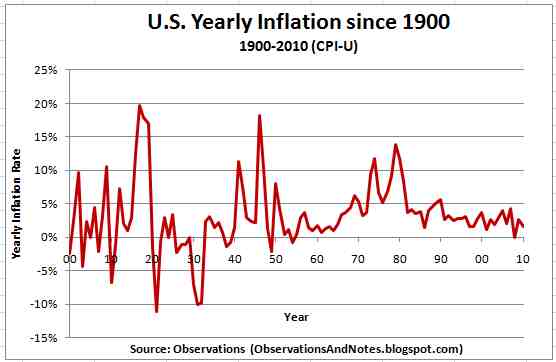
Also, there are several periods in American history when we had modest deflation and a booming economy. The Roaring Twenties was one. How did that happen?
If computers get cheaper while the average consumer’s disposable income stays constant, then people will just buy fancier computers, or spend less on computers and use their savings to buy more of other things, or be grateful that the cheaper computers make up for rising prices in other things they want (e.g., health care).
If the average price of everything goes down, then the average consumer’s disposable income must eventually decrease; to make up for the lost income, employers will have to either cut wages or lay off workers.
PS: The Roaring Twenties were not always so roaring. There was a depression in 1920–21, and according to the helpful St. Louis Fed graphs, there were two other recessions between 1921 and 1929.
Everyone has an opinion about BTC's deflationary nature, but few people seem to consider the possibility that BTC might be the first currency that works substantially differently in this regard to all other past currencies.
BTC is the first currency that is infinitely subdivisible. Ostensibly only 21 million BTC will be created, but since it is subdivisible to 8 decimal places, there will be [21 million / .00000001] = 2.1 quadrillion atomic units.
And that is only an artifact of the data structure used to implement it in code, not an inviolable requirement of the protocol. The precision, and hence the quantity of BTC, can be increased in the future if necessary.
This aspect of BTC, along with the fact that is not a debt-backed interest-bearing fiat currency might require a rethinking of the Quantity Theory of Money as it applies to Bitcoin-like currencies.
Additionally, only ~7 million Bitcoins have currently been created, only ~33% of the eventual total. The BTC economy is so new you can't buy much with it besides other currencies, computer parts from Newegg etc., and perhaps illegal drugs. Finally, forks like Solidcoin are appearing based on perceptions of consequential flaws in the BTC technology (absolute dependence on miners to extend the blockchain, etc.).
Imho it's worth withholding judgement for a few years at least and just observing how it develops. It's something potentially new, to which the old rules may not apply.
The ability to subdivide BTC is irrelevant to the question of depreciation. If 1 BTC goes from $10 USD to $20 USD, then 0.5 BTC goes from $5 USD to $10 USD. It doesn't change the money supply any more than slicing up a gold nugget creates more gold. Bitcoin is still inherently deflationary. All subdivision does is avoid imposing a minimum transaction size.
Bitcoin is also unique in that a substantial portion of the total BTC that will ever exist have already been destroyed, as many early adopters abandoned or lost their wallets.
That may be, but the western world is then abnormal. US population is projected to peak at 2030, and a number of countries already have negative population growth. Exponential growth assumptions should not be made for long periods ahead.
http://en.wikipedia.org/wiki/List_of_countries_by_population...
We have never before experienced a reduction in the human population for any extended period of time.
I wouldn't count the US out yet, it can easily augment its population with immigration. So can all the other developed countries.
Anyway, regardless, making a currency with a fixed supply doesn't work under any scenario. With a constant or increasing population, you want to increase the money supply. With a decreasing population, you want to decrease it.
Inflation is by definition a rise in price levels, usually measured by the CPI (whose definition is sometimes subject to debate, but no measure of price levels is perfect; the important thing is to choose one that's reasonable and then stick to it).
Inflation, i.e. a rise in price levels, can then cause an increase of money supply measures, as producing firms take on larger amounts of credit to finance their operations, and this leads to a (rather weak, and only valid over the long run) correlation of inflation and growth of money supply. There are also tertiary effects that can cause both inflation and growth of money supply (such as excessive government deficits). But it's important not to confuse those things.
Various operations by the Treasury and Fed affect the banks. Then you get a shiny new credit card in the mail. I wouldn't call that wealth redistribution.
I don't think we'll reach a peak of technological progress in the 2030s.
Unless, of course, economic stagnation is encouraged by discouraging the inherently risky process of investment by making the average return zero.
I could easily make the case that saving goes up! Why? Well if I took my goldbucks and lent them to you at 1% interest we would both be happy. My total return would be something like 3% per year (2% deflation + 1% interest) non-risk adjusted. You would be happy because there are plenty of people that are willing to lend money to you. Because you have access to lending capital, you hire more decreasing unemployment. You can try to make the case that you wouldn't hire because there would be no demand for your goods, but in practice there are A. Other countries, and B. A precedent that people do continue to buy, even during deflationary pressures.
The reason people buy computers and cars despite the fact that they are becoming better and cheaper as time goes on is that they expect that cars and computers are going to continue to get better and cheaper as time goes on. They know that they will face the same "save or spend" decision 2 year later, and they really do need a computer and a car.
The problem with inflation is that "encouraging spending" practically only happens to the poor or middle lower class. I can afford to research gold, silver, lithium, cesium, grain futures, bitcoins, etc. and protect my assets from long term depreciation, but they can't. So you end up with a class of people that have a negative net worth, that is totally unprepared for long term retirement.
* I know that money velocity starts to make a difference, but it is in effect the same as printing more money.
For those with excess money, inflation does encourage investment. Under a steady inflationary pressure, it is irrational to hoard your excess money under a mattress or put it in the bank and earn interest, because interest won't keep up with inflation. Your money evaporates away under that scenario. Instead, if you want to act rationally, you would look for other places to put your money where it could outperform inflation. That's the only way you have a chance of holding onto the value it represents.
Deflation discourages spending, but it also discourages investment. Sure, you could justify rolling the dice on some investments to try to outperform the constant bump in value you get every day from deflation, but why bother with that extra risk? If you just sit on your money, trying not to spend it, you'll have way more value in the future than you could ever hope to get out of it today.
This isn't about saving vs. spending, it's about using money for what money is meant for -- exchange of value for value, not as a durable permanent store of value.
The rich can afford to move their money to more stable currencies and commodities in an inflationary environment. They are more likely to have insights and are way less likely to spend a large portion of their wealth year-to-year.
I disagree that deflation discourages investment. Given a stable deflationary rate rational actors will look at the returns their fellow citizens are getting (from say a mutual fund, or even government bonds) and will conclude that their purchasing power can be furthered.
Furthermore, the United States had a (quazi) gold standard for years, as did most of the world, and investment continued.
And in practice, to most rational actors a mild deflation is almost indistinguishable from a mild inflation. It's when either of those swing wildly that we have issues. Bitcoin increased in value 11x in the six months from Sep'10 to Feb'11. That would be a major problem if we were all using bitcoins instead of dollars.
Mild deflation is indistinguishable from mild inflation to a rational investor only where he expects said mild deflation to be temporary, offering him positive average returns on long term investments.
What you want, ideally, is a currency whose value doesn't fluctuate much at all in the short term, and which has a long term trend towards slight inflation.
In a deflationary economy, it becomes a very valid option which will serve to drive down the other two, particularly investment in productive assets
In a deflationary economy, holding cash offers a net return equivalent to the average investment return, without the associated risks or loss of liquidity. Essentially investment would become equivalent to spread betting (the costs of running an investment operation being analogous to the bookmaker's spread which makes it certain the average investment returns a loss); you'd only consider it if you thought you were a lot smarter than the rest of the market.
Given falling prices, it would also be more appealing to delay consumption than it is now, though people would still need and want things.
The economy won't come to a complete standstill - people people would continue to buy what they need and some investors would be tempted to gamble. But it would certainly slow down.
If someone wanted the social trend to be towards historic lifestyles, would deflation accomplish that? It's hard to phrase what I am trying to ask so I hope I am being clear. Imagine that someone wanted everyone to live like the Amish. Would persistent deflation accomplish that? Would persistent deflation produce a world where people spend less of their time feverishly trying to make more money and more of their time enjoying what they already have? Would persistent deflation reduce the rate at which we destroy the environment around us?
If inflationary economic systems reward those with money to leverage into investment returns, do deflationary systems reward those who do not? If inflationary systems encourage people to lend out the product of their labor to others to use to create their own wealth, do deflationary systems discourage this, and if so, would the result be that it would be harder for people who are at an economic disadvantage to better their situation? Conversely, would it be harder for people who are at an economically advantageous position to increase their wealth because investment vehicles are less numerous and more risky?
I get the feeling that some people believe that economic growth is an objectively desirable outcome; but must it always be? I do not know exactly how I feel about it, but I feel that it doesn't seem like it should be the given that others seem to believe that it is.
That's not true except in an economy already operating at maximum capacity. The argument for a depreciating currency is that it encourages people to spend or invest it, while if you have an appreciating currency, people just hold onto the bank account numbers instead of generating any economic transactions or activity.
Mind you, there are counterarguments and other problems you get from a depreciating currency, but that's the argument.
And deflation encourages the sellers to sell today.
So, in theory, don't deflation and inflation both encourage economic activity?
Properties that they posses at least in part because of the fact that currency is not a good long-term value storage proposition, and so they are not hoarded.
Yes, currency is used (where available) for transfer of value because it is highly liquid, but I would not say that liquidity alone disqualifies a potential good from consideration as value storage. Quite to the contrary. And since currency circulates rather than being reformed as tissue paper at the end of every transfer, it effectively stores a constant amount of value until such a time as it is retired.
No, liquidity isn't important for investments. Liquidity is important for trade, and investment is not trade. It's perfectly acceptable for the transfer of long-term investments to take minutes, days, even months.
msbarnett suggested that currency is liquid partly because it cannot store value. I asserted that value stores do not need to be liquid, but it's a nice property for them to have. This is not strictly contrary to non-storing implying liquidity, so that was poor wording.
By currency storing a constant amount of value, I was referring to the fact that the money base is a concrete amount. It comes into existence in exchange for some value, and represents a debt equal to that value. Money is, in very real terms, a store of that predetermined value (convolved with the plausibility of collecting that debt), same as any debt marker.
This is not a big deal and people adapt to what provides the maximum real profit. You're only going to get depressed if you're used to the old trend of ever increasing prices.
Exponential growth can never continue forever. We are probably at or near the practical limits to growth on this planet.
I think inflationary currency is an ugly hack to cope with the era of exponential growth.
Why? ... Perhaps your views are different. Can you please point to a few good writers which you like with contrasting views than his.
(Asking a serious question. Since I, for one, like his views a lot)
He has a tendency of twisting basic economic theory to fit his political agenda. It makes me nauseous.
> Can you please point to a few good writers which you like with contrasting views than his.
Just read the Wall Street Journal. They actually specialize in this sort of thing. You'll get a far more accurate picture of what's going on. NYT is good for regional and national news, not for business and economic commentary.
The subtextual motivation for Bitcoin advocacy has always been "it's a speculative asset and I hold a position in it". Everything else is just rhetorical cover.
The unfortunate reality is that even by reasoning through Bitcoin's programmed-in deflation, we're dignifying Bitcoin. Bitcoin itself is a sham. The original paper may have been a good-faith contribution to the state of the art in cryptocurrencies, but the "economy" is a trap; a realistic-looking distributed transaction clearing system built on a deliberately volatile wholly synthetic "asset" that exists for the purpose of creating pump-and-dump scams.
This whole system is morally no different than Zynga tomorrow setting up a system to trade options on Farmville tomatoes.
"Bitcoin is a scam" is simply not enough to explain stuff from the Bitcoin bulletin to open source GPU mining software - hard work by obviously capable people, and not even remotely the most effective way to become rich.
Mind you, I think the "true believers" are incorrect, sometimes naive and occasionally downright stupid; but declaring them "evil" leaves quite a few unanswered questions. [EDIT: Even if the speculators are probably in the majority.]
(Also, I wouldn't be surprised if EVE had a foostone contract future market...)
EDIT: also, there was nothing wrong with the system design. A bit uninspired, maybe; current research involves zero-knowledge exchanges and the like.
Arguing that inflation is good is tantamount to arguing that illiquidity is good. If I were to argue for inflation, I would go with some other angle, like that capital should evaporate after a lifetime.
Please cite a source on this "one rule of money" you're thinking of?
says one of the properties of money is that it has to be a 'store of value'.
Actually, is there an efficient way that physical gold or other precious metals can be intentionally destroyed or put beyond use? Has anyone tried to use this technique to corner a market?
What would happen if Hugo Chávez actually got his hands on 211 tons of actual gold and announced he has verifiably shot half of it into the sun? Presumably, you could make money on such an event through the options market.
So it's a great point that it's comparatively easy to do such a thing with Bitcoin. It's even entirely possible to do it by mistake (i.e. a programming error).
Physicality is a fantastic hedge against loss.
In Goldfinger, the eponymous villain tried to irradiate all the gold in Ft. Knox with a dirty bomb, making it worthless.
I'm also not sure how much Krugman has looked at the price of Bitcoin. Every time I've looked at the price it continues to go down in terms of USD. A couple months ago it was around $16 now its at $7.
I think Bitcoin's real problem is the fact that it's not actually a commodity, because it's price isn't backed by any real goods. In that sense it's more similar to the dollar.
Second, providing interest to those that hold their bit coins in this bank must provide some facility for the bank to be able to give out bit-coins they didn't previously have (fractional reserve banking). Due to the mining nature of bit-coins which is not regulated by the fed but limited to an absolute supply, interest can not always be guaranteed to the holders, and there would be a run on the accounts to pull out.
What you've described is the system we have- BitCoin is an experiment on something different.
Now, I'm not saying anyone should actually try to do these things. In fact I agree that Krugman is missing the whole point of bitcoins to the point where he doesn't even bring up it's semi-anonymous nature. I simply wanted to counter his argument that commodity currency wouldn't allow the economy to grow, but as I said earlier bitcoin isn't a regular commodity. It is a currency whithout intrinsic value.
??? A bank makes money by taking deposits (giving interest) and then lending them out (collecting a higher interest). The reserve percentage is that amount that remains unlent.
Full reserve = no loans = no profits = no bank.
Edit: Yes, you can practice full-reserve with a negative interest rate, which is effectively a safe-deposit box does (they charge a fee for the box).
That is the tl;dr of the wiki link.
The week-to-week reality of Bitcoin is one of wild swings in the "valuation" of the Bitcoin "asset". Describing these swings as "inflationary" and "deflationary" dignifies Bitcoin. Was the collapse of PETS.COM and resulting devaluation of its stock "inflationary"? Was its run-up "deflationary"?
Save your value in assets.
The North American drumbeat urging the sacrifice of security for "the economy" is interesting... reminds me of communism's drive to sacrifice for "the collective".
Even if it should be encouraged, it doesn't matter the logic of it, people won't accept making less and less money over time. Non-fiat currency + population increase makes that inevitable.
It actually is. It you earn $100, by producing $100 worth of goods for the economy, and you don't spend it, you're producing more than you consume. This increases the supply of all goods on the market, decreasing the price, effectively making the entire world richer by that amount. Other people can use that extra money partly to increase their consumption and partly for investment purposes. When you take your $100 out of your pillow and spend it, you're then having the opposite effect. So in the end, you're allowing people to consume more at an earlier time (when you put the money in) and less at a later time (when you're taking it out). This is a very valuable service, as shown by the fact that people are willing to take out loans where they pay money (interest) for the ability to temporally distort their consumption patterns in this way. Some people can even use the temporary possession of additional goods as capital to generate permanent wealth.
A constant pattern of people saving under their pillow will simply reduce prices by a certain percentage and hold it there. If deflation is small, then this secondary price reduction will be lower than the primary reduction and the economy will remain stable. The problem only arises when deflation becomes too high - then, the secondary reduction becomes greater than the primary reduction, and causes a still greater tertiary reduction, leading to a deflationary spiral (ie. bubble), which screws up the economy until it inevitably pops, but if deflation is within reasonable margins it should not be an issue.
> Even if it should be encouraged, it doesn't matter the logic of it, people won't accept making less and less money over time.
How do we know this? One could imagine a deflationary society where people ask how people could possibly stand their money buying less and less over time.
It's good for the individual if investment opportunities aren't adequately regulated.
Spot friggin' on, Mr. Krugman. Bitcoin's supply limiting design has added a psychological dimension that encourages collecting. Perhaps when Bitcoin reaches supply maturity the value will stabilize but for now its value just too unstable to be used as a currency.