News for hackers. Stuff that matters.
Re:Museum of Plugs and Sockets by asplake on Thursday November 25, 2021 @01:41AM (#29338808)
As a Brit, got to say that I wish we used Europlugs here. Ours are so bulky (a pain for anything portable), and the US ones seem so flimsy.

Also, there ought to be a museum of hotel electrics. Weird light switch behaviour, dumb (pre phone charger) socket placement, heating/cooling controls, etc

Re:Museum of Plugs and Sockets by smcl on Thursday November 25, 2021 @05:00AM (#29339887)
As a Brit living in the EU, I kinda miss the ones back home - for two reasons, the grip and the orientation. I don't know anything about relative safety of either, this is purely about UX :)

The UK plugs usually have a very clear way to grip them and pull them out of the socket, and yanking them by the cable neither looks nor feels right. Whereas the Europlug ones I have mostly have a very dainty, slight place to grip with your fingers and are often very tight - often they really invite you to pull by the cable itself.

There's a little bit of ambiguity about orientation - sometimes the socket has an extra prong sticking out meaning you have to use the plug the right way up, and sometimes there's none. But it can sometimes happen that you're not sure if you're a few degrees out in aligning the prongs in the plug, or if you're just the wrong way up and the earth prong is in the way. Obviously if you can see the socket this isn't a huge issue, but if you're reaching behind a TV unit, or a desk or a counter etc you're in for a bit of fumbling.

I have a similar feeling around lightswitches - the European ones are large, delicate and a little flimsy and the UK ones are little and compact and feel solid. I think it's not allowed to have the UK switches here, which is a shame otherwise I'd fit out my flat with them :)

update: oh speaking of switches I completely forgot that power sockets generally also have an on/off switch in the UK. I guess it comes down to personal preference but I liked having the extra "off" switch for reasons that I can't quite articulate

Re:Museum of Plugs and Sockets by adders on Thursday November 25, 2021 @07:22AM (#29340723)
Yes, the Brit plugs are great until you step on them in the night

Funny comparison of different plugs from a few years ago https://www.cnet.com/tech/computing/plug-versus-plug/

Re:Museum of Plugs and Sockets by cameronh90 on Thursday November 25, 2021 @09:47AM (#29341761)
Who just leaves plugs lying around on the floor though?
Re:Museum of Plugs and Sockets by smcl on Thursday November 25, 2021 @07:43AM (#29340862)
To be honest unexpectedly stepping on any plug that's lying around on the floor is pretty unpleasant :)
Re:Museum of Plugs and Sockets by simondotau on Thursday November 25, 2021 @08:21AM (#29341122)
Yes but the UK plug has a high likelihood of idling with its prongs pointing up, a characteristic not shared with most other plug designs. As painful as it is to step on the side of a plug, stepping directly on the prongs is worse.
Re:Museum of Plugs and Sockets by ponyous on Thursday November 25, 2021 @07:06AM (#29340627)
European living in England, I really dislike the English ones. I got shocked once because it was so hard to pull out I had to use both hands and accidentally touched both pins at the same time...

I prefer both plugs and switches in Europe. Probably for the same reasons as you - I grew up with them, and they feel right.

Re:Museum of Plugs and Sockets by rxt_ian on Thursday November 25, 2021 @07:12AM (#29340669)
The live prongs are insulated to such a length you should not be able to touch any conductive part before the plug is no longer making electrical contact with the socket.

It's likely you got a small zap from a filtering capacitor inside the device that had not yet discharged.

Re:Museum of Plugs and Sockets by ponyous on Thursday November 25, 2021 @07:20AM (#29340710)
I am not an expert and the shock didn't feel as bad as I expected so you are probably right.
Re:Museum of Plugs and Sockets by iso1631 on Thursday November 25, 2021 @12:16PM (#29343072)
If it was a genuine plug, but there are non-genuine plugs around which aren't insulated (as well as ones with an insulated Earth!). If the plug was older than 1984 it could even have been genuine, as insulation wasn't required until then.
Re:Museum of Plugs and Sockets by cjrp on Thursday November 25, 2021 @11:00AM (#29342386)
That's where the off switch on the socket should be used; another handy design feature!
Re:Museum of Plugs and Sockets by mytailorisrich on Thursday November 25, 2021 @04:16AM (#29339637)
As an European who's travelled and now lives in the UK I find that the British plugs and sockets are the best ones.

The metal connectors are big, but that feels like quality, but the plugs are not bulky off the wall because of the overall angled design (European plugs actually eat up more space off the wall because they are straight although of course europlugs take much less surface area on the wall), which is good behind furnitures or where space is tight. There is only one sort of plug and it has a well designed earth connector. Plugs include a fuse and it's easily replaceable (this is partly due to the standard use of ring circuits in the UK but I find it a nice feature anyway). They have very good grip and stay in place very well (compare this to europlug...). Sockets have an integrated switch.

British plugs are a quiet success (the other one being postcodes).

Re:Museum of Plugs and Sockets by ginko on Thursday November 25, 2021 @04:19AM (#29339655)
I disagree, way overengineered and bulky. The fuse is only necessary due to shoddy British wiring standards.
Re:Museum of Plugs and Sockets by BerislavLopac on Thursday November 25, 2021 @04:29AM (#29339721)
> The fuse is only necessary due to shoddy British wiring standards

In other words, they're solving a very real problem here. And so is the rest of the plug as well.

It seems that most of the continental Europeans that have moved to the UK (myself included) are positively amazed by the details of the UK plug design.

Re:Museum of Plugs and Sockets by barrkel on Thursday November 25, 2021 @06:07AM (#29340278)
The area around Swiss sockets are more bulky in practice because (a) wires come out at 90 degrees to the wall and (b) adapters and extensions and whatnot are required to plug in wall-warts, which are really common these days, whether it's USB power for various gadgets, cordless vacuum cleaners, video Alexa (not USB-powered), etc.
Re:Museum of Plugs and Sockets by quietbritishjim on Thursday November 25, 2021 @07:28AM (#29340757)
> the plugs are not bulky off the wall because of the overall angled design

Not only that, also gravity pulling on the cable naturally tends to pull European and North American plugs out of their sockets, whereas this angled design in UK plugs prevents that.

Re:Museum of Plugs and Sockets by fooblat on Thursday November 25, 2021 @08:28AM (#29341183)
Gravity is a problem for N American plugs but not for Euro or Schucko plugs in Schucko sockets. This is what they have in Germany and the Netherlands. The plugs fit in snugly and do not move. If you don't push in enough to "lock" in then a spring (or something) pushes the plug back out. So it is very obvious when it is in correctly and basically can't be partially plugged in. Gravity has no impact on the plugs in my house whatsoever.

The Schucko plug/socket system is very robust, safe, and well designed.

Re:Museum of Plugs and Sockets by Phemist on Thursday November 25, 2021 @08:16AM (#29341083)
I studied as an Erasmus student for a year in England. Every European student I knew had an "epiphany" moment where they realised that standard European plugs work on UK sockets, if you stick a pen in the ground "hole" to unlock the rest of the socket holes.

Converters are a pain to use, they are always flimsy and there always too few available. It is usually not worth getting UK specific plugs for the short-ish duration of the Erasmus period.

Safety and the increased fire hazard was, in our student-mindset, a small sacrifice for the convenience we got in return.

Re:Museum of Plugs and Sockets by Symbiote on Thursday November 25, 2021 @01:14PM (#29343568)
With the modern Europlug design, this tends to wreck the British sockets, as the prongs can get jammed.
Re:Museum of Plugs and Sockets by OJFord on Thursday November 25, 2021 @04:07AM (#29339581)
We win on Earth, though. I'd be with you if Europlugs had a central Earth (still reversible) that was longer, making contact first & opening shutters as BS1363.

Shame BS546 ('lighting circuit') sockets aren't (still) more common really. You could (buy a house with them or fit them and) replace plugs on cables of course, but not your USB charger with plug & transformer in a single moulding.

Re:Museum of Plugs and Sockets by ginko on Thursday November 25, 2021 @04:17AM (#29339648)
The ground contacts in Schuko plugs DO make contact first. It's just less obvious from the design I guess.
Re:Museum of Plugs and Sockets by OJFord on Thursday November 25, 2021 @05:31AM (#29340053)
I'm aware, but Schuko != Europlug (despite being a plug used in many Euro countries), does not have shutters on the live/neutral opened by Earth contact, and (partly consequently) can often be trivially (mis)used not Earthing a device which should be.
Re:Museum of Plugs and Sockets by tremon on Thursday November 25, 2021 @08:13AM (#29341067)
It isn't that trivial, as a device that should be earthed is not allowed to be sold with a Euro plug, they must have a Schuko plug. And likewise, an extension cord featuring Schuko sockets must have a Schuko plug, so there is officially no way to connect a Schuko device through a Euro plug.

The real problem is with classic sockets as shown in [1]: these are two-pin (unearthed) sockets that can accept a Schuko plug nonetheless, and are widely used even in residential newbuilds, at least in NL. I think the building code has been updated now, but it's very common here to have entire rooms where the sockets don't even have a third wire in the wall box.

[1] https://www.plugsocketmuseum.nl/ContEUR_part2.html

Re:Museum of Plugs and Sockets by jacquesm on Thursday November 25, 2021 @11:53AM (#29342849)
Correct, new installations are required to carry ground to all sockets, but old systems are grandfathered in with the exception that if you upgrade one of the sockets in a room to grounded you have to do it for all of them.

To get really pedantic: you are allowed to put a device that normally requires a safety ground into a non-grounded ('old style') outlet but then that circuit should have ground fault protection installed and conversely, if you have a circuit (such as for instance an oven) that does not have a ground fault protector you must use the ground.

This covers a very large percentage of all normally occurring situations, though of course there will always be tricky ones due to rare combinations of devices and installation details.

If you can play it safe: put ground fault protectors on all of your circuits except where leakage current is too high as a result of the consumers design and limit those to one consumer per circuit (dedicated circuit).

This goes double for 'wet' spaces such as bathrooms, kitchens and so on, ground really is mandatory there from a safety perspective even if the code says it isn't, so if you still have ungrounded sockets in bathroom or kitchen add a ground if there is any reasonable way of doing so.

In bathrooms the ground point can frequently be found behind the bathroom mirror over the sink. And don't be tempted to use the waterline, those are frequently made of plastic nowadays and no longer count as safety ground.

Re:Museum of Plugs and Sockets by OJFord on Thursday November 25, 2021 @08:27AM (#29341177)
Thanks for the correction, think I'm confusing [1] (memories of France ~20 years ago, and old houses then) with Schuko.
Re:Museum of Plugs and Sockets by jacquesm on Thursday November 25, 2021 @11:58AM (#29342895)
Almost all of the sockets installed today have these shutters integrated, you need to put something synchronously into both neutral and live to get them to open.
Re:Museum of Plugs and Sockets by afiori on Thursday November 25, 2021 @05:08AM (#29339933)
In the uk plugs the ground contact also acts as a switch; you actually can use an europlug with the uk sockets but you need insert something in the ground pin anyway (some sockets simply a plastic pin instead of a connector)
Re:Museum of Plugs and Sockets by mytailorisrich on Thursday November 25, 2021 @06:36AM (#29340448)
It does not act as a switch. The way it usually works, as mentioned by OJFord, is that wall sockets have safety shutters on the live and neutral connectors, which open when the earth pin is inserted in the earth connector in order to prevent a plug without earth from being connected. That's why sockets always have an earth pin even if only plastic on some cheap ones (for double insulated devices that do not require an earth connection).

Pretty cool feature.

Re:Museum of Plugs and Sockets by ClumsyPilot on Thursday November 25, 2021 @06:52AM (#29340543)
Mobile phone adapters and other low power devices don't use the Earth even in Uk, they have a plastic prong there and you just get extra weight and bulk.
Re:Museum of Plugs and Sockets by jacquesm on Thursday November 25, 2021 @12:05PM (#29342970)
This goes for many devices that have an isolation transformer or equivalent in their primary circuitry. Beware of cheap knockoffs though, they will look the same but will lack that isolation and possibly the separation required to make such a device safely and they won't have ground. So if anything fails there the return path to earth will be you. Better hope you have a ground fault protector in place when that happens.
Re:Museum of Plugs and Sockets by aigo on Thursday November 25, 2021 @08:44AM (#29341297)
I"m doing by bit for those lighting sockets, I've just had about eight or ten installed all around my house. Turning on lamps from the wall light switch as you enter a room is a massive quality of life upgrade.
Re:Museum of Plugs and Sockets by dvdkon on Thursday November 25, 2021 @04:29AM (#29339718)
I have to say I like the CEE 7/5 exposed ground, it's admittedly a niche use, but it's easy to touch and/or clip onto.
Re:Museum of Plugs and Sockets by gmac on Thursday November 25, 2021 @04:31AM (#29339735)
Fellow Brit, strongly disagree. The Europlug feels to me barely less flimsy than the US type. Ours and the Schuko are about the only ones I feel fully safe using.
Re:Museum of Plugs and Sockets by tiziano88 on Thursday November 25, 2021 @04:42AM (#29339789)
If I had to choose a plug to use all over the world, it would actually probably be the UK one (or perhaps a slightly less bulky version of it). See https://youtu.be/UEfP1OKKz_Q
Re:Museum of Plugs and Sockets by wongarsu on Thursday November 25, 2021 @05:26AM (#29340025)
The Schuko and Europlug have the same safety features as the British one:

- the same shutters prevent screwdrivers

- A plug half in isn't an issue because the sockets are recessed (but as an additional measure the Europlug has the half-way isolation like the British plug)

The only real advantage of the British plug over Schuko is the fuse (a debatable feature) and the known polarity (Schuko and Europlug don't differentiate between live and neutral).

Nice features that the Schuko variant has that the British plug is missing:

- Ground connection is exposed in the socket, giving you an obvious way to reliably ground yourself (useful when working with electronics)

- Recessed socket design allows plugs that barely stick out (those are not the norm, but are available for use behind furniture etc)

- You have Schuko for "serious" use (ground wire, high current) and Europlug for things that don't need either, with Europlug fitting in Schuko outlets. This gives extension cords more flexibility, many have a mix of Schuko and Europlug outlets to fit more plugs in the same space.

Re:Museum of Plugs and Sockets by Vinnl on Thursday November 25, 2021 @06:24AM (#29340378)
> Nice features that the Schuko variant has that the British plug is missing:

It also doesn't land with the sharp side up, saving a whole lot of people from accidentally and painfully stepping on it.

Re:Museum of Plugs and Sockets by tentacleuno on Thursday November 25, 2021 @05:37AM (#29340089)
> The only real advantage of the British plug over Schuko is the fuse (a debatable feature)

Could I ask why a fuse is debatable? Seems like quite a basic security feature. There's a good video[0] on the design of UK plugs if you're interested.

[0]: https://www.youtube.com/watch?v=UEfP1OKKz_Q

Re:Museum of Plugs and Sockets by wongarsu on Thursday November 25, 2021 @06:35AM (#29340442)
If it's such a basic security feature, what is it actually protecting?

In a standard (non-British) home, each room has a separate (10A or 16A) breaker in the breaker panel. That breaker protects the wires from overheating (preventing cable fires), and in more modern instances might protect the human from electric shock with an RCD. Then each device may have an internal (usually self-resetting) fuse to protect itself from failure modes. That fuse is tuned to the device needs, both in how fast it triggers and how much current it allows.

What does a fuse in the cable buy you? It can't reliably protect the device, because the user might replace the cable or replace a blown fuse with one with a different rating. It can't protect wires because it's after the house wiring, a large number of functioning devices overheating your wires is at least as likely as a single malfunctioning device. The only context in which it makes sense it the one Tom Scott mentions: you have a copper shortage, so you put the entire flat or even house on one circuit with one fuse. And because you don't want to cut electricity to everything every time there's a short somewhere you put little fuses everywhere.

It's a good design for the circumstances of post-war Britain, but we aren't living in a copper shortage right now.

Re:Museum of Plugs and Sockets by JetSetWilly on Thursday November 25, 2021 @07:17AM (#29340692)
Not everything has a 13 amp fuse in the plug. In fact most things have a 3 amp fuse unless they are kettles or something. There's also 5 amp fuses and it is possible (tho not that common these days) to have even a 1amp fuse in the plug itself.

Surely it is better to have a lower amp fuse tailored to the device, than a high amperage fuse that's happy to send 3000 watts into your dodgy mobile phone charger without fusing.

Re:Museum of Plugs and Sockets by tentacleuno on Thursday November 25, 2021 @09:19AM (#29341542)
> What does a fuse in the cable buy you? It can't reliably protect the device, because the user might replace the cable or replace a blown fuse with one with a different rating.

Ehh. While I see the logic in the rest of your argument, I don't see how being able to change the fuse means the device on the end of the fuse can not be reliably protected. If anything, being able to adjust the fuse to the needs of the device is even better, e.g. if you go from a high-load bulb to something like an LED. I'm not saying anyone runs around the house checking every fuse in every wire, but this does seem like a consideration you've not really made.

> It can't protect wires because it's after the house wiring

I don't see how it can't protect the wires, could you give an example? If a device with a 13A fuse is drawing over 3120W, the fuse will blow to protect the device itself and the house wiring. Could you elaborate on this, please?

> so you put the entire flat or even house on one circuit with one fuse.

Yeah, and we still use that system today. In most residential houses in Britain, we have a main fuse coming into the house. The rating of the fuse depends on what the house can take, e.g. 60A, 80A, or 100A. The main high amperage circuit in most homes in the UK would be the shower, which needs more than 3000W. Mine is a 6.5kW shower with 32A wiring (and the respective RCD).

I personally think fuses in plugs also serve as a common sense mechanism: if your computer monitor is drawing 13A, there's obviously something wrong. That's where the fuse comes in. It's just another protection.

Re:Museum of Plugs and Sockets by iso1631 on Thursday November 25, 2021 @12:21PM (#29343127)
So you have a 16A fuse/breaker, and a wire that will take 16A. Then you plug in your lamp with a thin wire that can only take 3A. In the UK that's fine, as you have a 3A fuse, the lamp develops a fault and starts pulling 10A, the fuse blows, job done.

Without that fuse though, the wire overheats, and you get a fire.

Looking at the fairly new soldering iron plug next to me, with a 3A fuse that wire does not look anywhere near thick enough to qualify for passing 13A.

Re:Museum of Plugs and Sockets by tentacleuno on Thursday November 25, 2021 @05:34AM (#29340076)
The UK plug is honestly one of the best things the UK has ever done. It's reliable, hard to pull out via the cable, running at a sensible voltage, and they just feel so sturdy. Rectangular contacts also hold a grip much better than round ones (in America and friends).

I've heard horror stories about American plug sockets. It's just way too easy to shock yourself. And then you have all the other weirdness, like 240V on the grid being stepped down for 120V for appliances. Wouldn't it be easier (and more energy-efficient), to use 240V instead of stepping it down and having to pull more current at the appliance level to make up for the voltage?

Re:Museum of Plugs and Sockets by jakedata on Thursday November 25, 2021 @06:06AM (#29340272)
Here in the states we do not step 240v down to 120v. Typically a home has 240v split-phase service with 240v available L1 to L2 and 120v by using L1 or L2 to neutral. Our circuit breaker panels alternate L1 and L2 bus connections internally so a column of single breakers will alternate between L1 and L2 for balance while a double breaker will get 240v by connecting to both busses. A 240v double breaker has a physical connection between the trip levers so that an overload on either leg will trip both.
Re:Museum of Plugs and Sockets by kruador on Thursday November 25, 2021 @06:37AM (#29340451)
Relevant video: Technology Connections, "The US electrical system is not 120V", where there is a (long) discussion of how the breaker panel works and how you get 240V.

https://www.youtube.com/watch?v=jMmUoZh3Hq4

Re:Museum of Plugs and Sockets by teddyh on Thursday November 25, 2021 @09:23AM (#29341569)
By the same definition, the European electrical system is not 240V, it’s 380V.
Re:Museum of Plugs and Sockets by jacquesm on Thursday November 25, 2021 @09:56AM (#29341855)
This is an incorrect interpretation of the differences between the two systems.

In the EU the 380V (now nominally 400V) relates to tri-phase, the 240V to the voltage between a phase and ground.

Tri-phase power in the United States is available to residential consumers and very light industry (say a small farm) at a number of different voltages up to 480V.

The 240V in the united states is between two 'lives' that are both 120V and that are usually delivered on a center tapped transformer with the center being the neutral. Adding those two together gives you the 240V, but it all comes from a single phase, it's just a center tapped transformer with a 240V winding as the secondary.

You can easily see this when you look at your typical drop transformer that will take a 10KV low voltage distribution line to domestic voltages, where three phase power is required you'll see three transformers in a bank, one for each phase. A typical residence will have only one because in North America single phase power is the norm for distribution.

https://www.mytpu.org/wp-content/uploads/wires.jpg

Is pretty typical in NA.

So a typical drop will have a distribution neutral and a single distribution phase going in to the transformer and three wires coming back out: L1, N and L2 with L1 and L2 being the outside legs of the winding. In your distribution panel you then add your residential ground.

Re:Museum of Plugs and Sockets by jacquesm on Thursday November 25, 2021 @02:29PM (#29344203)
bugfix: the 240V to the voltage between a phase and ground

This is possible, but more likely is a phase-to-phase in a delta configured transformer. In that case there is no ground delivered to the distribution panel, just two phases (or three).

Re:Museum of Plugs and Sockets by frosted-flakes on Thursday November 25, 2021 @09:48AM (#29341775)
Europe does not have split phase electrical service. Three-phase service is ultimately how the US system works, same as Europe; it's just that entire neighbourhoods or streets will run off a single 240 V phase rather than each house getting all three phases (industrial buildings commonly have three-phase service).
Re:Museum of Plugs and Sockets by jacquesm on Thursday November 25, 2021 @12:11PM (#29343023)
> Europe does not have split phase electrical service.

This is incorrect in many places. Yes, you will have three phase electrical service pulled right into the distribution panel, but in many places all you will receive is a single phase because only one of the three possible fuses is installed.

If you want three phase hookup you just pay your utility company a small fee, they come out to install the extra two fuses and in some cases they'll upgrade your consumption meter to three phase.

> Three-phase service is ultimately how the US system works, same as Europe; it's just that entire neighbourhoods or streets will run off a single 240 V phase rather than each house getting all three phases (industrial buildings commonly have three-phase service).

In the US plenty of the last leg of the distribution network is single phase, in the EU it is almost everywhere three phase, except for some rural areas in former East block countries. Typically a step down transformer will take the distribution voltage and reduce it to something the residents can use directly, houses are then alternating in which of the three fuses is placed (R/S/T) to ensure relatively even distribution of the load.

Here you see a three phase domestic hookup (for instance because of an electric range):

https://www.superflink.nl/media/wysiwyg/1-of-3-fase-aansluit...
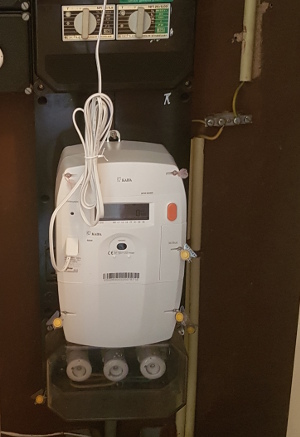
and here a single phase one:

https://www.circuitsonline.net/forum/file/58210/forum-post

In this case the 'S' leg of the transformer is used to power the dwelling.

Re:Museum of Plugs and Sockets by frosted-flakes on Thursday November 25, 2021 @01:51PM (#29343871)
What you describe is not split phase. Split phase is where one 240V phase is split into two 120V legs offset 180°, with a center-tapped 0V neutral.
Re:Museum of Plugs and Sockets by jacquesm on Thursday November 25, 2021 @01:57PM (#29343921)
See my comment elsewhere in this thread where I think I pretty much exhaustively treated the subject.

And no, that particular version of 'split phase' is not +120V and -120V, this is not DC that we are talking about. Europe used to have a lot of that kind of split phase but we 'phased it out' to use a cheap pun.

So now the term single phase is used to indicate what you typically get delivered to your house and we don't further subdivide it. This is good because it means you can run much thinner wire due to reduced current. You do get a bigger whack if you accidentally end up touching the phase or if there is an internal short in an ungrounded device that exposes that phase to the outside (this should never happen). In North America 240 V center tapped off a single drop transformer is the norm for residential delivery.

Re:Museum of Plugs and Sockets by frosted-flakes on Thursday November 25, 2021 @02:03PM (#29343981)
I should have said two 120V legs offset 180°.
Re:Museum of Plugs and Sockets by jacquesm on Thursday November 25, 2021 @02:11PM (#29344056)
That's accurate. In NL until the 70's we had two levels of delivery, 127V (phase to ground, transformer in 'star' configuration) and 220V (phase to phase, transformer in 'delta' configuration). The latter is interesting because it doesn't actually have a neutral wire at all.

The former was close enough that you could get away with plugging in US or Japanese devices, but if there was anything synchronous in there you'd be out of luck (50 Hz vs 60 Hz). Then 220V became the standard and now it is all 240.

Interesting tidbit: there was so much inertia from older systems that needed upgrading in this that it took until 2004 until the last of it (the 127->220V change) was finally done.

Re:Museum of Plugs and Sockets by tentacleuno on Thursday November 25, 2021 @09:20AM (#29341551)
> Here in the states we do not step 240v down to 120v. Typically a home has 240v split-phase service with 240v available L1 to L2 and 120v by using L1 or L2 to neutral.

Ahh, thank you! I should have checked that point more thoroughly.

Re:Museum of Plugs and Sockets by Kaibeezy on Thursday November 25, 2021 @06:00AM (#29340229)
A serious problem with UK fused plugs is when you buy a device so inexpensive it ships with a molded, un-fused plug. Mostly I've had that with removable cords, which can be replaced, but still.
Re:Museum of Plugs and Sockets by BoxOfRain on Thursday November 25, 2021 @07:55AM (#29340941)
I recently bought a variac for testing some old audio gear, it had a Europlug but contained an adaptor for UK plugs. The only thing was despite having an ordinary metal earth pin the adaptor never actually made contact with the existing plug's earth connector. That could have been dodgy!
Re:Museum of Plugs and Sockets by Symbiote on Thursday November 25, 2021 @01:18PM (#29343617)
Those are probably illegal, and a general problem with anything you might buy from Ali Express etc.
Re:Museum of Plugs and Sockets by ginko on Thursday November 25, 2021 @03:25AM (#29339361)
I'd say if we could pick a clean slate design for everyone then I'd go with the Swiss[1] one. Maybe also run it at 400V since modern cables should be able to handle that.

[1] https://www.plugsocketmuseum.nl/Swiss1.html

Re:Museum of Plugs and Sockets by barrkel on Thursday November 25, 2021 @05:58AM (#29340213)
Wall warts of various kinds don't work well with the typical Swiss cluster of three sockets at 120 degree angles to each other. Frequently, various extenders need to be added to actually plug more than one thing into the cluster.

Wires typically come out directly from the rear of the plug, making for a not particularly neat plug scenario. I find myself using 90-degree adapters a lot of the time.

Extension bars also often take advantage of the reduced space requirements, meaning that many of the slots can't be used if you're plugging in any wall warts there.

Finally, UK electricity is 13A @ 240V, whereas Swiss electricity - like most of continental Europe - is 10A @ 220V. The gap here is significant when (a) you need to extend a socket because of space constraints, especially in the kitchen, and (b) when you want a fast-boiling kettle. I had to get a new kettle when I moved to Switzerland and it's noticeably slower to boil.

Re:Museum of Plugs and Sockets by MayeulC on Thursday November 25, 2021 @11:58AM (#29342901)
> Finally, UK electricity is 13A @ 240V, whereas Swiss electricity - like most of continental Europe - is 10A @ 220V

I wonder where you got this idea. Both are 230V. Schulko plugs are 10 or 16 amps (with bigger connectors), 16 A is quite common in my experience.

https://en.wikipedia.org/wiki/CEE_7_standard_AC_plugs_and_so...

https://www.leadsdirect.co.uk/knowledge-base/what-is-the-dif...

> EU 230V -10% +6% (i.e. 207.0 V-243.8 V)

> UK 230V -6% +10% (i.e. 216.2 V – 253.0 V)

Re:Museum of Plugs and Sockets by _djo_ on Thursday November 25, 2021 @03:36AM (#29339420)
The Swiss one was codified as an international standard as IEC 60906-1, which South Africa and Brazil have adopted, so it should be the de facto option for any country looking to replace their current system.

The problem with replacing British plugs is that they need fuses because most British houses are wired with ring circuits, instead of radial circuits like the rest of the world. So I don't see them moving to a new standard any time soon.

Re:Museum of Plugs and Sockets by TorKlingberg on Thursday November 25, 2021 @06:22AM (#29340372)
Specifically most UK mains are fused at 30A, which is more than appliance cables are rated for. So you need a fuse in either the plug or the socket.
Re:Museum of Plugs and Sockets by _djo_ on Thursday November 25, 2021 @06:27AM (#29340392)
Thanks for that clarification!
Re:Museum of Plugs and Sockets by silon42 on Thursday November 25, 2021 @04:45AM (#29339804)
In Slovenia/ex-Yu we had a very similiar (but bigger) 3 phase (400V) plug/socket like that (https://www.plugsocketmuseum.nl/Obsolete_3hd.html #9,10). You can still find it in old houses.

One probably could force the Europlug into it (looks very close), I haven't tried.

Re:Museum of Plugs and Sockets by dingo454 on Thursday November 25, 2021 @04:32AM (#29339736)
I really like this design due to how compact it is. Italy has an almost identical historical design*, but the earth is not offset so LN can be swapped.

Both plugs and sockets are very compact, which is a far cry from the emerging standard which is the shuko/europlug which takes twice the space. Almost all new houses are equipped with shuko sockets.

But the sockets here do not have the additional prong to avoid swapping the neutral, so they're effectively just a waste of space.

* at least, we have two sizes for it, a smaller one rated for 8A, and the newer for 16A which we commonly have today.

Re:Museum of Plugs and Sockets by afiori on Thursday November 25, 2021 @05:00AM (#29339891)
In Italy in practice there are 4 common plugs, 2 type L (big and small), the schuko (type F) with many variations and the europlug.

the compatibility table is not trivial (in particular the europlug is compatible with everithing except the big type L sockets) and while new houses might be to nicer standards, there are a lot of very old houses in italy (i lived in a house from ~1850) and many public spaces use the cheapest sockets they can find so you either get a small type L (accepts also europlugs) a simple schuko (accepts also europlugs and unhearthed small type L) or a big type L (accepts only big type L).

Re:Museum of Plugs and Sockets by hvusslax on Thursday November 25, 2021 @06:49AM (#29340531)
Is the BTicino plug (https://www.plugsocketmuseum.nl/Italian2.html) used at all in Italy now? There was a serious attempt at adopting it in Iceland in the late 1970s to early 1980s. These sockets can still be found in homes that were built in that period and they are just called "Italian sockets".
Re:Museum of Plugs and Sockets by afiori on Thursday November 25, 2021 @07:46AM (#29340878)
Never seen such a plug before in my life, but I have spent very little time anywhere near Ticino

In Italy I have mostly seen (https://www.plugsocketmuseum.nl/Italian1.html) 1,2,4,5, schukos like 17a and when lucky schukos like 9 and 10; I have never seen most of the others.

Re:Museum of Plugs and Sockets by dingo454 on Friday November 26, 2021 @05:15AM (#29348932)
Never seen this one in Italy, and I've been in several fairly old buildings.
Re:Museum of Plugs and Sockets by dingo454 on Thursday November 25, 2021 @05:23AM (#29340011)
Oh I know, I lived in a old house as well and circled through europe so I've seen/suffered all the plugs from UK/France/Germany/Italy...

In this regard, long live the "europlug" and the trend switching towards type F sockets.

But I was just lamenting the bulkiness of it in general.

Re:Museum of Plugs and Sockets by lukeh on Thursday November 25, 2021 @05:25AM (#29340023)
I have a vague memory of getting the Apple (two-pronged) Swiss and European travel kit plugs mixed up, slightly different tolerances, resulting in one very hard to remove iPhone charger.
Re:Museum of Plugs and Sockets by cardinalfang on Thursday November 25, 2021 @07:43AM (#29340858)
Similarly you can fit a UK shaver into a Europlug socket, but may not be able to get it out again.
Re:Museum of Plugs and Sockets by cranekam on Thursday November 25, 2021 @07:33AM (#29340799)
Another cool thing about the Swiss system is the derived 3 phase T15/T25 plugs:

https://www.plugsocketmuseum.nl/Swiss_3hd.html

Our washing machine uses a T15 plug but the socket can also accept a T12 single phase plug instead.

(As a Brit, I'd also pick the Swiss plug as the best, except that the fuseless design wouldn't be good in the UK because of the 30A ring system described in another comment.)

Re:Museum of Plugs and Sockets by londons_explore on Thursday November 25, 2021 @05:43AM (#29340130)
In a clean slate design, I would have all power 5 volts unless negotiated higher.

And it could be negotiated up to 100,000 volts for charging cars with a thin cool cable. 100,000 volts is perfectly safe as long as system capacitance is kept tiny, and leakage current constantly measured. In fact, the voltage of the sparks when you take off a fleece jumper are more than that.

Re:Museum of Plugs and Sockets by 7952 on Thursday November 25, 2021 @07:10AM (#29340650)
Such a system would need a box in the basement and lots of seperate wires to outlets, which would be expensive. Or it would need to put more smarts in wall sockets, similar to adding USB. This is more of a safety risk than just plugging in a usb charger. It requires more skill to install, reduces seperation between high and low voltage parts, could become obselete and has components that might wear out. Also, any system that encourages the use of extension cables is a safety risk. The last thing we want is someone plugging a 5kw heater into an extension cord bought on Ebay.

The current system is nice and flexible and simple enough to be safe. Extension cords work well when you are plugging in a bunch of usb devices and tv/laptop/console. But you can also use the same outlet for a hair dryer or a mixer. Higher current devices like ovens, showers, and cars need to be treated seperately to prevent unsuitable parts adding a fire risk. Lack of compatability to domestic appliances is a feature.

Re:Museum of Plugs and Sockets by londons_explore on Thursday November 25, 2021 @07:54AM (#29340939)
> The current system is [...] safe.

Well, it kills 1000+ people per year in electrical fires in the USA alone. We would never allow electricity in homes like this if it were invented today.

> Such a system would need a box in the basement and lots of seperate wires to outlets.

Yes. But if high voltages can safely be used, and the system is safe in case a cable gets chafed, then the wires become super thin like headphone wires, and overall, the whole system could be produced cheaper than existing systems which use a lot of copper and plastic.

Fire is eliminated too, because a high tech solution measures power losses at every connection, and as soon as enough is unaccounted for to possibly be heating something up to the point of a fire, it switches off.

The main disadvantage is that every appliance or device needs circuitry to measure power flows. This is mitigated by the fact that voltage is variable - low power devices could simply run off 5 to 20 volts at sub-1-amp and not bother with any fancy measurement. Only high power stuff would need the high voltages and all the safety circuitry.

Re:Museum of Plugs and Sockets by robocat on Thursday November 25, 2021 @05:24PM (#29345533)
10’s of milliamps can kill you, and powerboard RCDs are set at 30mA trip. The extra insulation is mostly to protect you from shock.

I suspect the risk of fire very thin wires and AC voltage is fairly low - the wires will burn out before there is much of a fire risk.

Re:Museum of Plugs and Sockets by Sosh101 on Thursday November 25, 2021 @10:08AM (#29341976)
I have the opposite opinion. There are many things I don't link about europlugs, but the tubular prongs are probably the worst thing IMO. The friction between them and the contacts in the socket is often so much that it's no uncommon to pull the whole socket out of the wall when removing a plug. Also sometimes the "dome" at the end of the prong can get dented with extended use, making it very difficult to insert, and sometimes damaging the socket (though this may be due to cheap plugs). Also lack of on-socket switches means a lot of stuff stays powered needlessly.
Re:Museum of Plugs and Sockets by dairylee on Thursday November 25, 2021 @03:21AM (#29339345)
Thankfully Google make collapsible plugs[1] which make taking my charger on holiday nice and painless. Shame more companies don't so something similar if the product is portable.

1: https://store.google.com/gb/product/usb_c_30w_charger

Re:Museum of Plugs and Sockets by dspillett on Thursday November 25, 2021 @06:07AM (#29340277)
I've had a plug like that from another manufacturer, and you can get them easily as after-market parts.

It is a shame that the mü range by Made In Mind is dying, I have one of their USB2 models and it is rather convenient to pack. They are a tad expensive compared to others though.

Re:Museum of Plugs and Sockets by goodcanadian on Thursday November 25, 2021 @04:51AM (#29339836)
I like the Aus/NZ ones. Relatively compact like the North American ones, but very sturdy, in my opinion.
Re:Museum of Plugs and Sockets by pansa2 on Thursday November 25, 2021 @06:07AM (#29340280)
Compared to UK plugs, the Australian pins are very thin and the earth pin is optional. This makes it easy to insert a plug at a slightly wrong angle and make electrical contact without the socket gripping the plug at all.

Also the pins can get bent out of alignment fairly easily, which almost never happens with UK plugs.

Re:Museum of Plugs and Sockets by stephen_g on Thursday November 25, 2021 @09:39AM (#29341688)
I'll agree the pins could have been made a bit thicker and they do bend a bit, say, if you step on them with shoes. But the earth pin is definitely not optional - it is not present if a device is double insulated, but must be present if the device is not (even though the live and neutral pins are angled so you can't plug it in upside down, and the neutral is grounded in the switch box - you still have the separate protective earth pin on the cable to every device that needs it in case the wall socket is wired incorrectly).

I'm not sure what you mean about plugging it at a slightly wrong angle, I haven't experienced that (in ~25 years of using Australia plugs).

Re:Museum of Plugs and Sockets by aembleton on Thursday November 25, 2021 @10:19AM (#29342066)
If the earth pin is not optional, how do you plug something in if it isn't present? Do you have special sockets for devices that are double insulated?
Re:Museum of Plugs and Sockets by stephen_g on Thursday November 25, 2021 @11:49AM (#29342813)
I mean not optional by certification and law, not physically, so no, we don’t have different sockets - all sockets have earth, but it doesn’t have a shuttering system like the UK’s.

A two pin plug still plugs into a regular socket, it’s just illegal to produce or sell something without an earth pin if it doesn’t meet safety standards for double insulation.

Re:Museum of Plugs and Sockets by robocat on Thursday November 25, 2021 @05:28PM (#29345576)
Two issues I have seen with the AU/NZ standards:

1. When they introduced the plastic sleeve on phase and neutral pins, it severely weakened the pins of the plug and they can rip off inside the socket. Very very unsafe.

2. The standards are very weak on cheap four way plugboards - the sockets fail over time and have a variety of failure modes, especially fire risk. Buy quality plugboards (although hard to judge as a consumer).

Re:Museum of Plugs and Sockets by pmlnr on Thursday November 25, 2021 @06:52AM (#29340547)
European in the UK: I broke the pins of several europlug ones by accidentally bumping them. Thankfully they didn't break into the socket. I'll take the german or the uk ones only; europlug is just too weak.
Re:Museum of Plugs and Sockets by gumby on Thursday November 25, 2021 @08:31PM (#29346735)
The reason for the UK approach (which includes a fuse in the plug and a switch on the socket) is the point-to-point system used after wwii to rapidly electrify the country while money and resources (like copper) were short. It’s complete overkill today but path dependence keeps it in place.