- the same shutters prevent screwdrivers
- A plug half in isn't an issue because the sockets are recessed (but as an additional measure the Europlug has the half-way isolation like the British plug)
The only real advantage of the British plug over Schuko is the fuse (a debatable feature) and the known polarity (Schuko and Europlug don't differentiate between live and neutral).
Nice features that the Schuko variant has that the British plug is missing:
- Ground connection is exposed in the socket, giving you an obvious way to reliably ground yourself (useful when working with electronics)
- Recessed socket design allows plugs that barely stick out (those are not the norm, but are available for use behind furniture etc)
- You have Schuko for "serious" use (ground wire, high current) and Europlug for things that don't need either, with Europlug fitting in Schuko outlets. This gives extension cords more flexibility, many have a mix of Schuko and Europlug outlets to fit more plugs in the same space.
It also doesn't land with the sharp side up, saving a whole lot of people from accidentally and painfully stepping on it.
Could I ask why a fuse is debatable? Seems like quite a basic security feature. There's a good video[0] on the design of UK plugs if you're interested.
In a standard (non-British) home, each room has a separate (10A or 16A) breaker in the breaker panel. That breaker protects the wires from overheating (preventing cable fires), and in more modern instances might protect the human from electric shock with an RCD. Then each device may have an internal (usually self-resetting) fuse to protect itself from failure modes. That fuse is tuned to the device needs, both in how fast it triggers and how much current it allows.
What does a fuse in the cable buy you? It can't reliably protect the device, because the user might replace the cable or replace a blown fuse with one with a different rating. It can't protect wires because it's after the house wiring, a large number of functioning devices overheating your wires is at least as likely as a single malfunctioning device. The only context in which it makes sense it the one Tom Scott mentions: you have a copper shortage, so you put the entire flat or even house on one circuit with one fuse. And because you don't want to cut electricity to everything every time there's a short somewhere you put little fuses everywhere.
It's a good design for the circumstances of post-war Britain, but we aren't living in a copper shortage right now.
Surely it is better to have a lower amp fuse tailored to the device, than a high amperage fuse that's happy to send 3000 watts into your dodgy mobile phone charger without fusing.
Ehh. While I see the logic in the rest of your argument, I don't see how being able to change the fuse means the device on the end of the fuse can not be reliably protected. If anything, being able to adjust the fuse to the needs of the device is even better, e.g. if you go from a high-load bulb to something like an LED. I'm not saying anyone runs around the house checking every fuse in every wire, but this does seem like a consideration you've not really made.
> It can't protect wires because it's after the house wiring
I don't see how it can't protect the wires, could you give an example? If a device with a 13A fuse is drawing over 3120W, the fuse will blow to protect the device itself and the house wiring. Could you elaborate on this, please?
> so you put the entire flat or even house on one circuit with one fuse.
Yeah, and we still use that system today. In most residential houses in Britain, we have a main fuse coming into the house. The rating of the fuse depends on what the house can take, e.g. 60A, 80A, or 100A. The main high amperage circuit in most homes in the UK would be the shower, which needs more than 3000W. Mine is a 6.5kW shower with 32A wiring (and the respective RCD).
I personally think fuses in plugs also serve as a common sense mechanism: if your computer monitor is drawing 13A, there's obviously something wrong. That's where the fuse comes in. It's just another protection.
Without that fuse though, the wire overheats, and you get a fire.
Looking at the fairly new soldering iron plug next to me, with a 3A fuse that wire does not look anywhere near thick enough to qualify for passing 13A.
I've heard horror stories about American plug sockets. It's just way too easy to shock yourself. And then you have all the other weirdness, like 240V on the grid being stepped down for 120V for appliances. Wouldn't it be easier (and more energy-efficient), to use 240V instead of stepping it down and having to pull more current at the appliance level to make up for the voltage?
In the EU the 380V (now nominally 400V) relates to tri-phase, the 240V to the voltage between a phase and ground.
Tri-phase power in the United States is available to residential consumers and very light industry (say a small farm) at a number of different voltages up to 480V.
The 240V in the united states is between two 'lives' that are both 120V and that are usually delivered on a center tapped transformer with the center being the neutral. Adding those two together gives you the 240V, but it all comes from a single phase, it's just a center tapped transformer with a 240V winding as the secondary.
You can easily see this when you look at your typical drop transformer that will take a 10KV low voltage distribution line to domestic voltages, where three phase power is required you'll see three transformers in a bank, one for each phase. A typical residence will have only one because in North America single phase power is the norm for distribution.
https://www.mytpu.org/wp-content/uploads/wires.jpg

Is pretty typical in NA.
So a typical drop will have a distribution neutral and a single distribution phase going in to the transformer and three wires coming back out: L1, N and L2 with L1 and L2 being the outside legs of the winding. In your distribution panel you then add your residential ground.
This is possible, but more likely is a phase-to-phase in a delta configured transformer. In that case there is no ground delivered to the distribution panel, just two phases (or three).
This is incorrect in many places. Yes, you will have three phase electrical service pulled right into the distribution panel, but in many places all you will receive is a single phase because only one of the three possible fuses is installed.
If you want three phase hookup you just pay your utility company a small fee, they come out to install the extra two fuses and in some cases they'll upgrade your consumption meter to three phase.
> Three-phase service is ultimately how the US system works, same as Europe; it's just that entire neighbourhoods or streets will run off a single 240 V phase rather than each house getting all three phases (industrial buildings commonly have three-phase service).
In the US plenty of the last leg of the distribution network is single phase, in the EU it is almost everywhere three phase, except for some rural areas in former East block countries. Typically a step down transformer will take the distribution voltage and reduce it to something the residents can use directly, houses are then alternating in which of the three fuses is placed (R/S/T) to ensure relatively even distribution of the load.
Here you see a three phase domestic hookup (for instance because of an electric range):
https://www.superflink.nl/media/wysiwyg/1-of-3-fase-aansluit...
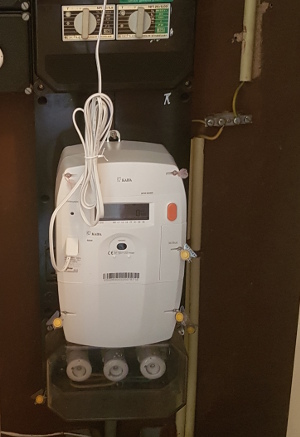
and here a single phase one:
https://www.circuitsonline.net/forum/file/58210/forum-post
In this case the 'S' leg of the transformer is used to power the dwelling.
And no, that particular version of 'split phase' is not +120V and -120V, this is not DC that we are talking about. Europe used to have a lot of that kind of split phase but we 'phased it out' to use a cheap pun.
So now the term single phase is used to indicate what you typically get delivered to your house and we don't further subdivide it. This is good because it means you can run much thinner wire due to reduced current. You do get a bigger whack if you accidentally end up touching the phase or if there is an internal short in an ungrounded device that exposes that phase to the outside (this should never happen). In North America 240 V center tapped off a single drop transformer is the norm for residential delivery.
The former was close enough that you could get away with plugging in US or Japanese devices, but if there was anything synchronous in there you'd be out of luck (50 Hz vs 60 Hz). Then 220V became the standard and now it is all 240.
Interesting tidbit: there was so much inertia from older systems that needed upgrading in this that it took until 2004 until the last of it (the 127->220V change) was finally done.
Ahh, thank you! I should have checked that point more thoroughly.