In the EU the 380V (now nominally 400V) relates to tri-phase, the 240V to the voltage between a phase and ground.
Tri-phase power in the United States is available to residential consumers and very light industry (say a small farm) at a number of different voltages up to 480V.
The 240V in the united states is between two 'lives' that are both 120V and that are usually delivered on a center tapped transformer with the center being the neutral. Adding those two together gives you the 240V, but it all comes from a single phase, it's just a center tapped transformer with a 240V winding as the secondary.
You can easily see this when you look at your typical drop transformer that will take a 10KV low voltage distribution line to domestic voltages, where three phase power is required you'll see three transformers in a bank, one for each phase. A typical residence will have only one because in North America single phase power is the norm for distribution.
https://www.mytpu.org/wp-content/uploads/wires.jpg

Is pretty typical in NA.
So a typical drop will have a distribution neutral and a single distribution phase going in to the transformer and three wires coming back out: L1, N and L2 with L1 and L2 being the outside legs of the winding. In your distribution panel you then add your residential ground.
This is possible, but more likely is a phase-to-phase in a delta configured transformer. In that case there is no ground delivered to the distribution panel, just two phases (or three).
This is incorrect in many places. Yes, you will have three phase electrical service pulled right into the distribution panel, but in many places all you will receive is a single phase because only one of the three possible fuses is installed.
If you want three phase hookup you just pay your utility company a small fee, they come out to install the extra two fuses and in some cases they'll upgrade your consumption meter to three phase.
> Three-phase service is ultimately how the US system works, same as Europe; it's just that entire neighbourhoods or streets will run off a single 240 V phase rather than each house getting all three phases (industrial buildings commonly have three-phase service).
In the US plenty of the last leg of the distribution network is single phase, in the EU it is almost everywhere three phase, except for some rural areas in former East block countries. Typically a step down transformer will take the distribution voltage and reduce it to something the residents can use directly, houses are then alternating in which of the three fuses is placed (R/S/T) to ensure relatively even distribution of the load.
Here you see a three phase domestic hookup (for instance because of an electric range):
https://www.superflink.nl/media/wysiwyg/1-of-3-fase-aansluit...
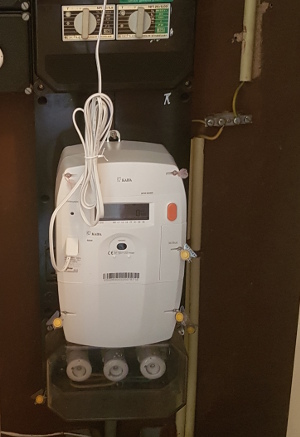
and here a single phase one:
https://www.circuitsonline.net/forum/file/58210/forum-post
In this case the 'S' leg of the transformer is used to power the dwelling.
And no, that particular version of 'split phase' is not +120V and -120V, this is not DC that we are talking about. Europe used to have a lot of that kind of split phase but we 'phased it out' to use a cheap pun.
So now the term single phase is used to indicate what you typically get delivered to your house and we don't further subdivide it. This is good because it means you can run much thinner wire due to reduced current. You do get a bigger whack if you accidentally end up touching the phase or if there is an internal short in an ungrounded device that exposes that phase to the outside (this should never happen). In North America 240 V center tapped off a single drop transformer is the norm for residential delivery.
The former was close enough that you could get away with plugging in US or Japanese devices, but if there was anything synchronous in there you'd be out of luck (50 Hz vs 60 Hz). Then 220V became the standard and now it is all 240.
Interesting tidbit: there was so much inertia from older systems that needed upgrading in this that it took until 2004 until the last of it (the 127->220V change) was finally done.
Ahh, thank you! I should have checked that point more thoroughly.