TLDR Brief 3 minute daily exposures to 670 nm (energies at the cornea were approximately 40 mW/cm2) for 2 weeks can significantly improve retinal function in those over approximately 40 years of age
Edit: 670 nm is deep red light
Then I started drinking a pint of kombucha, most days. I got my accommodation back, no more reading glasses! Other improvements too, e.g. blood pressure, skin elasticity.
I can't think of anything else to attribute the improvement to. I would never have guessed anything would help. (No guarantees, but would welcome other reports, positive or negative.) This is one of those "anecdotal" things where you might as well, because there is only potential upside, plus tasty hydration, no down. Like getting your Tdap booster (free at the drug store), because why not?
A pint of kombucha runs US$2.50-$4 at the supermarket. But I brew mine for <$0.20.
If you’re in a DIY mood, you can easily pick LEDs around that wavelength and they would generate more than enough light to even cause damage (if close enough).
Red light is also just fun to be in. It has a different atmospheric mood.
I use a small hand held concave vanity mirror and reflect the overhead light into my eyes. I wiggle the mirror handle to increase the spread. This is done while brushing my teeth since my electric toothbrush has a 3 minute timer.
Ergonomic ? yes. Practical ? for me yes. Safe ? maybe given the persistence effect matches what the paper said should occur. The Oxford paper used a small handheld red LED flashlight purchased for around $10 with a paper diffuser. I didn't enjoy doing it that way and stopped after a few attempts.
LCD display red should be pretty close to 670nm
https://www.amazon.ca/HIGROW-Flowering-Fruiting-Spectrum-Enh...
Here is a very informative sight which goes over how to make several different led grow light builds ranging from 2x2 foot grow tent to an led for a 5x5. https://ledgardener.com/diy-led-strip-build-designs-samsung-...
That's one of the reasons I created Lunar (https://lunar.fyi): because having to lower the brightness of the monitor throughout the day, using its hard to find buttons, was such an annoying endeavor.
I’ve always used f.lux and now Night Shift simply because I like warm colors. I have all LED bulbs and strips in my house adapt automatically to <3000K after sunset just because it gives me a sense of warmth and coziness.
But now, thanks to your comment I stumbled onto the “intense red light” cult. I had no idea about this effect, I thought all intense light is bad for the eyes. But I hope someone tries to reproduce this study. Usually, bold claims like these can be the effect of cumulative small errors in the study process.
Just curious, did it ever occur to you how much more blinding even a cloudy day outside is? Adjust cd/m2 to roughly match the ambient brightness of the room, that's general ergonomic advise.
But I can stay outside in very bright sunlight for 12 hours (which I did 6 days a week before college while working in agriculture with my parents) and not have a headache or feel my eyes tired afterwards.
That’s contrary to what the monitor backlight does to me when staring at it even 6 hours at a time.
Not blinking often enough is probably the biggest cause, you are kinda forced to do that when reading/writing code and have to consciously make a decision to blink more often.
Focusing your mind very hard on the task is also probably a big cause of this and unrelated to light intensity or energy.
But having the monitor backlight adapted to the ambient light is what helps me the most to end up in a relaxed state after I finish working. I know it’s not something that will work for everyone, unlike most blue light filter ads going on nowadays about solving your sleep and vision problems.
I think using low brightness screens/bulbs/strips may have also increased my light sensitivity, because now I can’t stand a normal TV blasting its light into a dark room, or >1000lumen overhead light bulbs or staring at my phone in the dark without having the brightness all the way down (and sometimes using Reduce White Point).
[1]: https://www.amazon.com/Dasung-Paperlike-Front-Light-Touch-Mo...
Edit: wow, they have a 25” monitor set to retail for $3k. Come on early adopters, get this price down for the rest of us!
TBH at this point I have no idea why you need e-ink out side of low power situations. Quality VA panels have great contrast and viewing angles. OLED is even better.
At the prices e-ink displays are, a OLED screen would be more versatile and probably just as little eye strain (just use low brightness).
[1]:https://www.youtube.com/watch?v=51JaR7KTeKs
I have heard of talks that Apple is investing heavily into microLED and the next big tech and skipping OLED for Laptops/next gen Monitors. That might be where the rest of the PC industry heads as well.
Glad to see the language is still alive.
I don't know the paper you're referring to but I'd be curious to read it. The most commonly espoused hypothesis that I hear is that increased exposure to blue light increases the rate of progression of age-related macular degeneration. Macular degeneration is essentially an accumulation of the byproducts of photoreceptor recycling in the retina. Certain people in the business of selling glasses latched onto this idea and it's spawned a cottage industry of snake oil salesman peddling dubiously effective blue-light filtering glasses and other gizmos. As far as I am aware there is no evidence that blue light actually increases the rate of progression of AMD in humans, and there's some compelling evidence that it has no effect.
https://www.aaojournal.org/article/S0161-6420(20)30727-2/ful...
Luckily there's no requirement to justify a personal preference. I hate staring at LEDs/monitors without a warm filter even if it isn't hurting my eyes.
There's a list of hardware supported by Displaycal here: https://displaycal.net/#instruments
You won’t get great results by downloading profiles from the internet because every unit is different coming out of factory.
Maybe you can measure this with some placard on a wall with different shades of black strips (kinda like those old TV calibration screens) where you can see some of the black strips but not others and as time goes on measure if you can improve your visibility into it.
[1]:https://www.audioholics.com/home-theater-calibration/hdtv-ca...
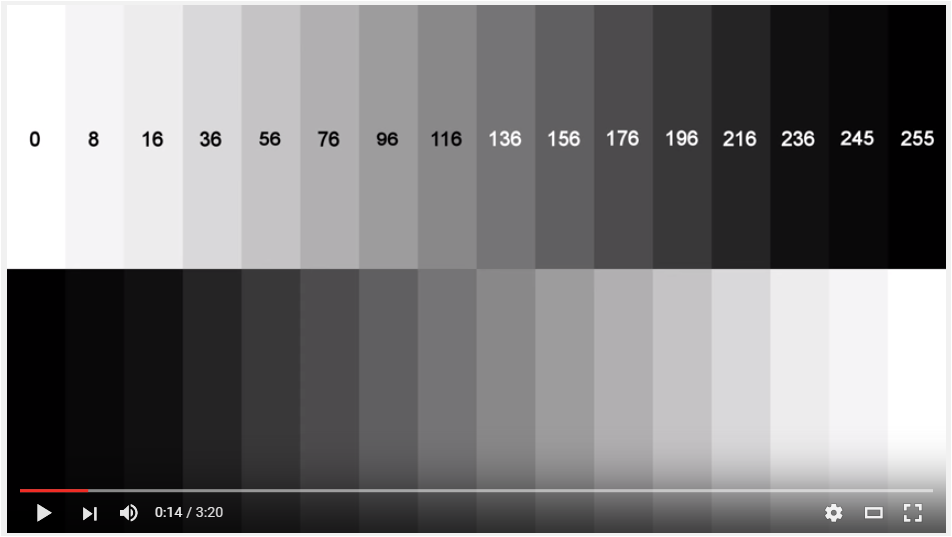
Maybe some other chart like this might work better.
Would just getting a red lamp for the office be enough for this?
Tangentially related, that same Oxford paper (sorry I don't have a link and no longer have access to the paper) did however claim that light generated by red LEDs with sufficient intensity to leave a significant persistence effect after 3 minutes of exposure can reverse aging and damage in subjects over 40 years old although the sample size was just a few dozen people IIRC. It does so because somehow the retina's mitochondrial function is improved by light in the 650nm to 1000nm range.
Continuing on this tangent, I am 50 and have been exposing my eyes to red light for 3 minutes a day for many months and feel like my night vision has been restored. If I wake up in the middle of the night I used to see gray noise and now I can see darker black with better contrast. But I may be kidding myself.