> Security sources said the person refusing to surrender their password would have to be a suspect in a crime and trying to obstruct the investigation of that core offence before they would be convicted over the password refusal.
It’s annoying that media coverage (by the “newspaper of record”) would rather cite speculation by anonymous sources rather than link directly to the text of the actual Bill. It’s only when I check the discussion on Hacker News that the source is directly referenced.
On the other hand, the state broadcaster does not even deem this proposed change to Irish law to be newsworthy enough to warrant coverage on its news website².
Somewhat Off Topic: The typesetting of the Bill itself is woeful and really impacts on readability of the text. It seems like the content was copied and pasted from multiple sources into MS Word without any consistent styling or indentation to reflect the hierarchy of bullet pointst.
1. https://www.irishtimes.com/news/crime-and-law/new-garda-powe...
Well that's handy then, the "helpful roomate" tries his best to enter the password, but didn't realise that after 3 wrong tries it wipes the device!
The way it's written makes it sound like the officers would be rifling through the computers and phones on site trying passwords they've found, themselves, or standing over the shoulder of people being forced to do so. It specifically talks about forcing someone to make information "visible and legible" and about copying documents, rather than just making forensically secure images of devices.
Easy enough to booby trap discreetly to delete things if not accessed the 'correct' way.
Maybe this is to show that this approach is so crazy that it could never work (hence the written reports to gather data), and that they do actually need <insert some crazy power> here in order to do it properly because "we tried to do it the nice way and it didnt work"
Better just to buy a bunch of USB sticks, wipe 'em all with random noise, use a couple for mundane files, and use a couple for sensitive files — deniably encrypted so as to look like random noise. Then, you can plausibly deny that they contain any sensitive files.
The real issue here is that we shouldn't need to use these sorts of measures. No one will do this unless they're a software professional with something to hide, and "having nothing to hide" doesn't mean you're not still entitled to privacy.
That depends entirely on how exactly you do it. And knowing something and being able to prove it are two very different things.
You're creating a situation where you have a set of encrypted and non-encrypted devices that are indistinguishable, and expecting the police to let you off. But there's nothing stopping someone with only encrypted devices to claim the same thing. I'd be worried that approach would fail either by 1) the police calling your bluff, or 2) indefinitely holding you in jail for contempt of court until you decrypt a drive that has un-decryptable random data.
Encryption with plausible deniability will not have readable headers. It will appear to be completely random data.
"Don't worry about my large collection of seemingly encrypted USB sticks officer, it's actually just random noise I filled them with for the lulz! No sensitive files here."
I see no flaws with this plan.
Usually when you encrypt a drive there's a telltale header, so the disks wouldn't be "seemingly encrypted" at all — and wiping disks clean with noise isn't especially uncommon. It's as plausibly-deniable as it gets, and it'd certainly fly in court.
Not necessarily.
https://www.truecrypt71a.com/documentation/plausible-deniabi...
2. Until decrypted, a TrueCrypt partition/device appears to consist of nothing more than random data (it does not contain any kind of “signature”).
Exactly! If I had anything to hide, I'd make sure to give them the 'correct" password that will wipe out selected data from the device.
Can it be done by giving them one wrong password which will trigger a disc erasure?
Serious question, as I wouldn't know how to do that.
For example, insert your filesystem-nuke (perhaps with an attempts counter) around line 78 of main.rs here https://github.com/akermu/rlock
Actually wiping the disk would take way too long. Assuming that you're running Linux and that all connected drives are fully encrypted: overwrite all keyfiles in a secure manner (ie flushing all caches and etc), write random garbage to the entirety of RAM, and trigger the equivalent of `halt -ff` (note the double --force).
Potentially of interest: `__noreturn machine_real_restart` in reboot.c (https://github.com/torvalds/linux/blob/5bfc75d92efd494db37f5...)
Bonus points for additionally finding a way to trigger the "secure erase" firmware feature of all attached devices as part of the above sequence. That's likely to prove a bit tricky though since that feature is generally locked out (for obvious reasons) once you leave the bootloader.
The contents of RAM in this scenario shouldn't be particularly vulnerable. If they're trying random passwords on the actual machine without any attempt to preserve the disks beforehand there's zero chance they're about to take the machine apart and extract what's left in RAM before it's gone.
>Potentially of interest: `__noreturn machine_real_restart` in reboot.c
Just write "b" to /proc/sysrq-trigger, it'll immediately trigger an ungraceful reboot without trying to unmount filesystems or flush the cache.
Or both.
But let’s be serious here it has to be at a place where a warrant is issued right? Tech folks are super paranoid. Like, try to make sure no warrants are out for you and your cousins and you should be fine. If you’re in the wrong place at the wrong time: sucks to be you anyway!
I can see it now: "I'm sorry, Officer, but my company's Data Loss Prevention (DLP) policy will not allow this document to be copied to any removable media or emailed outside of the company. I can make a request to Compliance for an exception but they take 7-10 days to respond!"
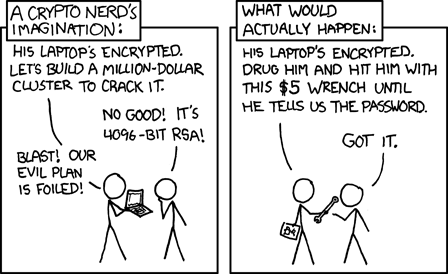
This kid couldn't write a paper let alone a police report. Boggles my mind why they'd ever let someone like that be a cop. I guess they value people skills over knowing people have rights.
Of all the jobs available, how many people really want a job that is historically known for low pay, long hours, and on more than occassionally requested to put your life on the line? How long did you personally contemplate that as an option? Of all of the people left that didn't say hellznah, fill the positions you have open on your police force. Policing is like politics in this one manner: those who want/seek the job, tend to be those that should never have the job.
Presumably the warrant defines the scope of the search. Of course the judges issuing the warrants aren't technical and generally cooperate with investigations, so I would expect vague and over-broad warrants to be the rule.
So... basically the entire internet, then?
- Stage a crime scene next door to the targeted machine.
- Ask for a warrant for the location.
- Knock on the door and ask the person to give the password for the Bitcoin.
But it wouldn't matter: documents and archives of the state are inviolable no matter where they are. And the property of a diplomatic mission must remain free of search and seizure.
Otherwise this will degenerate into police being allowed to sneeze devices and operate them away from their owner's presence.
Make it possible to "lock in" a single biometric profile and not permit adding a second profile without automatically wiping all data.
1. they can be compelled by force,
2. they can be physically collected, unbeknownst to the owner,
3. they share all the risks of digital passwords, including being leaked,
4. they can't ever be changed, even when known to be compromised by 1, 2, or 3.
Much better to have 2+ passwords for deniable secrets.
    A unlocks the device. Most people only have this one "normal" password.
    B unlocks the device plus secret b, maybe some extra kinky porn so people feel they've found your real secret.
    C unlocks the device plus secret c, your real secret, maybe Bitcoin wallets or that novel you've been working on forever.
You can go on forever with this stuff, especially if you have root on the device. Which gives you some clues about the true purpose of laws like this and who thinks they are useful.
Also make software self-destructing with a warning, i.e. if the user chooses it at installation time, all data will be destroyed automatically by the OS if they move the device off-premises. Make the setting unchangeable after installation time.
Police won't want to destroy evidence, so they'll have no choice but to leave it on premises.
I'm not trying to enable criminals, but rather enable whistleblowers and to not succumb to unreasonable new laws, and keep unethical searches for bad reasons in check.
This is not how forensic analysis works. Data is copied to read-only supports before any attempt of access is made.
(For twins they're more likely to have different usernames than different biometrics.)
Folks, keep your information AT HOME where it belongs. Don’t dirty the streets with those ugly snaps no one wants to see (unless there’s a cat filter) :)
* Pockets may contain items that are dangerous to an arresting officer, or to other arrestees. Emptying pockets serves the purpose of removing that danger. Data stored on a phone are not dangerous to nearby people, and so there is no corresponding danger that needs to be removed.
* Pockets can be verified to be empty, and so it can be verified that the person has complied with the order. There is no way to verify that all information accessible from a computer has been revealed. A police officer can demand that a suspect produce passwords that they don't have, then use the "noncompliance" as a way to add additional charges.
* Emptied pockets can be returned to their original state. If my pockets contain a driver's license, $5 and lip balm, those items can be returned to me. If I reveal a password, the reveal of that password cannot be undone, and that account must be assumed to be compromised.
* (For the US only) I have the enumerated right for my papers and effects to be secure against unreasonable search and seizure. A full investigation of accounts to which I have access, done at the site of an arrest, by untrained officers, with no checks for data security, no limits on the breadth of the search, with no basis of reducing external harm, and no right to contest the disclosure until after it has occurred, is entirely unreasonable.
I agree with your conclusions, that information security is important and should be more widely practiced. I disagree strongly with how you reached that conclusion, as a physical search of pockets is entirely unlike a search of one's phone or connected devices.
Except they can take your key, search your house, take your work key from there and drive with your car to you workplace and search everything there you can access, as well. So metaphorically as well as actually (home server etc.), your home is not safe.
- An officer can use these requirements on anyone who "appears to him or her to have access". They don't appear to need any evidence beyond that. The person does not need to be a suspect or, it appears, the subject of a warrant, just a person present at the location subject to the search warrant.
- It applies not just to access to information on the device, but information "which can be accessed by the use of that computer", and thus presumably includes information that is on other machine, or potentially not even in Ireland or the EU.
- It allows officers to freely operate computers on site during a search (this seems like horrible forensic practice?), and use passwords found on the site to try to access any information accessible from the computer.
- It does not just include disclosing passwords. It includes "any password or encryption key", and anything "to otherwise enable [the officer] to examine the information accessible by the computer".
- It even appears that it allows officers to compel people not just to disclose passwords but to actually operate the device for them so as to enable information access, and "to produce the information in a form in which it can be removed".
- It is not clear to me that there is any restriction on the scope of information, so long as it is in some way accessible.
- Head 17 appears to allow even legally (or otherwise) privileged information to be seized, so long as "the confidentiality of the material can be maintained pending the determination by the court of the issue as to whether the material is privileged material".
Combining these powers would seem to be able to result in ridiculous situations, for example, forcing a person to take data from a US server using an SSH key on their laptop, potentially violating US law by doing so, and for the person to do all the work necessary to do this themselves.