If you are bringing your laptop to a coffee shop, you probably won't need an ethernet port anyway, so you can leave the dongle at home. Lots of mobile use-cases don't involve plugging in to a ton of things, so why waste space having ports for it?
We're mostly programmers here, with nice keyboards and big screens as a necessity for work. On the other hand, lots of people are completely content with the base laptop. Making things easier for us at their expense is probably not a great business decision.
Luckily, macOS is going downhill as well, therefore my pain will end when the next version has not resemblance to a Unix system any more. The day Apple starts migrating its desktop OS to hamburger menus, I'll wipe and sell all my remaining Apple hardware.
I dunno. I've never owned a macbook because Linux has been good enough for most of the time I've seriously been using computers for work stuff. Even if you aren't a Linux enthusiast, the time to switch for developers was more than a decade ago, IMO.
Edit: Actually, didn't spot the Ethernet port on the first glance, might be worth a deeper look. :)
……………
Only Fujitsu use them AFAIK.
[1]https://www.theverge.com/circuitbreaker/2017/12/8/16750574/p...
If your uses case requires you to constantly plug/unplug ethernet cables in your laptop then you need a workstation class laptop with a full sized RJ-45 jack, not a sleek thin and light.
it's perfectly feasible to integrate one.
just look a the dell latitude 7390. really, look at it:
https://cdn.mos.cms.futurecdn.net/eB6gGRDZWSYT4XW6SeSMtf-120...
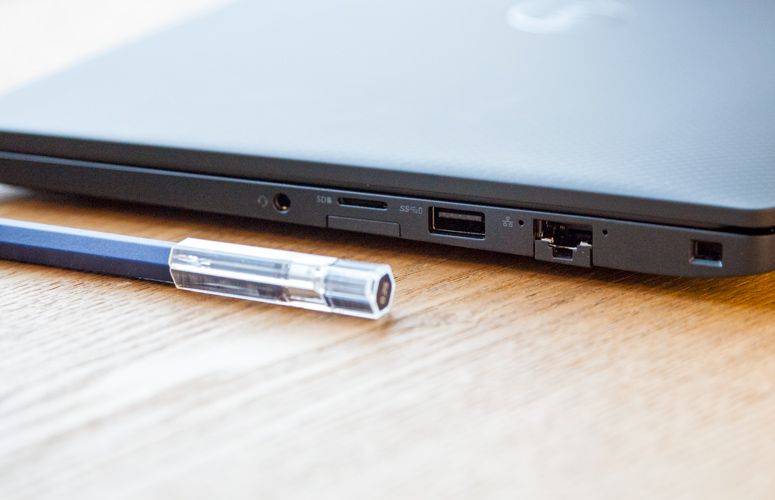
I mean. Really. That strikes me as willfully ignorant and arrogant. Clearly it's heavily used, especially in professional/corporate environments.
FWIW I use WiFi if I have to on the move.
But at home and office it's hard wire all the way.
In the office it's not even an option, everybody must.
At home, it's a quality of life thing.
The speed drops and disconnections and unpredictability of WiFi are not thing of the past yet. For some there's a security issue as well, real or perceived.
Wire just works.
Edit: other examples - gaming laptops; secure networks; dense environments either urban or corporate; anything that needs predictable connectivity, bandwidth and lag really :-/
Both my own laptop and the laptop from my employer (a large company) are used almost all the time on wired Ethernet, the main exception being during business trips.
It's so clear that they removed it from their lineup? Clearly you're wrong. I have two Macbooks work/home, and a USB-C dock has been life changing in its awesomeness.
And yes my dock has RJ-45 ;)
There are discussions on:
1. Is a particular connector still used/useful on laptops - my statement is that RJ45 is absolutely still used on laptops, and went into some examples / use-cases.
2. Separate discussion, hopefully informed by the first, is how do we do that - built into laptop or via a bunch of dongles.
Apple in particular removing it from their laptops does not speak one way or another to corporate/professional environment requirements. Their approach is "use a dongle/dock" which in their view is compatible with whatever use case is needed (and some people disagree, which is fine - lots of vendors and in particular HP/Dell/Thinkpad all have robust professional/corporate/roadwarrior models with dock, port and even pointing stick capability).
They also removed scissor switches, sd card readers and hdmi. But they're bringing those back (or have already), so they don't seem like a good authority to appeal to here.
My laptop is sitting at home 1,5 m away from my Unifi access point and the network cable is still measurably more reliable and performant. Wifi might have won the amateurs.
For me the dongle is annoying but probably sufficient.
I've also worked in offices where the Ethernet was better because it didn't require VPN access and was more reliable, but in those situations I plugged it into my monitor rather than directly into the laptop.
One had WiFi that only gave internet access, the other had no WiFi at all (in 2017).
Still very much useful in corporate environments.
Everyone who understands collision domains.
Everyone who understands bandwidth.
> By connecting each device directly to a port on the switch, either each port on a switch becomes its own collision domain (in the case of half-duplex links), or the possibility of collisions is eliminated entirely in the case of full-duplex links. For Gigabit Ethernet and faster, no hubs or repeaters exist and all devices require full-duplex links.
So is a wifi connection full or half duplex?
I don't think you understand collision domains.
Apple is content to push everything into dongles (which you have to carry around anyway) to get it thinner. The point at which I can't have a wired RJ45 ethernet port is already ridiculous - that is not a thick connector. Same with fullsize USB ports.
Battery life there are hard limits as well: nobody is making a laptop with more then 100Wh, because that's the limit that you can carry onto an aircraft.