Hyperinflation can always come after the bubble bursts.
Same with housing. Nimbyism is such a big deal in the US because rather than seeing housing as a utility that should be cheap, it's become a store of value that must always go up.
There are always funds that do better, until they don't:
* https://awealthofcommonsense.com/2020/12/a-short-history-of-...
Over a 15-year timeframe, most fund managers (especially in the US) underperform benchmarks:
* https://www.ifa.com/articles/despite_brief_reprieve_2018_spi...
The problem appears when valuation are caused only by the "store of value" usage, because it has no anchor on the real world, and thus, can vary freely from 0 to infinity.
Similarly, if you need a risk-free value store (e.g. because you’re very close to retirement) the market is not going to provide that for you.
Edited to add: clarification about the analogy.
A more pressing matter is that people are no longer able to afford a house, especially if they're young / early in their career.
The interest rate was 7.5% and my friends told me I was foolish not to pay 9.0% for a 30-year fixed rate mortgage. They calculated nightmare scenarios if rates doubled or tripled while theirs held constant.
Every year since then, my interest rate reset downward until it hit the lower limit of 2%. Even though my required payment decreased, I kept paying the original payment amount and paid off the loan 10 years early.
My friends paid hundreds of thousands in additional interest over the years for the peace of mind of a fixed rate.
PSA: 2021 to 2031 might be different than 1998 to 2018.
Adjustable rate mortgages exist too but got a lot of people in trouble in 2008. I think a lot of them are only allowed to adjust by a certain percentage regardless of interest rates each year they’re eligible to.
https://www.marketplace.org/2018/10/31/why-do-we-have-30-yea...
* https://www.ratespy.com/best-mortgage-rates/10-year/fixed
* https://www.ratehub.ca/best-mortgage-rates/10-year/fixed
For down payments <20% mortgage insurance is needed (usually from the federal government subsidiary, like Fannie/Freddie), but not for larger down payments: that's all free market.
Some institutions offer 18- and 25-year terms.
Case in point: there is no such government policy in Spain, yet most banks happily offer fixed rates.
You just need to hedge the fixed mortgage you are selling and add some interest to make profit.
It's not just common in the US, it is the de facto standard across almost all mortgage types and sizes. Even weird, non-conforming properties with "jumbo" sized loans can get fixed at 30 years.
Also, I will point out that in both Switzerland and the Nordic Countries, 40 and 50 year mortgages are now in very common use:
"Repayment periods in Switzerland can be incredibly long, with deals lasting between 50 and 100 years being relatively common."[1]
"Swedish regulators calculated in 2013 that the average mortgage term was around 140 years."[2]
In fact, now that I think about it, I am surprised that the US culture of "financial innovation" has not produced more standardized long-duration mortgages ... I do not know anyone, for instance, with a 40-year term ...
[1] https://www.expatica.com/ch/housing/buying/your-guide-to-swi...
[2] https://www.thelocal.se/20160324/sweden-limits-mortgage-loan...
But, yes, buying with variable rate mortgages when interest is at historic lows rather than paying a little bit extra initially for fixed rates is risky, and on a society wide scale that risk is going to materialize at some level.
https://www.forbes.com/sites/teresaghilarducci/2020/08/31/mo...
https://www.pewresearch.org/fact-tank/2020/09/25/few-in-u-s-...
https://www.reuters.com/article/us-health-coronavirus-stocks...
Source: https://www.peoplespolicyproject.org/2018/05/01/only-1-in-3-...
> In 2018, the average account balance for Vanguard participants was $92,148; the median balance was $22,217. [emphasize added]
Source: https://pressroom.vanguard.com/nonindexed/Research-How-Ameri...
33% * %42 = ~14%. And while the number is debatable, depending on how we define "significant", only a portion of that 14% has significant wealth invested in the stock market.
I agree with the previous poster. The vast majority of Americans (including employed Americans) aren't invested in the stock market in any meaningful way.
See the performance of Venezuela's stock market over the last 5 years:
https://tradingeconomics.com/venezuela/stock-market
(The "crash" in late 2018 was the redenomination of the bolivar at a 1:1000 ratio, which affected everything denominated in bolivars, including the stock market.)
Honestly wealth growth is the least of my worries if we have another 1929 level crash or hyperinflation.
Though bitcoin has really been untested as a safe asset and currently behaves more like a speculative one.
But even though I'm optimistic about Bitcoin, I don't see it as crash-proof except in one crash scenario. It's mostly a speculative risk-on asset that loses value in crisis scenarios. We saw that in the covid crash in March last year as Bitcoin prices tumbled along with other markets.
The one crash scenario where Bitcoin doesn't crash is if Bitcoin is the thing that triggers a crisis of confidence in fiat assets. That's the hyperbitcoinization scenario that still looks improbable, but easier to imagine now than it was a couple years ago.
It would be interesting to see how much the gold mining industry contributes to global warming (including not just extraction, but processing and shipping). Trading, too, but I suppose that's done mostly by contract, and not shipping gold bars around...
When the next crash does come, I’m ready to buy.
Remember when the US outlawed holding gold? [1]
People could simply exchange their domestic currencies for foreign currencies of more stable countries. That's what happens in countries with hyperinflation right now, despite access to cryptocurrency.
The only real advantage of cryptocurrency is that it could be transferred around hypothetical government controls. That's more of an extreme edge case scenario, though.
To be clear: The US inflation is too high, IMO, but it's nowhere near hyperinflation or government collapse. The average citizen is more likely to benefit from recent stimulus packages than to lose out from it. It's not like everyone keeps their 401K invested in pure cash.
That said, we're overdue for interest rates to start creeping up. COVID is coming to an end quickly and the unemployment never really got out of control in the first place. People aren't going to go bankrupt if their mortgages go back to 4-5% instead of 2-3%
Most of the developed nations are competitively devaluing their currencies. If one country does it, they gain a trade advantage: their exports are relatively cheaper on the world market, so consumption flows to their industries and makes them wealthy. Therefore once one country does it, they all have to do it, lest all their export industries become uncompetitive and they lose those jobs.
I've heard some speculation (nicely backed up by data [1]) that the real reason we couldn't follow through with monetary tightening 2015-2018 is because it created a carry trade of investors borrowing in Euros and investing in dollars [2], which led to a continual outflow of dollars out the door.
If hyperinflation hits it will likely hit nearly all the developed world in short succession. If the dollar goes, all investors are going to dump dollars for Euros, but if they do that the value of the Euro will skyrocket, which means European exports will become super expensive and Euro-denominated debt will be harder to pay off, which will spur European central banks to dump more Euros into the system. As long as we have free capital flows there's no way around this: inflation in one fiat currency will lead to inflation in others. That's why people are looking for non-fiat currencies. (You're right that tradable assets like stocks can fulfill this job rather than cryptocurrency, though.)
[1] https://www.pimco.com.br/-/media/global-assets/resources/edu...
[2] https://www.ft.com/content/fe099068-169d-11ea-8d73-6303645ac...
I think that's the gist of it, and as such I also think that free capital flows will be massively restrained in the scenario you mention (a scenario which I also find very likely).
A similar thing has just happened with the freedom of movement for people, a "right" that the great majority of us had taken for granted, and then Covid came and that "right" was forgotten about like it never had existed.
Don't forget the ECB raised rates during the onset of the financial crisis circa 2007-8 when everyone else was cutting desperately because of their inflation targetting mandate.
[1] https://en.wikipedia.org/wiki/Personal_consumption_expenditu...
I actually have spent considerable time poking through the basket definitions and while I was generally impressed by the effort I saw, the extreme sensitivity to minutiae and extreme incentives to obtain a particular conclusion make me hesitate to bet my portfolio on its integrity. I haven't re-implemented their entire methodology in an economic model and run monte-carlo simulations to evaluate their competence in the face of obvious hypotheticals but I'm pretty sure you haven't either. By comparison, "bet on assets to hedge inflation" requires much less concentrated faith in the continued wellbeing of a convenient scapegoat.
And then there are the other even more severely complicated parts. If next year's iPhone is better but costs the same amount, that's deflation. You got more for the same amount of money. How do we quantify that? Those are called hedonic improvements. How do you account for free services? What is Google worth? What if a new thing comes out that has never existed before? How do you compare that to the previous consumption basket? It would be relatively easy to argue that the preponderance of brand-new, incomparable, improving every year, cheap/free tech stuff that we are living in a relatively deflationary environment. You get more, better stuff every year for less money!
https://qz.com/1269172/the-epic-mistake-about-manufacturing-...
I found that episode informative and convincing, but in the exact opposite direction. I stuck my neck out on the basis of those numbers while arguing with conservative family members and it turns out the numbers were rigged after all. For a very reasonable definition of rigged.
In the face of shenanigans, I tend to put more faith in simple concepts like "assets hedge inflation" than in indices.
The "US manufacturing is super productive" narrative is unfortunate, especially if policymakers were making decisions based on it. But it doesn't really call into question the data or methodology, just that people have misinterpreted it. But the people who are actual experts in this area are writing papers about that! This paper is from 2014[1], and she's been writing about this since 2010! With economists from the Federal Reserve system, no less.
edit: I guess my point is, the point that article makes isn't, "the game is rigged, inflation is made up, we should use shells for currency." The point it makes is, "don't just read the top-line number and then write an opinion article, make sure you read the breakdown first."
Also, assets do hedge inflation. Most of them, anyway. I never argued otherwise. Just that asset price increases are not the same thing as inflation.
My invocation of the term "rigged" was not charitable but that's pretty far from saying it was actually incorrect. If I had to bet, I would bet on the middle possibility: metrics are built honestly but selectively promoted in accordance with political agendas in a manner that I would be comfortable to characterize as "rigged."
In any case, assigning blame is one thing and designing portfolios robust to this kind of mishap is another. Fortunately, the difficult parts of assigning blame are completely irrelevant to portfolio design. No matter who was responsible, the correct response is to avoid metrics that are easy to misunderstand (or rig!). Which brings us right back to favoring "assets hedge inflation" over "TIPS hedge inflation."
The idea that the government inflation indexes are rigged is conspiracy language. They are talking as if people from conservative think tanks and corporate boards are having the government fix inflation indexes to their way of thinking, or even retroactively setting inflation indexes to their way of thinking ( https://en.m.wikipedia.org/wiki/Boskin_Commission ).
I'd wager that there are more people that cannot afford the costs of servicing their mortgages doubling, than those that can.
It may not result in backruptcy, but it may result in them defaulting on their mortgages and literally losing the roof over their heads.
2% is too high? Really? What do you think it ought to be, allowing for a variance of 1-2% around the target?
https://www.statista.com/statistics/244983/projected-inflati...
2. EO 6102 made sense with the gold standard. It wasn't just an "FU" to gold hoarders, but a way to raise revenue to counter the depression. It's not clear to me that it would make sense for such a confiscation of crypto, especially if the legislature were to try option #1.
Except that, many rich investors and large corporations are putting money into crypto as we speak. Some of those large investors may include people who work in the government and at central banks. I tend to think that, these people will have a conflict of interest there. It might be in their own best personal interest to not ban crypto, and to leave that door open. In other words, it might soon be too late to ban crypto. The ball already started rolling down the hill.
Great analysis. Give it another few years: then when most of the S&P companies will hold crypto, along with your richest supporters and voters, trying to ban it will become political suicide.
Crypto would have to rise massively in value for that to happen. That's one of the bull cases for crypto.
No, crypto would rise massively if that were to happen.
Assets, stocks, real estate, all of the things that inflate with inflation. Crypto gets a lot of undue attention as a way to escape inflation, but investors have been investing in assets to losing buying power long before crypto came along.
zero percent and negative interest are like a roach motel for investors in 2021. no ones leaving anything.
in 2008 the fed introduced quantitative easing and by 2020 they'd never left it. the fed just..."decided" that they didnt want stocks to crash, ever, and increased the amount of liquidity in the market without thinking twice.
in 2010 they tried to ween the market off QE and were rewarded with an 800 point tantrum plunge. now its 2021, the feds 1993 crisis to real earnings (cheap credit) is now de-facto how most of American society runs. their 2008 stop-gap (QE) cannot be undone without a massive economic depression and every day hyperinflation looms on the horizon.
This means there is also no possibility of a minimum wage increase (doubling to $15)...ever, as no one knows if it would be good enough to trigger a collapse or not.
despite the furious protest of real-estate moguls many people see housing as a bubble, and when it pops, QE will not solve the problem a second time around.
The US has a bunch of real resources. They are being directed to companies that are basically burning them for no reason ($X off resource in, $X less a bit out).
If they demand that companies show any sort of ability to generate more than they consume, then too many companies fail. So instead they are encouraging wasteful companies to keep on doing what they do.
At some point, the deadweight builds up and a series of worsening crisises emerge as people start fighting over what is left, which is no longer enough to have a peaceful society.
The problem is that if losers don't lose, they will end up in control of the economy. I could out-compete almost anyone on vast amounts of borrowed money while making a loss.
Is it sustainable? No. But I disagree that it represents waste from anyone's perspective but the shareholders'.
The value creation I had in mind was with respect to the people who were previously very badly underserved by the traditional taxi/black-car industry, and are now served by Uber.
[…]
> If everybody has an incentive for rates to stay low, they will stay low. This ends in hyperinflation.
Japan has had rates ≤1% since April 1995:
* https://fred.stlouisfed.org/series/INTDSRJPM193N
The rate was 0.1% for five years (2001-2005). Japan's inflation:
Except for the part where the fed said (and continues to say) it would raise rates if it saw sustained high inflation
https://res.cloudinary.com/apartmentlist/image/fetch/t_rente...
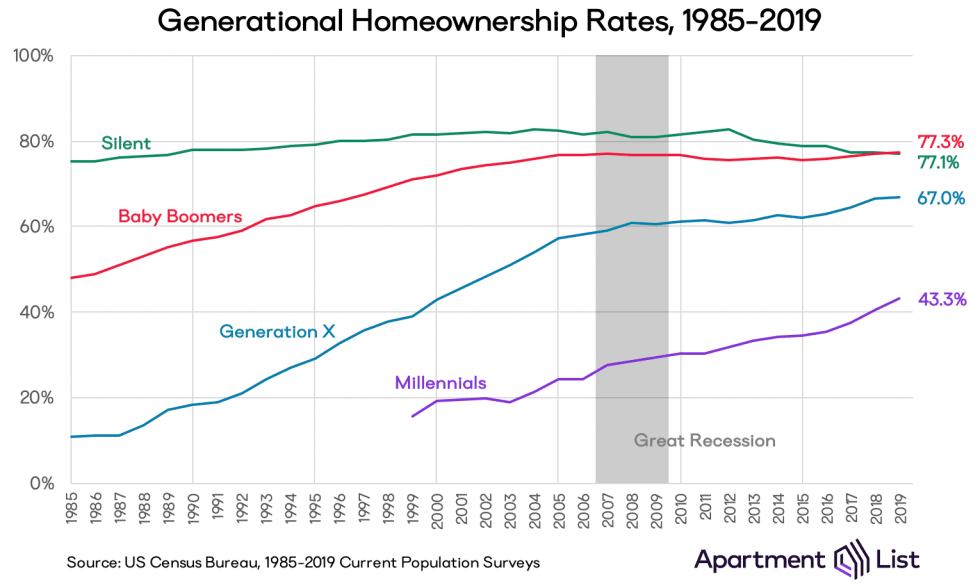
And at the risk of just reposting this comment on HN all the time. Focusing on central banks as the driver of asset price increases is looking in entirely the wrong direction. There is a third component that pushes both asset prices and central bank policy - the global supply/demand of savings vs investment opportunities. Which is driven mostly by demographics. China's massive working class, and the unprecedented rate at which they are getting wealthier, and their savings rate which is like >10x the average US citizen means there is a huge increase in the global supply of savings. Which bids up asset prices and pushes down yields, as savers compete with each other to buy up the extant profitable and safe opportunities. Central banks are the on the receiving end of this too: over-saving pushes down the natural rate of interest, which means policy rates must be lower to respond (unless you want to condemn some working Americans to unemployment). So long-term interest rates fall, and central banks have less operating space to smooth out the business cycle by moving short-term rates.
Nasdaq 100 - up 40%
Cotton - up 25%
Corn - up 40%
Gold - up 15%
Silver - up 25%
Steel - up 30%
lumber - up 100%
Copper - up 46%
Aluminum - up 22%
It's also hardly evidence for impending hyperinflation. For instance, aluminum is massively cheaper than in 2008, and copper is still quite a bit below the 2011 level. Commodity prices always fluctuate massively.
Salaries.
As long as the world runs on the dollar, it doesn't.
With T-bills trading at negative rates, the US is in a really strong position. People are paying the US for the ability to hold US currency.
This is why I find it so odd that supposedly nationalists in the US rail against the trade deficit and US "debt." Our "debt" is actually just the currency of the world, and as the world grows wealthier and wants to hold our currency, there needs to be more of it out there. This is good for the US and puts other countries at a disadvantage!
A strong U.S. dollar is generally good for U.S. consumers and bad for people who work in U.S. export industries. The dollar being the global reserve currency is good for the financial industry and bad for everyone else. So basically Wall Street (and workers in industries where America is dominant anyway, like tech, defense, biotech) should favor a strong dollar, while Main Street should favor a weak dollar. This isn't far off from reality: many of the "U.S. nationalists" represent constituents whose jobs have been eviscerated by foreign competition.
[1] https://twitter.com/LynAldenContact/status/13618187491044475...
If you still live at home you can buy it from your first wage. Otherwise it may take a bit longer. Government advices people to have a buffer of at least 5000 so you can have you washing machine fixed or get a new furnace (the thing that heats your house) and fix other house related issues (or your car). Most people I know try to maintain that buffer.
The majority of people throw a few grand at an old banger and drive it until it stops working.
If productivity continues apace, if value added to the economy continues apace, I don't see why it ends in hyperinflation.
Note that there is another potential ending for this: a deflationary trap like Japan is in, or like the U.S. was in from 2009-2020.
I'm betting on hyperinflation, though. The reason is that nearly all past hyperinflationary events have come from large sector shifts in aggregate demand and aggregate supply, notably when coming down from a war or transitioning from a command economy to a market economy. COVID just provided exactly such a supply/demand shock: large quantities of production were shifted into medical devices and remote work, while demand shifted away from travel, experiences, and gasoline to home improvement & home office supplies. When demand shifts back, those industries will have significantly reduced capacity, and a lot of bargaining power to raise prices. The raised prices cascade through the economy, and that's what triggers inflation.
It's like the economy is your heater, money-printing is turning up the gas because it's not getting hot enough, low productivity is not realizing that your igniter is broken, and COVID is lighting a match. Without COVID you'd just open your windows and air out the gas (although it still wouldn't fix your broken igniter). With it, we go boom.
This time around, the banks are well capitalized and the QE is targeted at monetizing the federal deficit (federal government issuing treasuries in order to finance relief packages and the like and FED buying them), so the money is actually going to make it into the broad money supply, which might lead to inflation (though hyper-inflation is probably an overstatement at this point).
Basically Lyn compares what happened in 2008-2009 to 1929 - which was a banking crisis; whereas what happened in 2020 is closer to 1940-1945 / late 1960's in terms of the FED monetizing the debt. We had inflation in the late 1940's and in the 1970s, so it's possible we'll see something similar.
1) 1929 bears no resemblance to 2020. They are completely different economies, and economic factors. It’s a non-starter to compare the two time frames.
2) Inflation != hyperinflation. We can handle inflation just fine, it’s a 5% change, a 10% change, etc. Hyperinflation leads to a collapse (Venezuela, or Zimbabwe or similar). If the United States collapses, you better have stocked up on lots of beans and ammo.
3) We should really only look at historical financial crises as unique events with unique circumstances, not as comparisons. It’s like people looking at home prices now and saying “it’s all going to crash, it’s 2008 all over again!” which is a surface-level analysis that doesn’t take into account how 2007-2008 happened. 1929 - Dust Bowl. 1970s - oil embargo. Etc.
I enjoy reading Lyn’s commentary as well, but the comparisons are non-starters. There isn’t, or so far hasn’t been any predictable events that have taken place. You can’t look at history and say “this thing is the same thing as this other thing”. They just manifest differently.
In Zimbabwe the government printed money and handed it out to people. This money directly makes its way into the economy.
In QE the Fed buys assets such as mortgage securities from banks. The banks chose not to lend more aggressively and decided to hold on to the cash. As a result there was no hyper inflation.
So how does QE affect stock / house prices ?
When the FED comes into the market willing to lend to anyone and everyone interest rates fall. As a result returns on bonds and bank deposits also fall. Forcing people into stocks. The effect of QE on asset prices is therefore indirect.
So the QE money itself is hoarded in a deflationary environment while savers get pushed into speculating on assets.
As the economy slowly recovers over 5-10 years the QE money is slowly sucked back out and assets slowly deflate to a fairer value. In theory this can work without too many hiccups.
The problem here lies in the inequality that this generates. Large banks, companies stay afloat thanks to buy backs. Asset owners get richer. Wages stagnate and people lose their jobs albeit less than if QE didn’t exist.
This topic is much more complex than I had initially thought. Nobody should come to conclusions such as “A crash is inevitable” or “Hyperinflation”.
On the inequality side, it is a bit unfortunate to be in the workforce at this time competing with the massive influx of other savers, bidding up productive assets to save for retirement, enriching the people who were "lucky" enough to be in the generation before that population/affluence boom. But there's not really anything that can be done about it, not without tightening financial conditions enough that it has severe negative effects for the labor market.
However my worry is that the economy seems to have become permanently dependent on low interest rates. Sure it won’t be zero but something like 1 % looks like a distant dream.
It seems to suggest that we have run out of ways to increase real productivity. A good example is the shale industry which will basically go bust if interest rates are like 3 %.
We seem to be in a new regime of lower economic growth, high asset prices and inequality. The real danger here is the political sustainability of this. Zero interest rates are an indirect pay cut via rents and mortgages. At some point asset owners will have to take a haircut.
But at this point, we're talking technology and society instead of economics. Will innovation continue, and are those innovations a big enough deal that they will continue to make our world more productive, wealthier, more successful? I lean towards yes, but it is not at all obvious. It is certainly possible that productivity growth stagnates, most countries catch up to a generally-developed level of output, and asset prices stagnate as temporary demographic bumps are smoothed out.
Growth is fundamentally tied to the availability of cheap energy. If you look at oil prices in gold you’ll see how it’s almost twice as expensive today.
We are also facing constraints on energy extraction due to climate change.
Every time oil prices spike shale oil comes online but the economy chokes on the price oil crashes and the shale producers go further into debt.
This may also be why a lot of growth is in the digital sphere which is far less energy constrained. Maybe future growth will be Virtual reality GDP :P
The only way I can be wrong is if someone invents a cheap fusion reactor or a cheap magical battery that stores endless amounts of solar energy. This is highly unlikely to happen.
Disclaimer: Very speculative thesis but I believe in it.
>I'm betting on hyperinflation, though. The reason is that nearly all past hyperinflationary events have come from large sector shifts in aggregate demand and aggregate supply
The user is arguing that large scale shifts in aggregate demand and supply are what is different this time.
Not sure I buy that. Yes, there will be temporary upwards pressure on prices in some segments of the economy but also, following your argument, temporary downwards pressure on prices in other segments. So a) it's going to balance out and b) it'll be temporary. Not enough to trigger sustained inflation, not nearly enough to trigger hyperinflation.
Are we going to see higher inflation in this decade vs. the last? Absolutely. But hyperinflation is a different beast altogether and I'm quite skeptical we have the environment for it to come alive.
Your list of stakeholders who like low rates is the same today as it was in the 2010s, the 2000s, the 1990s, the 1980s and the 1970s when rates were much higher.
If stakeholders who like low rates had the power to set the rates, the rates would have been lower then, too.
> This ends in hyperinflation
Counterpoint: low rates are a consequence of a sluggish economy, not Soviet-style central planning. If the economy comes roaring back with double-digit GDP growth eight quarters in a row, and central banks continue printing tens of trillions of new money in the face of an overheated economy, then we'll see a wage-price spiral. But if the economy remains sickly, or central banks ease off the stimulus, then it's hard to see hyperinflation on the horizon.
However, as you point out, rates have been low for a long time. This has caused retirees and people approaching retirement to invest in riskier assets. They have been forced into a loser’s game. That’s going to cause a lot of pain if we get a massive correction.
Those of us who have time to recover from a correction will be OK. Those who lose 50% of their assets in a correction, and don’t have the time to make that up, are going to have their lives turned upside down.
Imagine yourself in 1981 and could have locked up a 30 year U.S. treasury at 14.5%. Sure, there are riskier investments that may have beat that. However, if you are a retiree, that type of consistent, non-risky return is what you would want.
If you bought that 30 year at 14.5% and we had hyperinflation then you wouldn't be so happy. There was a reason why those rates were at that point, inflation was >10%.
Conversely you could try to short bonds now but if rates stay at zero for the next few decades or go negatively that's not gonna be so great. In the rear-view mirror someone will say how we were stupid(?) for not shorting bonds when the rates shoot up to >10% again, or they don't. It's hard to win this game.
What is true is that retirees might have a shorter horizon (though people keep living for longer and longer) and so they may be forced into safer/shorter duration investments and possibly into smaller returns.
Efficient markets something something ;)
Of course, you can then apply your argument to people who have pensions or life policies I suppose but those aren't things people often "sell".
The system is structured to prevent even the slightest bit of inflation by raising rates. The Fed has not forgotten that, and the politics of mass unemployment are readily manageable. Years of conservativism has seen to that. Call me back when inflation exceeds 4%. It's currently below the 2% target.
Look, interest rates are the market price of money. Money - investment - is not scarce. That's where the asset bubbles are coming from, after all. And it's not just a question of money creation, it's wealth creation and concentration that's driven this. Everything from Apple's cash pile to the unaccountable wealth of Saudi and Russian fossil fuel extractors to all the capital flight from China that's been bloating Western real estate markets.
The world is awash with money looking for a return which it simply can't find any more. Maybe my most controversial opinion is that if we don't get wealth taxes we'll end up having to have negative interest rates anyway. Something has to pay for the preservation of society around the pile of wealth. Switzerland has been doing good business charging people for stability with negative rates: https://edition.cnn.com/2020/01/23/investing/switzerland-cas...
Let's not forget the pension funds. Something like a third of a Western society is basically forced to be bond investors - they need low-volatility investments and annuities.
> Retirees have an incentive to keep them low, feeding 401K bubbles that they need to live on.
... they tend to be the main complainers about low rates since they live more off interest rates than asset prices and don't have mortgages.
Interest rates have declined for 40 years. There is no reason to believe they will trend up long term. I don’t know if it ends in hyperinflation though as the number of people that can access the cheap money is limited.
News to me! If that's their mandate they have utterly failed. Where is this written?
Full employment is defined by the concept of the NAIRU, the non-accelerating inflation rate of unemployment. The lowest sustainable unemployment before inflation begins to take off in a feedback loop (as higher inflation pushes expectations of future inflation up, resulting in a spiral).
Heck, even the "4%" is a percentage of people "looking for work", which is obviously a quantity that can vary depending on how good or bad the outlook is.
Right. The increase in 2005-6 was what set off the 7'8 financial crisis. I never understood that one. The previous cuts seemed like an over reaction to the tech bubble popping, but the rapid rise was even worse.
I thought they were very slowly raising rates prior to Covid, but using housing market to judge how slow to raise them.
Eventually, the yield curve will start to look somewhat normal again, and we'll start to have a yield curve that rewards longer-term fixed income investors. Longer-term interest rates reflect market forces, and eventually investors will demand higher yields for longer-dated US government and corporate debt.
Finally, though I increasingly see the term "hyperinflation" thrown around in conversation, hyperinflation in the US is just not even a remote possibility. The last time an actual hyperinflation occurred in a major economy was Germany after WW1. The differences between then and now are too many to mention, but here are a few: fiat current vs gold standard, reserve currency status (the US today), massive debt burden denominated in a foreign currency (Germany then), immature and non-independent central banking (Germany then). A Weimar Republic style hyperinflation is just off the table; so let's stop throwing the term around.
Maybe you're referring to something akin to the US 1970s era "very high but not event close to hyper-" inflation, e.g. 5-20+% per year. While possible, it's highly unlikely. Maybe we get to something like 5% annualized inflation for a year or so, but I wouldn't bet on much more than that.
The inflation period in the 70s (stagflation) perplexed monetary policy-makers at the time, who weren't used to seeing high inflation coupled with stagnant or negative growth. This period of inflation was caused largely by market characteristics that simply don't exist today: energy price shocks that caused raw materials supply constraints throughout the economy. The US was a much more concentrated economy in the 70s, with a relatively large portion of GDP tied to raw materials and thus imported oil. Today the US is largely energy independent and does not have such a narrow concentration of supply dependencies in the economy. The US has evolved into a much more diversified and service-based economy, as opposed to the manufacturing-focused economy of the post-war period. There is no one commodity that we rely heavily on that, if unable to access would effectively stagnate economic growth. In the 1970s, OPEC basically said, "hey, no more oil!", and we were like "yea but we need it for pretty much everything and if we can't have it we're fucked" and OPEC basically said "yea well tough shit".
There is not a modern equivalent of imported oil that is the lifeblood of the economy controlled by a cartel that when supply is artificially constrained we would be completely fucked. Even something like semi-conductors while worrisome, is fundamentally different than a commodity like oil. We can decide to produce semi-conductors if it's in our economic interest, but we can't just decide to have more oil.
Finally, central bankers are not stupid. They're very aware of inflation risks. And while they are committed to keeping short-term interest rates low for an unusually long period of time, long-term interest rates do and will reflect market conditions.
This does not end in hyperinflation; it ends with moderately elevated inflation and that outcome is undeniably better than a deflationary outcome.
this world is like a wheel with hamsters running ever faster and faster. obviously not going to end well.
It saddens me that we don't learn from past wisdom, and that greed drives the world. We see people vouch for clean energy, what we also need is clean finance and economics.
Further, these prohibitions originated in a different era, an era centuries before the existence of anything approaching modern finance. For instance, in the Roman era, loans were a purely private thing, and from what I could find, the rich elites who would loan out money would do so at rates potentially approaching 48% per year. It's fairly easy to see how a mostly poor, mostly minority religion during the time of the Romans would consider this practice sinful, considering it was likely a common tool used against their communities. As more modern commercial practices began to slowly form in the 1600s or so, average interest rates began to drop, and with it went much of the prior vehemence against usury.
Interest is what encourages a bank to lend me money now so that I can afford to build a house. The total value of the house is $200,000. I am willing to make a bet that over 30 years, I will earn enough that I can afford the purchase price of this house in present value dollars. However, the people building my house need to be paid now; materials need to be purchased now; and so on. Not in 30 years, but now. Who in their right mind is going to give me $200,000 to use now with no promise of recompense? At the very least we need interest to cover risk.
People no longer live in houses that they can build themselves with a modicum of diligence and work. (I am using houses here as just one example, but you get my point.) We have an unimaginably better standard of living than we did 2000 years ago. A large part of how we pay for that is interest. I'm just not clear how we could keep living in anything approaching an approximation of our current world without the existence of interest. Having idealistic visions of constant charity is not workable.
i can't believe we still need to explain this to people
That being said, I've seen some good attempts at producing proper Sharia compliant offerings. But most people will not want them, because they have true risk sharing, unlike the modern financial system which feeds off the poor and widens the gap.
Define "true risk sharing", if you mean what I think you mean, the opportunity for a borrower to file bankruptcy is true risk sharing.
Running an economy without lending for profit has already been proven to work, so the Book (Quran) most certainly isn't wrong about the evil of interest. Just look at Islamic history until post WWII and the fall of the Ottoman Empire, where colonialism followed and the occupiers brought with them and force installed their usurious financial systems. Even if you look at non-Islamic experiences: https://www.youtube.com/watch?v=Io2a4SOX22Y
True risk sharing is where there is no contractual obligation for the lender (or "investor") to profit. Islam declares that any loan that produces any sort of benefit to the lender (tangible or intangible) as Riba - a term used to encompass a class of impermissible financial transactions which includes, but not exclusive to, usury and interest.
More specifically, when the government openly inflates the money supply by a certain percentage every year, then investing your cash into T-bills could suddenly be seen as merely a defensive move, to protect your holdings, rather than a usurious transaction with you as the benefactor.
I am not arguing that point or another, but this is just one example out of many where the issue gets confused by the complications of the modern financial system. It could well be argued (and many do) that large swathes of the financial system is incompatible with Islamic principles, and that the only acceptable option is a radical reimagining of these structures. In that, they would agree with a growing secular movement who are increasingly discovering that the monetary and financial system is stacked against them, and enriches the few at the expense of the many.
I guess what I'm saying is that it makes little sense to rail against 'usury' while ignoring the realities of the 'modern' nature of money.
True. Which is another core problem. We should go back to proper money, not what we have today.
Let's take a step back. Why did the governments decide to detach money from gold and other metals? It's because they want to be able to print money at will to cover their ever increasing debts, due to interest. What effect does this have on the average person? They work hard to save money, only to have their savings devalued because of someone else's greed and incompetence. This is not sustainable.
The problem with rules against lending for profit is that you have no incentive to let anyone use what you have for their own benefit. If someone comes to me with an awesome business plan and wants some money, if I want to help them I am going to expect them to take the risk on their business plan rather than subject me to it.
> you have no incentive to let anyone use what you have for their own benefit.
Renting is a trivial counter-example.
> if I want to help them I am going to expect them to take the risk on their business plan rather than subject me to it.
Which is specifically one reason why lending with interest is prohibited. You don't get to profit off of the need or misery of others. There's a power dynamic difference that Islam aims to make more even. We've already seen countless times how this ended up throughout history. And we're living it today.
I've always disliked this appeal to scholars in Islam because Islam likes to set itself apart claiming there is no pope or interpretive authority on the law of God and then any time a person has a disagreement they appeal to an authoritative priesthood class to stifle discussion on issues that matter. For a religion that bills itself as easy to understand by the common follower of the religion, deference to human beings as authorities are quite common.
You're arguing against a strawman. I never said that people will be forced to lend money without compensation. With 0% interest rates, any lending will be purely out of charity. If people want to make money, they will invest it, as we've been doing for millenia. Invested in moral ways.
There exist today developers who will sell property in installments, without upping the price. I've seen this in at least one West Asian country, and I wouldn't be surprised if it were more commonplace.
I'm not calling you stupid or anything like that, but you're showing that you do not quite understand how lending and markets and even investing works. You're ignorant on this topic and I strongly advise you to do a lot of reading on it.
Think of it like this: if you are borrowing money for anything that does not increase your productivity, you're making a mistake. If you're lending money to someone for something that does not increase their productivity, you're increasing your risk of default substantially.
It isn't about greed, fact is, sometimes people need money they don't have, and sometimes people have money they don't need at this very moment, and if both parties make a good, sound judgment, both can benefit from this scenario. Every day people make their lives better by borrowing money. The view that lending and borrowing are innately bad is a very narrow minded view, one based on ignorance of the facts of how lending works.
If you want to build and prosper, you can find investors willing to put money into your project or business. Lending money is not the only way to prosperity, as evident by how we had an entire empire (the Islamic Empire) that prospered and was at the forefront of many fields, yet did not deal with interest.
People simply want the easy way out, and lending with interest is the easy way out in this case. It's intellectually lazy, and has caused destruction time and time again throughout history. But people turn a blind eye because of the relative few who stand to benefit greatly from interest, at the expense of everyone else.
How do you feel about the government being able to print money at will and devalue the dollars or euros you worked hard for? You can thank interest for that.
> but it's a little odd to see this comment on a forum hosted...
Why? They're not lending money, they're investing, two very different things.
If banks were insulated from the consequences of their lending, wouldn't you expect them to loan to risky startups?
Not entirely. VC exists for things where debt doesn't work. You can use debt to fund some things, eg. real estate, because a failed business still has a valuable asset to sell.
If a vc funded tech company goes under, the only thing to sell is source code, which is not nearly as fungible.
> creditors bearing the risk of default. The person giving away the money is always bearing the risk, that doesn't go away. VC will bear the risk still.
This is just one reason why lending money with interest is immoral. Read up about Islam's position on this issue if you want to learn more. It's quite eye opening, and sad that we have to live in a world that is based on fundamentally evil and corrupt financial practices.
If my company borrows money, then goes bankrupt, the lenders cannot come after my personal assets unless I've personally guaranteed the loan, or broken certain rules about mixing personal and business accounts (allowing the creditors to "pierce the corporate veil"). In personal bankruptcy, my primary residence and vehicle are protected up to a certain value, along with retirement accounts.
It certainly doesn't seem like a pleasant process, but at a theoretical level the rules generally seem fair to me. One huge problem is that people don't know the rules, a situation which I suspect lenders and debt collectors are happy to encourage. There certainly are a lot of corrupt financial practices, but I think lending money can be done fairly (at least in theory). I find other perspectives on the matter very interesting. I'll be sure to read some more about Islamic finance!
Be careful about what you read. As I mentioned in several comments here, most so called present day "Islamic finance" isn't actually Islamic. Don't let labels trick you.
So unless the commenter thought sukuk was illegitimate (I haven't seen them state this, maybe they have), wouldn't it be reasonable assume they consider sukuk acceptable?
Perhaps obviously, I'm only vaguely aware of Islamic finance, so I may be missing something basic.
*EDIT*:
I've just seen the comments where they appear to be condemning sukuk, or at least common implementations.
But it seems like their point is that they think it's simply slapping a different label on lending, which I'm inclined to agree with (especially if there are repurchase agreements and guaranteed returns).
It's well known that many Arab governments today have been installed by the Western colonialists. It's established history. We're still living the effects of post WWII colonization and Sykes-Picot. Of course, there is blame on us too, but to deny external influence is also ignorant.
Lending is absolutely critical to our economy. But that's not what we're talking about; what we're talking about is lending with interest. And right now, we're in a discussion here about the Fed hitting 0% or near-0% interest rates. Its absolutely a valid train of thought to consider.
I don't have the knowledge or skills to comment on why it may be invalid or valid, but I do believe that its a worthy point of discussion.
This gets us into trouble when life happens. Prices increase because of available credit so most people have to play the game, then something big happens. It can make the whole system collapse unless you bail out people who made bad bets. That pisses off the people who didn't overextend themselves for good reason.
Debt can be great, but it makes the system brittle and incentivizes weird instances of bailing out people who fucked up, not because they deserve to be bailed, but because the system will collapse otherwise. Let's not pretend its benefits don't come with drawbacks, like what's discussed in OP, or what happened in 2008.
It's easy to blame COVID for the latest rate cut, but interest rates were already dropping in late 2019. The Fed slashed rates 3 times from July-December, and then went straight to zero in March. I've heard (from finance industry professionals) that the reason was that corporate debt loads rapidly become unsustainable when interest rates go up. They need to roll their debt when it comes due, but debt levels are now such that they rapidly become insolvent when borrowing costs rise.
I'm seeing more people reach the obvious conclusion that interest rates are simply not going to rise. The Fed has an incentive to keep them low - they'll get mass bankruptcy and mass unemployment otherwise, contrary to their full-employment mandate. The government has an incentive to keep them low, since it keeps borrowing costs on the rapidly-ballooning federal debt low. Retirees have an incentive to keep them low, feeding 401K bubbles that they need to live on. Young adults have an incentive to keep them low: it keeps student loan and car payments manageable, and inflation reduces the real value of their debt. Homeowners have an incentive to keep them low: the value of their home will drop if mortgage rates go up. The only people with an incentive to see them go up are vulture funds & shorts, who nobody likes anyway, and prospective homeowners, who are largely the same people with loads of student loan debt that they'd like to see inflated away.
If everybody has an incentive for rates to stay low, they will stay low. This ends in hyperinflation.