A capital gains tax, on the other hand, strictly targets those whose assets have appreciated in value.
Wealth is always eventually taxed when it’s liquidated. And if it is never liquidated, then it arguably doesn’t really matter.
It can also matter for other resources which are finite, but land is one of the most crucial one in our current times, and why we are seeing such ridiculously large gains in housing costs in the past few decades after a century of housing costs remaining fairly constant.
I started mentioning land, as it's the most clear problem of idle wealth. But hugely unequal distribution of wealth also results in slower economic growth and overall less economic activity than if there is more equal access to capital and resources. Capital strikes can be just as effective as labor strikes, and though they don't get much attention they can cause great harm.
But wealth != capital. Wealth only becomes capital when it is realized/liquidated, at which point it is taxed. Before that happens, one person's wealth doesn't preclude someone else from investing or being productive because unlike land, wealth is not zero-sum.
Totally agreed that wealth is not zero-sum, and I thank you for bringing it up, because zero-sum-thinking is all too common, and the reason for so much misery when it comes to thinking about these things. (But even as a non-zero-sum, availability of capital is highly influenced by the degree of idleness of wealth hoards.)
But if wealth is never liquidated, then how is it anything more than just a life high score? It's inconsequential to the outside world.
But I do agree that since wealth is not zero sum, it is completely consequential. Where it really matters is when the wealth distribution becomes more unequal, resulting in less ability to initiate new economic ventures. Extreme wealth inequality results in only a very few people controlling the economy, and in those cases wealth hoarding becomes an end in itself to concentrate economic powers away from others, and an end in itself.
That makes no sense. Just because the fair market value of Elon Musk's holdings in SpaceX and Tesla is some collectively decided amount, doesn't mean that Elon Musk actually possesses that money and can do anything meaningful with it.
If he wants to do anything meaningful at all with that theoretical value, he will have to liquidate some of it and turn it into non-theoretical money, and that is taxed already. If he just lets it wither away, then it's of no use to anyone else.
> Where it really matters is when the wealth distribution becomes more unequal, resulting in less ability to initiate new economic ventures
But this just hasn't been true at all. Just because Bezos is a 100 billionaire on paper, doesn't mean that I will have a harder time raising venture capital for my startup. Wealth isn't zero-sum. And the paper value of one's wealth isn't backed by liquid money, I.e. Bezos's 100+ billion in wealth doesn't actually lock 100 billion dollars in cash from other investments.
If you're making the argument that it's difficult to initiate a new economic venture in the same space as Amazon, that's just because Amazon is a strong company — there is nothing wrong with that.
Regarding going to a VC to get capital: think about how this process works in one very tiny slice of the economy. You build trust with a small set of people that are the arbiters of capital and who gets the resources to start a new venture. If there was only one VC firm in the valley, it would be disastrous because they would hold all the power. It is only through the agglomeration of many potential sources of capital that really makes the system run well.
In the rest of the economy, there are few VCs, and for a lot of profitable, but smaller businesses, capital is super hard to come by. A person who sees a future in, for example, electrification retrofits of homes and has several good ideas about how to make it cheaper and more economically efficient, is going to have a really hard tome getting going. However, if their own community knew about this person's ability to scale a small business, and knew of the intelligence and grit of a person through their own personal relationship, and if that community had small amounts of capital to throw in to get the newcomer off the ground, overall wealth is increased as the new venture starts serving the needs of people.
But this requires more equal distribution of capital, and to change the arbiters of capital from a few hundred people to everybody.
I don't really hear many people talking about friends, family, and fools rounds these days because the game has changed. However if we had more people that could use their knowledge of the local lay of the land to invest more wisely, we'd have far greater wealth generation.
IMHO, the problem with inequality isn't the person with $100B, the problem is all the talented and skilled people whose ideas go to waste because they can't get the attention of the very few people that have been entrusted with the ability to allocate capital.
The more inequality there is, the closer we get to central planning, and erasure of the talents of so many people.
People got wealthy invested into funds or started funds and are now committing capital back.
Having a hard time raising money is an issue but that’s because 90% of companies fail. As such that is too risky for a bank to lend into so you need to go to other segments.
If this was true, then why is nobody talking about imposing a tax on the market capitalization of corporations? Think about how much revenue you can raise by levying a 1% tax on Microsoft's market cap. But this is absurd, because the market cap doesn't represent actual money, it represents the theoretical value on all shares outstanding.
> In the rest of the economy, there are few VCs, and for a lot of profitable, but smaller businesses, capital is super hard to come by.
This is manifestly untrue. In the last 10 years of near-negative interest rates and quantitative easing, capital has been almost too easy to come by. Everyone and their mother is lending money.
> A person who sees a future in, for example, electrification retrofits of homes and has several good ideas about how to make it cheaper and more economically efficient, is going to have a really hard tome getting going.
Not true at all. Most banks and credit unions would extend dirt cheap loans. We are arguably over-leveraged on these kinds of loans.
> I don't really hear many people talking about friends, family, and fools rounds these days because the game has changed. However if we had more people that could use their knowledge of the local lay of the land to invest more wisely, we'd have far greater wealth generation.
The reason for this has everything to do with globalization and 21st century communications technology. It is no longer sufficient to be the best electrician in your neighborhood, you now need to be the best electrician in the country or perhaps even the world, given how easy it is to reach consumers today.
To give you a sense for how the scale of globalization has made it difficult to compete locally, consider how easy it is for a new business to reach every American today. There are 330 million people in America. You just need to provide $3 of value ONE TIME to every American, and you become a billionaire. Likewise, on a global scale, there are 7.8 billion people in the world. If you can get 1% of them to pay you a penny once a year, you're making $780k/year.
"Inequality" is inevitable in this world, but again the wealth isn't zero-sum. We're not remotely close to "central planning", because the wealthiest person on the planet (on paper) only represents ~0.5% of the annual GDP of the US alone. And that's not even an apples-to-apples comparison because the paper wealth is accumulated over years, whereas the GDP occurs every year. The accumulation of Bezos' wealth over the last 20 years is about 0.05% of the accumulated gross-product of the US, alone.
The coalescing and hoarding of wealth results in the deterioration of the average value of a human life. This is bad for a western liberal society because it demonstrates that the values upon which the society operates do not yield positive outcomes for enough people to be satisfied and hopeful. If capitalism is to remain the dominant economic system, it either has to enslave the masses and oppress them into submission (which they are currently resisting), or it has to work to continually operate in a way such that the perception of wealth is maximally shared.
I agree inequality is inevitable. Everyone has different priorities, abilities, etc. But human rights must be preserved (globally) and access to opportunity and capital, hope, must be universally available. This is the only way to justify the inequality of outcomes.
To tax wealth is really to say that socially we don't want institutions to remain in comfortable positions of perceived power without continually demonstrating utility. You build up a large estate? Great. But you must continually demonstrate its utility by actively working to distribute the wealth, not just generate goods and services. Or, have it done for you.
It doesn't seem to me that it's a problem, per say, that wealth is not tangible. Money isn't really either. Cash is simply a tool that a capitalist society uses to encourage the exchange of goods and across markets where it wouldn't otherwise be obvious how to make an exchange. Having a lot of cash does not make one wealthy, and having wealth does not imply liquidity. At any moment one can become the other or simply evaporate altogether.
It seems that the point is really about how to mitigate the tendency for institutions that have extracted much wealth from society to deploy it in efforts of self preservation. In the current state, you need a revolution to tear down entrenched institutions. In this forum and generally in the valley where we have essentially arbitrary access to capital, we prefer (or have been trained) to be a little bit disruptive all the time rather than massively disruptive a little bit of the time. We've demonstrated that this model works. And fundamental to the model is essentially arbitrary access to capital.
So I guess my question is if as you suggest access to capital is more available than it's ever been, why isn't it being deployed? Perhaps globalization has driven the bastions of wealth to build such high walls that they find themselves among the clouds?
This is not true at all. If Bill Gates walks into a bar, the wealth distribution changes dramatically, but the absolute standard of living of the existing people doesn't change at all. In fact, you could even argue that the absolute standard of living increases, since almost nobody is super-wealthy in a vacuum; they enjoy their wealth because they provide value to others via goods & services. That's the whole point behind the argument that "wealth is not zero-sum".
> access to opportunity and capital, hope, must be universally available
Again, it's not clear at all how one's theoretical net worth negatively impacts someone else's access to opportunity / capital. When my rent goes up, it's not because I'm in a bidding war with Jeff Bezos. An MRI doesn't become unaffordable because Jeff Bezos exists.
> Money isn't really either. Cash is simply a tool that a capitalist society uses to encourage the exchange of goods and across markets where it wouldn't otherwise be obvious how to make an exchange.
Money is arguably zero-sum, because there's a finite amount of it. When someone else hoards billions in cash, it means that there is a significant portion of the total money supply that is out of circulation. That's what's bad for society. When wealth turns into money, we already tax it..
> It seems that the point is really about how to mitigate the tendency for institutions that have extracted much wealth from society
Wealth isn't "extracted from society", because it isn't zero-sum. It's not like there's some finite amount of wealth, and the super-rich have taken it from everyone else.
> So I guess my question is if as you suggest access to capital is more available than it's ever been, why isn't it being deployed?
I'm not sure the premise is correct. There is more capital deployed today, per capita, than at any time in human history, even after adjusting for inflation.
I'd be interested to read more about this. Any names I can research?
PPP Converted GDP Per Capita, derived from growth rates of Consumption, Government Consumption, Investment -> https://fred.stlouisfed.org/series/RGDPLPUSA625NUPN
Inflation Adjusted Gross Private Domestic Investment -> https://fred.stlouisfed.org/series/GPDIC1
Inflation Adjusted Government Investment -> https://fred.stlouisfed.org/series/GCEC1
Inflation Adjusted Federal Government Revenue -> https://www.taxpolicycenter.org/statistics/federal-receipt-a...
Our World In Data
Global trade -> https://ourworldindata.org/trade-and-globalization
Total world GDP -> https://ourworldindata.org/grapher/world-gdp-over-the-last-t...
Global economic growth -> https://ourworldindata.org/economic-growth
Other Misc statistics
Inflation adjusted per pupil education investment -> https://nces.ed.gov/programs/digest/d19/tables/dt19_236.55.a...
And yes, there are other options for solving problems like that beyond just a wealth tax, but maybe a wealth tax is part of the solution.
But...it's not? The only person who has concentrated an unimaginable amount of wealth for which this might be true is Jeff Bezos's Amazon, except Amazon workers all earn a $15 minimum wage, 401k matching, and are part of the same group health insurance plan as the engineers and product managers. They happen to enjoy some of the best health insurance available to an entry level job that requires no college education.
Outside of Bezos, the vast majority of the wealthy pay their workers handsomely (Bloomberg, Bill Gates, Tim Cook, Page/Brin/Pichai).
And even if this was somehow a pervasive truth, the solution to that is a basic income, not a wealth tax. A wealth tax wouldn't even come remotely close to funding a basic income. If you were to seize 100% of all wealth of the top Forbes 500, you would get enough money to run the current Federal government for 8 months. Not 8 months per year, 8 months ONE TIME.
Capitalism is a fantastic means for directing economic forces as long as everybody has enough capital to do the voting, as it were. If only a few people hold all the capital, then only a few people make decisions and will often engage in capital strikes rather than risk the chance that their position may be threatened.
I just read Progress and Poverty by Henry George and he makes this point very clearly. I highly recommend giving this book a read if you haven't yet.
Correct, they grow out of having a middle class with purchasing power, who can buy products and services, thus creating jobs for those who provide those things. But the middle class's effective purchasing has been going down for decades, while the wealth at the top has been increasing. So something needs to be done to balance these flows of capital - the current situation is not sustainable.
If the problem is middle class purchasing power, then the solution should be to directly improve middle class purchasing power (via a UBI).
And no, a wealth tax will not come remotely close to funding a UBI.
This feels like a fallacy
If we were being restricted by land availability, we could fix that easily by putting more housing on the same amount of land. That problem was solved long ago.
As somebody who has been watching the process for this for years, let me tell you that it is the exact opposite of easy, and nearly impossible.
And it's nearly impossible because current wealth holders are able to stop it from being built. And in most areas where there are housing shortages, locals and local governments consider the current land "built out" meaning that the zoning does not permit more housing or more height than is already built, an the notion of changing these arbitrary restrictions is so inconceivable that it almost never happens.
This is what has really changed over the past yes decades to make housing prices soar: refusal to allow more housing to be built on existing land.
Source: https://www.federalreserve.gov/releases/z1/dataviz/dfa/distr...
Building more housing on sites when they change hands, though normal, unforced moves, when a person retires and moves to a new location, or when a person gets a new job and moves for it will provide ample land to build more housing. As long as people are allowed to.
Property taxes forcing people out of homes is a common scare tactic, but it's simple to provide homestead protections that would prevent any forced moves, and also allow the homeowner to capture the fantastic gains in wealth that accompany any land market where there is a shortage of housing. Property taxes only shift the non-resident real estate investor to make sure that they are providing what people need, rather than using idle wealth to keep people out of an area where lots of people want to live.
Zoning restrictions have been used as a means to massively inflate home values in the US in high demand areas, and that program really came to fruition in the 80s and 90s as areas became "built out" according to allowed zoning. Which then fueled the massive inflation in housing costs.
This restriction on allowed uses has differing effects depending on whether it's applies in small areas or large areas: downzone a single lot or single neighborhood in a city and it may prevent those parcels from becoming too valuable because they have limited use. Downzone an entire city and it causes housing values to soar because it has created a housing shortage.
In the Bay Area we have a massive shortage of land that allows more housing to be built on it, and even land for which we can build offices.
For large segments of wealth (real estate) this is untrue.
Inherited property receives a step-up in cost basis to the current "fair market value", such that the capital gains liability is removed.
You might argue that this is realm of the "Estate Tax", but that is a different topic.
https://www.investopedia.com/terms/s/stepupinbasis.asp
> if it is never liquidated, then it arguably doesn’t really matter.
This is also not true. It does matter. It is not difficult to take extremely large "loans" (loans are not taxed) against assets that you own, in order to avoid actually selling the asset. This is a not-rocket-science way to reap the benefits of an absolutely massive fortune without any of it ever being "liquidated".
What? Why? This is pretty squarely in the realm of how to taxa transfer of wealth. The wealth tax is a really ham-fisted way to solve this problem.
> It is not difficult to take extremely large "loans" (loans are not taxed) against assets that you own, in order to avoid actually selling the asset.
Even if one were to take a collateralized loan, it would need to eventually be repaid, and for this to happen, some gain would have to be realized somewhere. That money isn't free. No matter what, that wealth is eventually taxed.
1) I agree with you, taxing asset holdings is strange logistically.
I think it be best to tax income. The only change I'd make is currently, income is taxed at a percentage based on your total income in the year. What could change is to tax income at a percentage that is a function of the current estimated value of your wealth instead. So if you cashed out 1 million and that's all you have, you'd pay less tax on it than if someone cashed out 1 million but still had another 10 million worth.
2) Maybe it's a bad idea to allow anyone to own too much of anything of great value to society.
In that regard, it could make sense to force wealthy people to sell some of it, to whatever treshold we believe is too much for one person to own.
That's where I think a wealth tax could come in as a vehicle to force people who own too much to sell some of it. So that we have a more evenly distributed wealth ownership accross the board.
The only thing here is I'm not sure if a wealth tax is the best scheme for this. I think the income tax that I described in #1 would be good when it comes to taxes (money that goes to the government). For wealth, I'd be more inclined with something like where people have to sell a percentage, but taxes don't necessarily need to be involved (beyond the income tax as described from the sell). The idea here is just that no one should own too much, so at some point, you need to sell so that ownership is better distributed. Not necessarily that this should go towards taxes.
Nobody who's sitting on $50M of assets is a loser.
First of all, we're not talking about "$50M of assets", we're talking about $50M ownership in your company. That is un-diversified.
Second of all, a wealth tax necessarily means that you will have to relinquish ownership of your own company unless you're "a winner".
> and it seems to me applicable to a very narrow case
The floor of the wealth tax doesn't really refute the central argument, because it just means that it impacts anyone who owns a business worth over $50 million. This is a LOT of businesses in the US!
> and even in that case doesn't have drastic consequences.
That level of liquidation and lost ownership will have potentially disastrous ripple effects on the economy, because for a lot of companies, the theoretical market value — upon which one's theoretical net worth ("wealth") is calculated — is based in large part on that individual maintaining ownership and control of the company. Once a founder starts liquidating large portions of their wealth and divesting their ownership, it's difficult to predict what that could do to the value of the company, and consequently the value of pension funds and portfolios that rely on the stability of the corporate value, and ultimately impacts the employees of those very corporations.
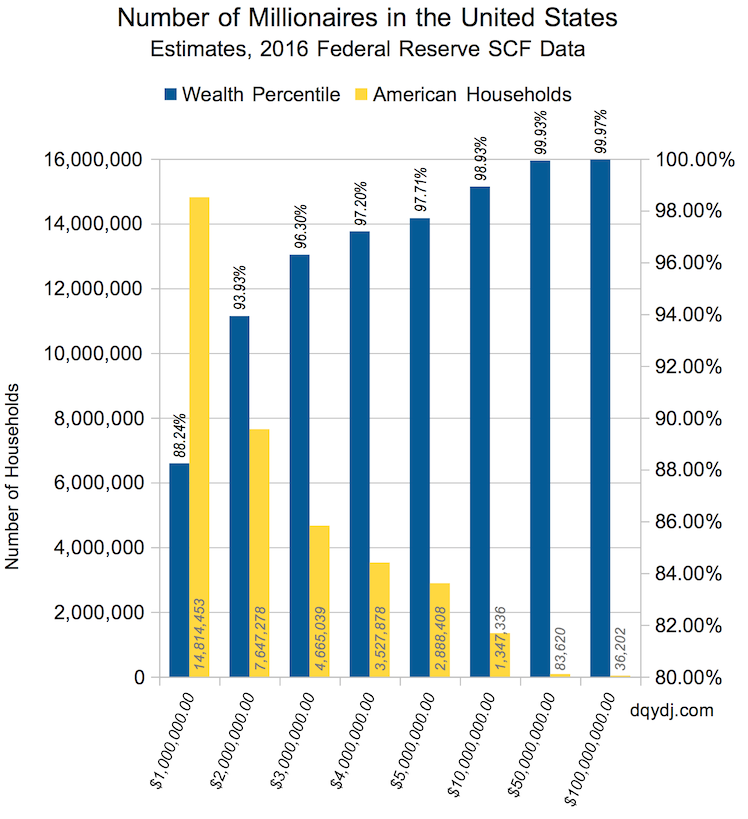
We can actually look at the Fed's Survey of Consumer Finances and get a reasonable number here. Household's with >$50m are top 0.07% percentile and there are approximately 84k of them out of around 130 million households....
[1] https://cdn.dqydj.com/wp-content/uploads/2017/09/millionaire...
- ownership percentage (0-100%)
- company value (50M - $2T)
The Cartesian product of all ownership * value that work out to > $50M is substantial enough that it's 1) probably not fair to individual business owners to force them to divest to raise a minuscule percentage of the Federal budget, and 2) probably not worth the potentially disastrous 2nd-order effects on pension funds and investment funds that are largely predicated on stable/competent corporate ownership.
In any case, it sounds like you've conceded that there is a forced divestiture, and now the argument boils down to: "is that justified?"
But there is an inherent right to the ownership of property (enshrined in the US Constitution).
A Federal wealth tax is currently unconstitutional for the same reason that you don’t have Federal property taxes: the Constitution explicitly prohibits the Federal government from levying direct taxes except for income (via the 16th Amendment). Wealth is not income.
Ah yes, the economic argument of "punish savers and people refraining from consumption will lead us to our Centrally Planned Utopia"
>If you have a bucket of money that isn't doing anything, then what value does it actually bring to the economy?
Do you and I live in the same reality? When a global pandemic has shown almost every single person on earth that cash balances should have been higher -- enough to sustain unexpected periods of inactivity -- it seems a little tone deaf to say saving money is unproductive. There's already a tax on holding central-bank money -- it's called engineer inflation and it's what's exacerbated the economic repercussions. Your Central ~~Bankers~~ Planners convince you taxing fiat money holdings (price inflation) and artificially reducing the cost of bringing future production to the present (downward interest-rate manipulation) will lead us to utopia when it's actually cause over consumption, over production, and a planned economy on the precipice of collapse.
I'll keep the "unproductive" savings, thanks.
You're sitting on greater than 50 million dollars? That what a wealth tax would most likely target
Outside of Disney comic books, money doesn't sit around.
The money "in" my savings account is just bits in a database. The value it represents has been loaned by the bank to someone who is doing something with it.
When I sell stock to pay a tax, the money to pay that tax has to come from someone who bought it. That value represented by that money is value that won't be used for other things.
Are you certain that what govt will do with that value is better than what those someones are doing with it? That's the question because taxing me means that they won't have that money and govt will. (Taxation doesn't create value - it moves it.)
All of the talk about roads and stuff is somewhat dishonest. Transfer payments dominate govt spending, not production of goods and services.
> That what a wealth tax would most likely target
Ah yes, the "the tax will only affect bad things" rule. Is there any good reason to believe that the folks who are pretty much responsible for the current tax system will somehow figure out how to do this correctly?
Your belief about "money just sitting around" is not encouraging.
When things go south, we'll hear about the value of breaking eggs, but for some reason the omelets don't show up.
If an economic agent holds a money, they are -- by definition -- saving their money. If they instead decide to speculate with the money "Hmm I think gluten-free bread will be in higher demand next year, better buy ovens today, to sell to the baker then" they consume scarce resources (labor and materials to make the oven). If they invest the money in a business endeavor "Hmm I need to allocate capital from money to wheat, ovens, to turn a profit as a baker to produce bread" they consume scarce resources. These capital allocations change the exchange rates of these goods.
Try as you might to avoid it, all forms of punishing cash holding induces undue consumption.
We're talking about multi-millionaires, often in the tens of millions, and more.
No-one is saying that regular Joe's with $800 in their savings account should be penalized for just letting them sit.
Does no one in this thread understand that there already exists wealth taxes in countries without explicit wealth taxes?
While many countries have explicit wealth taxes (Government agency that will demand you pay x on y), many (almost all) countries have wealth taxes that tax "regular Joe's with $800 in their savings account". The central bank in the USA literally has a charter to print enough money so that asset prices rise at a nominal 2%PA. If a central planner confiscates $16 in purchasing power from regular Joe does it matter if its done through direct taxation (taking the $16 dollars) or indirectly (printing enough money so that his future value of $800 will be only $784)?
Since you need it spelled out again: unlike inflation, actual wealth tax will not take $16 from your Joe because in case of actual wealth tax, $800 is three or four orders of magnitude below minimum taxable amount of savings.
Currently many countries have, or are proposing additional wealth taxes that are graduated in amount (What the original article is discussing).
>blame wealth tax for the faults of inflation
Who made this argument? Not me. You've misrepresented me pointing out that engineering inflation is a tax on all wealth (including average Joe's $800)
Best of luck to you in thinking that people writing words in a book in marble buildings can magic more food into existence.
Wealth tax would only apply to the very reach. i.e. the “job creators” whose wealth is supposedly “trickling down” the economic ladder.
Wealthy people don't just leave their money under a mattress, they invest it in something. Even if they just left it in a bank, the bank is still going to lend that money out and invest it. Taxing wealth just encourages riskier investments, as higher risk is needed to achieve comparable post-tax return.
Currently investment is only taxed on a "realized basis". No tax bill is due until the investor realizes a cash profit, either by receiving a dividend or harvesting capital gains on sale of the asset. In contrast a wealth tax is assessed every year, regardless of whether the investor has actually earned any actual income.
Under current tax law, an investor is not penalized for continuing to hold a high-value asset. In contrast under a wealth tax regime, an investor would be forced to sell some portion of his portfolio every year just to pay his tax bill. That heavily favors large, liquid, public companies over startups. Selling a million dollars of Amazon shares is as easy as pressing a button. Selling a million dollars of a Series-A startup, especially at a fair price, is really hard.
This would especially impact early-stage employees, who usually hold a very high fraction of their net worth in their stock options. At least VC investors usually have other holdings that they could liquidate to pay their annual wealth tax.
Imagine you own 20% of a company with a $50 million valuation. On paper, you're a deca-millionaire. But in reality you could easily have an overdrawn checking account. How do you get your hands on $100k in cash to pay your tax bill? There's no real market to sell your shares, and very likely you can't even do so without board approval. You could borrow the money, but if the company fails, you're now left with huge debt and worthless equity.
In all likelihood a wealth tax would pretty much destroy the Silicon Valley startup ecosystem. Or at least remake it into something totally unrecognizable.
A wealth tax does not reduce income, it reduces wealth! Income taxes and capital gains taxes reduce income.
But taxes provide services that give people a greater safety net. Healthcare is the canonical example but there are many other ways that taxes can help ensure that one mistake does not ruin the rest of your life.
Personally, I would love to live in a country where businesses took fewer risks and individuals could take more.
It doesn't seem like low risk investments like sticking money in the bank to be lent as mortgages or investing in government bonds are as good for humanity over the long term.
Taxing away 1% of an asset that grows 0% every year leaves 45% of the assets that would be present without the tax after 60 years.
Taxing away 1% of an asset that grows 7% every year leaves 45% of the assets that would be present without the tax after 60 years.
However, to be more realistic, modeling growth makes the taxation even worse, because at times when your equity is at a high valuation, you need to sell some equity and then some extra on top of that in case your equity value crashes before the end of the year/ end of the tax period. You are forced to act defensively.
What about dividends? Starting another company? Working as a CEO or board member?
The article has a terrible foundation because he's intentionally misleading the reader.
We already do that via inflation. Leave your money uninvested and we tax it 2% or more per year, every year.
That is its purpose. I'm not sure why people think otherwise.
Whether you think that purpose is a good reason to have a wealth tax is a separate argument.
It's surprisingly not different.
If you have an asset that is dormant, is $100, and you tax it with 1% for 20 years, you get to $81.79 by calculating 1000.99^20.
Now suppose instead, your asset grows by 10% a year, and you have no tax. That asset grows to 1001.10^20 = $672
Now suppose that prior to the investment each year you tax it with 1% and invest the rest, for 20 years, again at 10%. So you get 1000.99^201.10^20 = $550
That $550 of $672 is exactly the same portion as $81.79 is of $100. In other words, growth or no growth, it has exactly the same effect, either way a 1% tax over 20 years takes 18.2%.
> Penalizing static value seems almost reasonable.
In the philosophy of taxation there's a different approach. Money you own is money you earned. Typically earnings are taxed. You produce X value, and a small portion of X is allocated to a general pot of money to fund general things in society, e.g. infrastructure, rule of law etc. But after that, it's your money. If you then invest it and earn more, again, a portion of those earnings are taxed. But if you don't do anything with the money, for the government to take it, is seen as a form of theft.
The principle why the one form of appropriation is okay and the other isn't, is because when you earn, you benefit. And the government benefits, too. When you just store, you don't benefit, and taking it is a purely negative experience. Many people are willing to share part of their new earnings. Few are willing to give up something that has always belonged to them.
Inflation is a natural penalty on static value anyway. So are opportunity costs. Plus, actually static value is quite rare, money in a savings account is being put to work by the bank. The amount of really static money (like money under your mattress, or a permanently vacant home) is quite a small portion of the financial system and again being penalised by inflation and opportunity costs already.
THE philosophy of taxation? There is no central deciding authority here on a singular philosophy.
> When you just store, you don't benefit, and taking it is a purely negative experience. Many people are willing to share part of their new earnings. Few are willing to give up something that has always belonged to them.
That's a real stretch when just a sentence earlier you talked about earned benefits and taxation of those benefits. Storage is just the accumulation of earned benefits beyond your spending habits. Value isn't created in a vacuum nor is it used in one. And current taxation doesn't preclude future taxation, it's why us common folk are told to do any of our retirement funding that we can as pre-tax, since who's to say something that is taxed today (and is expressly stated as not being taxable in the future) won't be taxed again later on appreciated or total value. So, by this alone, the government saying taxes now, and deferred taxes later if that valuation meets certain thresholds isn't something that the government can't or even shouldn't do.
And, in many cases, the tax wouldn't apply to startups or their founders unless they're already sitting on multiple tens of millions of static personal valuation; which is where this whole argument really breaks down, and shows its disingenuous colors. When someone like PG talks about these wealth tax valuations in general terms of percentages, many of us are still thinking on OUR terms, which means we're thinking on "normie" scales of 10s or 100s of thousands, or maybe a couple million, where a 1% drop in valuation YoY would make a significant dent in what we can and can't do; when a wealth tax is floated (at least in the US) it's looking at $10M+ in static assets at the individual level, and applies to a wealth class that only a small percentage of people can actually comprehend. And, when a wealth tax is floated in the US, it also has discussions around non-realized asset valuation (such as small businesses, start-ups, etc) and what classes of assets contribute to the total value of an individual wealth tax.
Applying a wealth tax in a general way like how PG has done it is a bit disingenuous, not wrong; but is prone to personal wealth view biases. It becomes even more obvious when we take your example and put it towards something that would actually be taxed... $100M; which you end up with $81M for static assets or $550M instead of $672M in PERSONAL assets. Most only think of numbers in these terms if the "win the lottery" so who in the general public thinks the difference of $122M over a lifetime of nearly 3/4 of a billion dollars in wealth (not earnings, but accumulated valuation) isn't a bit of a "whatever," they'll pay more in taxes on that Mega Millions winner and won't bat an eye. (this also works for the usual lower bound as well, $10M, but $100M is guaranteed to be included in any of the recently floated wealth taxes).
If I have a 100 shares they'll take 1 share year one, slightly less year 2, etc regardless of the price of a share.
77% of Google is owned by mutual funds & other institutional investors.
62% of Apple is owned my mutual funds & other institutional investors.
79% of Facebook is owned by mutual funds & other institutional investors.
So now we should be penalizing unproductive assets? When did we all decide that was ok?
Based on that logic, wouldn't I be justified in draining someone's savings account in order to invest it more productively in stocks? Maybe it's ok to steal land from people if I will grow more crops on it than they will?
You can justify taking pretty much anything if you say you will use it for something more productive. What about property rights? Why should people who have played by the rules and built wealth in our society, which they were encouraged to do, then have to live in fear that their wealth might be taken from them?
We already do that---it's called inflation. And the justification used by economists is that the economy will collapse without inflation to incentivize spending money.
We didn't invent inflation, but we absolutely do set a target inflation rate as a social engineering tool. And the reason that deflation is considered "worse" is because it lets people keep equity in unproductive assets instead of liquidating it and moving the money into more productive assets.
No, the reason deflation is considered worse is the possibility of a deflationary spiral.
The Fed is primarily interested in preventing a collapse of the banking system. They don't really care if people are spending their money on productive investments or hoarding it -- in fact, if everyone was spending their money on productive investments there wouldn't be any bank reserves, and the Fed would be very unhappy about that.
When we went off the gold standard?
It is not simple just a management fee because instead of being used to purchase a luxury goods it may be used to improve healthcare, infrastructure or regulating industry.
If it wasn’t for government investing into DARPA none of these startups would even exist.
If you have a bucket of money that isn't doing anything, then what value does it actually bring to the economy? Penalizing static value seems almost reasonable.