TBF It’s not even the same company. Part of the same group, but the entertainment companies are separated from music hardware, have their own heads, their own deals etc.
It’s like boycotting Vox media because of Comcast. It follows a logic, but it feels peculiar.
On your general point, totally agree. There was a company touting to “design” everyday noise by sticking a small module we’d keep in our ear canal, the company seems to have disappeared but I was so sold on the idea. Almost permanent noise reduction, or filtering for nearby voices only would be the dream setup.
Now, Sony has banking, internet provider, insurance, camera sensor, NFC payment companies as well.
Would we also boycott all of these, as well as smartphones that feature a Sony sensor for instance, if the goal is to be consistent ?
I’d totally boycott Sony BMG for life, but I feel it would be the wrong signal to boycott other independent activities, in particular as the headphone devision is one of the last bastion of trying to provide the clearest sound at a fair price, in a world where Beats and Bose are runaway hits.
I’m not boycotting Sony, I just associate their name with crappy products.
The mirrorless cameras aren't just pretty good, they're the new standard unless you have Canon/Nikon brand loyalty. I can't find the stat right away but IIRC Sony supplies more camera sensors than anyone else for smartphones (or maybe its just the high end ones)
I mean I'm not trying to change your mind, just adding my 2 cents that every piece of Sony hardware I've had was extremely well built and lasted years or decades. I have an old Minidisc player too I dig up every few years to listen to recordings I made back in high school.
Also, considering how much these thngs cost, too much money gets thrown out when just the inbuilt lithium batteries wear out eventually. I now avoid buying anything with embedded and unremovable batteries if possible.
Same here, particularly during a time when I was living in a noisy apartment building. It was particularly difficult for me as I didn't to take sleeping pills since I'm a bit against those things.
>Whoever cracks this particular nut without headphones and manages to create a bubble of 2 cubic meters or so that is silent from outside interference will make a lot of money.
One of the first things when I got myself an RTX 2080, was learning how to use the ray tracing APIs to develop an idea similar to what you mention. I was using the rays to model the wavefront of an arbitrary source of sound, and then, given a 3D scene of a "room" or whatever, visualize how this wave was traveling through the space and reflecting over surfaces with different parameters.
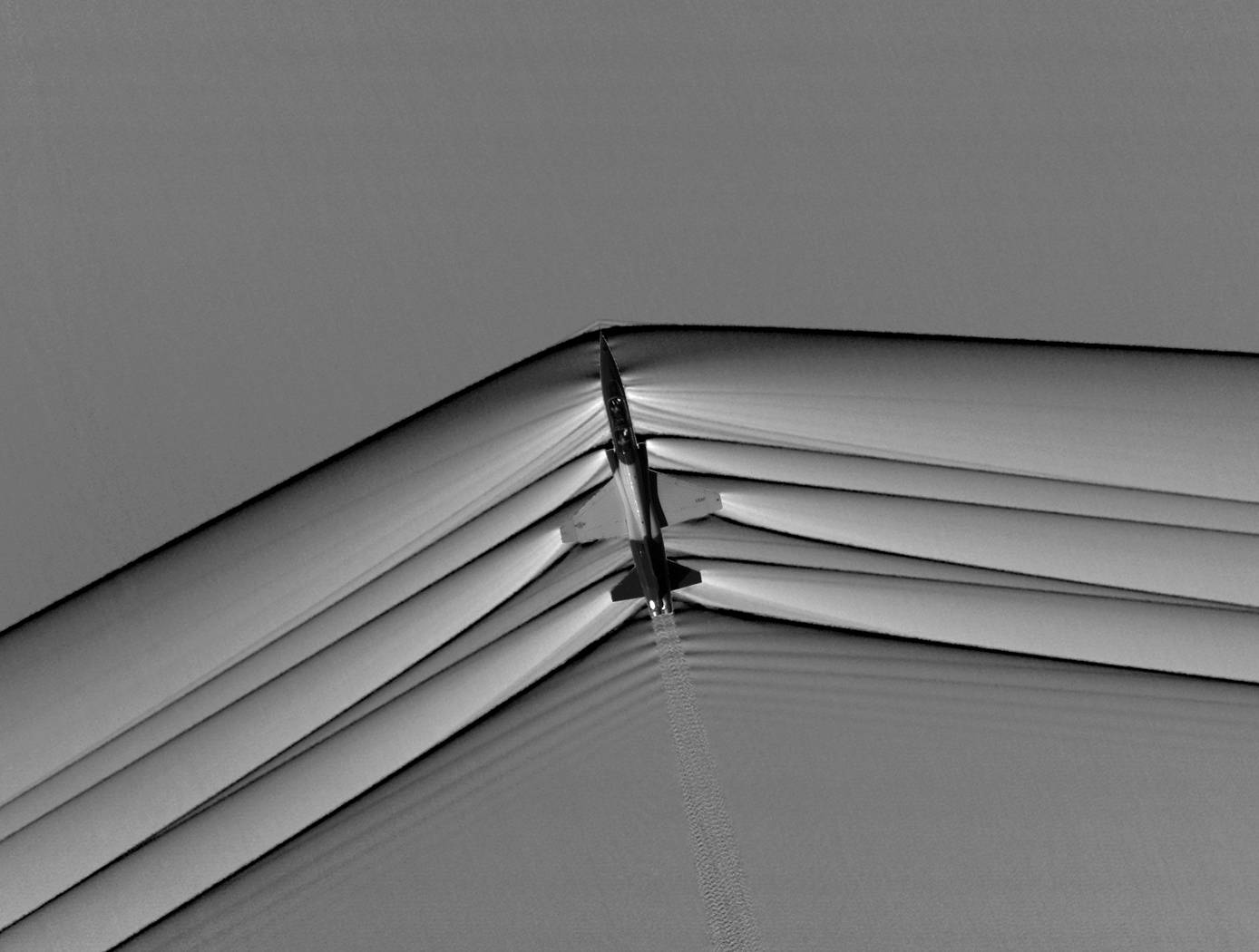
The point of this was to see if you could find/predict the spots in a room/house/building where noise is naturally damped. The visualization was very nice to look at as I modeled the wavefront as if it had an exaggerated effect over the diffraction of light on the air. I cannot find it now, but there used to be a 2000s or so tv ad for the Beolab 5 which looked very similar in essence, maybe also a bit like schlieren photography [1].
[1] https://ntts-prod.s3.amazonaws.com/t2p/prod/t2media/tops/img...
I love the hacker ethos here on HN. Most places, we would here about how high an fps a person obtained on their favorite game with the settings cranked up. Here on HN, we hear about using the ray tracing api to model sound. It is stuff like this that keeps me coming back: hearing how people are using tech in new, really cool ways!
Poking around I couldn't find them, but there are rather a lot of tiny fish-eye mirrors being sold to affix to the top or corner of a car rear view mirror (so-called blindspot mirrors). Those should be in roughly the correct size classification.
I really missed them on April Fool's Day this year. Like what's the point of even honoring the day if I don't get to start it by looking for the fake products in the TG catalog? Maybe I should just go back to bed.
[1] https://www.ebay.com/itm/10cm-Diameter-Focal-Convex-Mirror-L...
[7] https://www.amazon.com/Computer-Rear-View-Personal-Security-...
Another victim of open office seating, I'm sure.
You can tell roughly how far away a sound source is by measuring the curvature of the wavefront, since sound radiates out in a sphere. The farther away you are, the lower the parallax between two sensors.
If you have sensors with 20 cm separation (each ear) then you would need a minimum sample rate of 34.3 kHz to easily correlate sounds within 2 m. With 5 cm separation (to discriminate sounds coming from your sides), you'd need 550 kHz.
Since sound waves are ~10-10,000x lower frequency than that, you need to be able to measure pressure very precisely to distinguish two waves. Rough rule of thumb is 10x, so you'd need up to 1/50,000 precision microphones, or 16 bit. Thats an absolute minimum and you'd probably want ~20 bits.
You might need a DSP and this trick works much better with some high range microphones (electrets are maybe sufficient), but all of that is well within the range of possibility... so I'm kind of surprised nobody has done this yet. I might take a shot at it.
The tricky part is the noise floor, which is only 10-1000x (in terms of voltage from the microphone) below the things youre trying to measure. That means youve got to gather dozens to thousands of samples to determine what should get through, so you need to hear something for up to tenths of a second to decide to let it be audible.
> My 'ideal' soundsucker (sonic black hole) is a ceiling mounted device that projects a cone of silence. One possible way in which it could work is by using a phased array of speakers to 'fake' a larger one. But that ideal will likely never be reached due to limitations in physics, imagine the problem as applied to a wavy surface of water: create a wave pattern that cancels out the wavy surface in one circular area without touching the water directly.
You'd probably want a full network of microphones around your room for this to work, as standing waves will be set up at audio frequencies. It's nontrivial to handle reflections with data from a single spot.
You could do this if you could handle the reflections, but you would need sensors spread around the room (to detect sound before it was already in the cone) and it would only work at a single head height. You'd do it by intercepting the sound, sending opposite waves from above that reached the sound as it propagates across the silenced volume. If you're more than 10s of cm away from the band of silence, the desynchronization will start letting sound through.
It would also be less effective at higher frequencies unless you had head tracking, because the wavelength of sound is not far off from the size of your head.
Wireless is hard for this kind of stuff due to latency, wires are ugly but practical and for a first run I would definitely prefer a wired solution over none at all assuming it is even possible. An alternative configuration would be a cylindrical shape that is 'noise free', with speakers radiating outward, microphones would be set in a secondary circle around the first one.
I imagine this sort of setup would use a very large amount of computing power to make it work.
Wireless only has latency if you let it! Plenty of bandwidth outside wifi and bluetooth stacks, and communication over infrared is always an option. You are correct that wifi and bluetooth have way too much latency, though- 50 ms is 15 meters of distance at the speed of sound.
Computing power is surprisingly relaxed. The problem of figuring out what waveforms to output from a line of speakers to create a given distribution of sounds is actually just a fourier transform, funnily enough. Creating a volume of sounds is just a 3d fourier transform. Both are unreasonably fast to compute, given how powerful they are.
If you want to know more about how the math works and what it applies to, check out fourier optics. IMO its one of the coolest natural phenomena.
That only works in the free field. In a small room (defined as dimensions being larger than ~1/6th to 100% of a wavelength) you no longer have waves, the entire room is pressurized. And as you mentioned, modal behavior is also an issue.
If you're trying to measure the parallax of outdoor (free field) waves, that works in a truly free field, but once you have reflections (from, say, the ground) you have to account for that as well.
Further, that figure isn't very helpful for fluid acoustics. Within the equivalent distance you instead would get tons of nonlinear effects, because fluid flow dominates acoustic transmission. In addition to heavily changing transducer loading, things like vorticity also start to dominate. The net effect is that near field issues arise much earlier, at more like a third of a wavelength. Still, only the very lowest audible waves and quite small rooms create non-acoustic behavior.
> once you have reflections (from, say, the ground) you have to account for that as well.
Ish. Only for quite high frequency sounds which change very quickly. Otherwise reflections tend to mostly just overlap with the primary source. For low frequency waves the distance between the microphone and your ears is much smaller than the wavelength, so you don't need to worry about multiple waves very much.
I have young kids at home. Those are the exact sounds I’d want to cancel!
This exists today, it's just not a device, it's building materials. The more sound deadening you want, the more expensive the room will be. It's possible to deaden sound in this manner to the extent that many people feel uncomfortable[1].
___
For one person, a baffle of 10x 1cm sheets of plywood with a 2cm air clearance will do wonders (works out to be approx a 30cm cube with a 30x2cm slot at the front and back).
You can push ample air for one into a studio without any audible sound getting through.
I'm assuming one of the biggest things limiting sound cancelling is processing speed? being able to react to changing waveforms as they arrive at the ears
I use both (Bose QC35ii and 3M Peltor X5A) and I find the Bose is better in two ways: ear comfort and it doesn't trigger my tinnitus. It seems the Bose lets in just enough ambient sound that my brain doesn't go into a tinnitus-crescendo-loop.
Also, of course, the construction headphones don't play bluetooth audio.
Fitting both microphones and speakers in the device is the current challenge. The Bose device shows we are very close to solving that too, and the rapid shirking of wireless in-ear headphones is helping.
Mentioned here: https://news.ycombinator.com/item?id=22078517
Airpods fare a little better, but I'd like something even more improved... if it could somehow let fresh air in and cool my ears a little too, that would be great...
I put my sunglasses under my monitor with the lenses facing me and whatever is behind me. A rounded mirror works well too.
They have blessed me with some blissful naps, however. Possibly their greatest superpower is making robot vacuums disappear.
Finally I realized that I need NC for removing some fan noise like HVAC and server but I don't need superior one. I got Beoplay H9i for $300 and satisfied for both. Fewer battery life is cons.
The silence is pretty addictive.
Why not just put a mirror on your desk?
I have NE headphones but they are too big for me to comfortable sleep with them (I tend to turn in my sleep)
This was a key element for me in overcoming my insomnia, I used to stay awake at night because it was finally quiet enough that I could concentrate. After identifying that as a key part of the problem noise reduction became a focal point. It has created a new problem: the headphones are so good at this that it is very easy to creep up on me and scare the bejezus out of me when I don't receive any other clue such as a changing shadow or something like that. I'll have to figure out some kind of early warning system for approaching people.
Whoever cracks this particular nut without headphones and manages to create a bubble of 2 cubic meters or so that is silent from outside interference will make a lot of money. The article lists one entrant that seems to be a move in the right direction but it does not look like that particular version will be ready for prime time in the near future.
My 'ideal' soundsucker (sonic black hole) is a ceiling mounted device that projects a cone of silence. One possible way in which it could work is by using a phased array of speakers to 'fake' a larger one. But that ideal will likely never be reached due to limitations in physics, imagine the problem as applied to a wavy surface of water: create a wave pattern that cancels out the wavy surface in one circular area without touching the water directly.
Edit: Another - unexpected - benefit is that all the fan noise and other ambient noise in the room I'm in (which I normally don't even notice) also drops by a very large factor with NC enabled.