The stupid thing is that I know this is not what you actually believe. You say it in the first sentence of the second paragraph of the comment I'm responding to. If this is the tool you have, then it's a tool you can use. If you use it properly and understand the limitations, then it is fine. It's more than fine. It does what it needs to do!
I get that it's extremely easy not to understand how to do things. I get that it's extremely easy not to understand the limitations. I get that it's extremely important to send the message that unless you actually, truly know what you are doing, then probably you should not be using email and OpenPGP to encrypt messages. And in fact, if you have the chance to use something better, you really, really shuold. I get all that stuff. But it is just wrong to imply that you can't send information securely using OpenPGP and email. I mean, it's infuriatingly insulting to be told by a security expert (which I readily and without reservation admit you are) that I'm just playing when I know said expert knows they are exaggerating to push their agenda.
I can even show considerable sympathy for this agenda. I think you do a wonderful job of explaining problems and showing where there are better ways of doing things. You are doing good work! But, stop with the insults, please. It's beneath you. It pisses off people like me that would love to support your cause but are so pissed off with your attitude that I can't bring myself to do so. You are hurting yourself and you are hurting your cause with this line of nonsense.
LARP is a popular free time activity with nerds here in Germany. And people will fawn over kit and/or spend money on extravagant but useless equipment to earn social status inside the community.
So I thought that calling people LARPing was actually quite clever, because the reason why I would roll out buggy encrypted email would be the same as for why I'd walk around in a cow leather robe in a forest shouting like a madman. I have done both, btw.
And just like nobody would complain about me accidentally breaking character during LARP, nobody would complain if I accidentally break the encryption by replying the wrong way.
So as someone enjoying LARP and dabbling with encrypted emails, I didn't feel offended by his comparison.
You're great! Loved this.
People should stop using encrypted email.
Not every application is your application. Not every fight is your fight. If you absolutely must insult someone, target it and be specific. But, better yet, get your message across without insulting people. It will be much, much better.
I didn't see your original message but I'm sure it was well-intentioned and wrong. I am wrong often too. Just not this time.
Taking back an HN post you think will be taken as uncivil is a strong move. Respect for taking the community seriously. There's nothing personal in my criticism of encrypted email; it's the technology I hate, not the people behind it.
I think author is advocating for all of communications to be encrypted and it cant be email because its just bad. People should stop advocating for it.
I'm still looking for a solution for the situation when I'm trying to communicate without revealing my identity to the person I'm talking with. Signal's reliance on phone numbers means I'd need to get a bunch of burner phones or something, which is beyond what I'm willing to do: I'm not talking about an ultra-high-risk situation, just I'd rather not announce who I am when I'm interacting with people I don't know that well.
What do you think is the most promising tool for this sort of communication? I've been hearing about Riot/Matrix; do you think that's a good option for people to use?
> I'm not talking about an ultra-high-risk situation, just I'd rather not announce who I am when I'm interacting with people I don't know that well.
In that case, yes, with some caveats.
Be mindful of your list of Matrix devices because that is something all participants can see. Otherwise, Matrix will allow you preserve basic anonymity with respect to the other participants (but not with respect to the server) with solid encryption.
Also bear in mind that Matrix is built on the premise of storing all messages server-side indefinitely by default (in end-to-end encrypted form and with regular key rotation so forward secrecy is preserved).
Of course, forward secrecy does not help if the participants retain all keys indefinitely and subsequently leak them. I think disappearing messages are in the works.
Another concern I have with the proposed replacments is many (Signal, Keybase, etc.) depend on a single centralized service.
This exists. In the past, it took the form of an "anon.penet.fi" email address. This was a very simple, useful service[1] that many people used to great advantage.
In modern times, you can see this very same concept used at craigslist wherein CL maps your email address to a random craigslist email address, allowing you and another party to have painless email back-and-forth without leaking identity.
Now that I am thinking about it, you could set up a simple SMS remailer with codes that would allow the same thing to happen.
None of this addresses secure comms, but that's not the question you asked ...
[1] A "remailer".
CL implementation is flawed and only gives perception of privacy. I forget the header/tech name for it, but if you hit reply and your email account is set to “First Last <[email protected]>” it will pass along that entire string to the recipient in the body of the email. The obfuscation is only in the actual email address the message goes through
Oh wait, https://en.wikipedia.org/wiki/Signal_Protocol#Metadata metadata collection?
Pgp: you can see the title, sender, and recipient of every message.
This is already happening, which is why I disagree with your messaging: I don't think the way you attack it will fix it, because the people this post will resonate with already (generally) agree with you. But I digress...
I view encrypted email as services like PM/Posteo/whatever paranoia induced flavor of the week fits here. I don't know anybody who tries to use encrypted email straight up - I think the era of running your own mailbox is gone so I don't particularly count it for anything. If you do it yourself, it's a shitshow; if you're on one of those services it "just works".
You can shake the shoulders all you want, but people use email, and people look for the easy win. "Encrypted email" is easier for the average person to latch on to than the UI/UX most secure tooling has right now (a problem even you've noted: https://news.ycombinator.com/item?id=21897173). It's very telling that nothing has dethroned it yet.
Given that, I welcome these marginal improvements while something better is built. These things shouldn't be around in ten years, they're bridges. Email simply has an annoyingly odd usability bar to clear, and nothing is really close to that right now.
If I had to make a dumb analogy, it's like Objective-C and Swift: it's very, very clear that Swift is the future; inherent advantages abound, and much more difficult to shoot yourself in the foot with... but in lieu of Swift, I'd still sooner write Objective-C over straight C, warts and all.
If it has katas/forms, if certain moves are proscribed during sparring, or if your teachers have not told you the catch-22 about there being no morally acceptable way to practice genuine kill shots even though they're all that really matters, then you are not preparing for self-defense in a life-and-death struggle.
So, martial arts may be the appropriate metaphor.
Disclaimer: My knowledge here is limited to a few years of kung fu as a kid, a lot of armchair research in the past five years, and an old friend who used to place at multi-state competitions. I'm not an expert so I could be off here.
1) the mugger was going to attack you anyway, and does so every day
2) the "martial arts" was a vicious form of Krav Maga taught to CIA operatives, that was a state secret until a few decades ago
Seems like an unqualified win to me.
And yet, you catch more flies with honey than vinegar. Or, in other words (although this is an exaggeration) pulling a Linus to get your point across is counterproductive. The hostility radiating from article will turn off a lot of people who otherwise might benefit from considering it.
https://imgs.xkcd.com/comics/security.png
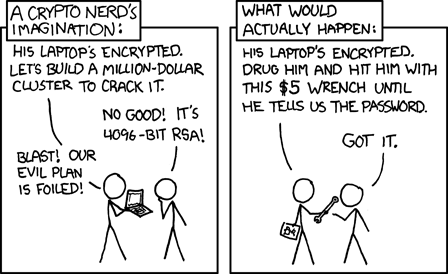
If your adversary is going to drop you, your family, neighbours and cat in an acid vat disappearing messages aren't going to save you.
If your threat model is organized crime, signal might be an ok solution, if you have messages set to disappearing faster than you would tell them your password after they start sanding your feet off.
If your model is first world law enforcement I hope you or anyone you care about have never committed any crimes ever because you will have the book thrown at everything you might have done: https://www.goodreads.com/book/show/6611240-three-felonies-a...
If your model is google, then encrypted email is perfectly valid and a wonderful way to use gmail.
In any sane setup, your (and your recipient's) email client will use encrypted connections to and from your respective email servers. Any competent email provider will use MTA-STS, ensuring that no one but the sender, receiver, and respective MTAs can read the message [1]. All this happens for regular unencrypted email, without any effort on the user's part.
So encrypted email purports to drop the ability to allow the MTAs to read the email. But... they don't really do that. Your email providers are required to MITM all of your email, and can trivially modify any plaintext attribute they want to. And anyone who has credentials to your email account can also trivially MITM all incoming email (and may be able to at least social engineer outgoing email, if not MITM as well). This means that pretty much any key discovery mechanism that allows an unencrypted email to initialize or update a public key is defeated [2].
So, encrypted email only provides extra security in those cases where: a) keys are negotiated completely external to email (in which case, why bother with email?), or b) you trust the email provider enough to not try to intercept your messages but not enough to not look at your messages without your permission. Given the BOFH principle (i.e., administrators have no inclination to look at your email because you're boring), that kind of means the second case doesn't really exist as a practical concern. You can improve your security in the second case simply be deleting emails from the server immediately, again not requiring encrypted email.
So... why bother with encrypted email? Unencrypted is secure enough unless you're paranoid, and if you're more than very slightly paranoid, encrypted email isn't secure enough.
[1] This is all happening via TLS, which has gone far, far further than PGP or S/MIME have in actually making "no one can read encrypted text" true. The latter protocols take the stance that "using the cipher.encrypt() is good enough," which has been known to be false for decades.
[2] And DANE-PGP is right out, because your email provider is of course the one publishing your public key.
You’re in control of publishing your public key, not the email provider.
I’d be remiss if I didn’t tell you how bad MTA-STS is:
* MTA-STS: compromise for the DNSSEC-challenged
    * Still can and should prefer DANE outbound

    * Authenticates domain control via CA leap of faith

    * Vulnerable to MiTM at cert bootstrap

    * Vulnerable to weakest root CA, and unauthorized certs

    * Open to downgrade on first (or irregular) contact

* Complex mix of HTTPS, unsigned DNS and SMTPThis is only true if you personally fully own the domain and have control of the DNS and other services, which is not the case for the utter majority (at least 99.9%, maybe a few more 9s) of the population. Of course, in that case, you are pretty much the email provider, so not trusting the email provider is a pretty questionable scenario at that point.
> MTA-STS: compromise for the DNSSEC-challenged
Yeah... DNSSEC is a classic example of a solution looking for a problem. Most of your criticism would apply equally well to not using DANE for TLS, and every browser vendor has looked at it and decided against it because it adds no security.
Right now, DANE is the only way to mitigate downgrade attacks with SMTP and TLS connections. Apparently use of DANE for email is growing [1].
DANE hasn’t taken off with browser vendors because of their concern about additional DNS lookups when making TLS connections.
[1]: “Number of DANE-enabled mail domains growing exponentially”—https://www.sidn.nl/en/news-and-blogs/number-of-dane-enabled...
And right from the MTA-STS RFC: https://www.rfc-editor.org/rfc/rfc8461.html#section-2
the mechanism described here instead relies on certification authorities (CAs) and does not require DNSSEC, at a cost of risking malicious downgrades.
So there’s that.
PGP and S/MIME do. The latter is used for all sorts of official messages for exactly that reason.
Unauthenticated encryption is rather worthless. Repudiation is a separate matter and threat model.
How so?
Mind you, unauthenticated encryption in terms of signal does not mean that anyone can forge a message, rather that you can't prove to a 3rd party that this was a message sent by the sender rather than forged by you.
b) I'm my own email provider, but I don't trust my server provider (they could read HDD of my server), for example. Or my recipient's provider.
Because I've been using that method for close to 15 years now?
If you mean FTPS (which I suspect you do as I actually had to set up something similar at one time), that's FTP over SSL and has nothing to do with SSH.
Your point still stands though: some of the background "FTP a CSV file with a cronjob" crap that goes on in the background would horrify anyone.
It's also a counterpoint to one of the OP's points which is that trying to secure email is a dead-end that we should give up on. It may be possible, though very difficult, to transition to secure email. But it would have to be a brand new protocol not tacked-on to the current system. The way that SFTP is the appropriate upgrade path for FTP and not FTPS.
A new e2e protocol that works just like email does would be excellent, but we don't yet have that. Signal &co are chat apps with a different feel and purpose and other than matrix and xmpp not federated, which is a non starter for many entities.
There are some things we could easily give up to get encrypted mail. For example, setting a max delivery time to allow ephemeral keys.
But there are other problems with encrypted messaging, and I'm particularly thinking of spam. How does Signal/WhatsApp manage to keep a lid on it? Would that be possible in a federated system?
It is not. Unencrypted is environmental pollution that need to be actively prevent until it reach zero use. A favorable future is one where the firewall blocks any unencrypted traffic by default.
Similar, giving third party clear text copies of private information is not secure. It is never going to be secure, and the only half working solution there is the kind of heavy legal regulations and systems that does not exist anywhere yet.
If people want to debate over which end-to-end encryption scheme is best then they can do so as much they want, but in the end the goal here is to stop plain text from continuing harming people.
Email is protected with TLS on all every hop if your provider is competent. My point is that this protection is sufficient for most purposes. Where it is not sufficient, email encryption doesn't actually add the protection you probably wanted (this is the what the original article is detailing).
Project like freedom box could make email encryption obsolete, but thats not because unencryption would be secure enough. It would be because the encryption would be moved away from the individual email and onto the whole server.
Because Gmail does all of those things, and spends more money and effort making sure they do it correctly than you will over your lifetime.
If you have secrets where you believe that, say, a government will extrajudicially lean on Google to access them, theres am equally, or even higher likelihood that you misconfigured something somewhere and leaked your data.
Giving google a plain text copy of everything you say in private communication is not good enough security. Anyone working with information that is covered under privacy laws should be held legal responsible for disclosing it to a third party, regardless if that third party is google or a friend at a bar. If it is a doctor, lawyer or government employee the probability of this is close to 100%. If its a company talking to customers, communicating personal data as defined by the EU between employees, there is only a google breach away from being found out and sued.
The only choice is encryption, with the choice between a encrypted server under the control of the person responsible for keeping the information safe, or encryption per email. Which of those two choices one choose does not matter but giving google a plain text copy and calling it safe is just LARP security.
I should mention that here in Sweden there were recently a large political scandal involving the government using IBM as a third party service provider. Sensitive data got sent over the border and outside the control of the government, and it continued for years as those in charged really wanted to believe that "the cloud" could treated as just as secure as running your own servers. The law said otherwise, and when reality came crashing down things had to change. Convenience does not make it suddenly acceptable to give a third party sensitive information, even if that third party is a large international operator who can't do any wrongs.
Using gmail without encryption in those cases is a security issue and also illegal. A lot of people still use gmail in those cases and google track record in regard to data leaks has meant that few people have been found out. That said it will only take one significant data leak and people will start to dig for all data being sent to google. That day a lot of peoples head will roll.
I would guess without exaggeration that a large enough data leak at gmail would cause a global market crash. There is just too much plain text data containing sensitive information that people would dig into. Not private, not meta, just information which people should not have given to a third party. Google privacy policy does not play a role in that.
Then PGP is irrelevant, you don't email that data around. And even if you are, then you aren't dealing with security, you're dealing with compliance, compliance with legal obligations has nothing to do with, and is often in direct action against, actual security.
> Using gmail without encryption in those cases is a security issue and illegal.
This, almost certainly, isn't true, given that Gmail is a GDPR compliant store. You might need to use enterprise gmail, for the legal requirements, but that's still entirely beside the point. "Use enterprise Gmail" is the solution here, not "fail to use PGP".
Enterprise Gmail is able to operate as a data processor, but there is a lot of fine details in order to stay within the law. It assumes that the company has agreed to the gmail processing terms and gotten permission from their own customer to process the data in such ways. Again here we hope that op security match the fine line between legal and illegal. (If we want a practical example which I know people do, imagine a administrator of a CRM sending a copy of the database to a new hosting provider. Now a copy of the database exist in the sent folder and an other copy at the email provider that the hosting company use. It is very doubtful that GDPR allows that kind of sharing of the private information. If the file get leaked in a data breach there is high probability of a successful lawsuit for mishandling of the information).
Using your own email server or tools that automatically encrypt everything does however prevent those risks.
It sounds like you're talking about encryption at rest, in which case Gmail does that already, more securely than whatever you're doing so the backwards approach to compliance is more effort and less secure in practice.
I wrote a program to do that, but there is also a package in Debian if I recall right that also do it. On the mail server it looks up keys in DNS and if it founds it, automatically encrypts outgoing email.
> talking about encryption at rest, in which case Gmail does that already
Emails at google is not encrypted. Good must have access to the plain text in order to do analytics and search. If google has a data breach it can include every single email gmail has in plain text, and that is a fundamental risk.
> more securely than whatever you're doing
That is kind of impolite to make assumption about my own setup. It is also wrong.
So you're not talking about pgp/e2ee, you're talking about, like, SMIME or something.
> Emails at google is not encrypted.
They're at least as encrypted as they are on your server from what you've told me.
> That is kind of impolite to make assumption about my own setup.
Given that you don't seem to understand the difference between end to end encryption, in transit encryption, and encryption at rest, I'm going to say that no, I'm very confident that you haven't done this correctly.
> It is also wrong.
And that therefore no, gmail and Outlook are both more secure than your email server.
Basic 101 security. In order to calculate risk you take the risk threats minus risk mitigation. The bigger the threat, or the fewer the risk mitigations are, the bigger the risk.
You might have forgotten that in 2010 there was this data leak called cablegate. NSA lost 251,287 diplomatic messages. NSA did store them on an encrypted server, and used transit encryption, and yet the data leaked. A major risk to data security is access, and in that case an administrator with access leaked it.
With my mail server, that administrator is me. One of the larger benefits of personal servers.
When you compare Gmail and my mails server then you include social risk just as much as technical risk. You compare the physical risk, that is servers located in multiple places on the earth. You compare the political risk of a single entity that control 80% of the world email with a private email address used by one person. you compare targeted attacks with passive and optimistic attacks.
Lets put money where out mouths are. Want to bet that google will have a new data leak before I do? Looks like a very lucrative bet to me.
In 2018 Google had a data breach. five million user's data was compromised. In 2018 I had zero data breaches in any of my servers. Zero users data was compromised. I have been running my own server for almost 20 years and not a single bit has been lost.
Have I Been Pwned? has billions of leaked accounts, not a single which belongs to me. What about you?
> So you're not talking about pgp/e2ee, you're talking about, like, SMIME or something.
No. There are RFC for email security written in this century. The adaption of putting pgp keys in dns is not great however which is why personal email servers is currently better, but both solution works fine either way as long both side of the conversation does it.
Ah I see, so you aren't actually worried about security, you're worried about privacy. Which We've been over when I said:
> Privacy is not security.
You also are ignoring a whole host of other risks, like data loss (your one server breaks, oops there goes your all of your email, etc.)
> Lets put money where out mouths are. Want to bet that google will have a new data leak before I do? Looks like a very lucrative bet to me.
Sure, I'll bet you $10,000 that my email will not be leaked before yours. Here's what we'll do, I'll tell you my email address, and you tell me yours. Mine is @gmail. Yours is hosted on your server. I'll then turn around and spend $8000 on a pen-test of your server, they'll exfiltrate data, and I'll win the bet and be up an easy $2,000.
> In 2018 Google had a data breach
Pause, hold on. No. In 2018, Google announced that there was a vulnerability that could allow semi-public information to be shared more widely than intended (literally it was things like name and phone number that you put on your G+ profile being shared with a wider than intended audience).
There was no evidence that this vulnerability had been used, and Google's own employees detected it.
> In 2018 I had zero data breaches in any of my servers
that you detected. Here, Google has a better track record than you: they are actively monitoring and red-teaming their own servers and systems to detect vulnerabilities. Do you?
So I'll put it bluntly one more time: you are putting your clients data at more risk by administrating your own mailserver than you would be if you let Google or MS do it for you. You can try to come up with all the counterarguments you want, but they are, as this article puts, security LARPing, not actual security best practices.
In the end, if you have your email leaked while I do not then that is what matters. Results. I have had zero leaked accounts. Most people have stuff that been leaked, and since you refused to answer, I assume you are listed in Have I Been Pwned?. You trusted someone to be secure and they were not. That was your choice, and it was the wrong one.
If you break the law however, which is what happens if a pen test a system without permission, then it doesn't really matter if you hack or use rubber hose tactics. Breaking the law is breaking the law. The police don't look kindly to bets under those situations.
I will also say the same thing I wrote to those two pen testers that tested our system. If you find any vulnerability I will happy help write the CVE report. What I did not tell them but will mention here is that I also happy take part in getting those bug hunting reward money that zero days exploits usually rewards. If you have for example a working exploit against current stable release of latest SSH then I am sure we can turn that in somewhere for a pretty good amount of money.
Again, if your counter party is an idiot nothing will save you.
PGP requires that you not only not be careless, but be near-perfect, and that every counterparty does the same. Good protocols prevent you from making mistakes that spew your plaintexts everywhere.
In other words, I want a protocol that doesn't necessarily protect me from idiots, but does protect me from humans who occasionally act imperfectly.
On the other hand, UA (for any protocl) which will not allow copy'n'paste from is crappy by definition and nobody could stop your recipient to copy'n'paste plain text from your message. Ultimately, it is THEIR message as much as YOUR message!
On the side note, I think that GMail is worst thing that has happened both to the web and to e-mail.
A secure protocol would, for example, not mix plaintext and encyrpted text messages, but would ensure that all messages were always encrypted. This way a we'll designed user agent couldn't accidentally mix cypher and plaintext messages.
I'm not arguing that UAs should do user hostile things in the name of security, which is the straw man you're arguing against. Nor did I mention anything webmail specific.
I'm saying that a security protocol shouldn't have, in practice, fail open attributes that user agents have to put warnings up about. A good protocol should allow the UA to entirely hide those dangers.
This is abundantly clear if you try to use any pgp mail client vs any signal protocol client. The protocol makes it easier for UAs to be both more secure and more user friendly.
You mean mailvelope[1]? That's a straight up plugin/extension. It gets installed once and is as secure as whatever is used to secure extensions on a particular browser.
Schemes like "everyone has great opsec".
The condescension I see is in calling out "technologists." I've never heard that before. Just looking at the word it sounds like it means a person who works with modern technology. Wouldn't that encompass the majority of Hacker News readers? But by context you don't seem to have a favorable opinion of the group. What makes someone a technologist to you? Do you include yourself and if not why not? What justification is there for you to generalize people in such an unflattering way?
In a world where encrypted email was popular and no reasonable alternatives existed, the equation would be different. But modern secure messengers have lapped PGP and S/MIME a practically uncountable number of times. I don't know what large power of ten the multiple is of messages protected by Signal Protocol compared to PGP, but I do know that it's large. The risk is not that people will naturally gravitate towards encrypted email (which is in practice a nightmare to use), but that well-meaning but poorly-informed technologists will try to talk them into doing that and adding encrypted email to the basket of tools ordinary people use. That can't be allowed to happen.
I also want the analysis to be somewhat bracing for technologists. I'm not making fun of PGP users when I say they're LARPing. I'm describing reality directly and meaningfully. I don't think proponents of encrypted email have really thought through why they're using PGP and S/MIME, and why they're not terrified of metadata collection and the occasional plaintext reply. Their risk profile is not the risk profile of the public at large; when you're LARPing, it doesn't matter if you get hit on the head with the sword.
† Not the term I would choose, but let's stipulate.