And the US, Canada and Australia are also outliers in this respect. In these cases one had vast amounts of land and resources and relatively few people. Anyone could in principle make it by working the land.
In most other countries civilization has existed for thousands of years and all land is taken. Without government working with people, there really is not opportunity in these cases.
If one takes the European experience, common people have a history of having been exploited by the rich, pushed into tiny plots of land. It was only through democratic control of government that the common man could start to get the government to work for his/her benefit.
Housing as a human right may be classically interpreted as being free to buy, rent, build your house, etc. but the widespread modern interpretation is that individuals are entitled to be provided housing.
* People should have a right to housing.
* Yet we see many people how apparently can't obtain housing.
* Assuming they don't just all prefer to live on the streets, some forces are hindering them to get housing.
* It is therefore the responsibiliy of society to remove this discrimination, so that people don't just have the right on paper, but also factually.
So this isn't about entitlement in the negative sense.
The constitutionalist view more common in the US:
* People should have a right to housing (I know, not per the consitution, but this is the right this article is about)
* If nobody is discriminated by law, based on race, gender or something else, from practicing this right (e.g. buying property, or signing a contract for renting a flat), then all is fine.
So the core difference is that the consequentialist view looks at empirical evidence to decide whether there is discrimination or not. The institutional view just looks at the law etc. ( = the institutions).
This is more fundamental because it indeed used to be that whole parts of society were banned from doing things or owning things.
We now take this fundamental right for granted, which might explain the shift to interpreting "right" as "being entitled to".
There is another aspect in your comment, which to conflate "not being to obtain" with "discrimination". I think this is going a step too far.
It makes no sense to talk about government being in the way of pursuit of happiness when most people are dirty poor renting some land all owned by a small elite, and there being no free land elsewhere.
That is why in Europe the purpose of governments is to a larger degree to guarantee rights of people. You can see that also in the different way free speech is understood in many European countries compared to the US.
In the US free speech is about government getting out of the way, but other entities obstructing your free speech is far more accepted in the US. While in Europe government to a larger degree seeks to protect your right to free speech in a wider variety of settings. That is why e.g. US company rules often restrict speech, while the same would usually be illegal in many European countries. As your speech is protected by government even inside companies.
People can have their preference on what they prefer. But I think the European model makes more sense for European history and society. It may make more sense in modern day America as well, since there the freedom to just find some land in the wilderness and do whatever is basically gone today. The US is in many ways recreating the old rich elite of Europe of old. The US is in many ways developing into an oligarchy and starts to mimic how Europe was in the early 1800s.
Can you remind me what are my ideological beliefs?
Picking an overly political username and being aggressive isn't very conducive to discussion.
Super simplified, but just to give a nuance between "right to have" vs "right to not being hindered".
> The government is ... not some overlord we need to ask permission from.
I see it as the government is restricting certain people from trodding on the rights of other people. Otherwise you get things like chemical companies dumping waste straight into rivers, etc.
That makes absolutely no sense. It only makes sense when it is a failed democracy where elections are corrupted or bought in some way.
Which people can make arguments for ;-)
Though I welcome citations to prove the matter one way or the other, I suspect that the 18th-century Lockean concept of natural rights which informed the founders of the USA, saw ownership of private property as a right and not a government-created privilege. That is, if one claimed land on what was seen as terra nullius, or if a person’s family had owned the lank back to time immemorial, then the land was rightfully theirs regardless of government recognition or not. State recognition in the form of deeds would only have represented something useful for dispute resolution, and did not imply that the state was granting any rights.
We should be demanding the government cede control of the land, instead of pleading for the government to give us a smidgen of what it does not rightfully possess!
Everyone needs a place to live and land is a finite resource. Plus, foreign investors love to use real estate to park money. Government doesn't seem to be the problem here. People will pay what they have to to avoid being homeless. At the same time, developers will build what's most profitable: luxury housing. The market won't fix the problem, so we the people, by way of government, should.
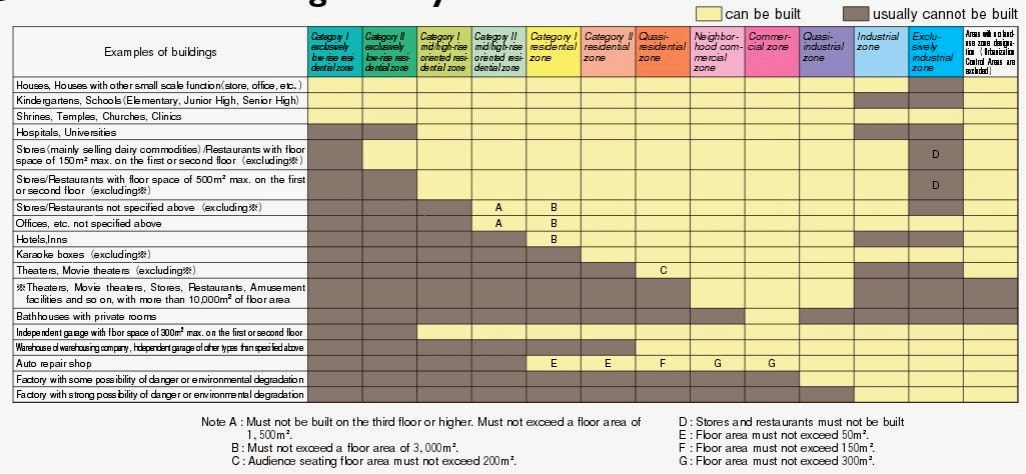
0: https://urbankchoze.blogspot.com/2014/04/japanese-zoning.htm...
1: https://1.bp.blogspot.com/-sV5ETXDs_8M/Ux-axBTuF2I/AAAAAAAAA...
Their land was just to be taken by violence. Hence without government created privilege all your are left with is a dog-eat dog world where the strongest through violence will take land for himself.
European settlers would respect each others claim of land mostly, but it basically meant it was in principle no different from an invading force stealing land.
Native Americans of course did not own land in the Lockean way. They held the land in common. The natural arrangement was in many ways closer to a communist/socialist ideal.
Really? I thought HK was notorious for it's housing crysis where you have people living in flats the size of closets. According to this[1] only 24 % of land is developed in HK (7 % is residential). My understanding is that the government does this on purpose because it makes the majority of its budget from this.
[1]: https://www.cedd.gov.hk/filemanager/eng/content_954/Info_She...
This is not to say that HK doesn't have a housing supply side problem, because it definitely does, but it's not just the government squatting of vast tracts of flat land.
I would instead favour making unproductive use of land exponentially expensive through taxation. However I admit the details of how that would be implemented are very fuzzy.
You obviously never had to pay actual rent in either place.
Who decides what inherent authority governments do and don't have?
The day, thousands of years ago, someone picked a fertile piece of land, cleared it, and started growing crops on it is the day private property of land was born.
That's only if you look at it from a very old and US-centric perspective. The UN's Universal Declaration of Human Rights from 1948 [1], for example, includes the following articles:
"ARTICLE 25
1. Everyone has the right to a standard of living adequate for the health and well-being of himself and of his family, including food, clothing, housing and medical care and necessary social services, and the right to security in the event of unemployment, sickness, disability, widowhood, old age or other lack of livelihood in circumstances beyond his control.
2. Motherhood and childhood are entitled to special care and assistance. All children, whether born in or out of wedlock, shall enjoy the same social protection.
ARTICLE 26
1. Everyone has the right to education. Education shall be free, at least in the elementary and fundamental stages. Elementary education shall be compulsory. Technical and professional education shall be made generally available and higher education shall be equally accessible to all on the basis of merit.
2. Education shall be directed to the full development of the human personality and to the strengthening of respect for human rights and fundamental freedoms. It shall promote understanding, tolerance and friendship among all nations, racial or religious groups, and shall further the activities of the United Nations for the maintenance of peace.
3. Parents have a prior right to choose the kind of education that shall be given to their children."
Those don't sound like "merely not obstructing" kinds of rights.
[1]: https://www.ohchr.org/EN/UDHR/Pages/Language.aspx?LangID=eng
A bare human in nature is barely human even - he/she has no language, no family, no nation, no history, no culture, etc. Same for his rights. There's no freedom guaranteed to him by nature - anybody can enslave him. There's also no right to life or property: anybody can kill him, get his valuables, etc.
Rights are what we declare/determine that our collective organization (i.e. a government in modern terms) must help establish, secure, and guard.
"Natural rights" is a way to say "We believe that the government should protect and secure this and that "right", and that it is the obvious and natural thing to do".
Otherwise "natural rights" means nothing, it's an empty wish, and has no basis without anyone to enforce it.
People do have natural gravity. The have mass, weight etc, just because they exist in nature as people. Nobody can take that away from them.
But they don't have "natural rights" given by any kind of nature, those are things that somebody must establish and enforce for them (including themselves, either because they are stronger than anybody else, or because they group together and enforce them for one another).
The Sixth Amendment guarantees the rights of criminal defendants, including the right to a public trial without unnecessary delay, the right to a lawyer, the right to an impartial jury, and the right to know who your accusers are and the nature of the charges and evidence against you.
People conflate these rights with human rights but they are in place to prevent the government from unduly interfering with your inalienable rights of "Life, Liberty and the pursuit of Happiness" which the Declaration of Independence says have been given to all humans by their creator, and which governments are created to protect.
I am surprised so few Americans seem to realize they are imposing an entirely American centric view of the role of government and the rights of citizens.
Every country has different traditions and understanding of the role government should play. There is no right answer to this.
One must be able to argue this philosophically, without attempting to settle the matter as some sort of legal battle in court where one can "win" the argument by presenting legal text from the American constitution.
I'm not the least bit surprised actually.
The interesting part is figuring out the correct answer. Possibly the questions themselves are wrong, because you answered a preceding question wrongly. But none of that changes that there is always a right answer, even if you ask the wrong question.
No, they are human rights, or, at least, they are in their framers view an articulation of a subset of such rights essential to call out in a particular context.
> but they are in place to prevent the government from unduly interfering with your inalienable rights of "Life, Liberty and the pursuit of Happiness"
No, they are essential components of Liberty in the context of the existence of government.
> which the Declaration of Independence says have been given to all humans by their creator, and which governments are created to protect.
Governments, more often than not, are not created for the purpose or protecting the particular vision of natural rights held in mind by the authors of the Declaration of Independence (in fact I would go so far as to say that since visions of natural rights are at least as varied as the people that believe in natural rights as a valid concept, and that even those individuals have their concepts shift over time, the only government that might ever have been formed for that purpose would be one formed at the exact time of the DoI by the same people.)
You don't really have an inherent right to security and security is not really even possible in a state of nature.
Bob down the street having a mansion doesn't impinge on my rights in any way. In fact, it is great that Bob's mansion doesn't get taken away for my sake, because it means I have the opportunity to also get a mansion that won't be taken away from me :)
That is some of the thought behind my argument.
Quite the contrary, almost all wealth in modern society is dependent on utilizing the knowledge and labor of other people. Either you extract rent from owning property or you extract profits by owning capital.
Either way you are somehow getting other people to do work for you. As your wealth and success grows your bargaining position improves.
In a market economy, the price paid for a product is determined by the bargaining position of the seller and buyer. A sufficiently rich capitalist owner can squeeze down the wage of his workers and thus extract a large surplus of income.
With wealth comes power. You can use your wealth to buy or influence politicians to create laws that benefit your and which are detrimental to your workers or possible competition. You can use your wealth to propagate a dynasty. Pay for your children to get the best education. Send them to schools where the rich and the powerful create special links and bonds. An insider game where they make sure they stay on top.
It is native to assume the game cannot be rigged in favor of the rich. It can and it has been done so since the dawn of time.
It does not mean we should not have rich people. But let us not kid ourselves into thinking opposing and conflicting interests don't exist.
references or examples?
"In all criminal prosecutions, the accused shall enjoy the right to a speedy and public trial by an impartial jury of the state and district wherein the crime shall have been committed, which district shall have been previously ascertained by law, and to be informed of the nature and cause of the accusation; to be confronted with the witnesses against him; to have compulsory process for obtaining witnesses in his favor; and to have the assistance of counsel for his defense."
Written a different way, this would say "the government can't take away your freedoms by arresting you, accusing you of a crime, but then delaying or denying a fair trial to figure out if you're actually guilty."
That's still far different from the government being obligated to provide you housing.
(To be clear - I'm not taking a position on universal housing. It might be a great idea! I just think it's a different class of right, and I think the distinction is worth preserving.)
I see, I always thought that those amendments were about equality between people, but in this context it makes more sense.
Your right to freedom is what's at stake. If the government wants to take it they agree to make their case, not do so capriciously.
The harsh logical truth is you /always/ pay for other people in some way. Choice only affects the cost and outcome.
> We hold these truths to be self-evident, that all men are created equal, that they are endowed by their Creator with certain unalienable Rights, that among these are Life, Liberty and the pursuit of Happiness.
Shelter is a necessity to life. Without a permanent address, it is extremely difficult to obtain gainful employment, which is widely understood to be necessary for the pursuit of happiness. I'm not sure when you're referring to, saying "used to mean," but this humanitarian view of rights is quite solidly entrenched in US law.
Ninth Amendment:
> The enumeration in the Constitution, of certain rights, shall not be construed to deny or disparage others retained by the people.
The founders deliberately left this barn-door open for the sake of progress.
If one wants to conveniently fit all the different views on the topic into two categories, the view advocated by you would be the instituionalist tradition, with e.g. John Rawls as a famous proponent. The reasoning driving Finland here is the consequentialist tradition, represented by e.g. Amartya Sen.
At the risk of oversimplifying things, the consequentialist interpretation is more popular in Europe, while the favorite in the USA is the institutionalist thinking.
No, that's for the government-phobic American liberals.
Rights used to mean things a person is warranted to, just because they exist.
For most European cultures for example the government = the enforcers of the will of the people (if we're talking about a democratic government, elected etc), so there's no hostility between the two (except to the degree that it doesn't enforce people's will).
That's the case for the more cohesive, ethnic-wise, countries.
For Americans it was more complicated, because it was established as a hodgepodge of peoples (as opposed to a single people) with different ideas, ethnic backgrounds, histories, etc. So no single government could cover those all, and any government was viewed with mistrust.
It also has the quality of creating dependency on a government and their ability to deliver and or their ability to dictate conditions.
a)
Quietly pass an obviously unconstitutional law (or better yet, a series of smaller laws that work together), don't enforce it too much against powerful or sympathetic people/groups and then do so for a decade until the court gets around to telling you to stop at which point you tweak the law just enough that you can lie and say it's different and reset the clock.
b)
Pass a law that lets you deny some right to "obviously bad people" (e.g. felons, people who beat their wives, addicts, etc) then quietly expand the scope of "obviously bad people" to include many normal people.
Decision whether something should be made a right should not be based on whether it can be labelled as passive or active, but whether it will benefit the society.
If making housing a right overall increases average life quality and makes unproductive lives productive it should be done. People here can disagree or agree whether the people who will get that housing will male something of their life, and this is something that we have to experiment with in order to find out.
Also if you believe that of the government and that government can not inherently be improved there is not much to do anyway.
Calling things that aren't innate to our humanity "human rights" is absurd - for housing, but especially for things like the internet. Should we try politicians in The Hague because they don't provide universal housing for their people? Should we impose international sanctions on countries that don't have widespread broadband? Of course not.
Conflating these concepts also devalues the concept of human rights, and reduces our ability to actually focus on human rights violations. Slavery, political oppression, violence, etc. are still a very real and special class of problem in our world. People's innate human dignity is being trampled every day by oppressive, violent regimes (and, even in some cases, by liberal democracies). Let's not water down our view of these travesties by conflating them with debates about the generosity of the welfare state in rich Western democracies.
Shelter is definitely pretty important in, for example, Maslow's hierarchy. Obviously there are less and more fundamental rights, and the degree to which something can effectively be realized as a positive right depends on the capabilities and wealth of a society, but surely it’s worth considering what society should work collectively to provide.
I also don’t think it’s at all reasonable to claim that freedom from arbitrary arrest and detention, the right not to be tortured, and other basic human negative rights are at risk - ethics mist be continually improved and adapted as society changes, and the mere fact that abject suffering exists in the world should not mean we can’t decide that there are higher order human needs within the effective purview of society.
Agreed!
> the mere fact that abject suffering exists in the world should not mean we can’t decide that there are higher order human needs within the effective purview of society
Again, agreed! I'm not arguing that we can't talk about universal housing. We can! We should! I'm just arguing against conflating what I see as two distinct types of rights - those that you have because you are a human, and those that governments choose to guarantee to their citizens.
> I get the impression that you’re playing pretty fast and loose with the word “innate”, to basically refer to the rights you think are most important
I'm not so sure. There's a big difference between a person (or government) taking away something I have by default as part of my humanity (e.g., taking away my life) vs. a person (or government) being required to provide me with something that's not guaranteed by my humanity (e.g., the fact that I will have food is not guaranteed just by virtue of me being a living creature with human DNA).
In the end, I can't stress this enough - I'm not saying a social safety net is bad, or that we shouldn't create political rights where the government should be obligated to provide food or shelter or whatever. Maybe those rights should exist! I'm just saying let's not conflate the concepts.
Human rights, in my mind, are something that existed before the UN, and exist independent of the UN. And there's centuries of political philosophy that agree with me on that point. See, for example language like "endowed by their creator with certain unalienable rights" in the US Declaration of Independence. That tradition of political philosophy sees rights as inherent to humanity (in this case God-given, but it doesn't have to be), not guaranteed by some statement of a government or group of governments.
For many thinkers in the years following the founding of the United States, precisely this language has been the fatal flaw of the “natural rights” approach. What if the world has moved on and no one can take seriously the notion that there is a Creator which has endowed men with rights? Even for the American Founding Fathers, those Deists among them were already well aware that this phrasing was a mere rhetorical flourish, it didn’t actually mean anything.
In the absence of a Creator who endowed men with rights, we can only view "rights" as a convenient fiction that humankind, as a social animal, proposes for mutual benefit. And in that case, a representative democracy’s decision to see housing as a human right is pretty straightforward.
At first blush, my thought is that you could still create a secular argument for natural rights, but I'm open to being persuaded otherwise.
Now rights seems to mean things the government is responsible for giving to the citizen, which turns the formulation on its head to imply that the government is the source of human rights.
Seems to be a dangerous trend, however humanitarian its portrayal may be.