News for hackers. Stuff that matters.
Re:SpaceX tests black satellite to reduce ‘megaconstellation... by prpl on Thursday January 16, 2020 @12:49PM (#22066941)
No, it’s not. This hurts survey telescopes and it’s an orders of magnitude issue.

A rule of astronomy is that if you can see it with your eyes near a city than it’s really really fucking bright, if you can see it with your eyes in the wilderness after your eyes have adjusted for 10 minutes, than it’s still extremely bright.

Bright, fast-moving things are pretty terrible.

Even if Starlink doesn’t kill astronomy, the next 4 companies with similar deployment will definitely exclude types of sciences and ruin billions of dollars of investments in new observatories.

Re:SpaceX tests black satellite to reduce ‘megaconstellation... by lutorm on Thursday January 16, 2020 @02:51PM (#22068181)
First, satellites are only visible in the optical when they are illuminated by the Sun, which is only for a fairly short window after sunset and before sunrise. The exact size of the window depends on how high they are, but most of the good "dark" time should be unaffected.

Second, astronomers already use image stacking to reject any number of transient artifacts, like satellites, airplanes, cosmic rays, etc.

Third, while these constellations are going to greatly increase the number of satellites in orbit, it's only by about an order of magnitude. Yes, that's worse, but it's not like it's a problem that hasn't existed before.

The type of observations that are likely to be most affected are surveys that actually search for moving near-Earth objects, especially near the Sun (and radio astronomy which apparently can detect terrestrial emissions scattering off of satellites) but I fail to see how this will mean anything like "the end of astronomy" (and I have a Ph.D. in astronomy.)

Re:SpaceX tests black satellite to reduce ‘megaconstellation... by exrook on Thursday January 16, 2020 @06:11PM (#22070091)
Just to add to this, the satellites can still cause problems during the night after sunset, as they can occlude other objects being observed as they pass overhead.
Re:SpaceX tests black satellite to reduce ‘megaconstellation... by lutorm on Thursday January 16, 2020 @06:36PM (#22070272)
This is extremely unlikely, and if it were to happen it is for an extremely small time. I have never heard of this being a practical concern.
Re:SpaceX tests black satellite to reduce ‘megaconstellation... by Dylan16807 on Thursday January 16, 2020 @06:34PM (#22070262)
Half a millisecond of occlusion is enough to cause problems?
Re:SpaceX tests black satellite to reduce ‘megaconstellation... by xkjkls on Thursday January 16, 2020 @07:26PM (#22070609)
Depends on the telescope, but yes.
Re:SpaceX tests black satellite to reduce ‘megaconstellation... by taneq on Thursday January 16, 2020 @09:10PM (#22071227)
I thought most 'real' telescope exposures were over minutes to hours?
Re:SpaceX tests black satellite to reduce ‘megaconstellation... by brians on Thursday January 16, 2020 @08:30PM (#22071014)
What happens from birds, soot, bugs, airplanes, frisbees, and clouds?
Re:SpaceX tests black satellite to reduce ‘megaconstellation... by xkjkls on Thursday January 16, 2020 @08:33PM (#22071033)
They don't emit giant amounts of EMR.
Re:SpaceX tests black satellite to reduce ‘megaconstellation... by xkjkls on Thursday January 16, 2020 @08:34PM (#22071038)
Also, almost all of those serious observatory telescopes don't have to worry about. Which is what we are talking about.
Re:SpaceX tests black satellite to reduce ‘megaconstellation... by gibolt on Thursday January 16, 2020 @08:50PM (#22071129)
I'd love to read an article on how Frisbees are the biggest threat to observing the universe :D
Re:SpaceX tests black satellite to reduce ‘megaconstellation... by pbreit on Thursday January 16, 2020 @09:25PM (#22071301)
Could describe what such a problem would be in layman's terms?
Re:SpaceX tests black satellite to reduce ‘megaconstellation... by xkjkls on Monday January 20, 2020 @07:34PM (#22103272)
Terrestrial telescopes, which we've invested a bunch of money in terms of observatories in, receive interference from Starlink satellites. Telescopes in space, like the Hubble, don't have the same problem, but they're on the magnitude of 100x more expensive and its difficult to have the same missions.
Re:SpaceX tests black satellite to reduce ‘megaconstellation... by manicdee on Tuesday January 21, 2020 @06:51PM (#22113096)
Noting that the orders of magnitude increase in cost are directly caused by infrequent launches by launch systems with tight mass and volume constraints, and the need to build a space telescope on the ground, have the equipment survive launch, and then survive with no intervention for a decade or two in space.

As new launch systems like Falcon 9, Starship, New Glenn and New Armstrong eliminate these constraints it will eventually be cheaper to build telescopes in space than on the ground.

Other “pusher” motivations include worsening access to real estate, reduced control over light pollution, recognition of indigenous rights, etc.

Re:SpaceX tests black satellite to reduce ‘megaconstellation... by prpl on Thursday January 16, 2020 @06:45PM (#22070339)
correct - I didn't think I meant Starlink would kill astronomy (I thought I was addressing some of the hyperbole rather than extending it) - but probably even at the level to be deployed in the near future we would see severely degraded quality of observations for solar system objects. Furthermore - I do think SpaceX is the "good citizen" here.

I don't think the next 5-10 companies launching constellation satellites will be quite as considerate, so one order of magnitude could creep on to two over 15 years.

I think image stacking has been simulated to work somewhere from okay to unusable even for 15s exposures - I think the trails are actually pretty bad due both due to quantity, velocity in the sky, and brighter-fatter.

Re:SpaceX tests black satellite to reduce ‘megaconstellation... by xkjkls on Thursday January 16, 2020 @07:25PM (#22070605)
It's an area that is plainly in the need for global regulation that currently has none.
Re:SpaceX tests black satellite to reduce ‘megaconstellation... by throwawaybbb on Thursday January 16, 2020 @11:11PM (#22071784)
Earth shine is a thing.
Re:SpaceX tests black satellite to reduce ‘megaconstellation... by lutorm on Friday January 17, 2020 @02:33PM (#22078292)
Not during the night. When the satellite is out of direct sunlight, it also does not see any illuminated part of the Earth.
Re:SpaceX tests black satellite to reduce ‘megaconstellation... by greglindahl on Thursday January 16, 2020 @06:27PM (#22070206)
Thanks for showing up to be dismissive of concerns that you understand! Nuance is a thing.
Re:SpaceX tests black satellite to reduce ‘megaconstellation... by ogre_codes on Thursday January 16, 2020 @01:16PM (#22067236)
Saying it will "Kill astronomy" is pretty hyperbolic.

It will likely affect some earthbound astronomy significantly, but much (most?) of the most important work in modern astronomy is satellite based.

I'm on the fence on this whole issue. It's not exactly clear what impact it will have on astronomy. Nor what impact it will have on making the internet pricing and availability. Where I used to live, the only options for internet access were expensive and really bad, the positive impact this might have is potentially quite big.

It's hard with a story like this to suss out what the long term effects will be so it's a big grey area.

Re:SpaceX tests black satellite to reduce ‘megaconstellation... by Rebelgecko on Thursday January 16, 2020 @01:38PM (#22067454)
>It will likely affect some earthbound astronomy significantly, but much (most?) of the most important work in modern astronomy is satellite based.

I'm not an astronomer but I'm not convinced that that's the case. The number of space telescopes pales in comparison to the number of terrestrial observatories. Moreover, advances like adaptive optics have done a lot to close the gap between ground and space capabilities (for optical telescopes). Even once you've invested in expensive tech like adaptove optics, a telescope in space still costs an order of magnitude more than one on the ground (thats being really conservative. JWST has already cost ~10x more than the most expensive ground telescope ever, and the thing hasn't even launched yet)

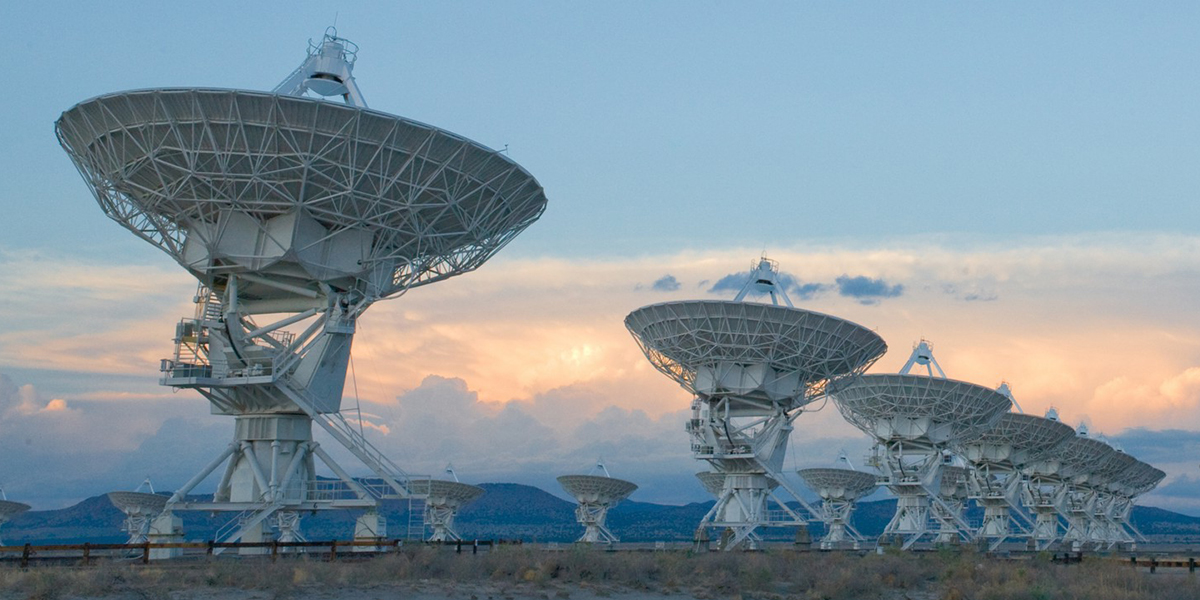
There were a few space based radio telescopes in the past, but I don't think there are any now. Imagine building something like the Arecibo Observatory[1] or VLA[2] in space. And speaking of the VLA, some of the techniques for getting high quality results (e.g. interferometry without physically conjoining the receivers) are difficult if not impossible to do in space.

[1]: https://en.wikipedia.org/wiki/Arecibo_Observatory

[2]: 27 of these guys, which are able to move around precisely on rails to generate constructive interference with the different waves they're receiving: https://public.nrao.edu/wp-content/uploads/2016/04/vla_panor...
Re:SpaceX tests black satellite to reduce ‘megaconstellation... by ogre_codes on Thursday January 16, 2020 @02:04PM (#22067732)
> I'm not an astronomer but I'm not convinced that that's the case.

I'm not entirely certain what the balance is here. I don't think my post made it clear that I'm not certain how big the effect would be, only that there is a tradeoff here which is hard to quantify.

I do know there is a lot of significant astronomy done by space telescope and that the importance of space astronomy is only growing.

Seems to me the answer is that those who benefit from the new satellite constellations (SpaceX, etc) should finance additional investment in astronomy to mitigate the effects.

Re:SpaceX tests black satellite to reduce ‘megaconstellation... by antognini on Thursday January 16, 2020 @09:45PM (#22071405)
> I do know there is a lot of significant astronomy done by space telescope and that the importance of space astronomy is only growing.

Former astronomer here. I would argue that the importance of space astronomy is actually decreasing. Satellite telescopes are most important at wavelengths that the Earth's atmosphere absorbs like IR, UV, and X-ray. At visible wavelengths satellite telescopes have been much less important over the past couple of decades due to the development of adaptive optics.

The main reason to put a visible wavelength telescope in space is that you avoid the smearing out of the source by the atmosphere. Adaptive optics solves this problem by correcting for the distortions induced by the atmosphere and bringing images to resolutions that are comparable to (though still not quite as good as) what you can achieve in space.

Since space telescopes no longer have the advantage of much greater resolution, there's much less of a compelling reason to use them for most research problems. (Some questions, of course, can only be tackled by using the highest resolution available.) On every other dimension space-based telescopes are inferior to ground-based telescopes. They are more expensive by many orders of magnitude, much, much smaller, and they cannot be changed once they're up (at least not easily). By contrast a ground based observatory can get substantially better over the course of a year by installing better detectors.

Re:SpaceX tests black satellite to reduce ‘megaconstellation... by Retric on Thursday January 16, 2020 @10:09PM (#22071514)
Adaptive optics have zero issues if you’re looking to make a cool picture, but they do introduce bias which is an issue for scientific instruments. That’s largely offset by more and larger telescopes for the same price, but it is very much a tradeoff based in launch costs which are falling.

IMO, over the next 30 years space based telescopes are going to play an ever larger role.

Re:SpaceX tests black satellite to reduce ‘megaconstellation... by cptskippy on Thursday January 16, 2020 @02:39PM (#22068059)
What about amateur astronomy? Are we now saying that only those with the means to afford space telescopes or expensive software can participate?
Re:SpaceX tests black satellite to reduce ‘megaconstellation... by ogre_codes on Thursday January 16, 2020 @03:01PM (#22068270)
Are you an amateur astronomer or just trying to be the devil's advocate?

I'd be curious to know what the impact is on impactful amateur astronomy (as opposed to backyard hobbyists who are just engaged for personal pleasure). I know some amateurs use images created by public telescopes, I'm not sure how much meaningful work is done by amateurs using backyard equipment anymore.

Not being dismissive, genuinely curious.

Re:SpaceX tests black satellite to reduce ‘megaconstellation... by cbanek on Thursday January 16, 2020 @03:32PM (#22068561)
Variable star observing is actually a place where amateurs really help, since it's about observation time, and not necessarily some hugely powerful telescope. And the more powerful a telescope is, the more people want to use it to point at all sorts of things, which makes it kind of expensive to use those telescopes for variable star observations which take a lot of time.

"Since professional astronomers do not have the time or the resources to monitor every variable star, astronomy is one of the few sciences where amateurs can make genuine contributions to scientific research." [0]

[0] https://en.wikipedia.org/wiki/American_Association_of_Variab...

Re:SpaceX tests black satellite to reduce ‘megaconstellation... by wbl on Thursday January 16, 2020 @09:08PM (#22071212)
And the Betelgeuse deathwatch!
Re:SpaceX tests black satellite to reduce ‘megaconstellation... by Rebelgecko on Thursday January 16, 2020 @03:32PM (#22068559)
In recent news, the only confirmed interstellar comet in our solar system was found by a dude who worked at an observatory (not as an astronomer) and decided to build own telescope for fun in his spare time. It's one of only two known interstellar visitors we've had, and because he found it early enough the pros were able to make very detailed observations.

A decent number of asteroids and comets are still found by backyard astronomers.

Re:SpaceX tests black satellite to reduce ‘megaconstellation... by FeepingCreature on Thursday January 16, 2020 @02:47PM (#22068135)
If SpaceX works out, we'll probably see a lot more telescopes in space. Wouldn't be that expensive at that point for, say, a school class to launch a telescope cubesat.

I'd trade amateur ground astronomy for that.

Re:SpaceX tests black satellite to reduce ‘megaconstellation... by SiempreViernes on Thursday January 16, 2020 @02:57PM (#22068245)
I'm not entirely sure how you think looking at an image on a computer screen compensates for the experience of doing observations with your own eyes.

There are plenty of good pictures on wikipedia already, do looking at those compare to going out on a clear night and looking at the stars yourself?

Re:SpaceX tests black satellite to reduce ‘megaconstellation... by fastball on Thursday January 16, 2020 @04:42PM (#22069287)
A LEO satellite constellation will absolutely not prevent you from looking into the night sky with a telescope and seeing stars.
Re:SpaceX tests black satellite to reduce ‘megaconstellation... by SiempreViernes on Thursday January 16, 2020 @09:22PM (#22071287)
"Seeing a star" is a low bar to pass, especially if you get a telescope to help you.
Re:SpaceX tests black satellite to reduce ‘megaconstellation... by petschge on Thursday January 16, 2020 @04:43PM (#22069302)
The dead of night will be fine. But during (astronomical) twilight, the time when you are most likely awake and looking up, it will have ugly extra dots.
Re:SpaceX tests black satellite to reduce ‘megaconstellation... by fastball on Thursday January 16, 2020 @10:20PM (#22071565)
Also I'm sorry but I really, really don't care about a hobby if it gets in the way of the progress of the entire human race.

Imagine if a painter in Greece in some century BC convinced his fellow Grecians that building a harbor in the cove by their town was a bad idea because it ruined his paintings of the cove. How was he supposed to look at the marine life if you stuck wood and industry in the water???

Re:SpaceX tests black satellite to reduce ‘megaconstellation... by jwhitlark on Thursday January 16, 2020 @11:54PM (#22071981)
This. Every change has some negative effect. The question is whether the net effect is positive or negative.
Re:SpaceX tests black satellite to reduce ‘megaconstellation... by fastball on Thursday January 16, 2020 @04:50PM (#22069368)
What makes a dot ugly?
Re:SpaceX tests black satellite to reduce ‘megaconstellation... by shadowgovt on Thursday January 16, 2020 @01:39PM (#22067469)
Can adaptive optics be applied to filter out objects like Starlink satellites?
Re:SpaceX tests black satellite to reduce ‘megaconstellation... by Rebelgecko on Thursday January 16, 2020 @01:48PM (#22067585)
Don't think so. Adaptive optics works by changing the physical shape of the mirror. If you measure the atmosphere continuously and bend the mirror the right way, you can remove atmospheric distortion from the image. If anything, AO just gets you sharper images of the starlink satellites (or significantly worse ones if a satellite flies in front of the guidestar that you're using as a reference point to measure atmospheric distortions).
Re:SpaceX tests black satellite to reduce ‘megaconstellation... by toomuchtodo on Thursday January 16, 2020 @01:43PM (#22067520)
You can filter them out computationally without adaptive optics with enough frames captured.
Re:SpaceX tests black satellite to reduce ‘megaconstellation... by HorstG on Thursday January 16, 2020 @03:14PM (#22068397)
Modern astronomy works at the edges of whats possible, a single frame might take hours. Needing multiple frames would mean multiple days per observation. It would mean no longer seeing faint and distant objects, limiting us to younger, closer and frankly far more boring objects. It would make observing variability impossible for certain timescales.

You need old distant objects for cosmology, observing the structure if the universe, big bang and stuff. You need variability for finding exoplanets, measuring distance and observing transitions such as supernovae.

Oh, and then a huge part is taking spectra, which means bouncing the light directly off a grating. Filtering transients is hard to impossible there. You need spectra for relative motion, magnetic fields, composition of matter and radiation and of course temperature.

Needing such filters would set astronomy back a few decades

[dead]
Re:SpaceX tests black satellite to reduce ‘megaconstellation... by mattkrause on Thursday January 16, 2020 @06:11PM (#22070088)
> pay for a resource they’ve been getting for free (unobstructed sky)

Wow.

Re:SpaceX tests black satellite to reduce ‘megaconstellation... by toomuchtodo on Thursday January 16, 2020 @06:38PM (#22070286)
If someone doesn’t manage or govern it with economic incentives, no one does (see: most of the “public good” rainforest slashed and burned in South America and Asia that we desperately needed managed better, through private ownership and conservation management, to avert climate change).

You’re shocked at my statement, as if StarLink is entitled. Consider the alternative argument: why should astronomy slow global comms progress? If astronomy is more valuable than the ~$30 billion/year global comms market, shouldn’t someone bear that cost?

Re:SpaceX tests black satellite to reduce ‘megaconstellation... by kalenx on Thursday January 16, 2020 @08:00PM (#22070808)
Because ultimately, arguments relying solely on economics are moot.

Technically, a human life has an economic value. And yes such value is used every day to decide health policies and insurance coverage. Would this mean that SpaceX killing N humans (where N=30B*number of years of operation planned for starlink/value of a human live) is ok? Absolutely not.

Re:SpaceX tests black satellite to reduce ‘megaconstellation... by shadowgovt on Thursday January 16, 2020 @10:05PM (#22071485)
That's exactly the calculus a company like Tesla does before taking a mass consumer product like a car to market.
Re:SpaceX tests black satellite to reduce ‘megaconstellation... by XorNot on Friday January 17, 2020 @12:02AM (#22072028)
No it doesn't. If you know something will kill people, economic arguments are not considered sufficient. This was famously decided when it was revealed Ford elected not to recall the Pinto on the basis of paying compensation was cheaper then the fleet maintenance they had to do.
Re:SpaceX tests black satellite to reduce ‘megaconstellation... by shadowgovt on Friday January 17, 2020 @09:59AM (#22075099)
Not considered sufficient to avoid penalties in a court of law. But even that example can be reframed as a failure to calculate total risk in the cost / benefit analysis (i.e. they should have factored in the risk of a lawsuit and federal fine).
Re:SpaceX tests black satellite to reduce ‘megaconstellation... by WWLink on Thursday January 16, 2020 @10:18PM (#22071547)
Hot take: Because Starlink is a shitty answer to ISPs being run by shitty people.
Re:SpaceX tests black satellite to reduce ‘megaconstellation... by HorstG on Thursday January 16, 2020 @03:36PM (#22068603)
Well then, we should also have Elon pay rent for use of space...
Re:SpaceX tests black satellite to reduce ‘megaconstellation... by toomuchtodo on Thursday January 16, 2020 @03:49PM (#22068739)
I think it’s hard to argue it belongs to you if you can’t get there. If you can’t defend it or control it, you can’t stake a claim to it.

https://en.wikipedia.org/wiki/Extraterrestrial_real_estate

Re:SpaceX tests black satellite to reduce ‘megaconstellation... by shadowgovt on Thursday January 16, 2020 @05:22PM (#22069648)
This is actually one of the more interesting questions in space exploration in general. It has been ever since someone tried charging NASA for parking on the section of the moon they claim ownership of.
Re:SpaceX tests black satellite to reduce ‘megaconstellation... by HorstG on Thursday January 16, 2020 @04:14PM (#22069027)
Defense would actually be quite easy. Just undesirable. There are working antisat weapons in the major powers' arsenals. However, they would produce nasty debris clouds.

And then there is also the vulnerability of the lauch site and control center...

Re:SpaceX tests black satellite to reduce ‘megaconstellation... by gpderetta on Thursday January 16, 2020 @04:53PM (#22069399)
And it is probably significantly cheaper to take down a sat than putting it up. So it would be a losing battle.
Re:SpaceX tests black satellite to reduce ‘megaconstellation... by shadowgovt on Thursday January 16, 2020 @05:20PM (#22069640)
Not in general. A kinetic striker would require as much energy to reach the satellite as the satellite used to get there. Something fancier, like a targeted laser, to my knowledge doesn't exist with anything like the wattage needed to punch through atmo and still have effective kill on anything that far out (assuming you could solve the targeting problem to resolve the beam that tightly in the first place).
Re:SpaceX tests black satellite to reduce ‘megaconstellation... by gpderetta on Thursday January 16, 2020 @05:29PM (#22069715)
The satellite is in orbit. It requires significantly more energy to put something in orbit than merely reachin that altitude. Satellite killers are relatively small rockets that can use a small supersonic fighter jet as first stage, while it requires a much bigger rocket to put a satellite in space (it would depend on the orbit of course).

It is true that spacex can put a significant amount of satllites in orbit witha single launch though, so it probably evens it out.

Re:SpaceX tests black satellite to reduce ‘megaconstellation... by shadowgovt on Thursday January 16, 2020 @05:24PM (#22069672)
That makes the relationship sound adversarial, when really there's mutual benefit to SpaceX and the international astronomy community. Astronomy can use cheap lifting capabilities.
Re:SpaceX tests black satellite to reduce ‘megaconstellation... by SiempreViernes on Thursday January 16, 2020 @03:36PM (#22068610)
And why does SpaceX get the privilege to rule the sky and the radio waves simply because they could stream Seinfeld somewhat cheaply?
Re:SpaceX tests black satellite to reduce ‘megaconstellation... by shadowgovt on Thursday January 16, 2020 @05:22PM (#22069651)
It's a complicated question, but there are echoes of it in "Why does the US get the privilege of having their flag on the moon, just because they could get it there and nobody can take it back down?" or "Why do people have any right to the land they occupy, merely because they got there before other people did?"

First-mover advantage is real.

Re:SpaceX tests black satellite to reduce ‘megaconstellation... by toomuchtodo on Thursday January 16, 2020 @05:24PM (#22069678)
It’s not complicated. The answers to your questions are, “Because they can.” Possession, control, and force carry much more weight than some would like. It just makes those without power, authority, or any other stakeholder equity uncomfortable.

The US is not a super power because it asked politely and a committee granted it permission. Similarly, SpaceX will move forward because anyone with the authority to challenge them allows them to proceed.

Re:SpaceX tests black satellite to reduce ‘megaconstellation... by shaklee3 on Friday January 17, 2020 @12:45AM (#22072210)
What is the SpaceX constellation enabling that others aren't? Hint: theirs is not for consumers.
Re:SpaceX tests black satellite to reduce ‘megaconstellation... by toomuchtodo on Friday January 17, 2020 @01:38PM (#22077677)
You're not wrong! The US DoD is already paying StarLink for proof of concept work for low latency, high bandwidth connectivity services.
Re:SpaceX tests black satellite to reduce ‘megaconstellation... by jsweojtj on Friday January 17, 2020 @12:26AM (#22072136)
Hey you're back! I asked you previously "That might work for imaging, but what's your fix for spectroscopy?" here: https://news.ycombinator.com/item?id=21577081

You replied "Optical, RF, or Xray?"

Then I said, "Let's start with optical." but then you disappeared!

So, what's your solution for long-slit optical spectroscopy?

Re:SpaceX tests black satellite to reduce ‘megaconstellation... by toomuchtodo on Friday January 17, 2020 @12:09PM (#22076589)
Hey! I'm still waiting to hear back from the astronomer I paid to do the research. I still intend to report back with their DOI from the resulting paper. I recognize when I've exceeded my domain knowledge and need an expert.

To be clear, I think we're well in the realm of academic discussion; no one is stopping any global constellation due to astronomy concerns. As I've said many times in this thread and elsewhere, I think it's a growth opportunity for the astronomy community to move towards space based observation platforms, and with the plummeting cost of lift (ie SpaceX Falcon and Starship) I don't think that's an unreasonable position to hold.

Re:SpaceX tests black satellite to reduce ‘megaconstellation... by SiempreViernes on Thursday January 16, 2020 @03:35PM (#22068586)
No, they are too bright and will saturate the detector with even very short exposures. Best you can do is just discard the affected area, at worst you have to discard several exposures because the saturation effected the readout electronics.
Re:SpaceX tests black satellite to reduce ‘megaconstellation... by nwallin on Thursday January 16, 2020 @05:22PM (#22069657)
Arecibo and VLA aren't affected by starlink at all. Those are radio telescopes. They don't even need to wait until nighttime to observe. It's only an optical/ir problem.
Re:SpaceX tests black satellite to reduce ‘megaconstellation... by manicdee on Thursday January 16, 2020 @05:55PM (#22069964)
Starlink uses radio to communicate with the ground. A common complaint from radio astronomers is new radio satellite operators promising to not interfere with radio astronomy and then making no effort to follow through in that promise.
Re:SpaceX tests black satellite to reduce ‘megaconstellation... by Ididntdothis on Thursday January 16, 2020 @03:12PM (#22068375)
“It will likely affect some earthbound astronomy significantly, but much (most?) of the most important work in modern astronomy is satellite based.”

Not true at all. Ground based is much cheaper and easier to maintain and reconfigure with new and different equipment. Just look at the cost of the upcoming >30m telescopes vs the James Webb or Hubble.

Re:SpaceX tests black satellite to reduce ‘megaconstellation... by maccam94 on Thursday January 16, 2020 @05:32PM (#22069741)
On the plus side, SpaceX is making launches much bigger and cheaper, which will make space-based telescopes much more affordable. Cheaper launches = more, cheaper satellites.
Re:SpaceX tests black satellite to reduce ‘megaconstellation... by Ididntdothis on Thursday January 16, 2020 @05:56PM (#22069965)
That's good but I am not sure if the launch cost is where the money goes for telescopes.
Re:SpaceX tests black satellite to reduce ‘megaconstellation... by ecpottinger on Thursday January 16, 2020 @06:29PM (#22070234)
You are right, but also wrong. Because the launch cost so much you spend even more move on the space telescope because you want it to work for a very long time to get the best value for your money.

And since you are going to spend so much money to launch it, you also add extra hardware to do other type of observations, so the cost of the telescope balloons upward but you are get more bang for the buck.

If on the other hand you have cheap launches then you can send up the minimum telescope needed since you can always send up a better one or even a very different one if you later discover the need.

Today because of high costs, we need to design the scopes to meet all the possible needs we can think of and afford, result very expensive space scopes.

Re:SpaceX tests black satellite to reduce ‘megaconstellation... by Ididntdothis on Thursday January 16, 2020 @07:07PM (#22070498)
I guess we would have to look at the actual costs and trade offs. Personally I am still not convinced that launch cost is the biggest problem but I am sure astronomers are crunching budget numbers right now and will adjust plans if it makes sense.
Re:SpaceX tests black satellite to reduce ‘megaconstellation... by astrodust on Thursday January 16, 2020 @06:28PM (#22070222)
A ground-based telescope will always be way cheaper than one in orbit.

Why make this more expensive than it needs to be? Researchers are already strapped for cash.

Re:SpaceX tests black satellite to reduce ‘megaconstellation... by SiempreViernes on Thursday January 16, 2020 @02:51PM (#22068176)
> but much (most?) of the most important work in modern astronomy is satellite based.

You're going to have to point out which source you pulled that out of! As a simple example, more than half of the Nobel prizes awarded for astronomy since 2000 are for discoveries made with ground based detectors. And of those awarded to satellite experiments, none was actually competing with a ground based experiment, so satellites mainly bring different, not better, capabilities.

Re:SpaceX tests black satellite to reduce ‘megaconstellation... by jessaustin on Thursday January 16, 2020 @04:47PM (#22069339)
...ground based detectors...

When I encounter this phrase I think of things like the neutrino detector in Antarctica, which of course isn't affected by satellites at all. How much contemporary astronomy relies on visible-light telescopy?

Re:SpaceX tests black satellite to reduce ‘megaconstellation... by petschge on Thursday January 16, 2020 @04:52PM (#22069389)
A very large fraction. Optical is still the most important band, probably followed by radio, x-ray, IR and gamma ray in that order. And less then 10% of optical is done using satellites.
Re:SpaceX tests black satellite to reduce ‘megaconstellation... by HorstG on Thursday January 16, 2020 @03:27PM (#22068518)
It will kill astronomy pretty good.

The key point is usable observation time. Our current handful of satellite telescopes provide 24h of time a day. Each terrestrial telescope provides maybe 8h. However, there are a magnitude more telescopes on Hawaii alone than in space. You would need to get a hundred satellite telescopes to begin to replace earthbased observation time.

And that doesn't even begin to talk about the possible instruments, mirror sizes, astronomical costs of buulding and running satellites, etc.

Re:SpaceX tests black satellite to reduce ‘megaconstellation... by nwallin on Thursday January 16, 2020 @06:00PM (#22070005)
It really won't.

Satellites are invisible if they're in the Earth's shadow. By the time useful observation can begin, there's an enormous swath of the sky that will have zero visible satellites in it.

Diversify your observation targets. There's more than one interesting thing to science at any given moment. If that means spreading out your observations so you spend two hours a night observing four targets as opposed to four hours a night on two targets, so be it.

At the very worst, this means astronomers will need to do more work during the day shift scheduling and prioritizing. This isn't a new problem. I remember reading a back page article in Astronomer magazine sometime in the late 90s with a page of BASIC code. Someone wanted to optimize a computer controlled telescope to make one observation of 100 or so stars every night. You need to roughly minimize the total Manhatten distance between every two observations, while also eliminating observations below the horizon and penalize observations low in the sky. So the author wrote a program to roughly approximate the traveling salesman problem with the additional constraints. In the 90s. In BASIC. In one page. It might be NP complete to get the perfect solution, but good enough is pretty good.

Add an additional constraints penalising observations where they might be impacted by satellites. Hire an intern working on their degree who's taken an optimization course and have them do it for you.

Re:SpaceX tests black satellite to reduce ‘megaconstellation... by vsareto on Thursday January 16, 2020 @09:34PM (#22071354)
>And that doesn't even begin to talk about the possible instruments, mirror sizes, astronomical costs of buulding and running satellites, etc.

We're going to have to start thinking bigger if we want to leave this rock. Might as well start now.

The real risk is Elon's companies dissolving and the satellites adding pollution for no real gain. If I could trade observatory time for (working) world-wide internet, I'd take the latter with no hesitation.

As much as I sympathize, most of the cosmos aren't really going anywhere. It'll be there after we build hundreds of telescopes.

Re:SpaceX tests black satellite to reduce ‘megaconstellation... by shaklee3 on Friday January 17, 2020 @12:47AM (#22072216)
Starlink is not for consumers, so you cannot get it anyways. It's for enterprise at this point.
Re:SpaceX tests black satellite to reduce ‘megaconstellation... by clmul on Thursday January 16, 2020 @01:21PM (#22067287)
The amount of important work in modern astronomy that is satellite based is limited, as pointed out elsewhere on this thread.
Re:SpaceX tests black satellite to reduce ‘megaconstellation... by stcredzero on Thursday January 16, 2020 @01:35PM (#22067420)
For now. Do the Elon Musk analysis from first principles. The future of astronomy is clearly outside of Earth's gravity well and atmosphere.
Re:SpaceX tests black satellite to reduce ‘megaconstellation... by 317070 on Thursday January 16, 2020 @02:03PM (#22067719)
Yes, but the current budgets clearly are not.
Re:SpaceX tests black satellite to reduce ‘megaconstellation... by eecc on Thursday January 16, 2020 @02:38PM (#22068056)
He's working on that ;)

/s (jeez, your sense of humor folks...)

Re:SpaceX tests black satellite to reduce ‘megaconstellation... by CamperBob2 on Thursday January 16, 2020 @03:37PM (#22068624)
Well, he is. For the Luddites in these threads, it's enough to cite the JWST as a reason to keep doing things the same old way, over and over, in space and on Earth.

Of course, the reason why people who enjoy lecturing others about why something can't be done differently or shouldn't be done differently seem to gravitate to a site called "Hacker News" is one of those universal mysteries that can't be answered with a computer or a telescope.

Re:SpaceX tests black satellite to reduce ‘megaconstellation... by pretendscholar on Thursday January 16, 2020 @06:51PM (#22070378)
How is that clear? What principles did you use?
Re:SpaceX tests black satellite to reduce ‘megaconstellation... by CamperBob2 on Thursday January 16, 2020 @02:41PM (#22068089)
Because access to space is insanely expensive.

Don't fight the people who are trying to fix this.

Re:SpaceX tests black satellite to reduce ‘megaconstellation... by SiempreViernes on Thursday January 16, 2020 @02:51PM (#22068182)
Also dangerous and inflexible.
Re:SpaceX tests black satellite to reduce ‘megaconstellation... by rtkwe on Thursday January 16, 2020 @01:18PM (#22067255)
Most astronomy is long exposure which the eventual mega constellation is particularly harmful too because there's no way currently to deal with the light reflecting off them.
Re:SpaceX tests black satellite to reduce ‘megaconstellation... by CamperBob2 on Thursday January 16, 2020 @02:43PM (#22068110)
You know they don't use film plates for those exposures anymore, right? They stack images digitally. Removing satellite trails is the easiest part of the post processing flow, or it damned well should be.
Re:SpaceX tests black satellite to reduce ‘megaconstellation... by rtkwe on Thursday January 16, 2020 @02:46PM (#22068130)
Digit and film single long exposures are functionally identical and for very dim objects you still need long exposures because the amount of light reaching the sensor is very low. You can't image stack if the object is too dim to appear in the shorter exposure's you're stacking.
[dead]
Re:SpaceX tests black satellite to reduce ‘megaconstellation... by petschge on Thursday January 16, 2020 @04:13PM (#22069009)
Astronomical sensors typically are 12 bit. So anything 4000 times brighter will overflow the sensor and can not be subtracted. And of course you have perfect solutions to Poisson noise, bleeding pixels, and increased dead time caused by shorter read out intervals as well, right? We are done here. But not for the reasons you think. You did not win this discussion.
Re:SpaceX tests black satellite to reduce ‘megaconstellation... by lutorm on Thursday January 16, 2020 @06:31PM (#22070247)
A simple median filter will take care of it. Have you seen what an unprocessed image from the Hubble Space Telescope looks like? It's riddled with cosmic ray tracks, and they all get filtered out.
Re:SpaceX tests black satellite to reduce ‘megaconstellation... by CamperBob2 on Thursday January 16, 2020 @06:54PM (#22070414)
There are any number of ways to correct observations for satellite trails, not the least because their appearance and duration are both transient and 100% predictable in any given field of view, and can be gated out of the exposure series. Cosmic rays don't even give us the latter break. (To be fair, the rabbit hole does go deeper than the usual places where a median filter alone will save you, but the general problem is far from intractable.)

But never mind, we've been told that digital imaging is "functionally identical to film," and we're "losing the discussion."

Re:SpaceX tests black satellite to reduce ‘megaconstellation... by letitgo12345 on Thursday January 16, 2020 @10:45PM (#22071673)
My impression is that a lot of interesting "leads" are generated by ground based telescopes and only then examined in more detailed by space based telescopes. If you kill off the generating mechanism, then effectiveness of space telescopes could also decline a lot.
Re:SpaceX tests black satellite to reduce ‘megaconstellation... by kerng on Thursday January 16, 2020 @06:02PM (#22070024)
It's nothing really new and the same dynamics can be observed throughout history. Imagine there was a time one could look over and see the bay without the Golden Gate bridge or high rise buildings. And now, its even an iconic thing!

A generation or two in the future astronomy will probably get redefined quite a bit via remote telescopes and adventure vacations to space and so forth.

Even now there are plenty of enthusiasts who are excited to take pictures of rockets during take off or explore satellites as they pass by. So it actually get more people interested in space and astronomy.

And there will always be people on either side supporting or opposing technological advances - as we have seen thought history. The one thing that is certain in my opinion though is that things will change.

Re:SpaceX tests black satellite to reduce ‘megaconstellation... by krastanov on Thursday January 16, 2020 @06:18PM (#22070136)
OP is talking about affecting astronomy the science, not astrophotography the hobby. Land-based survey telescopes are incredibly useful cheap tools that do not have alternatives.
Re:SpaceX tests black satellite to reduce ‘megaconstellation... by discordance on Thursday January 16, 2020 @06:56PM (#22070430)
I guess the argument becomes this:

Does the proliferation of high speed Internet to every part of the world outweigh the cheapness of current land based astronomy tooling?

If not, maybe spacex can compensate by providing some launch load for space bound telescopes.

Re:SpaceX tests black satellite to reduce ‘megaconstellation... by wbl on Thursday January 16, 2020 @09:06PM (#22071206)
We already have cheap internet where people live via fiber optics. Last mile market failures are solveable.
Re:SpaceX tests black satellite to reduce ‘megaconstellation... by TomMarius on Friday January 17, 2020 @02:33AM (#22072650)
No, we don't. There are tons of places right around me, in central Europe, where people will benefit greatly from Starlink. A lot of rural-based people are excitedly talking about it, even older people who you would not expect to know what it is - and they don't, but they're excited about their access to the Internet.
Re:SpaceX tests black satellite to reduce ‘megaconstellation... by skuthus on Friday January 17, 2020 @11:43AM (#22076234)
Re:SpaceX tests black satellite to reduce ‘megaconstellation... by xkjkls on Thursday January 16, 2020 @07:25PM (#22070597)
Ok, then Tesla should really prove they can provide that or find ways to compensate those with land based astronomy tooling. They have done neither and have not communicated in any form that they want to.
Re:SpaceX tests black satellite to reduce ‘megaconstellation... by skuthus on Friday January 17, 2020 @11:44AM (#22076249)
tesla?
Re:SpaceX tests black satellite to reduce ‘megaconstellation... by xkjkls on Monday January 20, 2020 @07:35PM (#22103274)
Sorry, SpaceX, it's easy to get Elon Musk's three card monty of companies confused.
Re:SpaceX tests black satellite to reduce ‘megaconstellation... by wnkrshm on Thursday January 16, 2020 @12:54PM (#22067008)
Also, asteroid detection may be hampered - there is still a significant contribution of 'amateur' observations to detecting them.
Re:SpaceX tests black satellite to reduce ‘megaconstellation... by TrainedMonkey on Thursday January 16, 2020 @02:49PM (#22068158)
Staring at a night sky in a designated dark sky area is amazing. Given the pace of SpaceX launches amount of time you can do that without sky crawling with LEO constellations is pretty limited. So days of humans experiencing night sky raw are pretty limited (some would argue it is already impossible). However, I think astronomers will find a way to operate even in a noisy environment of mega-constellations. Given that the objects are bright they can be tracked extremely well. Filtering out them out of the datasets does not seem intractable. Am I missing anything here?

Moreover, I think mega-constellations will actually be a boon for astronomy. Think of it as a platform, while initial iterations will be focused on communication systems, what is stopping them from adding sensor packages looking both inwards and outwards? They already have the bandwidth to downlink all of that. Once on the ground those streams could be combined to produce datasets of unprecedented coverage and fidelity.

Re:SpaceX tests black satellite to reduce ‘megaconstellation... by BurningFrog on Thursday January 16, 2020 @01:41PM (#22067490)
I think you're missing OP's point:

Once the sun is set in their orbit, they should be invisible both to the eye and telescopes.

Re:SpaceX tests black satellite to reduce ‘megaconstellation... by reaperducer on Thursday January 16, 2020 @02:50PM (#22068162)
"Invisible" isn't quite correct. They won't be visible as white spots, they'll be black spots blocking out the things behind them. Not a big deal for human eyes. Quite a big deal for astronomers.
Re:SpaceX tests black satellite to reduce ‘megaconstellation... by lutorm on Thursday January 16, 2020 @02:54PM (#22068217)
This is totally false, the solid angle subtended by the satellites is tiny so the effect of their obscuration is totally negligible.
Re:SpaceX tests black satellite to reduce ‘megaconstellation... by reaperducer on Thursday January 16, 2020 @03:00PM (#22068268)
If it's flying in front of the sun, you are correct. If it's flying in front of an object 100 light years away, you are incorrect.
Re:SpaceX tests black satellite to reduce ‘megaconstellation... by DuskStar on Thursday January 16, 2020 @05:23PM (#22069665)
It'll block a star for ~1/2500th of a second (assuming a three meter blocking radius, and 7500m/s) - I wouldn't be surprised if that went undetected 99% of the time. At most it would read as a minor brightness fluctuation, right?
Re:SpaceX tests black satellite to reduce ‘megaconstellation... by lutorm on Thursday January 16, 2020 @06:29PM (#22070230)
Not only that, but it first has to actually pass in front of the star. This gets increasingly likely as you look at fainter and fainter stars, but the sky is still mostly empty and is not as common as you might think. (Olber's paradox and all that.)
Re:SpaceX tests black satellite to reduce ‘megaconstellation... by modeless on Thursday January 16, 2020 @05:23PM (#22069664)
The satellites are not only small, they are also fast. A fast moving satellite can only occlude a 100 light years away object for a couple of microseconds before it passes. This is absolutely negligible for an astronomical observation lasting seconds to minutes. And even if you launched billions of opaque satellites they couldn't come close to blocking a big enough percentage of the sky for this to matter at all.
Re:SpaceX tests black satellite to reduce ‘megaconstellation... by usrusr on Thursday January 16, 2020 @06:16PM (#22070124)
There go my hopes for an effective planetary sunshade in LEO...
Re:SpaceX tests black satellite to reduce ‘megaconstellation... by BurningFrog on Thursday January 16, 2020 @09:48PM (#22071418)
That should probably be at L1 anyway.

That's where it can shade 24h/day.

Re:SpaceX tests black satellite to reduce ‘megaconstellation... by endorphone on Thursday January 16, 2020 @03:21PM (#22068461)
It'd be in front of an object 100 light years away for an absurdly tiny amount of time. The percentage of the sky occluded by these satellites is absolutely minuscule. This is not a rational notion.

These are not geosynchronous satellites, but instead are 200-500 miles above the Earth, moving many, many thousands of mph. No, it isn't blocking anything 100 light years away unless your shutter speed is in the single-digit nanoseconds.

Re:SpaceX tests black satellite to reduce ‘megaconstellation... by natch on Thursday January 16, 2020 @03:27PM (#22068513)
The relative (apparent) motion differences and the fact that the locations of the satellites are known should take care of that, no? It’s unlikely that the motions are going to track each other exactly in most cases.

In fact if, as you believe, these satellites would actually occlude things beyond them, they sound very useful for calibration and education.

Re:SpaceX tests black satellite to reduce ‘megaconstellation... by bryanlarsen on Thursday January 16, 2020 @01:06PM (#22067144)
It's bright because it's in a low orbit and a lot closer to us. Because it's in a low orbit it's in the earth's shadow for most of the night. It's not bright while in shadow.
Re:SpaceX tests black satellite to reduce ‘megaconstellation... by shadowgovt on Thursday January 16, 2020 @01:38PM (#22067461)
> Bright, fast-moving things are pretty terrible.

Why is that? Almost everything astronomy studies isn't fast-moving. Shouldn't it be easy to filter out that noise?

Re:SpaceX tests black satellite to reduce ‘megaconstellation... by tspike on Thursday January 16, 2020 @02:31PM (#22067973)
Bright = overexposure or unmanageable dynamic range

Fast-moving = more likely for it to traverse your field of view while the shutter is open

Re:SpaceX tests black satellite to reduce ‘megaconstellation... by hackinthebochs on Thursday January 16, 2020 @01:41PM (#22067493)
This is what I'm wondering. It seems pretty trivial to filter out with some basic image processing.
Re:SpaceX tests black satellite to reduce ‘megaconstellation... by reaperducer on Thursday January 16, 2020 @02:50PM (#22068173)
Everything is "trivial" when it's someone else's problem.
Re:SpaceX tests black satellite to reduce ‘megaconstellation... by Ididntdothis on Thursday January 16, 2020 @03:16PM (#22068410)
That’s 100% true!
Re:SpaceX tests black satellite to reduce ‘megaconstellation... by Klathmon on Thursday January 16, 2020 @02:09PM (#22067778)
I think there are 2 issues here, and it's making the conversation around it difficult.

First is the impact to "professional astronomers", and from what I've seen this group won't be impacted nearly as much as the other. This group has the ability to use satellite based telescopes, or has the tech already to be able to filter/post-process the images to remove satellites, planes, meteor showers, and any other stuff that might get in the way.

Then you have "amateur astronomers", this groups is likely to be impacted by starlink. This group doesn't have access to the digital filtering stuff that the "big guys" do, from what i've seen, most of the people in this group just use normal long-exposure setups and adding in a processing step would mean a pretty significant change to their process, and probably a lot of additional costs.

Even still, the impact to amateur astronomers seems limited to when the sats are in sunlight, which traditionally isn't a super popular time for stargazing (although I may be wildly wrong on this, as I've read that these sats are removing up to 1/3 of the normal viewing time for some astronomers, so don't take this as gospel), and I still think the impacts will be a lot less doom and gloom than some are saying, but I still hope that SpaceX can work with the astronomy community to see if there are solutions or mitigations that can help everyone out.

Re:SpaceX tests black satellite to reduce ‘megaconstellation... by nwallin on Thursday January 16, 2020 @06:37PM (#22070284)
We absolutely use short exposures. It's actually more important for us than the pros because the mounts are a lot less stable and polar assignment is far worse. Doing a lot of short exposures is a lot easier than nailing your polar assignment. It also help with bad seeing; you throw away the blurriest quarter of your images and the stack looks a lot better.

Filtering is less advanced, but masking outliers (and their neighbors) and replacing them with an average of the others isn't advanced filtering.

It's annoying the way getting cut off in traffic is annoying, not the way getting T-boned is annoying.

Re:SpaceX tests black satellite to reduce ‘megaconstellation... by zAy0LfpBZLC8mAC on Thursday January 16, 2020 @04:06PM (#22068928)
So, you clear your CCD, collect photons for 30 minutes, then some satellite sprays you with a multiple of the number of photons collected thus far, and then ... what?
Re:SpaceX tests black satellite to reduce ‘megaconstellation... by ggreer on Thursday January 16, 2020 @07:42PM (#22070707)
Instead of exposing for 30 minutes, astronomers take lots of shorter exposures and stack them. Otherwise you'd get tons of noise from CCD hot spots, cosmic rays, aircraft, meteors, satellites, etc.
Re:SpaceX tests black satellite to reduce ‘megaconstellation... by zAy0LfpBZLC8mAC on Thursday January 16, 2020 @10:20PM (#22071558)
Well, but then, you also get noise from CCD readout, so it's not like you can just take 18000 100ms exposures and stack them to get the same result as a 30 minute exposure minus the "broken frames". Stacking frames is a workaround for disturbances, but it comes at a cost in the form of readout noise. The shorter you make the exposures, the more disturbances you can filter out without wasting observing time, but the more readout noise you get. So, if you have more disturbances, you either need more telescope time so that you still have enough frames left to see your signal after you have thrown out all the bad frames, or you need to reduce exposure times so you can throw out frames as higher granularity, but then you have to accept more readout noise, which makes it harder to see the signal.
Re:SpaceX tests black satellite to reduce ‘megaconstellation... by ggreer on Friday January 17, 2020 @01:14AM (#22072338)
There are already enough disturbances that a 30 minute exposure is impractical. Astrophotographers tend to use exposures around 30 seconds. It's true that more satellites mean that astronomers will have to tweak their observation methods and/or reduce their observation windows, but it's not a showstopper. At worst it's an inconvenience to them.

If we were to employ the reversal test[1], the concern about astronomy would be a non-problem. Imagine if the entire planet was covered by the equivalent of 4G cell networks. And imagine if some astronomers asked us to destroy those networks so that some of their work could be made more convenient. Imagine all of the people affected by this network. All of the lives saved by emergency calls, all of the remote locations made digitally accessible to the rest of humanity, all of the scientific experiments in jungles, deserts, tundra… cameras and microphones and sensors reporting data through this global satellite network… imagine all of that destroyed so that some astronomers could be relieved of an inconvenience. That is absurd. Yet that is the world that some people want to live in.

It's so clear to anyone whose view isn't so parochial, so local in time and space, so blinkered by where and when they were born. Does anyone think that astronomers will still be preventing the launch of satellite constellations in the year 2100? In 2200? In 2500? Clearly not.

I'd rather the improvement happen in my lifetime than after. Launch away.

1. https://en.wikipedia.org/wiki/Reversal_test

Re:SpaceX tests black satellite to reduce ‘megaconstellation... by optimiz3 on Thursday January 16, 2020 @05:09PM (#22069555)
Is there any way, perhaps with software, that we could remove a moving object, from an otherwise mostly static set of images?
Re:SpaceX tests black satellite to reduce ‘megaconstellation... by gibybo on Thursday January 16, 2020 @06:42PM (#22070312)
Absolutely, in fact it's pretty easy and is routinely done by amateur and professional astronomers alike. We've had satellites, airplanes, and meteors obstructing astronomical images ever since we began taking them.

A very simple and common way is to stack all of the static images aligned on top of each other such that you have a set of values for each pixel corresponding to the same region of sky. Then sort the values of each pixel by brightness and keep the median value for that pixel. Or throw out that top and bottom 10% and average the rest, or throw out the top and bottom N, etc.

This is a standard feature of essentially all astronomical image processing software and has been for a long time.

Re:SpaceX tests black satellite to reduce ‘megaconstellation... by petschge on Thursday January 16, 2020 @06:56PM (#22070432)
Sure. But increasing the number of frames with tracks increased the number of datapoints you need to throw away, reducing the effective time on target and therefore sensitivity of your observations. Astronomers are not idiots. They know how to deal with obstructions. But that is not free of cost. Neither in observational limits nor computer time nor required brain power.
Re:SpaceX tests black satellite to reduce ‘megaconstellation... by gibybo on Thursday January 16, 2020 @07:04PM (#22070479)
Sure it's not without cost, but in most cases the cost is not very high.

Remember you don't need to throw away the whole frame, only the pixels that were obstructed. One track across a frame will obstruct less than 1% of the data in that frame.

Re:SpaceX tests black satellite to reduce ‘megaconstellation... by jsweojtj on Friday January 17, 2020 @12:29AM (#22072154)
One of the key assumptions that's being made, throughout this thread, is that astronomy is mostly imaging. Taking or stacking images. A ton of astronomy is spectroscopy, which is nothing like a stack of static images with one that has a streak in it.
Re:SpaceX tests black satellite to reduce ‘megaconstellation... by pbreit on Thursday January 16, 2020 @09:24PM (#22071295)
Could someone explain what the actual tangible negative implications are besides astronomers needing to adjust?
Re:SpaceX tests black satellite to reduce ‘megaconstellation... by chrisco255 on Thursday January 16, 2020 @03:43PM (#22068690)
Personally, I don't want to be limited to observing the stars from planet Earth for too much longer. The development of commercially viable space technology will fund and fuel investment in interplanetary expeditions and help us move to the next stage of human progress.
Re:SpaceX tests black satellite to reduce ‘megaconstellation... by martythemaniak on Thursday January 16, 2020 @01:37PM (#22067445)
Could you explain how something that orbits 500km up could be seen at night?
Re:SpaceX tests black satellite to reduce ‘megaconstellation... by TeMPOraL on Thursday January 16, 2020 @02:24PM (#22067899)
Like most other satellites, it can be seen when it reflects the Sun. Satellites tend to be shiny. For an extreme case, check out "Iridium flares" - a brief but bright flares on the sky caused by old Iridium satellites, whose antennas were essentially large, rectangular mirrors.
Re:SpaceX tests black satellite to reduce ‘megaconstellation... by HorstG on Thursday January 16, 2020 @03:34PM (#22068579)
Depending on the type of measureme t taken, a dark transient is also harmful. However, by far not as bad as a bright transient.
Re:SpaceX tests black satellite to reduce ‘megaconstellation... by martythemaniak on Thursday January 16, 2020 @02:45PM (#22068119)
To reflect sunlight you need the sun. If a satellite is 500km up (and 300km for later revisions), there is no way for sunlight to reach it.

There is no way to see Starlink at night. You can potentially see them for a short period around twilight.

Re:SpaceX tests black satellite to reduce ‘megaconstellation... by mkl on Thursday January 16, 2020 @09:16PM (#22071256)
Here is the actual geometry at the equator, ignoring axial tilt (the blue/black circle is Earth, the red/black circle is a satellite at 500km, and the radial lines are hours): https://www.desmos.com/calculator/3br1snafmj

Starlink satellites directly overhead are in sunlight for about 1.5 hours after sunset, and the same before sunrise. Including observing on an angle, you probably lose 4 hours per night out of 12. With 300km satellites, you probably lose 3 hours. I think the situation will be worse away from the equator in summer.

Re:SpaceX tests black satellite to reduce ‘megaconstellation... by reaperducer on Thursday January 16, 2020 @02:51PM (#22068186)
You've really never looked into a night sky and seen a satellite? Unless you live underground or never leave a big city, it's quite easy and there are dozens of apps that will help you understand what you're looking at.
Re:SpaceX tests black satellite to reduce ‘megaconstellation... by outworlder on Thursday January 16, 2020 @03:10PM (#22068355)
I guess the point they are trying to make is that 500km (or 300km) is essentially hugging the planet. Which means that, if it is night, they will be in the shadow for the majority of the time.

The satellites you can easily see at any time are much higher up.

Re:SpaceX tests black satellite to reduce ‘megaconstellation... by outworlder on Thursday January 16, 2020 @03:09PM (#22068346)
> There is no way to see Starlink at night. You can potentially see them for a short period around twilight.

The time window is limited, yes. So it is not the end of the world. It is still a problem.

Re:SpaceX tests black satellite to reduce ‘megaconstellation... by CamperBob2 on Thursday January 16, 2020 @02:40PM (#22068073)
A shortsighted attitude, IMO. Terrestrial observatories are in a good position to clean up satellite artifacts digitally. They already have to do more image processing than the staff at Playboy. Meanwhile, cheaper access to orbit can only be a good thing for astronomy, given that we've picked most of the low-hanging fruit in terrestrial-bound optical observations.