antognini
Re:I Don't Understand Quantum Physics (2018)
on Saturday October 24, 2026 @03:21PM (#50224230)
This is more or less Roger Penrose's position: https://web.archive.org/web/20150327124054id_/http://image.s...
He argues that the wavefunction collapses on a timescale of h-bar / E_G, where E_G is the gravitational self-energy of the quantum system.
Re:I Don't Understand Quantum Physics (2018)
on Saturday October 24, 2026 @02:53PM (#50223996)
I've heard this claim, but I don't think it holds up. The idea is that supposedly the calculation is done in parallel across the different universes which allows you to see an exponential speedup in some calculations. But the whole point of many-worlds is that after a branch event the various branched portions of the wavefunction no longer interact. Even if it were true that quantum computing was really a bunch of parallel classical computations (which it is not), there would be no way for any of the other universes to communicate the result back to the universe you observe it in.
Re:How Strong Is the Strong Force?
on Saturday October 10, 2026 @09:15PM (#50038849)
I think a lot of people have an understanding that the force that binds the nucleus together is quite a bit stronger than the electromagnetic force. (Obligatory xkcd: https://xkcd.com/1162/)
What is not always appreciated is that the forces binding the nucleus together are the strong force analog of the van der Waals force in electromagnetism. So it is not really right to compare the way the electron is bound to the nucleus to the way the nucleus itself is bound together. If you want to compare the electromagnetic force to the strong force, the better comparison is between the force binding the nucleus to a hydrogen bond.
The strong force itself is many orders of magnitude stronger than the force binding the nucleus together.
Re:Black Holes or Black Hole Stars? Astronomers Spar over 'Little Red ...
on Sunday September 20, 2026 @08:48PM (#49781731)
I'd recommend Carroll & Ostlie's Introduction to Modern Astrophysics, though it requires some basic calculus and physics.
Re:Black Holes or Black Hole Stars? Astronomers Spar over 'Little Red ...
on Saturday September 19, 2026 @12:20PM (#49767799)
The outer boundary is the point where a photon has a ~50% chance of escaping without encountering another particle.
Re:Tiny Black Holes May Be Exploding Stars Across the Milky Way
on Thursday August 06, 2026 @12:04PM (#49198556)
We have constraints that primordial black holes must be less than the size of a large asteroid. They would be gravitationally insignificant to the Earth unless they actually passed through it.
I also don't think it would really be detectable in the Sun. Perhaps there would be some transient astroseismology signature.
Re:Tiny Black Holes May Be Exploding Stars Across the Milky Way
on Thursday August 06, 2026 @12:01PM (#49198503)
They did some modeling in a previous paper of how this would impact Ia supernovae and it depends on whether the supernova is driven by Kelvin-Helmholtz instabilities or not. In the case that it is, this would only trigger Ia supernovae for white dwarfs which are already very close to the Chandrasekhar mass. In this case the standard candles would be pretty much the same.
In the case that KH instabilities are weaker they claim that you can get supernovae at masses farther from the Chandrasekhar limit. This could plausibly have more of an impact on Ias as standard candles. (Though perhaps less than you might think becauseit would also likely have an effect on the shape of the light curve, and Ias are normalized based on their light curve shape.)
All that said, even if this process does occur, I doubt the rates would be high enough for it to be a substantial fraction of observed Ias.
Re:AWS: Inaccurate Estimated Billing Data - $1.7 BILLION
on Friday July 17, 2026 @03:41PM (#48951470)
To paraphrase the old joke, if you wake up with a $78,000 AWS bill, you have a problem. If you wake up with a $78 million AWS bill, Amazon has a problem.
Re:Newton's law of gravity passes its biggest test
on Monday May 04, 2026 @09:13PM (#48016912)
We already know that some particles interact extremely weakly with others. Neutrinos were postulated as a "dark" particle in order to preserve conservation of energy and momentum, but it took more than a decade before they were observed directly. There's no reason there couldn't be another particle with an even weaker interaction.
Re:There Will Be a Scientific Theory of Deep Learning
on Friday April 24, 2026 @07:33PM (#47897092)
This is the field of information geometry: https://en.wikipedia.org/wiki/Information_geometry
Re:A new Bigfoot documentary helps explain our conspiracy-minded era
on Monday March 16, 2026 @12:15AM (#47395180)
In a similar vein I highly recommend Behind the Curve, which is a documentary about the flat Earth movement. It was a pretty fair film and tried to get to know the people involved in the movement and what it was that motivated them.
It was interesting to see that one of the main figures featured in the documentary started out pretty generically wanting to get into conspiracy theories and started reading up on one after another until he found a particular one that clicked.
Re:Meta acquires Moltbook
on Tuesday March 10, 2026 @05:27PM (#47329003)
Did Moltbook even have any investors?
Re:Looks like it is happening
on Wednesday February 25, 2026 @12:23AM (#47147647)
I think the long term impact of this will be to strengthen the importance of social ties in academic publishing. As it is there are so many papers published in many fields that people tend to filter for papers published by big names and major institutions. But the inevitable torrent of AI slop will overwhelm anyone who is looking for any gems coming from outsiders. I suspect the net effect will be to make it even more important that you join a big name institution in order to be taken seriously.
Re:Beowulf's opening "What" is no interjection
on Wednesday January 21, 2026 @02:24PM (#46710250)
I remember one of my friends in college pointing out before lecture that the professor would always start by saying "OK, So."
Re:Sun Position Calculator
on Thursday January 15, 2026 @12:37AM (#46628481)
You would basically want to calculate the solar altitude angle (or, equivalently the zenith angle): https://en.wikipedia.org/wiki/Solar_zenith_angle
Given the mountains, the sun would appear to set when it descends below some altitude angle. Given the equation in the wikipedia article you'd then just solve for the hour angle. (You'd then have to use your latitude to convert the local solar time to Mountain Standard Time.)
Re:Learning to Play Tic-Tac-Toe with Jax
on Friday January 09, 2026 @01:10PM (#46556973)
Thank you for the kind words! Yes, I think you're right about the missing factor of rho. And rho^2 is being drawn from a chi-squared distribution, not a chi distribution. (But the mode I stated is correct for a chi-squared distribution --- I must have omitted the squares when typing this up.)
Learning to Play Tic-Tac-Toe with Jax
The Stars of Bethlehem
Re:Ask HN: Does anyone understand how Hacker News works?
on Thursday December 18, 2025 @01:54AM (#46309628)
I've found that there can be a lot of randomness for what makes the front page. Not too many people read the "New" page and articles drop off it pretty quickly, so it can be hard for a niche article to attract the handful of votes it needs to appear on the front page. (Though there is a "second chance" feature which helps to ameliorate this issue.) So there's a lot of randomness to what makes it onto the front page.
For instance I submitted an article three times (spaced a year apart). The first two times the article got no upvotes. The third time it got 600+ and hit the top of the front page. It's just a matter of who happens to be looking at the New page at the time.
Re:Why do commercial spaces sit vacant?
on Wednesday December 17, 2025 @05:17PM (#46306341)
Mark-to-market can create liquidity crises when coupled with capitalization requirements, though. This can happen in, e.g., bond markets.
Say a bank is sitting on a pile of very safe bonds. If the interest rate suddenly increases, the mark-to-market value of the bonds goes way down. The bank would still expect to get the full value of all the bonds at maturity. But if the bank has to mark-to-market, the current value may be low enough that capitalization requirements force the bank to sell all the bonds in a fire sale. So even though the bank in theory could have held onto the assets and gotten exactly what it had expected from the start, it instead ends up taking a big loss.
Re:Why do commercial spaces sit vacant?
on Wednesday December 17, 2025 @04:19PM (#46305639)
This article probably omitted it for simplicity, but you would discount the income stream over time. Projected income at the 20 year mark is valued much less than income next year. That helps to account for the uncertainty.
Re:Why do commercial spaces sit vacant?
on Wednesday December 17, 2025 @04:17PM (#46305625)
How would this help? If the existing operators refuse to lower rents and leave their spaces vacant then under this scheme no one else can build new spaces which rent at lower rates. You would just be stuck with vacant properties at above-market rates.
Re:String Theory Inspires a Brilliant, Baffling New Math Proof
on Saturday December 13, 2025 @01:51AM (#46252613)
You don't need a full fledged theory of quantum gravity to describe Hawking radiation. Quantization of the gravitational field isn't relevant for that phenomenon. Similarly you don't need quantum gravity to describe large elements. Special relativity is already integrated into quantum field theory.
In some ways saying that we don't have a theory of quantum gravity is overblown. It is perfectly possible to quantize gravity in QFT the same way we quantize the electromagnetic field. This approach is applicable in almost all circumstances. But unlike in the case of QED, the equations blow up at high energies which implies that the theory breaks down in that regime. But the only places we know of where the energies are high enough that the quantization of the gravitational field would be relevant would be near the singularity of a black hole or right at the beginning of the Big Bang.
Re:Tides are weirder than you think
on Friday December 05, 2025 @06:06PM (#46168590)
You may have seen diagrams of the tidal force of the Moon on the earth (like this one: https://www.oc.nps.edu/nom/day1/tide_force_diagram.gif).
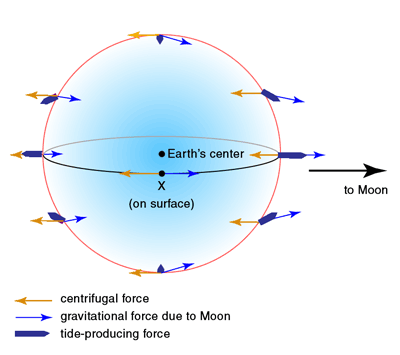
Intuitively you would think that the tide is being formed because the Moon is "lifting up" the water at the point closest to the Moon. But this contribution is actually very miniscule to the tidal effect. Instead the bulk of the tides are produced about 45 degrees away where the tidal force is parallel to the Earth's surface. This has the effect of dragging the water closer to the tidal bulge.
Thought experiments on the computational theory of consciousness
Re:Brain has five 'eras' with adult mode not starting until early 30s
on Tuesday November 25, 2025 @04:24PM (#46050979)
It's kind of interesting to compare this to Ptolemy's eras. In the Tetrabiblios, Ptolemy argued that man went through seven ages in his life, each associated with a different celestial object.
1. Infancy --- The Moon. Since the Moon waxes and wanes more rapidly than any other celestial object, this period is characterized by the fastest development.
2. Childhood --- Mercury. As Mercury is the fastest of the planets, at this age children have the short attention spans and flit from one thing to the next.
3. Youth --- Venus. Starting around puberty, a man's mind starts to become focused on love.
4. Young Adulthood --- The Sun. A man comes of age, he starts to think about his work and people begin to take him seriously.
5. Middle Adulthood --- Mars. In his mid 30s a man's demeanor becomes more severe. He realizes he has certain goals he would like to accomplish and there is not much time left to achieve them.
6. Maturity --- Jupiter. By his mid 50s, having achieved what he can in his life, he has arrived at a position of authority in the community. He has gravitas and respect.
7. Old Age --- Saturn. By his late 60s, he starts to decline physically and mentally.
Re:Angel Investors, a Field Guide
on Friday November 07, 2025 @07:21PM (#45852897)
Later on it looks like he classifies him as a "vanity angel" rather than a "strategic angel." It sounds like it can be useful to have someone with name recognition as an investor when you're talking to people who aren't very familiar with the space.
Re:Universe's expansion 'is now slowing, not speeding up'
on Friday November 07, 2025 @01:37AM (#45844059)
It's true that it leaves open the possibility of a conserved quantity that is not associated with a symmetry. But the kinds of conservation laws we are thinking about, like conservation of energy, do originate from a symmetry. So if the symmetry is broken it is very reasonable to assume that the conservation law would be broken as well.
Re:Universe's expansion 'is now slowing, not speeding up'
on Thursday November 06, 2025 @05:49PM (#45841451)
Noether's theorem tells us when we would expect conservation laws to hold and when we would expect them to fail. In the case of global energy conservation, there would have to be a global time invariance associated with the spacetime. But this is manifestly not the case in an expanding universe. It is generally not even possible to have a well defined notion of global energy in a dynamic spacetime.