I'm not an astronomer but I'm not convinced that that's the case. The number of space telescopes pales in comparison to the number of terrestrial observatories. Moreover, advances like adaptive optics have done a lot to close the gap between ground and space capabilities (for optical telescopes). Even once you've invested in expensive tech like adaptove optics, a telescope in space still costs an order of magnitude more than one on the ground (thats being really conservative. JWST has already cost ~10x more than the most expensive ground telescope ever, and the thing hasn't even launched yet)
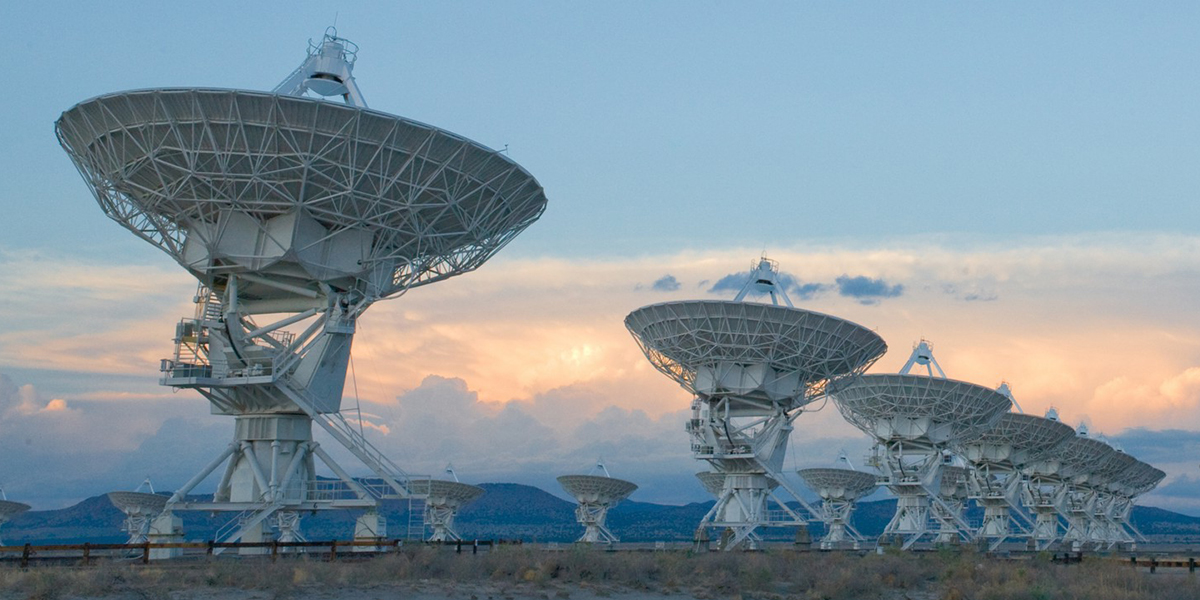
There were a few space based radio telescopes in the past, but I don't think there are any now. Imagine building something like the Arecibo Observatory[1] or VLA[2] in space. And speaking of the VLA, some of the techniques for getting high quality results (e.g. interferometry without physically conjoining the receivers) are difficult if not impossible to do in space.
[1]: https://en.wikipedia.org/wiki/Arecibo_Observatory
[2]: 27 of these guys, which are able to move around precisely on rails to generate constructive interference with the different waves they're receiving: https://public.nrao.edu/wp-content/uploads/2016/04/vla_panor...
I'm not entirely certain what the balance is here. I don't think my post made it clear that I'm not certain how big the effect would be, only that there is a tradeoff here which is hard to quantify.
I do know there is a lot of significant astronomy done by space telescope and that the importance of space astronomy is only growing.
Seems to me the answer is that those who benefit from the new satellite constellations (SpaceX, etc) should finance additional investment in astronomy to mitigate the effects.
Former astronomer here. I would argue that the importance of space astronomy is actually decreasing. Satellite telescopes are most important at wavelengths that the Earth's atmosphere absorbs like IR, UV, and X-ray. At visible wavelengths satellite telescopes have been much less important over the past couple of decades due to the development of adaptive optics.
The main reason to put a visible wavelength telescope in space is that you avoid the smearing out of the source by the atmosphere. Adaptive optics solves this problem by correcting for the distortions induced by the atmosphere and bringing images to resolutions that are comparable to (though still not quite as good as) what you can achieve in space.
Since space telescopes no longer have the advantage of much greater resolution, there's much less of a compelling reason to use them for most research problems. (Some questions, of course, can only be tackled by using the highest resolution available.) On every other dimension space-based telescopes are inferior to ground-based telescopes. They are more expensive by many orders of magnitude, much, much smaller, and they cannot be changed once they're up (at least not easily). By contrast a ground based observatory can get substantially better over the course of a year by installing better detectors.
IMO, over the next 30 years space based telescopes are going to play an ever larger role.
I'd be curious to know what the impact is on impactful amateur astronomy (as opposed to backyard hobbyists who are just engaged for personal pleasure). I know some amateurs use images created by public telescopes, I'm not sure how much meaningful work is done by amateurs using backyard equipment anymore.
Not being dismissive, genuinely curious.
"Since professional astronomers do not have the time or the resources to monitor every variable star, astronomy is one of the few sciences where amateurs can make genuine contributions to scientific research." [0]
[0] https://en.wikipedia.org/wiki/American_Association_of_Variab...
A decent number of asteroids and comets are still found by backyard astronomers.
I'd trade amateur ground astronomy for that.
There are plenty of good pictures on wikipedia already, do looking at those compare to going out on a clear night and looking at the stars yourself?
Imagine if a painter in Greece in some century BC convinced his fellow Grecians that building a harbor in the cove by their town was a bad idea because it ruined his paintings of the cove. How was he supposed to look at the marine life if you stuck wood and industry in the water???
You need old distant objects for cosmology, observing the structure if the universe, big bang and stuff. You need variability for finding exoplanets, measuring distance and observing transitions such as supernovae.
Oh, and then a huge part is taking spectra, which means bouncing the light directly off a grating. Filtering transients is hard to impossible there. You need spectra for relative motion, magnetic fields, composition of matter and radiation and of course temperature.
Needing such filters would set astronomy back a few decades
Wow.
You’re shocked at my statement, as if StarLink is entitled. Consider the alternative argument: why should astronomy slow global comms progress? If astronomy is more valuable than the ~$30 billion/year global comms market, shouldn’t someone bear that cost?
Technically, a human life has an economic value. And yes such value is used every day to decide health policies and insurance coverage. Would this mean that SpaceX killing N humans (where N=30B*number of years of operation planned for starlink/value of a human live) is ok? Absolutely not.
And then there is also the vulnerability of the lauch site and control center...
It is true that spacex can put a significant amount of satllites in orbit witha single launch though, so it probably evens it out.
First-mover advantage is real.
The US is not a super power because it asked politely and a committee granted it permission. Similarly, SpaceX will move forward because anyone with the authority to challenge them allows them to proceed.
You replied "Optical, RF, or Xray?"
Then I said, "Let's start with optical." but then you disappeared!
So, what's your solution for long-slit optical spectroscopy?
To be clear, I think we're well in the realm of academic discussion; no one is stopping any global constellation due to astronomy concerns. As I've said many times in this thread and elsewhere, I think it's a growth opportunity for the astronomy community to move towards space based observation platforms, and with the plummeting cost of lift (ie SpaceX Falcon and Starship) I don't think that's an unreasonable position to hold.
Not true at all. Ground based is much cheaper and easier to maintain and reconfigure with new and different equipment. Just look at the cost of the upcoming >30m telescopes vs the James Webb or Hubble.
And since you are going to spend so much money to launch it, you also add extra hardware to do other type of observations, so the cost of the telescope balloons upward but you are get more bang for the buck.
If on the other hand you have cheap launches then you can send up the minimum telescope needed since you can always send up a better one or even a very different one if you later discover the need.
Today because of high costs, we need to design the scopes to meet all the possible needs we can think of and afford, result very expensive space scopes.
Why make this more expensive than it needs to be? Researchers are already strapped for cash.
You're going to have to point out which source you pulled that out of! As a simple example, more than half of the Nobel prizes awarded for astronomy since 2000 are for discoveries made with ground based detectors. And of those awarded to satellite experiments, none was actually competing with a ground based experiment, so satellites mainly bring different, not better, capabilities.
When I encounter this phrase I think of things like the neutrino detector in Antarctica, which of course isn't affected by satellites at all. How much contemporary astronomy relies on visible-light telescopy?
The key point is usable observation time. Our current handful of satellite telescopes provide 24h of time a day. Each terrestrial telescope provides maybe 8h. However, there are a magnitude more telescopes on Hawaii alone than in space. You would need to get a hundred satellite telescopes to begin to replace earthbased observation time.
And that doesn't even begin to talk about the possible instruments, mirror sizes, astronomical costs of buulding and running satellites, etc.
Satellites are invisible if they're in the Earth's shadow. By the time useful observation can begin, there's an enormous swath of the sky that will have zero visible satellites in it.
Diversify your observation targets. There's more than one interesting thing to science at any given moment. If that means spreading out your observations so you spend two hours a night observing four targets as opposed to four hours a night on two targets, so be it.
At the very worst, this means astronomers will need to do more work during the day shift scheduling and prioritizing. This isn't a new problem. I remember reading a back page article in Astronomer magazine sometime in the late 90s with a page of BASIC code. Someone wanted to optimize a computer controlled telescope to make one observation of 100 or so stars every night. You need to roughly minimize the total Manhatten distance between every two observations, while also eliminating observations below the horizon and penalize observations low in the sky. So the author wrote a program to roughly approximate the traveling salesman problem with the additional constraints. In the 90s. In BASIC. In one page. It might be NP complete to get the perfect solution, but good enough is pretty good.
Add an additional constraints penalising observations where they might be impacted by satellites. Hire an intern working on their degree who's taken an optimization course and have them do it for you.
We're going to have to start thinking bigger if we want to leave this rock. Might as well start now.
The real risk is Elon's companies dissolving and the satellites adding pollution for no real gain. If I could trade observatory time for (working) world-wide internet, I'd take the latter with no hesitation.
As much as I sympathize, most of the cosmos aren't really going anywhere. It'll be there after we build hundreds of telescopes.
/s (jeez, your sense of humor folks...)
Of course, the reason why people who enjoy lecturing others about why something can't be done differently or shouldn't be done differently seem to gravitate to a site called "Hacker News" is one of those universal mysteries that can't be answered with a computer or a telescope.
Don't fight the people who are trying to fix this.
But never mind, we've been told that digital imaging is "functionally identical to film," and we're "losing the discussion."
It will likely affect some earthbound astronomy significantly, but much (most?) of the most important work in modern astronomy is satellite based.
I'm on the fence on this whole issue. It's not exactly clear what impact it will have on astronomy. Nor what impact it will have on making the internet pricing and availability. Where I used to live, the only options for internet access were expensive and really bad, the positive impact this might have is potentially quite big.
It's hard with a story like this to suss out what the long term effects will be so it's a big grey area.