Unless I'm missing something, maybe it would be better to assign the emission penalty of a product to the consumer rather than the producer?
But that is the whole world. I live in the Netherlands, and I don't want all of our nature to die, because I enjoy it and I want my children to be able to enjoy it. So I still want less production in the Netherlands.
Also because much of it is meat production, fed on imported soy from the other side of the world. And mostly for exporting. It must be possible to produce the meat elsewhere.
Moreover, our nature areas are generally smaller and closer to agriculture. Therefore, nitrogen output has (had) a lot more impact on nature here than in other countries.
More information can be found in this news article (Dutch): https://nos.nl/artikel/2307260-kan-de-ruime-duitse-stikstofn...
Isn't this just because it is producing highly efficiently, at least in terms of land use? If you move the production elsewhere, it will consume the same amount if nitrogen on a wider area, so with worse impacts on wildlife and biodiversity.
And now, when push comes to shove, they get pissed because they are not protected from by the government anymore. Measures that should have been slowly introduced over years have to be implemented quick now and that hurts. But ANY other branch would have had to adjust to market conditions and not complain. Yet the farmers got subsidized when they produced to much milk driving the prices below production costs...
It would be fair to point out the allowed nitrogen levels are orders of a magnitude smaller than in for example Germany, which is the result of a political decision to assign many many Natura2000 areas.
edit: and to add to this, there is plenty of support for the farmers, and their activism in The Netherlands.
On a more serious note though, much of the agriculture in the Netherlands is the production of meat, especially pork, for export. This is by far the biggest source of pollution. I'd rather live with less animal farmers and more Natura2000 areas than the other way around.
https://www.rijksoverheid.nl/actueel/nieuws/2019/01/18/neder...
There is no need to import food, we could just start exporting less.
Are you going to pay the unemployment salary for the people who currently work in the agricultural sector?
Check it out at the grocery store sometime. It's not so easy to find the nice Dutch produce (the Germans are enjoying it!)
My own country is also great at mass producing poor quality food in the sense of taste - in other terms of look, feel and uniformity it's great.
I'm not convinced they couldn't produce great taste in Netherlands, though, if they put their mind to it. I think it's more of a bug in the market mechanisms. But it's depressing for sure. I root for the day small-scale shipping is automated and solved for good, and then I can be the one deciding who I'm buying peppers from.
Wait, is Dutch produce supposed to be nice? I know that in Germany, Dutch tomatoes are disparaged as "Wasserbomben", and in Romania the Dutch vegetables are the cheap supermarket stuff that you buy if you don’t a chance to pass by the marketplace and buy something locally grown.
If the analogy would hold up just a little bit, all this nature already would have perished, right?
This is about the subtle opinion of some green leaning people who think it is not the 'right' nature which is growing in the Natura2000 areas right know.
Nothing catastrophic, just a purely intellectual debate.
The other problem is that the government, in cooperation with many sectors, has created paper realities. One by one, those realities go down when people start measuring and then a sector is in trouble.
From what I can gather, Dutch farming is higher output - production wise as well as emissions wise.
There is basically less material for the pollutants to disperse.
https://ec.europa.eu/eurostat/statistics-explained/index.php...

Yet they apparently have huge backing from the public.
When I try debating the problem with people they get extremely angry with me when I mention that the farmers are:
  a) Entirely responsible for the problem.
  b) Largely capable of fixing the problem.
  c) Relatively rich. Agricultural land is VERY valuable here.
  d) They are actively destroying our planet and country.
You have rich business men who have invested in quadrupling their farming capacity (and now have problems with their loans) demanding that the government bail them out, or they'll ghost ride along the motorway (which they did this afternoon on my local motorway). Or they'll block the supermarket distribution centers for Xmas.
If I wasn't alone I'd love to protest at a few hundred of the farms here in the region, see how they like it when we block their commerce. We can import food from Germany, their businesses wouldn't last half a year if they can't ship anything.
You are never alone. Find like-minded people and go ahead. (I am not saying whether I find it a good idea or not).
Now the farmers are hanging nooses everywhere and trying to compare themselves with the Jews in WW2. I'm inclined to think that being forced to reduce your business production by 20-40% is not quite the same as being captured and put into a gas chamber to die.
But you have to be ready to make sacrifices for your ideals. I didn't say it's gonna be easy.
The government needs to stand up to these thugs.
Fortunately our eternally right-wing government finally seems to realise that something should be done. Let's hope they actually do.
You have to take into account the capacity factor of what you install https://jancovici.com/wp-content/uploads/2017/11/load-factor...
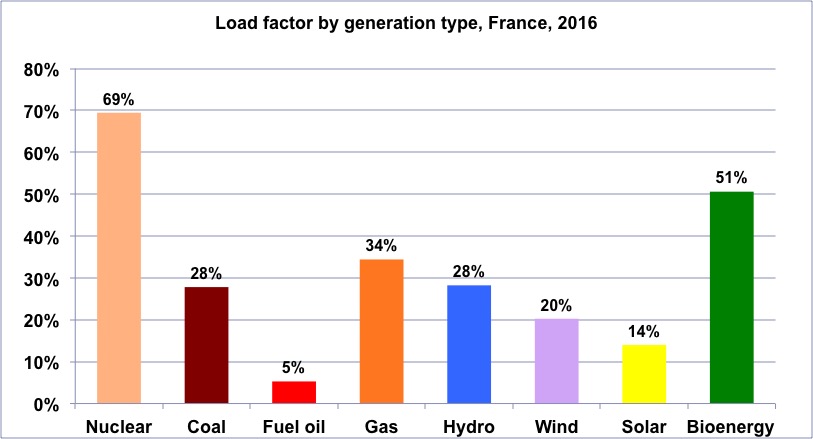
You need to install 3 to 4 times more windmill and solar panel to approach the same output. You also need to install huge way to store your electricity (mostly using damns, hard to get in places where you don't have mountains such as NL) and you need to invest the double into the electricity infrastructure to transport this electricity (your windmill will produce most of the time at 10-20% of it capacity, but the day it produces 90% you still have to transport it, therefore your grid need to be oversized for the average usage).
Solar panels are mostly coming from China and need to be changed each 20-30 years (they are loosing efficiency after a few decades). Windmills need to be changed each 20 years (lots of mechanical stress involved), and are mostly impossible to recycle (https://www.livingcircular.veolia.com/en/industry/how-can-wi...). Also, to install windmills you need to put a lot of concrete in the fields as a base, concrete that is emitting also a lot of CO² to produce.
As a result you'll still have a non-controlled electricity production, where prices will vary a lot and where maintenance costs will stay really high decades after decades. It's not only about investing, it's also about maintaining something that works through the years.
Here's a chart that shows the yearly CO2 emissions from electricity generation in Denmark
https://energinet.dk/Om-nyheder/Nyheder/2017/05/19/El-produk...
If you know a bit about Danish politics, you can clearly tell at which point there was lackluster political support.
How does this maintenance cost compare to the operating cost of a coal plant where coal has to be delivered non-stop?
But overall, if it's about CO² emission we want to reduce, I think it's way more efficient to invest into house/buildings isolation, heat pump and save 20 or more % of energy better than trying to invest massively into renewable energy that will gives non-controlled productivity.
Hum... You mean that the only control that had an actual effect was the land/agriculture methane. The impact was really small, huge changes lead to only ~0.3°C changes in a century, but it was the only one where you could make large changes.
And all of their efforts combined, even if it were 100% successful, will be a drop in the bucket of the emissions coming from China.
The farmers are right to protest pointless austerity measures, especially since they’re growing food to keep people alive.
30% of China production is exported.
Growing tomatoes in December in huge greenhouses like you can see in many places in Netherlands is maybe not the smartest way to save energy.
There is literally nothing the Netherlands can do to materially affect global CO2 output at this point. The measures put forth are unserious in the face of real data.
https://en.m.wikipedia.org/wiki/List_of_countries_by_carbon_...
It's super easy to say "look I'm not to blame" when most of what you're doing is not at home.
Except for the intensive agriculture, most of the Dutch activity is in the 3rd sector, services. And in those services you have banks, oil companies, lobbying… (and also tax evaded ones, but that's another topic) that can be considered as the most impacting companies, even CO² wise, in the world.
So please, counting on the fact that Dutchies are not a lot of people and are putting solar panel on their roof is really missing 95% of the topic.
Source (Dutch): https://www.trouw.nl/binnenland/vooral-jonge-boeren-worden-s...
ED: Didn't mean to scare anyone. Just following a thread of logic.
So while I did bring up the farmer protests, which are indeed about nitrogen and not about climate change, it's still one facet of the same problem: commercial interests over regional and global health interests.
Right now the Dutch farmers are again harassing the country with their tractors on public roads, angry about what they feel is undue pressure to reduce their emissions. Maybe they'll get one or two more generations of farming as they hasten their own demise.
Meanwhile, since NL has failed significantly to meet EU (nitrogen) emissions requirements - almost entirely because of mass agriculture - there's a freeze on building housing, roads, etc. Oh and the country-wide max speed limit will be limited down to 100kph starting Jan 1 (which I don't mind so terribly, but many people do mind).
So basically, the commercial farmers are ruining this country (and contributing to ruining the planet), and being jerks while doing so.