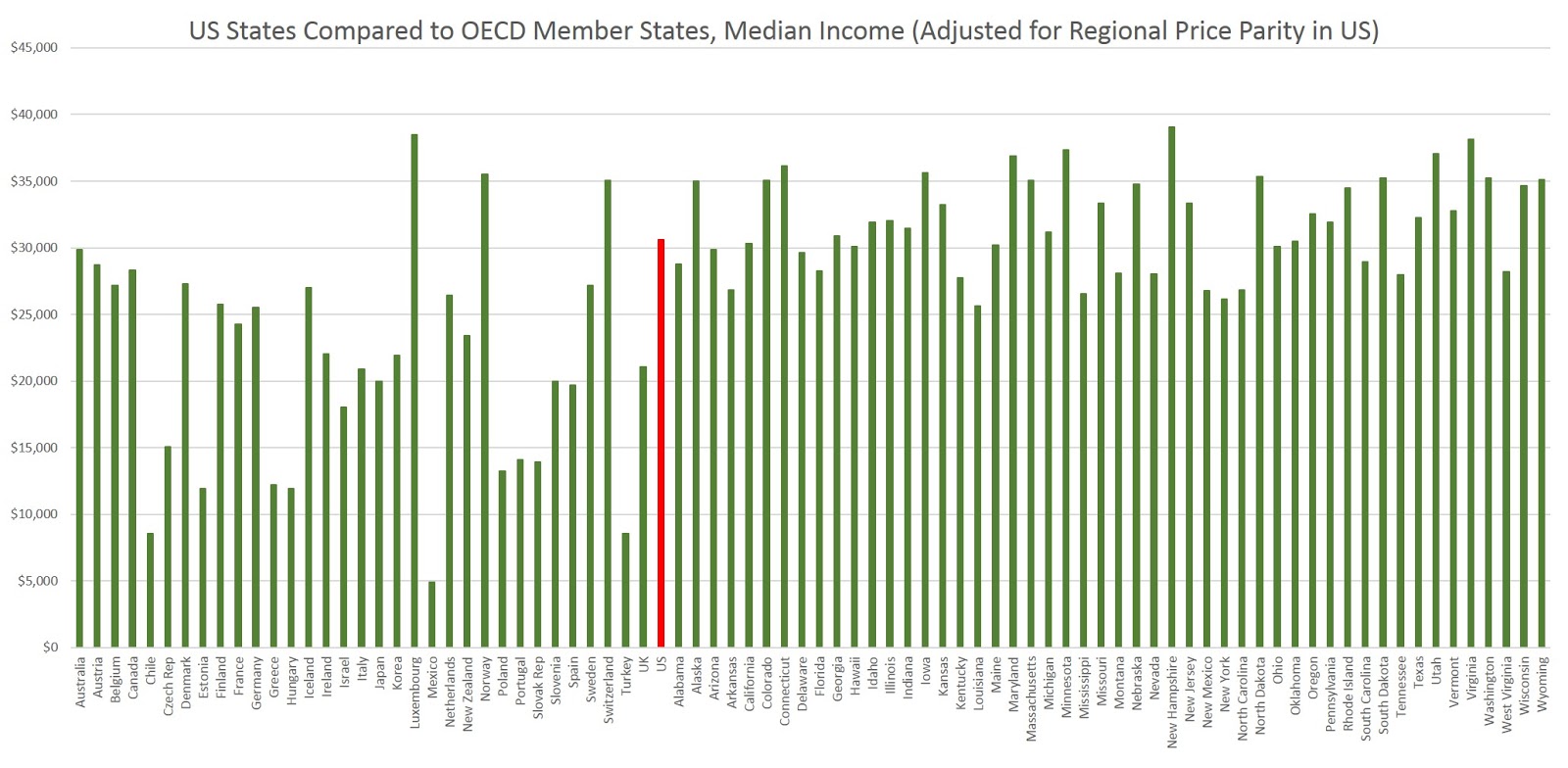
On the flip side, there is actually quite a difference between states like New York (second poorest in the US) and Virginia. And there is a very large internal migration from states like New York to states like virginia.
Median doesn't tell me much because it doesn't describe the skewness of the distribution of incomes. Without looking, I bet that both: 1) max income is higher in MD than in WV 2) there are more people at higher incomes in MD than in WV
So I looked it up for MD [0] and WV [1] and while they don't really help with my conjectures, MD has a higher per capita income ($24,774 in WV vs $39,070 in MD) and lower poverty rate (19.1% in WV vs 9.3% in MD).
Also interesting to note from those sources that they have basically the same retail sales per capita and rate of persons without health insurance (although MD has about half the disability rate).
[0]: https://www.census.gov/quickfacts/MD [1]: https://www.census.gov/quickfacts/WV
I wonder how long until someone builds a high speed commuter line into the heart of WV from DC. There is probably an obvious reason not to, but from my west coast perspective it seems like a good idea.
At the same time, much of WV's private economy was centered around extraction and manufacturing, both of which have declined over the decades.
There's a big highway under construction into the center of WV, currently called "Corridor H", that is intended to link up with 66, a major artery in and out of the DC metro area.
I think it's unlikely that high speed rail gets built in that corridor any time soon, simply because high speed rail in general seems unlikely in the U.S. right now.
And unlike some other regions known for mountains (like New England) there are no (relatively) wide valleys between them.
It's wild, beautiful, and absolutely awful for building even a decent sized town in. It's why the few cities in the states are at the far edges, and even they are hilly. It's also obviously terrible for building transport infrastructure to get anywhere quickly.
I grew up in MD and spent a lot of time in WV. It's a beautiful state with a lot of wonderful people. It has a modest crime rate and a murder rate typically 1/3 lower than the US rate. And of course as noted it's quite poor relatively speaking. Sub par economic outcomes is one of the long-term constants of WV. You will often notice the difference in the quality of the roads immediately when you cross into WV from MD or VA.
Here's one big reason why that high-speed line will never happen from DC to eg Morgantown or Charleston WV: the population of West Virginia hasn't increased since the 1930s. 1.8m people in 1935, 1.8m today (and falling). The demand just is never going to be there, given the extreme cost to build infrastructure in the US.
I'm not sure I could tell you if I was in (non-coastal) rural MD or rural WV (same as I'm not sure I could tell you if I was in Fairmont, Cumberland or Winchester).
I guess my main point is that we take this freedom for granted in the U.S. and generally folks don't examine it, or consider it to be good, or consider it not bad enough to be worth changing. I can tell you that there is zero public concern in VA about economic migrants from NY state.
Of course there is, for plenty of reasons:
- Moving away from friends and family is not free, is risky financially (what if your new job does not pan out), and is often simply not something people want
- Population-wide differences do not guarantee that you personally will gain anything by moving (correlation vs causation)
- Small differences in average incomes are imperceptible to most people, and the quality of average person's financial analysis is lacking. For example, looking at just median income ignores differences in cost of living, quality of government services, lifestyle, and anything occupation-specific.
- There is often more variation in median income within a state (e.g. urban vs rural areas) than across states. Migration from rural to urban areas is a thing.
- etc.
I don't feel particularly qualified in this area, it's an interesting question though; but, this really needs a citation. I think you're making a very strong claim here, that there is a "very large" migration from New York to Virginia -- although I have a problem with the qualifier "states like" -- what does that mean? Blue/red states? Northeast/South? Does "states like Virginia" include Florida, because that feels like a pretty strong outlier for the rest of the South.
In any case, here's a little information I've found, which I don't have the time right now to seriously analyze to support or refute your statement
* https://www.census.gov/library/stories/2019/04/moves-from-so... * ttps://www.census.gov/data/tables/2018/demo/geographic-mobility/cps-2018.html
Then there's the issue of comparing median income, without including average or standard deviation in the analysis. And while I can see the value of adjusting for Regional Price Parity, I would be curious to see a county-by-county breakdown of New York state -- I would guess the burough of Manhattan ("New York County" apparently) would also be a dramatic outlier, statistically, compared to the rest of the state.
Lies, damn lies, and statistics, I need to see a lot more to feel convinced of either argument.
On what basis? It ranks 15th for median household income.
> On what basis?
Probably the same basis by which California is the poorest: statewide cost-of-living adjusted poverty line.
There's a number of ways this measure is potebtially misleading; for instance, both New York and California are diverse states where the local cost of living varies considerably, and the numbers for any CoL adjusted measure would look very different if instead of a statewide CoL you used, say, county CoL based on residence and then aggregated the statewide numbers.
But using this or other statewide CoL-based metrics does get at something that mean or median income or measuring against the even less relevant national poverty line does not.
The chart I posted uses the BEA’s regional price parity figures: https://www.bea.gov/sites/default/files/methodologies/RPP201...
Which are almost on opposite sides of the planet, never mind that the one is a very small country and the other is a huge continent.
People don’t move to Washington from Oregon because their jobs are in Oregon and they would be subject to income taxes anyways. Really not smart if you work in Vancouver WA to live in Portland, however (income taxes are an or proposition).
However, I totally agree. Contrast this to China’s hukou system, where you can be a foreigner in your own country because you live in a city without hukou, even if you were born there.
Interestingly, the asterisk in the title indicates the research was funded in part by the Chinese government and the user who included the paragraph/source in the article has been banned by Wikipedia[3].
[1] https://en.wikipedia.org/wiki/Hukou_system#Hukou_conversion_...
[2] [PDF] https://www.geog.ucla.edu/sites/default/files/users/fan/a133...
This is a bit different from people moving from one place to another, and involves another nuance between urban and rural hukou within the same area.
So confusing...
If anything it would disadvantage citizens.
Immigrants then spend the money they've earned which further stimulates the local economy and increases tax revenue for governments.
This basic reasoning is why economists are pretty united in the idea that immigration is good for citizens of host countries experiencing immigration, and real-world data has shown this over and over again.
The idea that immigration to the United States disadvantages citizens just isn't supported by evidence.
Where did you come up with that idea? Maybe you meant there is unmet demand for labor at a lower cost, or lower than minimum cost (under the table, etc). This can come at the expense of people earning moderate wages who are not going to be happy about this. A race to the bottom does have issues.
However, the UK still has to allow free movement of people. Meaning that it can not stop Europeans from living in the UK. This does not cover working though, and I believe that some European nationalities still have to apply for a work permit.
See http://www.europarl.europa.eu/factsheets/en/sheet/147/free-m...
These were granted the same rights in 2014.
Yes, the state that wants to be a sanctuary state has border gates and enforcement.
As far as the diversity in culture, I would not agree with that amongst states. Not in a way of comparing say Costa Rica to Panama or the UK to France.
> Before the war, it was said, "The United States are." Grammatically, it was spoken that way and thought of as a collection of independent states. After the war, it was always "the United States is," as we say today without being self-conscious. That sums up what the war accomplished. It made us an "is." *
I certainly, today, think of the U.S. as a whole, not as a collection of independent states, and consider the issue of states' rights to be a generally pointless debate.
* Ignore the issues for a moment with the documentary itself and with Shelby Foote, who has stated Nathan Bedford Forrest is "one of the most attractive men who ever walked through the pages of history" -- seriously, I don't even know what to do with that. And I don't know if they did their footwork -- a textual analysis of, say, newspapers prior and subsequent to the Civil War saying "the United States are" compared to "the United States is." From what I've seen regarding issues with the documentary, I would question it, but I don't know for certain. Some things they seem to have done good scholarly work on; others, not as much.
I echo your amazement with the sheer size of the open border area. It's possibly the largest in the world.
US states are very culturally homogenous. Likely the highest similarity in the world among large countries. Possibly a result of such a mixed heritage and extremely pervasive cultural influences. Who really knows though.
I've been to many states and the difference between even coasts is the same as maybe 300 miles of travel in Europe or Asia.
Tax is belabored because it's so ideological, like when the Kansas governor claimed cutting taxes would bring a rush of new industries into Kansas (it didn't).
I know though when I chose to move from Texas to Hawaii to Washington State I never thought too much about taxes at any point.
(until 5 years ago I lived in Portland and worked in Vancouver)
States can hardly be considered sovereign entities anymore. They are subservient to federal laws, educational standards, international trade restrictions, environmental protections, etc. States aren't even allowed to leave the federation.
In my experience it's most often taken for granted, or seen as contributing to American cultural and economic strength--a good thing.
Yeah, not really free. They can't pay rent in Beverly Hills, they can't afford to shop at Beverly Hills shops, they can't even be walking around looking poor without harassment (especially if also black/latino), they don't have access to closed communities, and so on...
I don't quite know where you're getting that. I mean, it's not like the city has enacted some kind of Jim Crow regime. Beverly Hills residents were among Barack Obama's most generous donors. You think they would stand for that kind of evil in their own city?
Beverly Hills is represented by Democrats at the state and national levels. It sits in the middle of one of California's bluest counties. Are you saying LA County is tolerating that kind of blatant discrimination in one of its cities? This isn't Louisiana or Alabama for goodness sake.
https://en.wikipedia.org/wiki/Beverly_Hills%2C_California#20...
Such places have done exactly that, in several ways. E.g.: https://en.wikipedia.org/wiki/Redlining
This a good source of tens of other methods (and it's not even up to day) used in L.A in general to keep the "riffraff" out:
https://www.amazon.com/City-Quartz-Excavating-Future-Angeles...
>Beverly Hills residents were among Barack Obama's most generous donors.
That's not really relevant. They can virtue signal how non-racist they are (as long as it doesn't cost them anything real -- donations help buy favors) and still only live in 99% white areas, with closed gates, and local pops/private police ready to harass black/latino people for your protection.
>You think they would stand for that kind of evil in their own city?
100%
You're not presenting evidence specific to Beverly Hills here. Saying that "such places have done exactly that" is not evidence of what's happening today specifically in Beverly Hills. And redlining is not a scheme for harassing people who are walking around on the street. Why is that your response in this context?
> They can virtue signal how non-racist they are (as long as it doesn't cost them anything real -- donations help buy favors) and still only live in 99% white areas
You're assuming the very point you should be proving. You haven't offered any evidence about why some BH residents supported Obama. Instead, you assigned them a motive without providing any objective evidence. How are you going to persuade anyone of your viewpoints that way? And Beverly Hills is not 99% white.
Some of this opposition continues to this day. Here’s the latest dispatch: https://www.lamag.com/driver/beverly-hills-finally-loses-cra...
Anecdote: my friend from Trinidad who has an affinity for Caucasian women told me a story of harassment in Beverly Hills. He and a lady friend were in the woman's Mercedes and the police pulled them over and kept asking the woman if she was "under duress".
While the same "but how I would afford the same lifestyle in US" might be a concern for middle class immigrants from poorer countries considering getting there, it's not really relevant to mass immigration from poverty stricken areas, as people from there can (and do) enter the US and live in dirt poor areas, working whatever minimum wage job they find (in fact they're welcomed from employers for being able to get paid so much less), and taking it up from there if/when they can...
it's also true that many people from poverty stricken areas in other countries live in moderate to expensive areas in LA County, like LA's West Side, Downtown, and Koreatown, as well as neighboring cities including Santa Monica, Burbank, West Hollywood, Torrance, etc. again, to do this, multiple inviduals or families simply pool resources and rent an apartment or house and share that space.
given that about 9% of Beverly Hills's population falls below the poverty line, it's a safe bet that this high density renting strategy is also employed within that city.
just from examining the nearby BH/LA border, we see that there may be other "invisible borders" (e.g. "Our prices discriminate so we don't have to") that prevent two populations from really fully merging.
it seems likely that any "open border" is actually accompanied by a unique set of additional, invisible borders, and cultural, financial and linguistic "force fields," sometimes powerful, sometimes weak.
sure they can: eight or ten people can pool resources and rent a one bedroom apartment. happens all the time in other cities.
States also retain full sovereignty of their territory except for limited cases and maintain their own armies navies and air forces
Say what?
As an example, California has pretty strict border controls on its state bordera. Bringing certain agricultural goods into california is illegal and they will fine or jail you depending on the severity.
It is entirely possible and legal, but unlikely, that the governor of California sends it national guard troops to the border if Oregonians for example were attempting to storm the border with ferrets or something.
Moving into a higher-income area is the last thing poor rural Americans want - and the last thing that would help them. They are already living in high assistance areas - the area assisted by the United State federal government.
People invading the US are not looking to be in a high-income area, because that implies a higher cost of living. They are looking to be in a high-assistance area. They are not looking to make money, and have little prospect of that. They are looking to be given money.
That must be taken from someone else.
Despite this, U.S. residents can travel or move anywhere they want within the 50 states, with no prior approval and relatively inconsequential paperwork that largely amounts to notifying local authorities after the fact.
Given this, I think it's surprising, and somewhat illuminating, the degree to which population, cultural, and economic differences persist across generations. The states with the highest (MD) and lowest (WV) median household incomes are directly adjacent to one another, but WV has not been emptied by mass migration into MD. Plenty of Oregon residents complain about income taxes, but don't move next door to Washington, which does not have an income tax. Etc.
I know it's not the same as international borders, but it's also more significant than a single national government with purely administrative regions. Thinking about this has led me to question some of the fears about open international borders.