It's a constant hype/disappointment cycle, albeit it's getting better at every iteration; it's far from delivering on their promises though.
Electric cars are far from new, in fact, the first car to exceed 100 km/h in 1899, was an electric car named "La jamais contente".
And for decades after that, other impractical electric cars came out. But as technology improved, they started looking more and more promising, then commercially viable, then desirable, and they are on their way to becoming mainstream.
I think we are at about the same point with VR. It is more than a novelty, but here are still kinks to iron out before it becomes mainstream.
Also, in the "Early 90's," state of the art was an AMPS Motorola bag phone on Cellular One.
Not the same as mobile itself being a hype for any period of time.
The only people I knew who had cell phones in the early nineties were my rich uncle and Zack Morris.
Not because "huh, why would I want one" given the price being alright.
In case you forgotten what we're disputing, a grand-grand parent wrote "[VR] It's a constant hype/disappointment cycle" and another replied: "Mobile” was the same until it was just everywhere".
To which I replied that no, mobile wasn't "like that" (= a constant hype/disappointment cycle).
Mobile started growing fast (exploded) in early nineties and KEPT growing. Like with the iPod (that broke in early 00s and kept growing and growing until it was superseded by smartphones), there were no hype/disappointment cycles with mobile.
VR, on the other hand, did have hype/disappointment cycles. In 90-92 VR was touted as the "next big thing", then the craze passed and it disappeared (living only the legacy of having inspired the Lawnmower Man movie), taking 15+ years to re-emerge.
Similar, AI was touted as "imminent" in the 70s, only to break down in the 80s (the so-called AI-winter) and it took 20+ years to drive back mainstream tech interest again.
Mobile, on the contrary, never stalled once it got going.
http://1.bp.blogspot.com/-LyjMpXpsnyI/TZWzzCflQiI/AAAAAAAAP_...
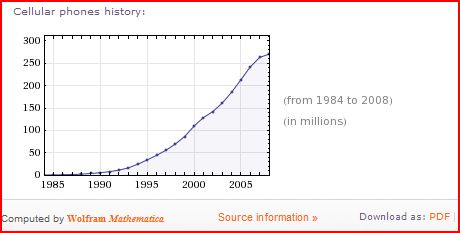
You: There was an explosion of mobile phone use in the early nineties.
Me: no there wasn't.
You: well that's only because the tech was too expensive.
Me: glad we agree.
You: no I was right the first time, look at this graph which shows an exponential increase in use in the early 2000's.
Me: ?
Explosion in the early 90s != everybody used them in the early 90s.
Explosion = the industry got traction / was kickstarted and kept on going and going.
Just as in the chart.
As contrasted with VR which in 90-92 there was a huge hype, and it got nowhere, people forgot about it, and it was resurrected 10-15 years later.
>You: no I was right the first time, look at this graph which shows an exponential increase in use in the early 2000's.
Err, the graph starts around 1988 -- and the "increase" is sustained from then until the end of the graph (and probably still today).
Nope
>Explosion in the early 90s != everybody used them in the early 90s.
Never said that
>Explosion = the industry got traction / was kickstarted and kept on going and going.
No, explosion means something along the lines of "a sudden outburst". Anything that plods along slowly cannot be considered an explosion. The slope of your own reference is rather timid until at the later nineties.
>As contrasted with VR which in 90-92 there was a huge hype, and it got nowhere, people forgot about it, and it was resurrected 10-15 years later.
Not the same thing. The tech simply didn't exist. At least, not in a manner which we would deem acceptable. Cell phone tech was fine, but it was simply too expensive.
>Err, the graph starts around 1988 -- and the "increase" is sustained from then until the end of the graph (and probably still today).
It is not "sustained": it begins increasing rapidly in the late 90's! In other words, it "explodes". Let's be honest here; in a response to another person you claimed that the plot showed 1B users, but the Y axis only goes to 300M. I'm not convinced you can even read that thing.
That's a pedantic distinction (not that I mind). I wasn't going for "explosion" as in "suddenly tons of people had one", but as in "suddenly there was a boom and a new viable market had emerged".
How hard is to get my main point?
Mobile got some kind of kickstart in the early 90s (I called it an explosion, but I could not care less if it's not that, that's not my point), and it never stopped going. Perhaps you'd agree if I'd merely called it "a bang" in the 90s? A starting point for big growth?
That was my point in a throwaway response I made at someone's comment that "mobile was like VR" at the start of this thread.
Whether that can be called an explosion or not, I could not care less. In my country, that's what we'd call it. There was a market that started from almost nothing before (some flat numbers in the US, almost zero in most of Europe). Unlike early 90s VR, which was a short hype in 1990 or so that then stopped.
From 1990 onwards, every year we had a big boost in the sub numbers. As I wrote, from a few dozen in 1990 (~16M globally) to ~1 Billion in 2000 (~ 800M to be precise).
That's explosive growth in my book, and I've lived several others techs that never seen such rapid growth. The only comparable thing would be the internet itself (from mostly academics in 1990 to a huge economic force in 2000). To contrast, it took 5 decades of development for PCs to get to the same point.
In any case, my focus wasn't on it being an "explosion" part, but on it never have been an "hype/unhype" cycle like early VR was. Unlike 90s VR hype (and other hypes) mobile merely went from strength to strength.
>Not the same thing. The tech simply didn't exist.
Sure, but that didn't stop the media and companies then to hype it for a couple of years. And then forget about it for 15+ years.
Here's what I'm referring to:
https://www.pcmag.com/feature/343351/the-wacky-world-of-vr-i...
http://1.bp.blogspot.com/-LyjMpXpsnyI/TZWzzCflQiI/AAAAAAAAP_...
Globally the numbers were ~15M in 1990, ~100M 1995, ~0.8B in 2000 (far from 100M in 2000).
And my point was, mobile exploded in 1990 and "kept expanding" (literally my words") -- there was like VR "a constant hype/disappointment cycle" (literally the thing I was responding to in this very thread).
For VR, most of the major industry players are continuing to invest (and were never expecting it to go mainstream in the last few years), and the active user count is persistently going up. The absolute numbers are relatively low. But the cost, software, and hardware right now are all pretty terrible and rapidly being improved.
With a growing base and major cost/quality improvements on the horizon it probably has a fairly secure future as a niche gaming platform. I don't think the data is conclusive yet on whether VR is the Next Big Thing.
There's kind of a chicken-and-egg SW problem for new platforms. Most of the popular mobile apps were only developed because of a large existing base of networked devices. For iPhone 1.0, the killer app was probably the ability to use the desktop web. Is there anything VR could do for normal consumers, that doesn't require enormous software investment (before there's a market)?
People watching TV/movies on their phone/tablet is pretty common (in addition to the living room). It doesn't seem too out there that VR could become cheap/good/comfortable enough to be popular for that use case (watching 2D TV on a phone). It's only marginally less social if you're watching by yourself anyway, and could even feel more social depending how the virtual theater is set up. Maybe that's one pathway that could drive more mainstream adoption.
I think it's premature to mark VR as a fad just yet, at least before not-terrible mobile systems come out. There's not too many tech products I can think of that would be popular if they could only be used chained to a $1000 desktop PC.
In any case, it's not really debatable: mobile grew and kept growing. I know, I was there in those "early nineties".
I think we're done here. It's ok to just say you were wrong you know.
I just did that re: the numbers, above, you know.
Explosive, we have to agree to disagree. I'm not a native speaker, but it seems to me a perfectly OK use of the word. In any case, it wasn't my main fucking point, which was simply that unlike VR in the 90s, mobile never had a hype/flat period: the market got on, and never stopped growing until almost everybody on the planet had one. I already wrote that like 6 times. Do you disagree with that?
Amazing how someone can go into such trivia and miss the main point I was making and in a thro-away comment of mine at that... Jeez...
PSVR is unironically the hope for VR right now, even though it has by far the lowest quality.
It has some very good games (Astrobot, Wipeout, RE7, Ace Combat 7, Moss, Beat Saber). It's cheap, easy to set up (aimed towards couch VR instead of room scale), cool helmet design, and the fact that the headset works as a regular monitor for non-vr games and one person can be watching TV while the other person gaming, is genius.
Compared to let's say Oculus where you need, 4 usb ports (3x usb 3.0), cables everywhere, space, a ~$1200 pc/headset combo...
I do believe in VR though and am excited for what the future holds.
For me it's the upcoming Oculus Quest. I've been refreshing /r/oculusquest daily, hoping to get a release date or a way to reserve it.
Would be great to have one device that can operate as both a standalone device and be connected to a computer for more graphically intense experiences than the Quest's snapdragon hardware can provide.
IIRC it's running at a lower framerate than a Rift does, but it'd still be cool to have that option because I have no plans to buy a dedicated PC-connected headset.
Odds of this actually happening are probably not good, but fingers crossed anyway.
I got a gaming laptop right as the first VR headsets were coming out, and I'm just at the cusp of being able to power them with my setup, but the input ports may be my limiting factor.
Save those helmets. 30 years from now they'll be worth a fortune on fleaBay the way Philco televisions are now.
• Games needs to be reinvented for VR, which basically makes adoption much harder - playing a FPS in VR will get you dizzy very quickly, even for people that are not very motion-sickness sensitive
• Quality is still not good enough, you can feel the pixels, and it breaks immersion - 4K screens, or even 8K screens, are probably the minimum, which means that we need also graphic cards that can deliver two 3D scenes combined at 4K or 8K, and these cards aren't there yet
• Plugging/handling all the messy cables is a pain
• And of course the price, but I don't think this is the biggest issue here
1. It's surprising how well flat screen games work in VR with minimal changes. 3rd person RTS, retro top-down shooters, casual puzzle games. I personally would love to see more "low-effort" ports to VR of existing content as just adding stereoscopy, 6DOF and 360 to a game can make it visually stunning.
2. I wouldn't turn my nose up at more resolution but even first gen Vive and Rift and more than enough to make me happy. You see past the pixels fairly quickly. I've demoed VR to over a hundred people and very few comment on the resolution (I'd prefer more FOV than more pixels personally)
3. Cable management varies from the annoying (Rift with 3 cameras) to a non-problem (plugging in a Windows MR headset is basically just 1 USB and a HDMI)
4. You can grab an Acer WMR for close to $200. The GPU cost is still a burden but we're on the 3rd gen of VR capable cards now so a 1060 or a 970 is now entry level for PC gamers.
"Completely ruined" is hyperbole in any case.
Whilst I haven't produced any commercial VR games I have spent two years working with VR in Unity and there are many shortcuts to moving traditional content into VR.
Note that I'm not talking about turning FPS games into room scale experiences. I'm talking about using VR as a stereoscopic 360 view into the game world but maintaining existing control schemes. First person games might be more problematic.
What does that get us then? Just a worse version of the games we already have?
Hopefully we will have quality eye tracking and foveated rendering in a few years, so we will not need to render the whole screen in high resolution ever.
As you can see, over the past 2 years we've gone from 0.36% of Steam users having a PC VR headset, to 0.89%.
We're also nearing the launch of the next generation of VR headsets. Both Vive and Oculus have products in development, and its rumored that Valve is working on a new headset as well. I expect we'll be seeing the launch of a few new headsets over the course of the next year.
So no, VR isn't dying on the vine; it's just taking longer to reach maturity than some may have expected.
If you're trying to judge the size of the market in absolute numbers, you also have to account for the fact that this survey only measures _Steam_ users. So Rift users who don't use Steam, and owners of non-PC VR headsets like PSVR aren't included.
YMMV. My Vive-equipped PC launches Steam on boot, because that lets it install updates quietly in the background as they come in. Otherwise, the first thing likely to happen when I try to launch something is a long wait for stuff to download.
The Vive on the other hand is only plugged in when I actually use it. It gets hot, and I don't particularly want it to burn electricity for no better purpose than to die a premature death.
So even as an active VR user, my Vive is only visible to Steam for a minor fraction of the time my PC is logged on.
It's also not that commercial interesting that a big percentage of people gets sick of VR. We stopped demoing because of this. AR seems to have less of those problems from empirical experience. I can use a Hololens for hours without feeling anything while with an oculus rift I get queasy after a couple of minutes.
The only thing that I'm still waiting for is project northstar (http://blog.leapmotion.com/northstar/) so the devices becomes cheaper. The high price seems to hamper the adoption a lot.
Even conservative Apple is was working on AR.
The ability to augment the real world has lots of useful benefits.
Currently AR has two form factors, phone and glasses.
Phone-based AR is gimmicky. It can be fun and can work in some scenarios but it's monoscopic, has a ridiculous field of view, requires holding your phone in the air, and it's not really augmenting reality anyway, it's augmenting a video stream of reality (increased latency, reduced dynamic range, motion blur, etc.).
Glasses-based AR will be great but currently has fundamental challenges with field of view, latency, optics, and integration of augmentations in the real world (e.g: procedural objects dynamically matching physical obstacles). It requires new inventions in hardware and software to fully realize the vision we have of it.
On the other hand VR has a clear technological path for the next decade into human-like field of view and visual fidelity. The full enclosure means we can get +200° and fit eye tracking cameras in the headset. Foveated rendering, only render what you actually look at at full res. The advent of ray tracing hardware (easier foveated rendering and non-linear optics). There is no fundamental barrier to get from here to 60 pixels per degree at 200° fov.
> Currently AR has two form factors, phone and glasses.
> Phone-based AR is gimmicky. It can be fun and can work in some scenarios but it's monoscopic, has a ridiculous field of view, requires holding your phone in the air, and it's not really augmenting reality anyway, it's augmenting a video stream of reality (increased latency, reduced dynamic range, motion blur, etc.).
> Glasses-based AR will be great but currently has fundamental challenges with field of view, latency, optics, and integration of augmentations in the real world (e.g: procedural objects dynamically matching physical obstacles). It requires new inventions in hardware and software to fully realize the vision we have of it.
> On the other hand VR has a clear technological path for the next decade into human-like field of view and visual fidelity. The full enclosure means we can get +200° and fit eye tracking cameras in the headset. Foveated rendering, only render what you actually look at at full res. The advent of ray tracing hardware (easier foveated rendering and non-linear optics). There is no fundamental barrier to get from here to 60 pixels per degree at 200° fov.
I 99.9% agree with this assesment, particularly with respect to the timeline of product maturity/adoption. However, I also agree with Andybak above, that AR & VR applications are complimentary, but largely different. One will not displace the other, but the technologies will merge such that you can seamlessly transition from AR to VR nd back using the same hardware (likely Virtual Retinal Display-based displays) and operating system.
I use VR in my job (evaluating power plant designs), and for that, I need to be immersed in a 3D model as opposed to AR where not being fully immersed would be unnecessarily distracting. On the other hand, after a plant is constructed, AR will be extremely useful (not yet, but eventually) in identifying where the actual design departs from the contractual model, or for training (new people learning how to operate the plant), or for monitoring (seeing overlays of temperature/pressure/planned maintenance data/etc., and so forth).
VR right now is mature in that the quality of display and ease of UI make it useful. It's still a pain to set up and get the models imported. It also still suffers from relatively low resolution. Resolution is still too low to say, emulate a computer monitor (i.e. present a virtual desktop computer monitor and use it at normal seated viewing distance - which requires a minimum 35PPD). For my needs, it's hard to read even large text on virtual signage in VR (you have to get VERY close to the virtual sign to read it). So, unlike the above comment, I think the VR industry has quite a bit of work to get from it's current sub-35PPD to a 60PPD display approaching the limits of human eye resolution.
Also, regarding your AR remark - I do think video-see through AR can (will?) have it's place while optical see-through AR matures.
I wonder if a major benefit of VR is that it forces us to create visualisations that are responsive. It is easy to get away with slow rendering on a desktop, but you can't on a headset. The software has to be realtime, and the model optimised for that.
1. Visibility assessments. In VR you can get a true sense of Field of View (FOV). For example, operators want maximum visibility through windows in control stations (or in a flight control tower, or sitting in the driver seat of a car). In 2D viewing, you can adjust the perspective settings to be anything and you simply can't match a humans natural FOV, which in addition to matching true perspective, you also capture the real time dynamics of how visibility changes as a user's body/head move. I've seen control stations completely redesigned after being built because the customer didn't like the experience (a risk largely mitigated with VR). You can't put 'control stations' in glass bubbles. It just isn't feasible. You need reasonably-sized windows and mullions, and there are many obstructions to contend with. 2D visualizations of 3D walk-through models simply don't accurately capture what's a VR experience can. We've actually found that, concerns about visibility identified from 2D visualizations are often discounted when we check it out in VR, just because the way and how quickly people move around naturally and subconsciously improves visibility.
2.) Ergonomics (Human-Machine Interface). In VR, you can literally reach out with your physical hands and determine if a valve, or a button is safely reachable by an operator. In initial design, you rely on standards/rules of thumb for placement of these items. However, as the design matures, you inevitably end up with pipes/wires/beams that complicate matters - it's impossible to right rules for every possible scenario. Historically, the only way to be sure.
3. Efficiency. I've found that user's can intuitively move around in a VR model much faster than they can with a screen/mouse. Especially, when you have a complex nest of pipes you're trying to evaluate. Using mouse/joystick/keyboard clicks and rotating takes people much longer than simply bending down and turning their head to see an object hiding behind a pipe or other object.
4. Remote Inspections. Once the plant (or whatever) is built, it's typically not near the office of the engineering firm that designed it or customer's headquarters that paid for it. Historically, when you get reports of people complaining about a design, you go into a 2D model first to check it out. If you can't get a good sense of the issue (typically because you can't get a true feel for the ergonomics/visibility aspects of the issue), you buy a plane ticket, rental car, hotel, and go an inspect in the plant in person. However, VR is good as assessing ergonomics and visibility issues (as described above), so you can use VR to avoid the need for travel. This has occurred already on a few occasions.
We currently only use static models, but smarter people can begin encoding dynamic features (e.g. opening doors, removing panels, etc.). I'm sure other people are doing this already. In conjunction with the ergonomics/visibility aspects above, I expect this will greatly enhance VR benefits.
You don't want AR if you're aiming for a sense of immersion. The real world just gets in the way.
You don't want VR if you also need to engage with your environment. Taking a headset on and off is a productivity killer.
But VR can approximate AR with pass-through cameras.
And AR will at some point approximate VR if it's overlaying enough of it's own stuff that the real environment is entirely obscured (display tech is far away from this point however.
It really depends whether you're talking about productivity or presence. And that's not the same as "entertainment" vs "business" as some business applications require immersion (architectural viz) and some entertainment apps don't.
VR has the advantage of being a much more mature technology with much lower technical hurdles. AR display tech is a very tough nut to crack. The best current tech - as demonstrated by the Hololens 2 - is woefully low on field of view, luminosity and affordability. 53 degrees horizontal FOV, non-functional in strong sunlight with a several thousand dollars price tag? Fairly niche...
Given the choice between spending $X on porting Skyrim to VR, and spending $X on an all-new AR game, and spending $X on trying to find an unmet industrial need AR can fulfil, I know which I think is the safer bet!
You can see this with racing or flight simulations, genres that translate perfectly to VR in theory (also in practice if you ignore competing solutions).
People there still buy and recommend monitors or projectors to get an competitive edge, to be able to use other peripheral devices like controllers and indicators (which would be blocked out in VR).
This existing market of peripheral devices and their manufacturers are tightly knit with the core audience, and recommending VR would go against their own business. A VR user wouldn't buy a controller that he can't see.
Augmented Reality with a VR like FOV could be a solution for both, VR manufacturers and existing audiences because it doesn't exclude a large part of the existing market and removes that resistance.
The problem with native VR genres is that you can't show off how it's really like to people who don't own VR headsets. On top of that they compete for attention with existing gaming ecosystems which can be seen as hobbies in their own right, meaning that VR really needs to conquer existing genres one by one, which is difficult if it ignores existing market forces.
Meanwhile, secondlife's open source clone, opensimulator, has thousands of regions and users online[3] despite being a super buggy platform, with less than $0 in funding.
1. https://highfidelity.com/user_stories?include_actions=concur...
2. https://forums.highfidelity.com/
3. https://opensimworld.com/ (disclaimer:shameless plug)
VR is a fairly radically different technology and in the scheme of things it's still in its infancy. Given that, whether it's currently growing or shrinking probably isn't very meaningful, as that doesn't really say anything about VR's longer-term prospects.
I currently have to pay a pricy $2K+ license for a 3rd party software (Revizto) to view Navisworks files in VR. It's worth it for my work, but it amazes me the lack of VR support these companies provide given the huge potential.
VR in my field is still very new. Many engineers (young and old) I show it to have never used it or had just done a demo somewhere and had no idea you could use it for work.
You can do stuff in VR you simply can't do on a 2D screen.
The big problem is that even doing something super simple takes a fair amount of effort. Even watching a 3D video requires sourcing content and then finding a compatible video player.
Porn?
If someone could manage the point cloud reconstruction techniques that would let you watch from positions in the middle of the game while there is no camera, they'd be on to something.
Oh, and it's a bad business model - the sports IP owner would want almost all the money.
What are you missing? The ability to pay $20 for a water bottle?
I can see it being a novelty but not a normal situation.
In the late 1990's I had seen the Virtuality VR headset on various Orbital album covers, when I got to have a go with the headset I was quite taken by it and didn't even notice that the '3D' wasn't ever stereo. At around the same time I saw Virtual I/O's iglasses and thought the experience was compelling. Had it not been a trade show I would have bought them there and then.
I have a feeling that some person at Facebook had a similar moment of 'oh yes this must be the future' as what I had. They just had more money than me and bought the company instead of hoping to buy just the headset.
Around the time this happened I was saying 'we have been here before' and everyone was saying 'this time it will be different!'.
It wasn't different, there were just more pixels.
So we will see what happens next time around when the next generation comes along and gets wowed by the VR of the day.
Incidentally some of the use cases of the Virtual IO iglasses included being able to watch TV soaps whilst doing the washing up. People got dishwashing machines and Netflix instead of standing at the sink watching broadcast TV to occasionally look down at the draining board.
Rinse and repeat.
I'm a little skeptical that either will become mainstream daily-use technologies.
There's a of low hanging fruit for improvement in the first wave that came out recently. Needing to be tethered with a cable to a $1000 PC is one of the big ones, and that should be addressed by the Quest in a few months.
I don't know how it will compare to mobile phone growth, but I expect VR to grow at a much faster rate once the Quest comes out. It will bring the entry cost to $400 (from ~$1400 for most people, who don't already have gaming PCs), remove one of the biggest nuisances (the cable), and be drastically easier to set up. The software library is still small but better than it was a few years ago.
Also keep in mind there's huge numbers of people who haven't ever tried VR yet. The Quest is likely to get in front of a much larger number of potential customers since it's so easy for a friend or relative etc to bring it over compared to the current non-portable systems.
AR is the more interesting space right now. On the consumer side, Pokemon, Ingress, and the new Harry Potter game are doing ok from what I can tell. I'm not sure when we'll really get to a wearable AR device that is popular (Google Glass obviously wasn't able to meet people's needs).
Microsoft is still investing in AR, but they're focusing on business use rather than the consumer space. I'm not sure it will really take off with the HoloLens 2, but another iteration that improves the field of view and if they can bring down the price (the newest version starts at $3500) they might be able to manage broader adoption. But even that is likely to be a couple of years away.
No VR is heavily used in architecture, healthcare industry and other professions.
VR as a mass market however is not doing that great right now, because it's not yielding the results the entertainment industry hoped, which leads to less investment and so on... it's a vicious circle.
Ultimately someone will get it right. Apple, maybe.
Around the time the first Oculus Rift, the HTC Vive, and Microsoft's HoloLens were released some years back seemed to be high water mark of media stories about VR. Since then it seems to be pretty quiet.
Is VR dying on the vine?