I typically have 2-8 tabs open (hasn't changed much over the years). Maybe other usage patterns used to cause problems... Also worth noting I was always on Linux; maybe Windows/Mac versions weren't as good?
When quantum came out, I didn't personally notice a big performance improvement in terms of user experience (though I don't doubt it's there, and I don't watch CPU/MEM constantly). I've seen these headlines and have just been thinking to myself "but it's always been good!"
I didn't switch to Chrome when it first came out, but over the next couple of years I found Firefox frustratingly slow and crash-prone. When I cut over, everything was drastically faster and more reliable, plus the feature set (extensions, url completion, incognito for parallel sign-ins, and so on) was noticeably better. High memory usage was the only price, and Chrome surrenders that somewhat gracefully when it's needed.
I'm hoping to make the switch back. Chrome has become more frustrating as Google adds brand alignment, and moreover I simply don't like being siloed by a brand. But the usability gain was massive when I first switched, and I'm only making the move now because there's been a lot of good news out of Mozilla.
Even today, Travis-CI really struggles in firefox, it's modern pleasing animations are just so atrociously coded. And remember when the Reason (facebook language) website was unveiled, it really killed firefox, because of some strange shadow effect applied to all letters or something ...
Whether inadvertently or not, the Chrome team hit on a genius way of gaining market share by focusing on dev tools so heavily.
(Disclaimer: I work for Mozilla.)
It wasn't really a mass exodus, but a gradual wax & wane over time (with more moves FF->C over the long term than C->FF).
In development fields the count is complicated by people who regularly use both, but prefer one.
> I typically have 2-8 tabs open
I tend to have many open[1], over several windows on different desktops. I use open tabs more than I use bookmarks! Every once in a while I go through the open tabs and close those I've not touched in a while that I don;t expect to touch any time soon (obviously the need to have it open has passed). I currently use Chrome more then FF, and here The Great Suspender[1] is a godsend for saving RAM (and to a lesser extent CPU time) Chrome would otherwise consume.
[1] TGS lists my current use on this machine as "22 windows, 148 tabs"
Edit: spelling
As a developer i noticed some minor default CSS bugs with the new Firefox Quantum that didn't used to be there but that's about it.
I also use Chrome in my development cycle so it does seem to have some neat features that Firefox is lacking but I doubt regular users would ever notice that.
It was just never enough to make me switch although I would appreciate Mozilla putting more effort into their developer tools.
P.S. I end up having over 100 tabs open so yeah... although my OS is Linux not Windows so your mileage may vary.
I've seen no difference in performance in recent years, at least on my home machines. My browser performance is basically limited by my internet connection, making all the browser v browser speed tests moot. (At work I have to use windows+IE+bing+outlook because work are idiots.) I switched to chrome last year because a couple quality of life plugins were not longer compatible with the latest versions of firefox.
What I want is firefox from a couple years ago, back when all the plugins I wanted worked nicely together (mostly privacy and dev tool stuff). Firefox needs to simplify itself, to get rid of things that can be handled much better by plugins.
I think this is because there is a marketing campaign for firefox at the moment.
When it was front page reddit, the comments were overtly positive and any pro-chrome comments were downvoted to oblivion.
Thinking there is a massive marketing campaign and thats why we are seeing it.
Since this had no effect, except causing an instant loss of a lot of users (one that hasn't been completely felt yet due to esr), and a slight bump in chrome's user numbers, there's no resort other than advertise heavily the benefits of not using google's browser, without mentioning google negatively because they generally rely on google for funding. So just weird platitudes about "freer people web standard access foundation" or something. Or talk about start-up times that no one cares about, and which don't make them distinctive from chrome.
The immediate problem is the vast majority of people who are sympathetic to that branding were already firefox users, and at some point were turned off because firefox killed some plugin or other or it just stopped being updated, or because of some UI change which are now explicitly not mitigatable in quantum. The way firefox responded to those complaints (which is not materially, even once; when a meeting of firefox management has determined something is going to be done, it is going to be done, and exactly in that way) has assured that target audience that development by a non-profit is no more amenable to consumer desires than development by the largest, most predatory companies in the US. At least Microsoft and Google are big enough that user complaints catch fire in the mainstream media, and they're forced to respond to a critical audience. If firefox decides that they're going to take out the back button, because "in a modern internet, users shouldn't be moving backwards", you're just going to find a closed WONTFIX bug with 400 angry comments from users on it, and a few comments from Mozilla explaining how their user testing showed that people don't want a back button, the bug tracker isn't for general complaints, that the tone of the thread was very negative and regrettable, and that the thread was being closed for further comments.
The real problem is that Firefox has 10x as many employees as it needs, and is just another corporate bureaucracy collapsing under its own weight. Should have been slim and user-focused, and instead of rhetoric about a "free people web standard internet brings people together", central and visible in every conflict regarding the internet and its architecture, and the distribution of knowledge in general. It used to be almost that, but I think the fight over h264 broke it.
Now, the only reason it's alive is to keep the forces of antitrust from google's door.
Their employees, whether intentionally or inadvertantly, also brigade message boards.
Do you have any idea how much work it takes to maintain a modern web engine in 2018?
And that was a good thing. However, I regrettably find Google now pushing and pulling the rest of us harder than we want or need. Now that they are in the lead, they give the impression they are the writer of the scrolls. (In fact, a Google employee is the editor of HTML.)
Now, one cannot complain too much. Google's leadership has done far more good for the web and we should be grateful, but too many developers are turning first to them for what to do and how to do things rather than seeing the whole forest.
Only time will tell.
Personally I'm not that grateful to Google. Like you said, it all started out as a good thing - rather innocent. And of course it turned to "profit at all cost" soon after that.
IMHO most people not quite understand the trade-offs involving technology choice. Large companies like Google, Microsoft, Apple (in no particular order) take advantage of that in the interest of their stakeholders. Violating their user's freedom and privacy along the way.
Apple for example is a privacy leader. Easier to secure their walled garden perhaps and they have their own pros and cons but they shouldn’t be in a set with google, Facebook and to a lesser extent, MS.
The performance improvements are quite substantial.
This whole BINARY vs. PLAINTEXT paradox where the binary tends to be more efficient where the plaintext more open and intermediate ground between humans and machines, for me can be solved in a optimal way where the final output is always binary, but where you can assist humans with plaintext latter.
Just look how many beautiful and expressive computer languages we have now where the output is a pure obscure binary.
So i think if you follow this path you can have the best of both worlds. And because of that i tend to disagree with your point of view, where the default must be plaintext.. The layered approach is probably much more sophisticated and less amateurish when you care about waste of CPU cycles and RAM memory, without the need to have only a obscure and opaque representation.
If you're talking about Hixie, it's probably worth mentioning that he previously worked for Mozilla (and Opera).
> a small company can't fend itself from Microsoft. It took Google and Chrome, later, to knock IE and Microsoft into its place with its big push forward.
It wasn't Google that dethroned Microsoft, it was Apple. The combination of Microsoft neglecting Mac, and the resurgence of Apple were the primary drivers away from IE. Chrome had almost nothing at all to do with it, they just out maneuver Apple and Mozilla to steal the crown form the fallen king.
In the late 90s IE was king and many websites demanded it. Netscape lost the browser wars and opensourced Communicator under Mozilla in 1998. Mozilla was in no position to compete with Microsoft so it instead pushed for standards compliance.
Internet Explorer 4 on Mac and PC were based on the same code but when IE5 launched in 1998, it wasn't available on Mac. When it did eventually land, IE5 for Mac was based on a different code base and rendering engine. This caused a problem for Apple because their platform was no longer on feature parity with the PC when it came to the Internet. IE in general was slow but IE5 on the Mac was worse.
Apple announced Safari at Macworld in early 2003 with a big emphasis on performance, during the demo Steve Jobs spent 30 seconds closing and reopening the browser to drive home the fact that it loaded fast. Apple went to great lengths to make Safari standards compliant and fast but they went one step further and worked with the most popular websites around to make sure they too were standards compliant too.
Around the same time Apple brought Safari out of Beta at the 2003 WWDC, Mozilla released Phoenix (Firefox) with an emphasis on standards compliance and performance. This set the stage because Apple and Mozilla were now aligned in a common goal, to make the web fast and standards compliant, and neither of them registered on Microsoft's radar.
It was Apple's push for the adoption of standards compliance by major websites that allowed Firefox to capture 25% of the PC market and by the time Microsoft responded with IE7 in 2006, it was already too late. Microsoft had lost, the world had decided that IE was garbage and there was nothing they could do to save the sinking ship.
Apple saw this power void IE left and so in addition to launching full Safari on the iPhone in 2007, they also launched Safari for Windows in a bid to become the dominate browser on all the major platforms. Unfortunately Google saw that same vacancy but Google was the default search engine in Safari and in Firefox. Apple and Mozilla were contractually obligated to promote Google Search so in 2008 when Chrome was launched, there was nothing they could do to stop Google promoting Chrome on google.com.
When Chrome arrived in 2008 it touted compatibility with Safari and adherence to standards compliance but the killer feature was stability. At the time all browsers crashed, it was accepted as an eventuality. It was so bad that Session Restore had been touted as a major feature. Chrome launched with multi-process isolation so that when something crashed, it didn't bring down the whole browser. Google's other innovations were rapid development cycles and background updates. This meant their browser always had the latest features and their users were always up to date. It took Mozilla years to catch up, Apple still has not.
I'm stunned. Is this still a thing? Last time I remember seeing websites recommending a browser, it was late 90s with "get Netscape" gifs.
Google Flights began blocking Firefox for Android last week, and Google still serves a degraded Search experience to Firefox users on Android (but hey, no AMP).
Despite well-meaning concern from the Chrome team, it's abundantly clear that Google's other product managers do not view interoperability with open, cross-browser standards as a requirement. And while many products eventually gain Firefox support, that support usually only comes months after launch, if at all. To wit, Earth was recently rebranded from "Earth on Web" to "Earth for Chrome," so who knows what's going to happen there.
> Time for an upgrade. Looks like your browser needs a boost. To get the best Google Flights experience, upgrade to one of the supported browsers.
It's shady for Google to lie to their users especially when they imply its the browsers fault and not just their dev team being lazy gits and not validating that features work on Firefox.
Because that's the only valid excuse I could come up with that would make sense as to why they don't support it beside being shady that is...
EDIT: So it does! The last reason I was keeping Chrome as my default (so Meet calendar invite links would work) is gone.
Great response from Alex Russell, but it's clear that the sentiments of the Chrome team aren't translating into policy elsewhere in Google, or we wouldn't be dealing with something like this every few months.
Unfortunately, often giving the official thumbs up requires passing some test suite. If companies have gotten better with their development methodology, their testing methodology is still often "Take a bunch of guys in India and have then run through that extensive check list".
Given that everyone else on my team uses Chrome, I think we'll likely be sporting a "works best in Chrome" banner soon, especially as most people would be confused by "works best in WebKit/Blink".
Here's a screenshot: https://imgur.com/a/2CCRVDf
Meet did start to work in latest Firefox recently, and then this week they broke mic audio. -.-
Joking aside, I've never really known the difference between Google Talk, Hangouts, etc, but I regularly chat with my contacts from the Gmail website, using Firefox, without any problem so far.
For anyone confused.
When Quantum was released, I did a side by side comparison, opening the exact same tabs in each browser, switching browsers each day, manually keeping tabs in sync. Did this for about two weeks. For my use case at that time, Firefox's memory usage was 1/4 of Chrome's right off the bat. After a full day of use, Firefox's memory would double, while Chrome's would triple. Given the starting numbers, this meant at the end of the day, Firefox would be using 4-6GB of RAM, while Chrome's memory usage would be something like 16-24GB.
By the time I switched, I had already moved to Rambox for Hangouts and Gmail and stopped using Keep, in an effort to reduce Chrome memory usage. Rambox mem usage was about half of what I saw with the Chrome Hangouts plugin.
Although I use FF 90% of the time now, I still prefer Chrome, probably due to using it for so long. I especially prefer the Chrome bookmark manager. I really wish I could find a good way to keep bookmarks in sync between browsers! Any suggestions??
A big bonus has been the huge improvement in battery life. I had no idea how much I was losing to Chrome. Safari is supposed to be great for that, but plugins and the fact I'm an Android user means it doesn't offer me much.
The downside is that FF has made my tab hoarding worse. Still, despite doubling the number of tabs, mem usage is still half of what I saw with Chrome.
As for the unused memory is wasted memory argument (which may be tongue in cheek re: browsers), my browser is not my OS and I have a lot more going on than just a browser. 32GB MBP can't come soon enough.....or a touchpad experience on any other hardware+Linux experience+lots'o'RAM. 3 yrs ago, I finally gave in and tried Mac. Touchpad experience is probably the number 1 thing that keeps me here.
(don't get me wrong, I like libinput's idea and I know old synaptics driver is an awful mess when it comes to its code, but there are still lots of papercuts libinput needs to handle. I believe it will get there, but it's not there yet)
Once you register, all you have to do to save a bookmark is go to "saved.io/www.google.com", for example, and it will save www.google.com.
If you want to save to a subfolder, all you have to do is go to "subfolder.saved.io/www.google.com".
To access your bookmarks you just go to saved.io in whatever browser on whatever device you want. I use Safari on the iPad, Chrome on my Android phone, and Firefox on my desktops and it works great in all of them.
Firefox is still bad compared to Safari.
Second, when you type stuff into the address bar Firefox searches through opened tabs and suggests switching to that. This minimizes the number of times you'd open a new tab.
Third, there are many addons that help you organize your tabs. There are ways to search for tab content, group them into containers, find duplicates, etc.
How to start having many tabs open? Just change your MO when you use the browser. Want to search for something? Hit new tab and go. Researching something? Open every link you find somewhat promising in a new tab. When you have 200+ tabs opened, another 8-12 won't be a big change. Done with your research? Why close tabs? Just keep them open in case you'll need them later.
Often when I work on a project for, say, half a year I don't close tabs at all, and keep getting back to stuff I accidentally stumbled upon 2-3 months ago. It's very helpful at times to be able to dig stuff up one tab away. One could argue that bookmarks and history could be as helpful, but in practice when you switch to an old tab you see the context around it. What else I was looking at at that time, often information in the neighboring tabs is relevant, yet bookmarks and browser history don't have a good UI to surface it if front of you.
Yes, your browser becomes a memory hog, but as people noticed Firefox has means to compensate that. At 200+ tabs it consumes significantly less memory than Chrome (even with Chrome's load on demand turned on).
It takes time to get used to, and ones or twice a year you'd be doing tab cleaning, but I've being using browsers like this for 15+ years and really see benefits in this workflow.
For context: right now I have 330 tabs opened, Firefox consumes 1.8 GiB of RAM
This is how my Firefox looks like:
https://dosowisko.net/Screenshot_20171030_203716.png

https://dosowisko.net/Screenshot_20171030_203804.png
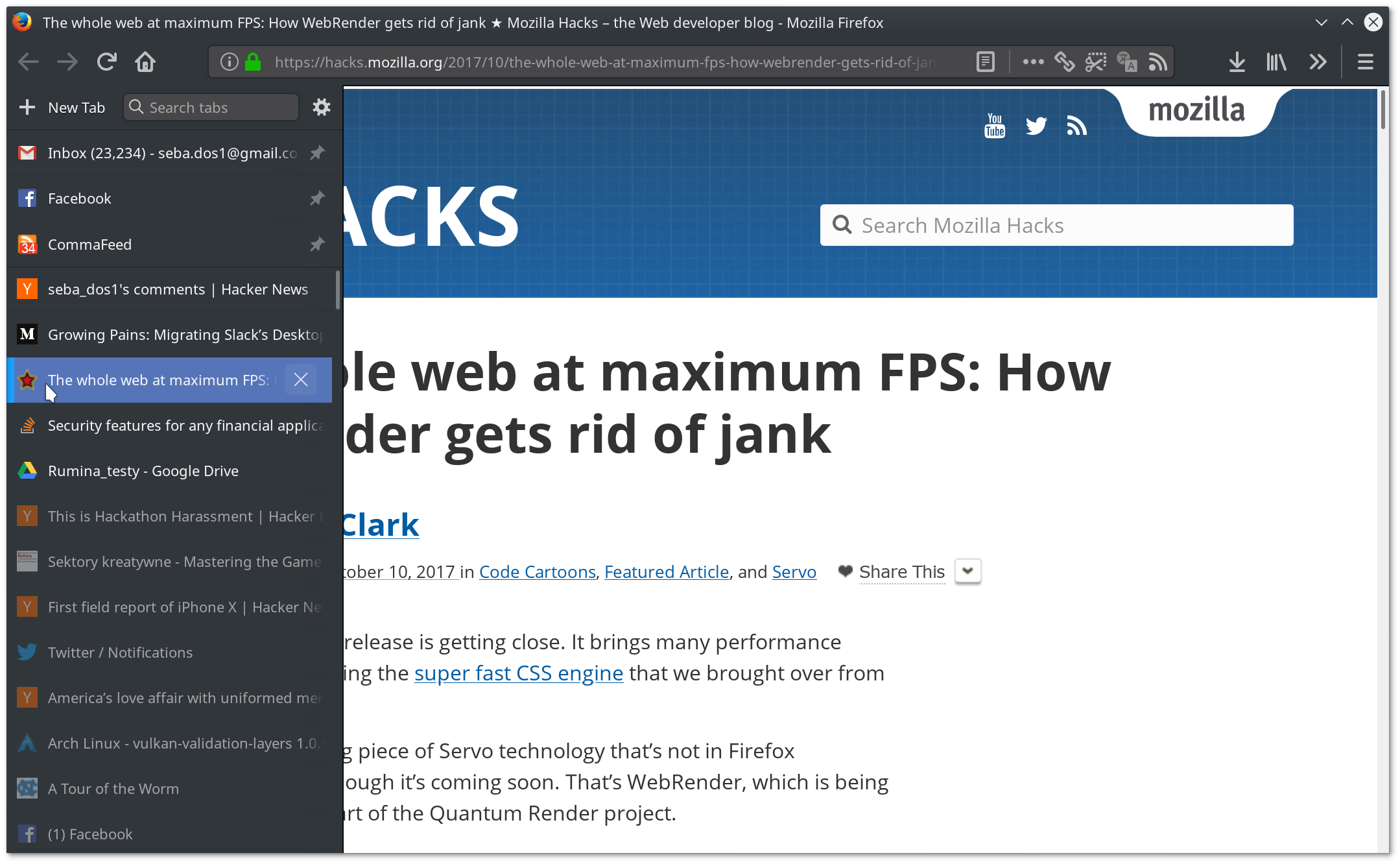
Once a while I'm getting to 1000-2000 open tabs and this is a point where the whole UI starts to feel a bit heavy, which is the only reason I clean them up then - navigating is a non-issue.
It's a symptom of my non-optimal behavior. Blame the wetware between my ears. On any given moment, I might have perhaps 5-50 new tabs that I actually work in, closing them as I go along (but along those numbers). The rest are mostly left-overs since previous days.
My weakness is eg "this is an interesting read, but I don't have time now", or "this is a good reference, better save that". Over time, those add up.
To actually make it work, I set FF to not load tabs until focused. Then, when I start up, there are in reality a couple of hundred place holder tabs where I can see the icon and page name so I can find them again.
The second enabler is the plugin to have the tabs vertically, in a list on the side, instead of horizontally on top.
I really should just close them all and never look back, but I gotta admit, it's hard to say goodbye to dear friends. In this case though, I only know them by name :P

API documentation. It's very, very useful to have the structure of the APIs represented in a tree of open tabs. It gets messy eventually, but the groups can be easily rearranged.
Later on TreeStyle Tab came out, and I've used that ever since. I've got 501 tabs right now (thanks tab count extension), I usually go on purges every so often when it gets around this high and close large groups of them, reading some before closing, bookmarking many of them before closing with a current month/year annotation and other tags, so I can get back down to a more reasonable ~100-200. Even if it didn't have its tree collapsing functionality (I've got 25 tabs collapsed in a tree right now related to setting up and using some new software I started doing last night, it takes up one tab of space when collapsed) I would still use it just for the fundamental insight that with widescreen resolutions being standard vertical screen real estate is much more important than horizontal real estate. Admittedly that's not as big an insight anymore with 4k screens (and I use a big 42inch one). Anyway with TreeStyle Tab I can have tabs that are on the left side of the browser, that grow down, with scrolling, but I can still read the titles of each tab unlike in Chrome where each tab after ~10-20 is just an icon (at best).
The URL bar is also just superior to Chrome's. It's not called the Awesome Bar for no reason. The table at the bottom of https://support.mozilla.org/en-US/kb/awesome-bar-search-fire... has a list of commands you can use to match things -- I actually often have that page in my sea of tabs since sometimes I forget a couple sigils but I found it immediately with ctrl+L + "awesome %".
This submission's title is kind of hilarious. Firefox never went away, I started using it pre 1.5 on a Windows 95 machine and though now I use Chrome/Chromium for some things I've never felt the need to leave Firefox. Well, except until recently with the Quantum updates, ironically. For my personal desktop, I'm still pre-Quantum, it works just as it always has, while on my other machines I've been giving the new Firefox a fair chance and am just hoping it gets better. The tree tabs addon port especially isn't as good, I really miss my right click context menu for noscript, etc.
Firefox does it at least as well, just having both open is a bit much.
Chrome 5.3 GB
Firefox 4.2 GB
I couldn't find a tally of where Windows applies its "memory compression" logic, to be honest I don't even know what exactly it does, but let's assume it's some background task and it did more to Chrome than to Firefox since Chrome had been running longer.
So yes, Chrome needs noticeably more memory, and I prefer Firefox overall, but both can handle tons of tabs in my experience. Chrome also appears to be more responsive under pressure, I assume this is because it splits work into lots more processes than Firefox does, which is both probably a memory drain and a security benefit.
------
EDIT in response to your reply:
Please do! I agree that logging would be interesting.
Do you know, does Firefox defer/discard tabs again if they do fully load but you don't use them for a long time? Or are the only deferred tabs, ones that you never looked at this session?
Maybe I should set up logging for this, might be interesting.
Do you know, does Firefox defer/discard tabs again if they do fully load but you don't use them for a long time? Or are the only deferred tabs, ones that you never looked at this session?
(Doesn't matter if I have 2 or 100 tabs if there is one bad apple.)
People have different workflows and different priorities in that department, the best thing a browser could do to try and gain market share is keep their mind open to these differences and try and enable all of them. Something most browsers fail at to one degree or another.
For example, I loved firefoxes two address bar approach over chrome's omnibar. I would set the default search on the address bar to route to google's browse by name (it auto selects showing a search results page or going to the first result (i'm feeling lucky) based on how confident it was that the first result was what the user wanted) and the default search on the search bar to google. If I wanted to go somewhere by name I'd type in the address bar, if I wanted to search for something and be sure i got a results page I could just type it in the search bar.
I've used chrome for my daily driver despite loving firefox for one simple reason, and that's the Google Voice extension. It has a little number in the icon next to the address bar, that tells me how many unread voicemails or text messages or missed calls I have on my cell phone, its always visible in the window I have active on at least 1 monitor 99% of the time, and it's the primary way I keep track of incoming text messages as well as missed calls.
I would be lost without this so despite firefox having a lot of features I prefer over chrome, chrome is still my daily driver because of one extension that firefox doesn't have last time I checked.
But then sometimes the free option is also, i.e. in addition, the better choice for other reasons as well. And those cases (e.g. Postgres, Darktable, etc.) are worth pointing out, because they may serve as gateway drugs to free software, for users that may not initially care for it because they associate it with invariably bad user experience.
I have an article brewing on this, because I increasingly think it's important. When free software does not suck from an UX perspective, there is zero reason not to use it. That's a huge market.
I don't have a whole lot to add to this discussion that hasn't already been said except:
I'm the frontend developer at my job, and my coworkers are slowly discovering that I'm not joking when I say that Chrome is the new IE, for reasons pertaining to this. One example that I think made a few of them realize what I mean when I say that was during that short time recently when Chrome Experiments worked in every browser except Chrome, and the reason why that was the case: a (shady, to me) built in whitelist.
But I do agree that one company shouldn’t control the internet or browsing experience end to end. Although as far as pushing web standards and browsing Google has mostly been a good citizen. Let’s just pretend AMP wasn’t a thing.
But Firefox is free software :)
[0]https://commondatastorage.googleapis.com/chromium-browser-sn...
Google won. Everything people hated MS for in the 90s Google has actually accomplished. Resistance is futile.
one feature directly related to it is support for extensions. why can chrome run extensions on the desktop (ie ad blocker) but not on mobile? the answer should be obvious.
Personally, I port my Chrome extension to a Firefox addons without much trouble, except for the stringent review process by a human developer which raised a lot my opinion of the firefox community.
While magicalbeans may be a bit hyperbolic in their criticism, as a web developer who uses all the major browsers, I am still annoyed every day by little things that are worse in Firefox since that time. It is a reasonable and valid criticism that many useful extensions were broken by the change and that a significant part of the functionality that was lost can't be reimplemented in the new system. The claims that the general reduction in functionality through loss of previous extensions would be a temporary problem and would be corrected as the new model evolved over subsequent versions have proven to be optimistic.
It is also fair to say that claims of extensions being better contained and more stable in the new model have been exaggerated. I see far more problems caused by the smaller number of extensions I now use than I ever saw before, and I have done consistently ever since the change, through three more major versions of Firefox itself and several updates to most of the extensions.
I appreciate the intent to make Firefox faster and more reliable and more secure. Surely no-one would argue that those aren't good things. But the fact is, a lot of stuff did get broken and hasn't been fixed, and for the class of users who valued Firefox for its customisability, it is a worse browser today than it was 9 months ago.
The API is a superset of Chrome's. You can do stuff with Firefox WebExtensions that you cannot do with Chrome.
I am stuck on FF 53 (and reinstalling it whenever automatic updates sneak past me) since it still has the XUL API Pentadactyl uses to receive keyboard input[0]. The new WebExtension API don't expose the same level of functionality, so it can't be simply ported to them as is.
/usr/bin/firefox53 -P esr
/usr/bin/firefox -P quantum
and if you want access to the same saved bookmarks, just use Firefox Sync to match them up.
It won't help with Pentadactyl, but folks with other use cases may find it useful.
Pardon ?
Actually FF is better that Chrome!
Then I find Firefox better than Chrome when both run with or without extensions.
Having said that, all sites which I regularly use work perfectly for me in Firefox with acceptable performance. So I never found a reason to switch at all. Rarely, I come across a website which is "best viewed with Chrome"; my default action is to close that site immediately.