One of the big issues with the demonetization on YouTube is that it's a binary flag -- either "acceptable content for advertisers" or "unacceptable for advertisers." As if advertisers were a single block with a single set of values!
When YouTube is not under an obligation to act as the virtual-public-square (because "they're a private company"), then they are especially vulnerable to defining that "acceptability" either by internal ideological conformity, or by external ideological pressure. Part of the concept of "free speech" (as a doctrine, not just as 1A legal structure) is that it allows for a society where the distinction of "I don't agree with this but someone out there might and so it's OK for it to exist" is a distinction that is possible. Without that, we're left with a world in which expression has to be mediated by the approval/whims of external forces for it to be present.
Whatever strange, fringe things this person was having as YouTube videos, I'd be willing to guess there's some fringe company out there who wouldn't care if they were advertised on those videos. Think of the kinds of advertisers 4chan, Infowars, or adult websites get. Their standards don't fit into a generic mold of "acceptability." But if someone was a video creator who wanted to court such advertisers, what kind of audience would they even be able to build without access to the de-facto public-square that YouTube is?
I don't know how to get there from here. But I think a more healthy ad-revenue model would somehow have YouTube saying "OK, these mainstream videos are able to be monetized by mainstream ads from companies A B and C, while these fringe/controversial videos can be monetized by whatever companies X Y and Z want to."
The attacker videos seemly were mostly about exercising, vegan diet, and some lighthearted videos...
AFTER demonetization, seemly some videos with criticism about Youtube and US, saying that Iran (her home country) had more free speech than US, showed up.
At the risk of drumming up unneeded controversy, it reminds me of when Marine Le Pen in France tweeted graphic images from ISIS actions as a rallying cry against them, only to be charged by the state with circulating violent content inciting terrorism ( https://www.theguardian.com/world/2018/mar/01/marine-le-pen-... ). Without proper application of context and judgment, a terrorist spreading propaganda and an anti-terrorist illustrating the terrorist's propaganda would be seen as the same sort of thing.
Of course, there's no simple solution -- we wouldn't want a world in which someone could get out of responsibility for spreading needlessly graphic content just by saying "oh I was just spreading it for educational purposes!".
Can automated processes ever hope to achieve the nuance we need in our societies?
Well, it's not exactly that: it was a response to a comment from a journalist, which could be interpreted as equating the Front National (MLP's party) to ISIS.
I think all speech should be protected (the good, the bad, and the weird). Ideas should die on their own merits.
To be clear - they aren't actually responsible for an active shooter showing up on campus. It sounds like you're saying they could have some responsibility in someone coming to their office with a gun.
The created an environment where people could work hard to create their own destiny while giving themselves the ability to destroy those destinies without cause or recourse.
It was only a matter of time until one of those furious victims took up a gun to get revenge.
> It was only a matter of time until one of those furious victims took up a gun to get revenge.
I strongly disagree that given YouTube's arbitrary policies murderous retaliation was inevitable.
However, your pointing to the economic context of Ms. Nasim's grievance with YouTube is very helpful.
Before continuing, I want to clarify that whatever may have motivated Ms. Nasim to take the actions she took, I believe her actions are ultimately unjustified and unbearably tragic and that no one is responsible for what Ms. Nasim did except Ms. Nasim herself.
Concerning the economic context, the arbitrary foreclosure of a career path where the contractor (YouTuber?) has little to no recourse over her livelihood highlights problems with the unequal power between platform and content generator.
I believe platform owners (like YouTube, Instagram, Facebook, etc.) have the ability to make matters more equitable. Attempting to make platforms that rely on user-generated content more equitable undoubtedly will present new challenges, but such consideration for the people whose labor a platform depends for its existence is the moral and ethical thing to do.
Giving content generators more power over the monetization of their content is the right thing to do.
EDIT: add a "the"
It's the law of large numbers at work. With how many youtubers there are, and how severely some have been impacted, and how two faced/hypocritical they've been, and the current state of mental health in america I don't think it's rational to believe the risk is zero.
If a company algorithmically fired portions of their workforce every day without even talking to those employees or giving them a chance to appeal, then I would expect something terrible to eventually happen. I would expect that eventually an employee would snap under the injustice of the situation and commit a mass shooting, just like eventually an employee would commit suicide.
Firings/layoffs are stressful and those edge cases happen already. When you add in a feeling of "injustice", then I postulate that those edge cases become a little bit more common.
Ad money provides an incentive to make money, encouraging you to post some video. It isn't exactly a salary paying thing like a job.
Sure every once in a while some kid could become a millionaire posting reviews on toys. That rarely means everybody can or must.
Its also in a way the plight of so many street performers and musicians. When you go to Pier 39 in San Francisco, many performers are on the verge of begging for tips. People don't understand the concept of paying for content, and most of it works like 'Bystander effect'- If I'm not paying may be somebody else is.
Hence the term, "going postal."
That stat doesn't pass the sniff test, so I looked up some numbers[1].
In 2016, there were 500 workplace homicides in the US. No where near the 2nd most common cause of death.
https://www.osha.gov/dte/grant_materials/fy03/46j3-ht47/prev...
I should have clarified that I can see how it would seem improbable.
If you get your plans and (faltering) livelihood ruined by some Big Boss Man, you absolutely could be filled with rage, but the chances that you will direct that rage at some random secretary in a wholly other division is nil. You can identify the boss that fired you, you are enraged, maybe you try to revenge yourself and maybe not, and maybe you feel that just telling the world how rotten that guy is, will suffice.
If you're not allowed any focus for your rage because the organization is completely abstracted, those are the conditions under which 'just any employee' might seem like just as valid a target: there is literally nobody available who would seem more to blame.
So, lay off people in person if you want to minimize (a) the chances of an attacker mass murdering just employees, and (b) the chances of that person being completely deprived of any other outlet for their rage. I mean, if they knew who you were they could make a doll of you and stick pins in it. How are you going to make a voodoo doll of 'Youtube'? How are you going to let people go 'My monetization got taken away, and I'm down $30 a month I was using to feed my kid, and it's THAT GUY's fault!'
If you expose only the blameless as a target, you take away the chance for people to vent more productively, just for your own personal comfort. You're a cog in the Google machine, but you've got human shields.
People really like protesting, people like yelling at those who've wronged them, people like finding the boss and giving 'em a piece of their mind. If you can yell at the person responsible for ruining your big plans, you've probably vented that feeling safely. If you can identify some middle manager or CEO as responsible for actions that have harmed you, then you can go yell at that person.
Creating a situation where 'go murder random employee people, as many as possible' seems like an appropriate choice, is actually quite difficult. If you can identify ANY more relevant target for your anger then you focus on that target, and if you can identify other humans then there are a wide range of options for hurting those humans non-lethally (including shame, simple verbal abuse and so on)
YouTube gives itself the ability to destroy individual humans' plans/destinies FACELESSLY. This is in fact the problem with setting up massive unanswerable corporate power as a faceless system. It enables you to abuse people far more than you could get away with face to face, or as a corporate manager publically known and subject to social pressures.
Unfortunately, when you abuse people on a vast scale while giving them no legitimate outlet for their anger, you expose your own people to personal danger to the extent they can be identified as you… since you aren't allowing anyone important to be identified as you. (the scale is important because it means that, statistically, you'll sometimes be extremely unjust to somebody that can be dangerous)
[citation needed, God help us all]
>It was only a matter of time until one of those furious victims took up a gun to get revenge.
Damn, that's a pretty fatalist viewpoint and an odd way to state that. "We updated the ToS, somebody went and shot a few of our employees, oh well, what can we do?". It's very tempting to let the discussion stray into "Americans and gun violence" at this point but I guess I'll stop there.
So, you have a website with your videos, you have proper advertising on your videos, maybe a subscription system setup. What next? Where do you get your audience?
Today the universal truth is that you get your audience on Youtube, and to some extent Vimeo. You just lost practically 100% of potential customers.
You can depend desperately on extra income even if you have a job (or two). “Real career/job” is just not something many people can count on in the US, and hasn’t been for a long time. I strongly recommend that you learn more about this. People are really, really hurting right now, no matter how many millionnaires there are.
You can't act shocked and surprised if a mentally ill person snaps when you've been happily profit sharing that mentally ill persons content and then change the deal.
YouTube/Google likes to think these relationships are all one way and not think about the consequences of their choices and algorithms on peoples lives. I'm actually surprised it took this long for this to happen, it was a morbid inevitability in my eyes.
If YouTube/Google can't understand when money is involved actions have consequences then maybe the whole partner program should be scrapped.
If a business capriciously de-indexed from Google search, I think there'd be plenty of room for criticism of Google. I don't think there's a terribly large difference here. It might not rise to the level of illegality, and it certainly doesn't justify shooting employees, but I do think it's a predictable result.
Please do not suggest 'you can make your own website' is an answer to issues around the management of massive, subsidized content-aggregation platforms. A thing like YouTube cuts off the air supply of competitors, especially when it's run at a loss, and individual web hosts are not remotely comparable.
A victim of a free service? The degree of entitlement on display here is ridiculous. You have no right to the service to begin with, no right to the audience and no right to the income. All you have is the potential, and if you don't like the terms of service you can instead of bringing a weapon to the company you disagree with fuck off and host your own content.
If all business disputes were sorted out by people taking up arms then it would be a pretty wild world.
Think of it like this - does youtube bear some responsibility when creators leave the platform because of demonetization? Of course. Does youtube bear some responsibility when creators make lots of angry videos because of demonetization? Of course. Does youtube bear some responsibility when demonetization is implemented in a way that feels arbitrary to it's creators? Of course. Does youtube bear some responsibility for failing to stand up and protect it's creators from some of the advertisers demands? Of course.
The company makes decisions that affect some peoples lives in a profound way thus they also have some responsibility in the direct and indirect effects of those decisions.
"Maybe if they hadn't been so mean...". News flash: normal people don't go on a shooting spree when bad things happen in life.
This is squarely the fault of a psychologically troubled woman. Discussions about YouTube's monetization policies shouldn't even be part of the story.
Features of the environment that lead troubled people to lash out should certainly be a part of the story.
Why so black and white? I'm arguing for a shared responsibility. I even acknowledge that most of it lies with Nasim just that youtube also shares a piece, I don't think that's really an extreme viewpoint.
>News flash: normal people don't go on a shooting spree when bad things happen in life. This is squarely the fault of a psychologically troubled woman. Discussions about YouTube's monetization policies shouldn't even be part of the story.
Actually I do think some normal people go on shooting sprees when bad things happen in life. The idea that if you commit a shooting you must be mentally troubled seems wrong to me, it allows us as a society to remove our responsibility from these peoples lives. Besides it's not as if being 'psychologically troubled' just springs from the ether. Of course sometimes it can but it can also be caused by life stressors such as the ones youtube introduced to the life of this woman. Take this from Wikipedia:
In 1993, the United States Congress conducted a joint hearing to review the violence in the U.S. Postal Service. In the hearing, it was noted that despite the postal service accounting for less than 1% of the full-time civilian labor force, 13% of workplace homicides were committed at postal facilities by current or former employees.[19]
I'd say that there was something specifically and especially dehumanizing about working for the postal service and that the postal service had a shared responsibility in the fact that this happened. To say that youtube had no responsibility here and that the postal service had no responsibility with it's shootings demonstrates that we can see individual factors at play but are purposefully blinding ourselves to the systematic factors at play. I'm just saying that both play a role in actions like this and that implies a shared responsibility.
When a fit minded adult makes a decision out of his own free will, there's a lot of factors and reasons involved. However, since it's his decision, he's the only one responsible for it.
Imagine if Uber started randomly denying drivers payment, taking away their source of income for arbitrary reasons with no chance of appeal. It would only be a matter of time before someone showed up at their door with a gun.
Only the shooter is guilty of the crime. But YouTube is responsible. And the courts will agree when the victims sue.
Obviously YouTube is going to cave to advertiser pressure and start to restrict what videos can have ads, their whole existence depends on it, and if I worked at YouTube i'd see demonetizing some videos as a welcome alternative to closing the whole thing down.
I don't blame the advertisers one bit from wanting to remove their ads from many videos. Once the media starts playing the game that "an ad on the video == the advertiser agrees with the message" I too would want to do everything I can to ensure that I'm not associated with bad things.
Media outlets are (in many cases) just trying to report on things. They are (correctly) pointing out how many users and creators are upset with YouTube's moves in this case, and how many advertisers are upset about being associated with "bad" videos.
Obviously there are things that each group can do better (YouTube could stand up to the Advertisers a bit more, Advertisers could push back on the notion that "an ad == approval", and the media could stop trying to "stir up" controversy), but in each case the thing that is better for society is worse for that group (at least in the short term). I can absolutely see an alternate universe where people are boycotting Coke because they allow their ads to run on gun videos, or where YouTube ends up losing out to even more money because they won't enact more strict rules about which videos can have ads.
I don't know the answer here, but it's obvious that the current "solutions" aren't working.
Ads are far more than just "approval", they're funding. An ad appearing with a video is funding the production of more, similar videos.
It's quite meaningless to "boycott" a service that you're not paying money for, but people recognise that the modern flow of money around the economy is extremely indirect. This results in a lack of moral accountability. Campaigners aim to collapse the distance between those spending the money and the actual actions that result, to say "are you really happy paying for this to happen?"
To me it seems likely that this person felt that this was the only way they could 'reach' YouTube.
The problem is people thinking they are more important than they are and then going to extreme lengths to make themselves relevant. That's what mass shooters are, people with egos that don't have the influence to match.
This is wrong though. See Valve for a counter example. Steam is also run by algorithms but Valve has managed to give people tons of information on what their algorithms are doing at various points on their store ("this game was shown to you because of X, Y and Z", for instance). The communication problem that YouTube has can be solved by them improving their product and letting creators see more of what their algorithms are doing behind the scenes, like Valve did with Steam.
We'll, people can just understand the algorithms are flawed and not blame the advertisers for having an ad for toilet paper next to an video of someone TPing a house.
Softly (the toilet paper brand) simply deselects 'pranks' as a tag to advertise on.
Why do we do that on youtube when we don't do that on TV? Do we assume that if you're ad runs during <some sitcom> you agree with the jokes in it?
TV just has also built up years of trust with advertisers and have legal departments reviewing all their content while YouTube was throwing up ads in front of ISIS recruitment videos.
Nobody is complaining that ISIS is losing their youtube ad revenue stream, that's a strawman argument. ISIS recruitment videos violate youtube's guidelines so they'd just be taken down, that's not what we're talking about here. What's actually happening is videos that have a dissenting or unpopular viewpoint have their ads removed, with a lot of harmless content caught in the crossfire due to the indiscriminate nature of youtube's algorithms.
Also, the FCC regulates broadcast TV and commercials. you can't simply run an obscene advertisement just because the station and/or station's audience approves it.
Our society does do that on TV and radio. Consider the recent boycott attempts against Laura Ingraham: https://en.wikipedia.org/wiki/Boycott_in_support_of_David_Ho...
>Do we assume that if you're ad runs during <some sitcom> you agree with the jokes in it?
I don't think most people actually assume that the advertiser literally agrees with all the content they are running ads on. Rather, I think that people have found that it's an effective ideological weapon.
Going after the advertisers to attack content is a tactic that works. The attackers don't have to literally think that the advertisers are morally signing on with the content, they just have to think that enough people out there think that, and that the advertisers are risk-averse to bend the knee, that it's a useful tactic.
You're thinking the marketing manager at Coke clicking buttons in an admin panel on youtube.
The reality is 3 layers of management inside Coke, 2 external advertising agencies, a brand management company, ad aggregators and 3rd party ad exchanges and resellers, video networks, then youtube.
When the boss at coke sees an ad next to dubious content, it's much easier for them to say "don't advertise on youtube" than "switch this special setting on youtube to avoid controversial channels".
Youtube is taking the "safe" approach by not allowing such advertising at all.
I would be more guarded and say in some cases. The previous comment's accusation that "mainstream" media, televisual, radio, & written, is stoking the anti-youtube sentiment has legs to stand on. Self publishing and social media are their competition and as they are getting desperate they are playing dirty. This is true of both the big players and some collectives of small players (which like those in the Sinclair Broadcast Group are effectively one big player as the individual outles have to tow the corporate line). The hope that moving bits of advertising budgets away from online outlets will mean that some of it comes back their way.
Of course this doesn't in any way make them culpable for the events at youtube's offices this week.
Similarly while youtube's terrible user support (which I'm told is very much in keeping with Google's apparent policy of "like we give a fuck about individuals"), while it may have increased her ire, can't be considered even partly responsible either.
The woman obviously had issues, and they were going to blow up in someone's face sooner or later if not treated. I can't pretend I have an answer, as it is a very complex issue, but a key part of the problem is the lack of support available for those with mental problems, and the lack of ways to protect the rest of society from the fallout when something pushes people over the edge.
Lack of gun control is also part of the problem too IMO (sure she could have attacked with a knife instead, but knife attacks are generally less deadly).
The no-win situation you describe is a prime example of "Moloch."
Is an ad exposure before a "controversial" video any different in its effect compared to "acceptable" video exposure? It shouldn't be. I presume ad-to-video strong association is some kind of established US norm, where you pressure companies to "pull ads" when something offends you. Not being able to pull ads in a targeted manner is unacceptable I suppose, and that great American institution of pulling ads is "ought to be preserved".
Also I don't understand why Youtube went with advertisers' demands -- they have near-monopoly, big coffers and can impose their own rules. Like "You can't dictate at the start of which particular video your ads are shown, only the demographics and some keywords". The current set of rules is giving advertizers the power they shouldn't really have. It's as if the ogranization is willing to implement what equals to advertizers moralistic/political policing of content.
The advertisement pays for the video. Without the ads to provide money for a given type of video, there will be less of them and they will be less sophisticated. Thus, whether an advertiser likes it or not, they are supporting the video content, albeit indirectly.
Also, I don't think advertisers care at all to engage in moralistic or political policing of content. They just want to sell stuff. Being associated with controversial content offends people, which drives away what could otherwise be good paying customers. So they just want to avoid it.
Advertisers pay for ad exposures on this platfrom, not for the video. The fact that some money goes not only for infrastructure but also to the creators, should be considered just a side effect of the need to increase viewcounts, and as a result ad exposures. Any attempt to associate particuilar algorithmically matched ads to videos and vice versa should be considered as a powergrab and an attempt at speech policing, IMO. Which is exactly what media fishing for unsightly associations is doing.
>Being associated with controversial content offends people, which drives away what could otherwise be good paying customers.
I doubt that a controversial video after youtube ads has any significant effect on driving away or attracting paying customers. Your statement requires proof. If viewers willingly choose to watch a video with a controversial topic, it's their choice, and their taste. As for media fishing expeditions "this company's algorithmically matched ad was shown before this controversial video" -- I doubt anyone reads or takes this seriously. At least at youtube video scale.
>Also, I don't think advertisers care at all to engage in moralistic or political policing of content.
Are you telling me people don't want power? Are you telling me ad and silicon valley companies workforce are not all elite college educated and espause particular political views? Are you telling me humanities departments are not basically training political activists?
I'm only explaining the viewpoint of others, not trying to argue to change yours. IMO, you're welcome to your viewpoint, if it doesn't involve harming others. Just understand that it isn't necessarily shared by the various actors in this situation and that if you understand their viewpoints you can better understand what's going on here.
That would be even wider scope for stirring up controversy.
When this happened, total ad spend on youtube dropped dramatically. It was a real emergency inside youtube. Had it continued for any long period of time, I would guess youtube would have been forced to close.
I don't see the irony. Perhaps they are just saying "my content is better, that ad-money belongs to me!"
I’m not a vegan, but I don’t see the point in opposing them. Other than the banter about how in-your-face they can be, do people violently oppose vegans, or animal rights activists? She was upset over a workout video being age-gated: who would oppose that video?
[1]: https://www.reddit.com/r/OutOfTheLoop/comments/5b41o2/what_i...
Mental health is no joke. She shouldn't had any access to any guns. To be fair though, I haven't read about how she acquired the gun.
WWII Allies killed Nazis to save humans. They weren't shocked to realize that Nazis were humans.
So yes, that's exactly how it was.
You seem to be confusing respect for animal life with pacifism. Fighting to defend the helpless is company with caring for the helpless. Soldiers kill people to defend their countrymen.
I doubt being vegan is the key here.
Though there is a fair amount of bullying, through ad-homenim attacks or idiots just trying to wind people up for shits & giggles. There are also some with a persecution complex that seem to take even the slightest criticism as a violent attack. This is not constrained to veganism though: there are similarly unhinged people in many walks of life.
> or animal rights activists?
I expect this is the more important factor. Being a vegan is likely a consequence of her strong feelings in this area (the fact that some are highlighting the vegan thing is an example of the bullying I mention above). Animal rights is a very emotive area and some people (a few, but a very active and vocal few) get dangerously passionate about it to the point of losing all view of any other logic or moral sensibility (like not killing human animals).
> a workout video being age-gated: who would oppose that video?
I've not seen the video in question so I can't make specific guesses, but there are a couple of possibilities that spring to mind:
* Some people are very puritan about the showing of skin and so forth, perhaps there was a complaint about that sort of thing?
* Was anything potentially divisive said during the workout clip, even in passing? Given her apparent anger at the world that is not unlikely.
* It could just be someone that disagrees with her views on something else. Down-voting and reporting entirely unrelated content in response to something else is an immature but very common reaction.
Also I don't see the last part about their responsibility in the shooting. Had this been a gun (2nd Amendment) fanatic whose gun demo videos were banned, like many on Reddit prematurely guessed, I don't think anyone would be saying " youtube is responsible for this". Now that it is a woman and she was pro-animal rights suddenly the blame is starting to shift towards YouTube, gun laws, society in general.
The algorithm also seems very poor implemented, like it should give the benefit of the doubt, like if I have 10 wrongly flagged videos that a human decided it is advertising friendly then mark my channel as "trusted" and don't allow the AI to de-monitize the video , flag it and have a human check it.
In the present the algorithm is favorable to YouTube and advertisers and creators suffer.
I don't think they have any responsibility for the shooting. None at all. Whether the videos were demonetized rightfully or not.
Likewise The Gaurdian's headline about the 'unarmed' guy with a gun is his car, which they were forced to retract by the PCC.
The death of traditional media and "news" cannot happen soon enough.
Anyone that’s been paying attention knows the reason. If you can’t attack free speech, make that speech too expensive. All of the recent controversial issues have one side scrambling to publicly list advertisers - see the March Against Guns tweets about who has deals with NRA or advertises on Fox News.
It’s a horrible tactic that’s very much mob censorship.
People treat Facebook, Google, etc. etc. etc. as if they themselves are "The Internet" when they are publishers. "You" are not publishing content on YouTube, YouTube is publishing your content. Just because they do almost nothing to curate what they publish, doesn't mean the little they do is some civil rights violation. We're learning with the Russia+Facebook thing that there is a fundamental problem with third party corporations publishing and promoting anybody's content automatically.
Nobody claims the New York Times violates free speech when they won't put some radical wonk's opinion on the front page.
If you want to publish your content with your own hardware on the Internet, you can. The tools aren't very good to do it, but you can. When the problem becomes network providers censoring your views, then come back to me.
When your definition of "censorship" becomes advertisers refusing to pay you for your whacky extremist views, your view of freedom has become distorted from the liberty to expression to the freedom from criticism.
YouTube, Facebook, etc. do not owe you publication rights. They are not public spaces.
The threat to freedom isn't non-public spaces exercising their rights, it's the nearly complete lack of actual public space online for anyone that isn't wealthy or a hacker.
The issue is that, unless we have some sort of political movement toward a US-Government funded equivalent of YouTube, there will never be a public space online for the average person. More and more of daily social interaction is moving onto a platform on which everything is inherently private, where there is no public square anymore. I'm concerned about a future where technically you can scream on a physical public streetcorner but have it mean nothing at all in terms of impact on public discourse. "What good is speech if you are unable to make a phone call?" to twist the Matrix quote.
>If you want to publish your content with your own hardware on the Internet, you can. The tools aren't very good to do it, but you can. When the problem becomes network providers censoring your views, then come back to me.
The problem is that there's nothing fundamentally different about the arguments when it comes to the network providers. They're also private companies, why should they be forced at gunpoint to deliver content they disagree with? And yet we acknowledge that having the phone company shut you down for political speech on their phone lines would be an overstep even though the phone company is private.
At a certain point, the sheer dominance and size of some of these social media networks means we should be treating them differently. The fact that, as you say, "People treat Facebook, Google, etc. etc. etc. as if they themselves are The Internet" means that there is a distinction of kind that the citizenry are perceiving. I don't think the solution is just to say they're wrong, but rather to find a way to formalize this implicit categorization into something workable.
It seems like the options are to regulate, nationalize, or build government-funded public alternatives to mega-social-media systems. Other options are to add some better system of decentralization that nonetheless allows users to access the common public pool of an audience and not just ghetto-ize themselves into irrelevance and destitution.
I don't want a federally run YouTube, and I don't want to rob publishers of the right to choose what to publish.
There's nothing preventing a company from selling hardware and software to enable you to publish yourself. It won't be free, it shouldn't be free.
The only "platform" that should be a public space is TCP on the Internet.
There is one problem with two solutions.
Social media giants aren't public spaces.
You can either force them to be public spaces through strict and probably ridiculous regulation or you can create fundamentally different ways to publish on the existing public space of the Internet as a whole.
Except it's not fundamentally different. Much more towards the beginning of the Internet the way you shared information with people was by setting up a web server and an email server. They were yours so there was nobody to censor you.
That creating things yourself action hasn't really moved into the 21st century. It is still possible but ever more the realm of experts.
Actually, no, not at all. The Internet was for defense contractors to share information, and when made available to the public it was for corporations to sell services to the public. All that "free information" propaganda was just propaganda to get the public comfortable with allowing large scale surveillance technologies into their homes and to be carried on their persons. "Social media" is a genius re-writing of surveillance technologies.
It preceded the commercialization of the internet.
Ultimately service providers have to take a stand for free speech and allow both the publishing of controversial media, as well as let people easily filter out what they don't want to see. I would really like to see a youtube in the model of reddit or 4/7/8chan where you can manually segregate by "board" and just not engage with speech you don't like. This entire problem is because each new user content publishing site has to re-learn the lessons from UseNet, except the ones that are popular today want to take away the voice of people they don't like and put them in some underclass that doesn't have access to what everyone else has. Let people pick their spaces, move or delete content that doesn't fit the space it's posted in and warn&ban repeat offenders.
Where does it stop? Does the comment section on my personal blog have to be a public place? If I start a newspaper or open a book store do I have to publish or sell whatever anybody wants me to?
If I start a grocery store can I choose what to sell do the local farmers all get the right to sell in my store regardless of my wishes?
Where does it stop exactly?
> no single person can bear the costs of publishing videos online
I could. I am.
I have a server running Plex in the closet. It "publishes" videos over the Internet. Right now there are only two people who have access to see what I publish.
If I wanted to publish videos myself and let the public consume them, I could. It would take slightly different software, but the server is in the closet already. There might be some issues if something I published got to the front page of HN. There isn't much risk of that.
If the comment section on your blog started to comprise 80-90% of all the comments on the Internet? Yeah, maybe it should,
There's so much distance between your hypothetical and what YouTube, Facebook, et al are doing that it's not even a "slippery slope" argument. Maybe a "slippery Marianas Trench" argument.
Does Congress pass a bill declaring Facebook public? The rules can't be gut feeling, how do I tell the difference between a comment section that is a public place and one that isn't?
If there are two types of things: A which is a public place and B which isn't, how do I sort into those two bins?
"Congress shall make no law ... abridging the freedom of speech, or of the press; or the right of the people peaceably to assemble"
What part of the first amendment guarantees me YouTube has to host and monetize my videos?
The government isn't allowed to tell me I can't say something or to punish me for doing so (with the exceptions decided by SCOTUS). The first amendment doesn't mean my neighbors have to be my friends if I use obscene language at dinner parties.
People seem to confuse the First Amendment and the Civil Rights Act.
The Civil Rights Act reached into much less public places and prevented certain behaviors. If YouTube was deleting videos because they were made by black people or Muslims or women, this would be a very different conversation. Religion, race, sex.... those are protected classes.
Freedom of expression doesn't mean your opinions are a protected class. The law doesn't and won't reach that far into the behaviors of private entities. The first amendment protects you from the government, nothing else.
Well, one starting point would be looking at past examples of antitrust action. The AT&T and Standard Oil cases might be instructive.
> What part of the first amendment guarantees me YouTube has to host and monetize my videos?
It doesn't necessarily have anything to do with the First Amendment. I think they should either be declared a common carrier (and thus required to serve all without discrimination) or (conversely) they should have their DMCA safe harbor privileges revoked.
"discrimination" legally is about protected classes, and like I said expressed opinions aren't protected classes.
Do you take 'required to serve all' as services without moderation? I don't really want to be surrounded by opinion anarchy.
Protesting is great. Civil discourse is better.
Using your twitter gang to side channel attack the people you hate because you can’t make your point in a direct way - is nothing but intimidation.
You have no problem with this? Cool. Tell me how it’s “the American way” when it turns around on you.
A proxy war between assholes and advertisers is good for no one.
Indeed. Robespierre, Trotsky, Ernst Röhm, and many others could tell you how this winds up.
The fire-breathing revolutionary extremists are always taken by surprise when the new regime no longer requires their services.
Your responses where you assume the political affiliations of the commenters are actually against HN guidelines in that you are not assuming good faith.
It has no resemblance of discourse. It’s just intimidation.
Edit: thought experiment... you really think you’d have the same opinion if some alt-right group was using this tactic to shut out people you agree with?
In the case of the NRA’s sponsors being boycotted, you must be fucking kidding or forgot what happened to Delta, or that the NRA is still doing fine. It seems you are just as low-information as the mobs you deride.
Dude, be honest. You are only OK with targeting advertisers because it lines up with your beliefs instead of allowing all speech and just making better arguments against those who you disagree.
Oh, surely this could never turn around on you!
Laura Ingraham is being boycotted because she decided to tweet a childish insult against one of the Parkland shooting victims. You realize that dozens of prominent media personalities have pushed back against the Parkland survivors, right? Why haven't they been boycotted too if boycotting was as simple and easy as you suggest?
I'm arguing against your position because it seems to lack knowledge of how complicated real world discourse is. The First Amendment bars the government from banning speech; this gives citizens the responsibility to police themselves and corporations. But you're arguing for that to be taken away so that there is basically citizens have no legal recourse against speech they dislike? So how are any boycotts justifiable?
If you were more aware of how things actually worked, you would easily be able to cite boycotts that have gone against left-leaning people. I'll help you: Remember Kathy Griffin? [0]
[0] http://www.sandiegouniontribune.com/opinion/the-conversation...
Numerous left-leaning celebrities, as well as personalities on CNN, have ripped into Trump. If what you fear was actually the reality, you would have no problem citing successful boycotts against left-leaning celebrities.
You can make a point about government not being allowed to deny groups the freedom of speech, but there's absolutely nothing wrong with private people voting with their wallets to show where they stand in relation to speech that they feel that is threatening to them.
It's not "encouraging a mob" if someone say "Hey, these companies are advertising with bigots and racists, let's do a boycott to show them that we will not tolerate this".
What you are saying is that they should "shut up and dribble"? Stay quiet with their heads low while they are being constantly attacked?
Calling for a boycott when you don't agree with someone is pretty far from "encouraging a mob" as you put.
I'm not sure any of the people arguing points and counterpoints in our society's current free speech debate really value free speech?
I think it'd be a bit more accurate to say that these people value THEIR speech and freedom, not really the speech and freedom of others.
YOU value the free speech of whoever is speaking, but not that of the counter protesters. Who themselves value THEIR free speech, but not that of whoever is speaking.
It's an intractable problem really.
The problem is that some groups have defined "intolerance of intolerance" to be somewhat good, so then discourse stops.
If a bunch of Americans want to yell at each other, they're free to do so. That's what the First Amendment is all about. And that's what I think you guys all don't understand. The government doesn't have to give you pristine conditions under which you can speak, they just have to let you speak.
Unfortunately... they have to let everyone else speak too.
At the same time if those people choose.
That's what freedom is all about. That's why America is great.
First off: In America, 1A free speech means the government cannot oppress you, NOT that private citizens cannot disagree with you and make their displeasure with your speech known.
Second off: Voting with your wallet (a "boycott") is Economic Free Speech. It's Free Markets in their most basic and pure form. The freedom of an actor to associate how they please. Anyone who suggests that we should not be free to spend our money how we please is acting beyond the pale in a free society.
Quite frankly, it's incredibly ironic that those in our society who used to pretend to be "pro Free Markets" and "pro Free Speech" and "pro Freedom of Association" are now howling and crying about people freely choosing to associate with cetain businesses based on their freely chosen private criteria.
And of course: relevant XKCD https://imgs.xkcd.com/comics/free_speech.png
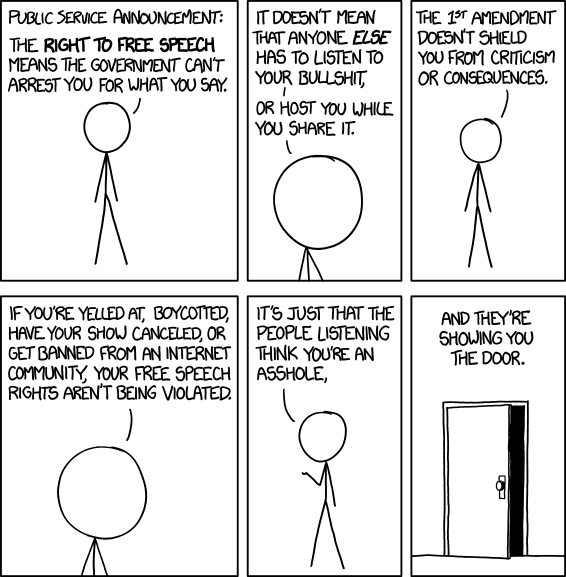
TL;DR: Free speech includes the freedom to not spend money with businesses whose speech you disagree with.
Let's back up. Opposition to free speech looks like using power to shut up ideas. Free speech, in contrast, prefers that ideas are best addressed with better ideas.
So GP criticizing tweets is fine. And I think it's a fair thought to consider whether these boycotts are just a combination of free expression and free association or whether they are more like expressions of social power and therefore bullying.
In defense of the latter view, the rejection of NRA funds has been too immediate to come from economic behavior. So we are left wondering what caused the sudden change of heart. GP might argue that it's fear of blacklisting and punishment at the hands of the relatively socially powerful. Though one could argue that each change of heart was genuine and based on a new appeal to morality and ethics.
No, that's absolutely false. Opposition to free speech looks like using the government to censor people. FULL STOP. Shaming people who say bad things isn't opposition to free speech, it is itself free speech to respond to their free speech. You insistence that we should "be silent" in the face of those who say bad things is an assault on free speech IMO, and your "bullying" line is again an attack on free speech. "Don't respond to my speech, bully! You attack my rights when you use yours!"
Please read the American constitution. In America, Free Speech is a special concept and you have ignored that.
>So GP criticizing tweets is fine. And I think it's a fair thought to consider whether these boycotts are just a combination of free expression and free association or whether they are more like expressions of social power and therefore bullying.
Protip: Bullying bad actors is free speech, too. I have no problem with identifying anti-social speech and using social force to reprimand and demand conformity.
This is how you deal with racism and other anti-social behaviors. Shaming. Or if you prefer, bullying.
But you won't catch us with the Paradox of Tolerance. Intolerance of intolerance is vital the health of tolerance.
> ...your "bullying" line is again an attack on free speech.
I think here you acknowledge that free speech is broader than just the first amendment. If it were only about that, I literally couldn't attack free speech by posting some text in a comment on the internet.
> Bullying bad actors is free speech, too.
So the question is "what speech isn't free?" I'd argue speech that moves beyond advocating a better idea. Examples include fraud and threats of violence. Applying social pressure to corporations that give NRA discounts is clearly neither of these. Arguably, a platform for speech (YouTube, HN) can and should use its freedom of association (removing content) to restrict freedom of speech (maybe to prevent doxxing).
> I have no problem with identifying anti-social speech and using social force to reprimand and demand conformity.
I can tell. There's an argument for that, but it's not free speech. You can argue that it's good nonetheless, I suppose.
[1] See the wiki article about "Freedom of Speech". It's certainly broader than just being about laws and regulations. https://en.wikipedia.org/wiki/Freedom_of_speech
[2] https://www.quora.com/Does-freedom-of-speech-only-apply-to-U...
So, any business which wants to support the NRA, who is anti-intellectually defending the gun violence epidemic through the destruction of research and the hamstringing of tools, in my book, doesn't deserve my dollars.
I want the gun violence epidemic to end, and it's pretty easy to see that the the NRA is the number one lobby and number one reason why common sense gun control that is strongly supported by 70 and 80% of the country cannot become law.
My free speech is that the NRA is a terrorist organization, and that any business who works with them and their members aids and abed's the gun violence epidemic, and absolutely deserves not even a cent of my attention or support.
It's MY LIBERTY to not associate with the NRA or ANY business who supports them, gives them aid, gives them discounts, or treats them in anyway better than anyone else.
You would infringe on my liberty to remove my free association and my free choice?
"I can tell. There's an argument for that, but it's not free speech. You can argue that it's good nonetheless, I suppose."
I apologize but you appear to be playing some "No True Free Speech" game where the only person who "knows" what free speech is you alone. I can never live up to your personal, no true scotsman of Free Speech, but I can speak about the American constitution, the American culture, the American concept of speech, and how we practice it (which I have done quite accurately).
That's the most utterly ridiculous thing I've heard today.
That type of systematic degradation always pushes some people beyond the edge but because internet companies are disconnected from their users/workers they've mostly been able to ignore these side effects. This woman's act is horrific but it's also illustrative of the effects these companies actually have on people's lives.
For whatever reason they started scouring youtube for “controversial” videos checking if they had ads (no matter how little views they had) then they would contact the advertisers for comment.
Advertisers would initiate damage control and pull their ads from youtube.
Youtube would explain that the numbers and views in question are insignificant and that this type of complex system can never be 100% error free but they reluctantly imposed restrictions.
After successfully manufacturing a story and gaining attention and traffic reporters continued scouring and contacting advertisers forcing youtube to enact tougher restrictions.
They then would extended the coverage to the anger in the youtube community and how it’s tough for them out there with all the latest policy changes.
Rinse, repeat; keep reporting on any video you find disagreeable no matter how little views it has.
. . .
Be sure to remind youtube of their power and responsibility after tragedy strikes.