But here’s the thing. Regardless of intent, these Millennials are telling an older generation of elite Americans — the very people whose policies and financial decisions kneecapped the economy — what they want to hear: that everything is more or less okay, and young people just need to be more thoughtful about their money. And that’s a shitty idea to perpetuate. Because whatever happens in the years ahead, penny-pinching will likely remain a lifestyle enhancement for bourgeois Millennials who possess enough money to enjoy the dividends of being thrifty. For most of us, there are no dividends: just thrift.
It's not about the advice itself -- the advice all seems pretty reasonable -- it's about the place that advice has in the story we tell ourselves about young people. I myself practice many of these thrifty tips, but I cringe to think that the blog posts that people write about them will be used to justify continuing to build a world where they are more and more necessary.
My grandmother can still, to this day, recount living in an apartment with no furniture except a mattress, with my grandfather who was employed as an engineer in New York. It took, by her estimate, about two years to have enough furniture before she was willing to invite over any sorts of company.
Today you can furnish an apartment reasonably with about a months worth of wages. I know this because I helped take a friend who makes a bit over minimum wage to IKEA to get all their furniture for an apartment they moved into.
The myth of decline is that - a myth. The economy is better then it has been in decades, violence is at an all time low, and jobs are widely available in many areas of the country.
I have friends who complain about the economy "being destroyed", who max out credit cards to buy brand new cars and buy expensive home theaters. I have one friend who despite making six figures a year, took a predatory payday loan because she had spent her wages on expensive unused tools.
That's not to blame "millennials" anymore than to blame any other generation. Bad financial choices have existed since the dawn of human history, but in many cases today they are choices, not pre-supposed economic outcomes. We can help correct that by teaching good finance skills (budgeting, doing things yourself instead of hiring people, focusing on cheaper hobbies, etc).
You do understand there's a difference between a month of wages and having a month of wages saved to spend, right?
Considering most people live month to month... saving an entire month would take many people more than 2 years.
Maybe you shouldn't start a family when you are making minimum wage, in a city with a high cost of living.
But its a little weird that a Caveman's most basic prerogative (To procreate), is not something many people in modern society can afford to do.
It's also something that is fairly important to the continuation of our species, so hopefully we can figure out a way more people can responsibly afford to have children.
Food went from being very expensive (people actually died of starvation not that long ago!) to being so cheap that obesity is a major epidemic among the poor.
Since 1940, the percent of the US with a high school degree went from < 50% to over 80%. The percent of the US population with a college degree went from < 10% to over 20%.
What is your argument that the economy is in decline? That you don't magically get a two story house with a yard, a new car, and the ability to support a family of four? That has never once been the case in US history. It's a great myth in the past that the 1950s were somehow a magical time when everyone had a house and the income for a family, but it's that - a myth.
I make about 4X what my parents combined made as schoolteachers, yet my housing costs about 10X what theirs cost. In order to get that great price I had to move about 2 hours from work (and pay for the required transportation), compared to their 10 minute commute. I came out of grad school six figures in debt, whereas theirs was cheap enough that they barely had to finance it. They paid for reasonably priced doctor visits out of pocket, compared to my high deductible "healthcare plan" that still has me dropping $hundreds for a single X-ray.
But I have a cellphone so I'm a reckless spender.
Food being cheap is not the reason for the obesity epidemic. It's because food has become of such poor quality. Also, it is engineered to cause you to overeat.
Otherwise, I agree with your overall point.
Further the needs have also grown: without a car it’s impossible for most people to have a job
Yes and no. One thing to keep in mind is inflation, so we always need to compare prices to average incomes. A house is listed as being <10k in 1940, but the average yearly salary was also <2k, and the minimum wage was $0.30 per hour.
However, things have genuinely gotten more expensive in some cases usually due not to the economy, but due to safety. That's a good thing - we no longer have asbestos and lead paint, cars are safer, and working fire alarms are a thing. However, those things do cost money. You can no longer buy an all metal box that goes 80mph without seatbelts or airbags.
I find the car claim to be somewhat of a red herring. Yes, you need a car now whereas before a bicycle might of sufficed. However, a decent car can be had for two thousand dollars - not a pretty one, but a functional one. You might be able to go cheaper if you have any mechanical ability, but we'll assume the average person doesn't have that.
In addition now of course you need drivers insurance, and you probably need to take a drivers ed course before getting your license. Those things do add cost, but they also save lives.
The median home value in 1940, adjusted for inflation to 2000, was $30,600 ($2,938 pre-adjustment).[1] The median income for a man was $9,948, using the same inflation factor of 10.406639 ($956, unadjusted).[2]
The median home sales price in 2015 was about $300,000[3] while median household income was $54,000.[4]
[1] https://www.census.gov/hhes/www/housing/census/historic/valu...
[2] https://www.npr.org/2012/04/02/149575704/the-1940-census-72-...
[3] https://fred.stlouisfed.org/series/MSPUS
[4] https://www.census.gov/library/publications/2016/demo/p60-25...
The size of homes has also gotten much bigger.
So the $30,000 home in 1940 (in today's dollar) wouldn't look anything like a $300,000 home today.
I'd be more interested to learn what a townhouse in Manhattan cost in 1940 and 2010.
Nowadays the cost (for a new house) for "utilities" (water, electricity, heating, A/C, etc.) plants/hardware is a considerable factor, as a rough estimate 20-30% of the construction costs, and a large house in the 40's would probably have had one single bathroom/WC (if any[1]) for a 3 bedrooms home.
jaclaz
[1] In rural parts it was not so unusual to have an external loo
With housing, on the other hand, we are routinely seeing people pay upwards of 500% what people were paying for the exact same property a few decades ago with few or no changes, even with the effect of inflation removed.
In parts of the US. For most parts of the Europe, and indeed many cities in the US, a car is not a requirement.
My grandfather's college fund (to be a dentist) was wiped out, the bank closed. He worked at a GE factory his whole life, work that I will say was far beneath his potential. He never complained. He once traded his easy job on the line for a much harder one, where he had to lift each engine block twice to inspect some fiddly bit on it. He traded to get a 5-cent raise. If you offered my grandfather a government subsidy, he might not have been able to conceal his contempt.
I don't think the decisions of any of the individuals we've mentioned are great indicators of what's correct or incorrect, but the depression didn't influence everyone the same way.
A five cent raise in today's currency or back then? Per hour or week?
Assuming it's hourly, if it's from "then" could you convert it to modern currency, or present it as an percentage increase so we can understand what kind of relative increase that was?
Five cents sounds like nothing today, but 70 years ago it would have been significant.
Figuring out a percentage increase is a bit complicated without knowing how much mod's grandfather earned. According to https://www.archives.gov/publications/prologue/2012/spring/1... in the 1940 census average (yes, not median) annual income was $1368, which works out to $24,505 in 2018 dollars, or $12.25/hour assuming 40 hour weeks and 2 weeks of vacation.
So at a guess, $0.05/hour was less than a 10% raise, but more than 1%. I expect it was /hour, not /week, because weekly wages would have been in the ballpark of tens of dollars.
Disclaimer: I am not mod, and this is not my grandfather we're talking about.
For comparison, when do you plan to retire?
Now do the same run down for your entire cohort.
I'm a distinctly unfair comparison, since I could retire as early as 55 to 60 (I doubt I will, I do terribly when left without something to do, but who knows.) That being said, I recognize my situation is very unlike most of my peers.
My cohort falls into three categories:
+ Those with high income and good financial management. Like me they are capable of retiring without any government assistance at 60ish in most situations.
+ Those with high income, but no financial management skills. Even now with no family to support and no "required" debts, they struggle to remain afloat. Simply throwing more money into the fire doesn't help it turns out.
+ Those with low income. Universally, and not for lack of intelligence, they have no 401k, no major longterm savings. If they retire it will be through programs such as Social Security (assuming it still exists). This is the group that worries me the most, because I don't have any answer for how to improve their situation. They're simply caught in the spiral of not having enough money to make progress on saving.
Please don't take my argument as "Everything is perfect now!". Mostly my argument is, "Things aren't majorly worse and are generally better." Nor am I making the claim that the future will forever be better - Social Security might collapse, pension programs dry up, etc. We shouldn't stop assisting the poor, teaching financial literacy, or behaving intelligently. Simply that the average condition of people is better than it was.
Ok. Peace.
"...average condition of people is better than it was."
My generation (X) griped about student load debt, which seemed crippling at the time.
No comparison with today's kids. Then pile on housing costs, rising insurance premiums, day care & pre school (for anyone choosing to have kids), ...
I despair for the millennials.
Inflation has been 3% a year for decades and wages have stayed flat.
Your example of home furnishings has been improved by industrialization.
Property value have skyrocketed, vehicle prices have skyrocketed, college, healthcare...
Things you NEED have become way more expensive. Luxury goods have gotten cheaper.
Every time I read this claim and go looking for data, I find data that says that real wages are roughly flat, which means that they have kept pace with inflation. (That's the definition of real wages: that they are in inflation-adjusted terms.) It seems a common journalistic (and often political) talking point to say exactly what you said, which makes the math or reading comprehension challenged assume something quite different. While the author or speaker is not technically lying, they are merely misleading the reader/listener with a confusing (and sometimes confused) combination of nominal inflation and real wages.
See figures 3 and 4 here: https://www.epi.org/publication/charting-wage-stagnation/
> Property value have skyrocketed, vehicle prices have skyrocketed
This next chart is in nominal dollars (meaning, not inflation adjusted): http://ritholtz.com/wp-content/uploads/2018/02/pricechanges....
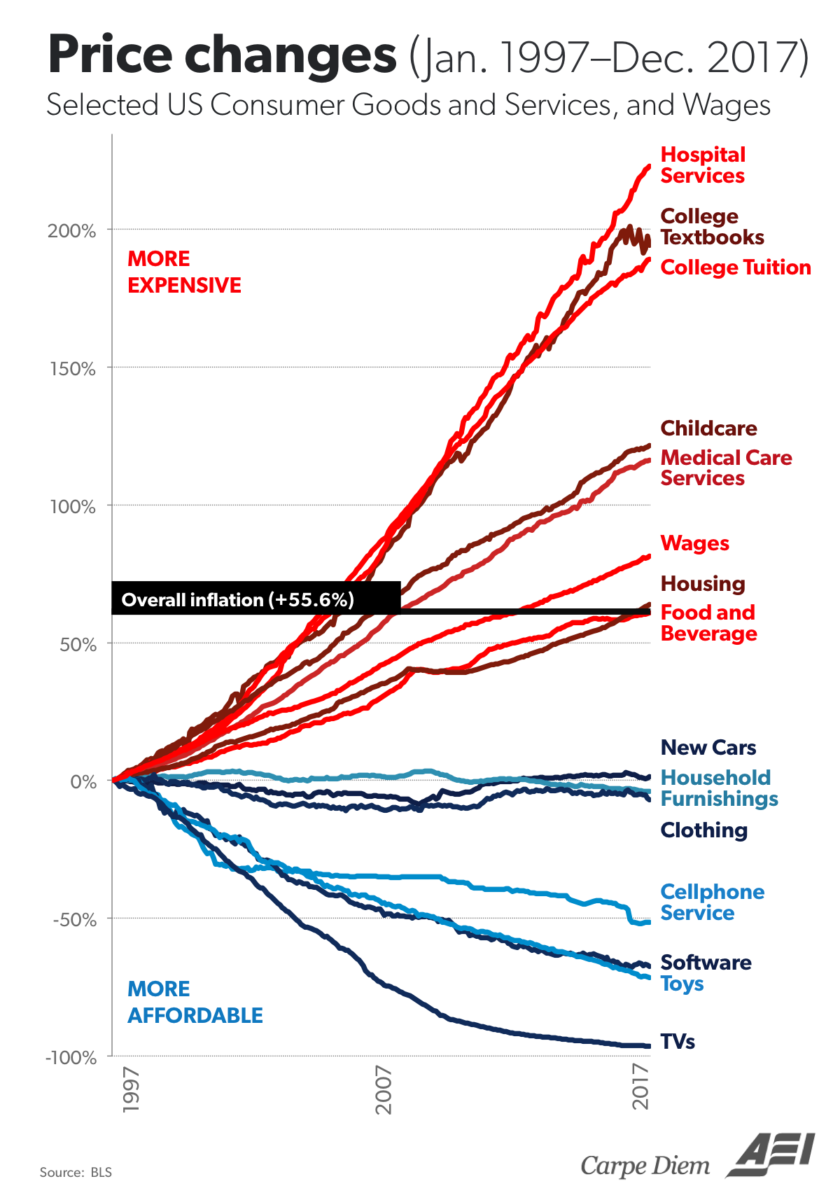
It shows that vehicles have not gotten more expensive (even as they've gotten much, much better, safer, more reliable, etc) and that housing and food/beverages have inflated by less than wages and by roughly the same amount as general inflation (which is no great surprise, given that they are a substantial component of the inflation calculation and that it would be difficult to sustain inflation over a long period of time in a consumer-driven economy in the absence of [nominal] wage growth for consumers).
College and healthcare have indeed risen much more quickly than wages or general inflation.
Do you have contrary sources?
Figure 4: "Middle-class wages are stagnant—Middle-wage workers’ hourly [real] wage is up 6% since 1979, low-wage workers’ [real] wages are down 5%, while those with very high wages saw a 41% increase"
I wouldn't exactly describe those figures as "misleading". In fact, they're pretty clear: one group is benefiting much more than the others.
As for the second one, is it really saying that real new-car prices have declined by ~50%?
I agree that they would likely not refute a different, unmade, point about income inequality.
The second reference is saying that real new-car prices have declined by about 36%. ==> 1-(100/155.6)
Median wealth has fallen by 28% in a decade.
The middle class has been reduced by 11% since 1971.
Even in the chart you posted, things people NEED have become steadily more expensive while wages have remained flat.
Student loan debt has skyrocketed over 200% since 1990 which is needed in most cases for a good job.
How is this not decline?
* http://www.pewsocialtrends.org/2015/12/09/the-american-middl...
What hasn't remained flat is the wages paid to the top N% which has greatly increased and accelerated the wealth gap. It is this gap that leaves people less satisfied despite being generally better off.
Things like the extraordinary rise in the cost of higher education -- which has become a near defacto requirement to obtain a livable wage -- should not be discounted. The example of student debt is particularly salient because it appears to materially impact the vast majority of millennials. Even those of us fortunate enough to be making six-figure incomes spend many years pouring money into debt instead of retirement or brokerage accounts. In most cases this setback leads delays in home ownership, starting a family, and retirement. This is a problem that cannot be remedied by teaching good financial skills.
People who knew me early on in certain contexts thought that I was "rich" comparatively speaking.
They didn't see the 10 year old car, 4 roommates (in a cheap city), camping vacations, sale clothes, etc. I was debt free quickly. I'm in a fairly well compensated gig now but kept the habits. The car is a 2003, my house is older, vacations are in nicer hotels but we drive, etc.
That's not to say that people have challenges that are tough... but so did I!
Discussions here are supposed to be conversations. Imagine someone insisting on reading the complete lyrics to Common People out loud in a real conversation. That would be awfully tedious, unless you're an Andy Kaufman and can get away with it.
https://dangerousminds.net/comments/andy_kaufmans_sublimely_...
I’ve personally seen people with high five figure student debt go on regular international trips. These people more or less live paycheck to paycheck and save specifically for travel (or use credit cards — if they can get them).
Educating people as to why that might be a bad idea and creating a supportive culture of anti-consumerism seems like a good idea. Sure there are policy decisions at play too, but being “frugal” can hardly hurt.
The “American dream” of the 20th century was never sustainable. We’re just now realizing that en masse. Being frugal is just a natural realignment of culture and reality.
Regarding the American dream, maybe it's sustainable or maybe it's not, but it's clear that it would be a lot more sustainable if people where willing to create a world with fewer obstacles to attaining it e.g. by implementing universal health care. If we tell ourselves that people who can't afford health care probably deserve to struggle with money because they're not being frugal, then that's a problem.
As for universal healthcare, good luck getting everyone to agree on that...
I disagree that every word spoken in public is political. “Don’t touch the hot stove” is great advice. Let’s be free to have those kinds of conversations without dragging them into the political mud.
We need to get to the idea that there are not enough good jobs for everybody. Once we get to that point, we can start to figure out what to do about it.
Perhaps the article got that wrong though.
It could be just as likely that the Millennials are saying that they are shunning the crass consumerism that the 'older generation of elite Americans' are steeped* in.
* Boomers, "You're soaking in it." ;)
To hear someone who was making $10/hour out of college and bought a home for $40,000 say that the reason millennials can't buy a home today is because they're buying avocado toast and not because equivalent homes cost $1.6 million today is infuriating. Relatively speaking, millennials are doing better, frugally, than baby boomers were (saving more, spending less, etc), but the cost of the things that people are complaining about has grown exponentially.
Meanwhile, almost all of the growth of the economy has gone towards the top 1% of people. If you look at, for example, Canada, the average CEO makes as much by January 2nd as the average worker does by December 31st.
CEO pay growth over the last few decades has skyrocketed (compared to inflation, worker wages, or even corporate profits), while worker wages basically track inflation. In other words, people are making the same amount of money as people 50 years ago, even though a lot of things cost more (e.g. housing).
Blaming the economy inequality on the fact that people aren't willing to take on second jobs ignores the fact that wealth and power is all being concentrated in a small number of people and the rest of us are forced to fight over what they're willing to leave behind for everyone else.
Your essential argument is that from a relative perspective the American middle class is not as well off as it was during a unique time following WWII during which the American middle class reached the highest levels of relative wealth in the history of the planet. Okay, but they're still nominally better off than they were back then and an almost unimaginable number of people have had their lives dramatically improved across the globe in the process.
We can all care about societal inequality, and how it probably suggests that the levers of civilization need to be jiggered a bit, without hating anyone.
I think housing in the PNW is way unaffordable but that doesn't mean I hate either the developers, the planners, or the numerous other social and geographical factors that have led to this situation.
In short, please don't bring up things like "hate the rich" when no one else is.
Affordable housing is a problem best addressed by the people who live in the areas that have a lack of affordable housing. It's not something that needs addressing on the national scale.
If you think the poor need something, like say more funding for inner city schools, then say that and suggest a reasonable tax, perhaps a tax on luxury goods that would disproportionately affect the wealthy. Or if there's a specific bad behavior, such as pharmaceutical advertising, talk about that. But just complaining about wealth inequality sounds more like hating the rich than caring about the poor.
I haven't seen any convincing evidence-based argument that a high degree of inequality is either neutral or good for society as a whole, nor do I have any philosophical leanings that suggest that it is an acceptable byproduct of an otherwise fair and just society.
Going by both evidence (health outcomes, class mobility, etc) and by my philosophical leanings that it don't seem right for so few people to own so much (when ownership itself is a purely fictional thing), I'm going to keep talking about inequality as a Bad Thing to be addressed.
Don't like it? You do you, but telling me I'm focusing my behavior on one thing or another is about the least compelling thing to say.
Do you suppose it's possible for you to advocate for a specific amount of welfare that you feel is "generous" without attempting to villainize the very people you hope to pay for it?
>They advocate against redistributive inheritance taxes, so that their own children continue to have enormous advantages over anyone else.
First, one of the major motivations of achieving success in life is so that your children will be better off. So all you've established is that rich people are good parents. Secondly, you're still just upset that someone has a lot, rather than focusing on a specific problem that some group of poor people has. You're just hating the rich rather than showing an interest in helping the poor. Third, fortunes generally disappear after 3 generations, so it's not as if huge dynasties are being created that last forever. If you're rich, your grandkids get to go to a nice private school. That's pretty much it.
>They advocate policies that guarantee they can continue to extract wealth from rents rather than productive avtivities, dragging down the economic well being of all.
Yes, things like regulatory capture are a problem. I will hold up a sign and protest it alongside you. But do you see you you're STILL pointing to the "rich" rather than "bad policy?"
>And the rich are more likely to cheat on their taxes, try to bribe officials, or flat out disregard the law.
I've never met a person who worked for tips that didn't cheat on their taxes, have you? But more importantly, we're back at the same place. Rather than advocating for or against a specific policy, you're just slinging mud. You care more about saying mean things about rich people than you do about issues the poor might be facing.
This is not universally true. It is not true across individuals among the rich/nonrich nor is it true across specific agenda items. This caricature you've created for these two groups is called classism. You are no better than the people who think all poor people are stupid or lazy.
>yet only one of these groups have any great power to see to it that their interests are served.
Okay, let's talk about campaign finance reform. Or is making sure there's no rich people more important to you than making sure everyone has equal political power?
Saying that rich and nonrich have different interests is not controversial, except to those intent on denying what is obviously true.
Either you are ill equipped to engage in a discussion on this topic or you are being utterly disingenuous; certainly you have misrepresented what I have said in ways that push a rather tired narrative, one trotted out every time someone pushes back on the status quo of enormous wealth disparity by noting that it has serious negative consequences.
You just can't help yourself. Once again you express more hatred for the rich than you do concern for the wellbeing of the poor.
I'm not denying that there are consequences to wealth or income disparity. I just think you don't appear to care about the wellbeing of the poor beyond the minimal lip-service you have to pay it to justify voicing your hatred for the rich.
Common talking point, not borne out by data.
See https://news.ycombinator.com/item?id=16682711 for references.
Is it tight?
I see very few occupations with rising wages. That's the REAL test for a tight labor market.
Let me be anecdotal for a moment ...
I was at a conference recently where the companies had a panel session complaining about getting more people into the business. Unlike most software disciplines, they really do have an infeed problem. In addition, they are also getting poached and losing their junior guys from the shop floor.
Okay, think I, I was a hiring manager in the DotCom Boom(tm), I understand getting poached in a narrow field.
So, do you know who their primary opponents are?
Amazon and Foxconn.
Two of the worst employers on the planet. You are losing employees from your manufacturing line to Amazon warehousing and Foxconn manufacturing.
Um, please go bankrupt and may your industry die in a fire if you treat people so badly as to lose them to Amazon and Foxconn.
And black unemployment is at historic lows a well.
Does the absolute inflation and purchasing power adjusted value even match 90s?
Yes: https://news.ycombinator.com/item?id=16682711 for references. (Wages rising slightly faster than inflation over decades long period.)
That said, the original discussion was about the rate of wage growth as a measure of how tight the labor market is. In that sense, the instantaneous rate is fine.
So why am I harassing you about your answer to AstralStorm, when AstralStorm was disagreeing based on something that was outside the scope of the discussion at hand? Because of the way you answered, with dismissiveness rather than actually thinking about the point raised. That's not cool.
If you're poor, being frugal is very unlikely to lift you out of poverty. That doesn't mean frugality is bad, but that marketing is as the key to financial stability is deceptive.
It resonated me with a lot.
They claim they could've paid cash for it but chose to get a mortgage - so they don't own it "free and clear". Unless they've ended up paying off the mortgage early. Assuming a 25% down payment that's a $310k mortgage. You'd need annual household income of around $80k to qualify for a mortgage that size, which also seems within the reach of a dual-earning household of white-collar/skilled trades professionals.
A household earning $80k annually could save up the $90k down payment for that property in about 3-4 years, assuming a 40% savings rate. I'll admit it's aggressive and ambitious by most people's standards, but not actually impossible.
Now I don't think it's actually a good idea to buy property worth nearly $400k if your annual household income is $80k but it's not an entirely outlandish idea.
I assume the Frugalwoods had annual income well in excess of $80k before they "retired". Their savings rate is also correspondingly huge - 71% according to the article. A brief skim of some other posts suggests they're going to be renting out their current house + putting the new property to revenue-generating uses. They clearly know how balance sheets work and the numbers make sense for their situation.
Pulling back a bit I think we should acknowledge that the Frugalwoods are people who have optimized the heck out of the very good hand that they were dealt. We should be applauding that rather than trying to pick at their story and point out why it doesn't work for everyone. I might not have Michael Phelps' swimming genes but following his workout routine would probably improve my health, even if I never become an Olympian.
It's obvious that having a higher income makes it easier to frugal your way into early financial independence. The vast majority of high-income households don't take that path even though there's not much stopping them.
1. https://www.frugalwoods.com/2016/04/22/the-finances-of-our-c...
Being frugal is incredibly helpful for all but the richest among us, and I'm amazed that people are so critical of it. I see so many people who would be so much better off than they are if they just didn't buy so much unnecessary shit.
I actually think the higher-income you are the more frugal (in terms of savings rate) you should be.
It sure looks like that to me:
"My Courses to Help You Make More Money" - https://millennialmoneyman.com
It's infinitely more likely to do so than being financially irresponsible.
Can't we focus on the message instead of the messenger? Or stop assuming that the message is for Millennials alone?
Each of them typically does three things: They keep their household yearly spending under $35,000 (some even less than this), increase income as much as possible, and invest the savings, taking advantage of tax-deferred accounts whenever possible. Though, the three things are basically common sense when you think about it.
Perhaps pursuing FIRE is something only available to the upper middle class. That's an interesting argument, but not one put forward in the article. Furthermore, I think it's bordering on class warfare to set the upper and lower middle classes against each other. It reeks of divide and conquer, and who benefits? The people pushing over expensive lifestyles funded with debt.
I don't really like doing plumbing, but I've replaced quite a few faucets and toilets. Not because I wanted to be "frugal", but because I could not afford to pay someone to do it; if I didn't, it wasn't getting done. I didn't blog about it; I didn't tell everyone, "Hey, lookit me! I'm saving money!" because everyone else I knew was also doing their own plumbing because they were also broke.
(Now, of course, I could pay someone. But that ship's sailed. Besides, it's really hard to find good contractors.)
The McFrugals, according to the article, aren't talking to millenials or anyone else who needs to be frugal; they're talking to the wealthy, saying "all those people you think are whiney, spoiled kids, really are spoiled, whiney kids."
No, because my taxation burden alone is well above 29%.
I'm pretty sure they're calculating that they're saving 71% of their earned income, but they're almost surely not saving 71% of their earned income plus gross rent receipts.
Edit: Here's how they do it: https://www.frugalwoods.com/2014/04/10/how-we-save-65-annual...
Keeping up with the joneses is less about having the same thing and more about having the joneses quality of life. They aren't the same if you look at them.
Having a fancy car for example is a status symbol, what is the status? The status is that this car has nicer features, butt warmers, more comfortable seating, better safety. Taking that status symbol a step further, I can deduce that if the joneses can afford that fancy car they also have other fancy things.
Most reduce this logic down to the following: The more individual items I have that the joneses have the closer I'll be to their quality of life.
I think this is a really interesting dynamic though because the more money I make I am not proportionally happier. In fact, my happiness stopped increasing with salary increases the moment I was able to afford bills and have leftover for savings. Since than my salary has grown many times over and I am still the same person I was fresh out of college getting by. My wife and I are still the same couple, we are no happier with the weather we have achieved over the years.
First, you can't tell from looking at their car how well-suited their finances are to paying for it. They could have a 12.99% 72-month loan that doubles the actual cost (plus higher insurance premiums, premium fuel, etc). Or they bought it cash, self-insure, and have money invested that compounds over time and pays their insurance and gas bill for them.
Second, you probably don't know how they are using it. If you're a master salesman with an excellent income, selling 7-figure deals to executives, you might actually get utility out of perceived status! But if you're a coder who walks a quarter mile from parking and works in the basement of the building, the brand name on that car is worth nothing. And most of those comfort features can probably be found in a Mazda for $20K less. Or a ten-year old luxury car. (Personally I love the hatchback which combines all those features with utility and fuel economy! No need to buy the luxury sport sedan.)
Finally, wait, why do you think advertising isn't doing its job? People know what they can't have because of advertising. Then they want it.
This is the perspective people need to have to stop comparing themselves against others. When I learned this I stopped comparing myself and try to buy based on the value add a product gives to me in my use case.
Maybe so, but why would we discourage good spending habits? For example, choosing to eat one or more meals out each day versus bulk cooking is an option available to most people. Likewise, choosing to spend $800 on rent with roommates versus $1,600 for a studio or one bedroom apartment.
I'm not seeing how millenials or members of the middle class benefit by uncritically opting for more expensive options. My read on frugal culture is spend however much money you want on whatever you want, but do so eyes-wide-open. Break free from all the advertising, inertia, and "keeping up with the joneses".
Frankly I think if more people adopted this style of thinking it would have serious ramifications for the rich and their businesses built on over consumption and debt.