Every time I read this claim and go looking for data, I find data that says that real wages are roughly flat, which means that they have kept pace with inflation. (That's the definition of real wages: that they are in inflation-adjusted terms.) It seems a common journalistic (and often political) talking point to say exactly what you said, which makes the math or reading comprehension challenged assume something quite different. While the author or speaker is not technically lying, they are merely misleading the reader/listener with a confusing (and sometimes confused) combination of nominal inflation and real wages.
See figures 3 and 4 here: https://www.epi.org/publication/charting-wage-stagnation/
> Property value have skyrocketed, vehicle prices have skyrocketed
This next chart is in nominal dollars (meaning, not inflation adjusted): http://ritholtz.com/wp-content/uploads/2018/02/pricechanges....
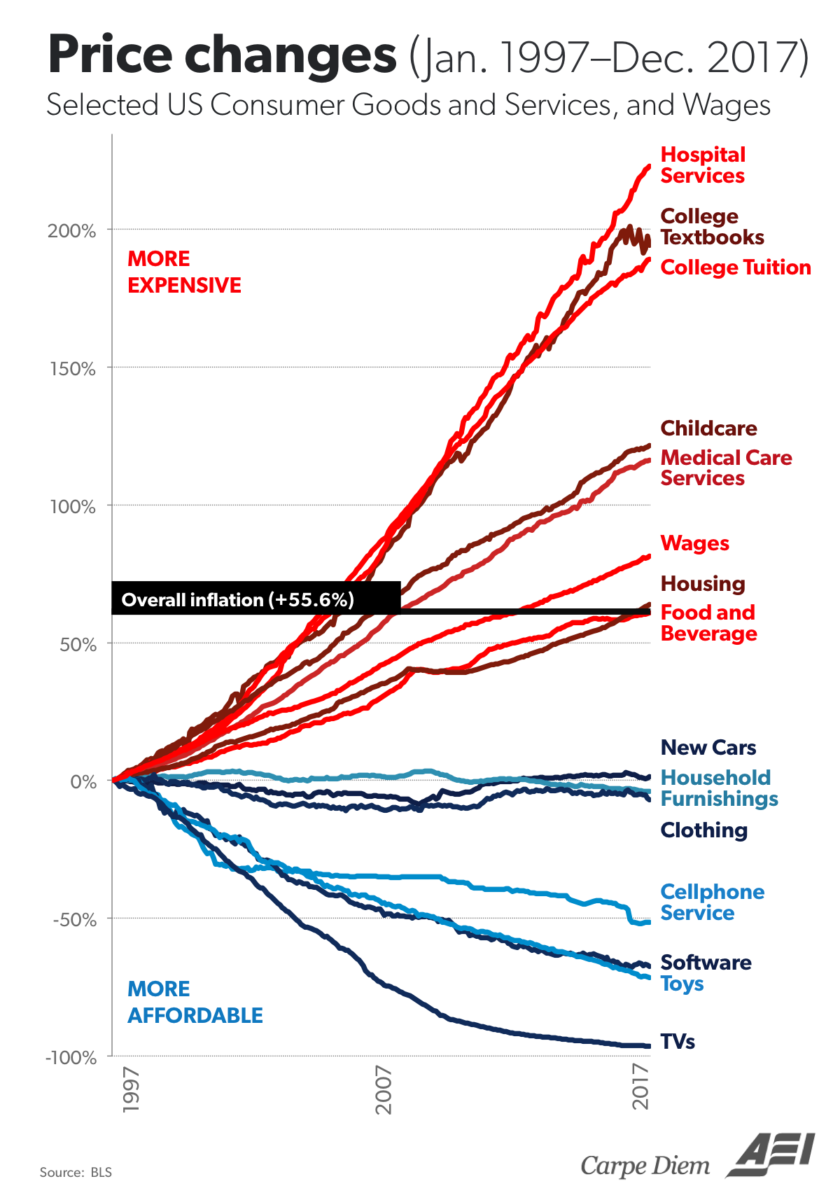
It shows that vehicles have not gotten more expensive (even as they've gotten much, much better, safer, more reliable, etc) and that housing and food/beverages have inflated by less than wages and by roughly the same amount as general inflation (which is no great surprise, given that they are a substantial component of the inflation calculation and that it would be difficult to sustain inflation over a long period of time in a consumer-driven economy in the absence of [nominal] wage growth for consumers).
College and healthcare have indeed risen much more quickly than wages or general inflation.
Do you have contrary sources?
Figure 4: "Middle-class wages are stagnant—Middle-wage workers’ hourly [real] wage is up 6% since 1979, low-wage workers’ [real] wages are down 5%, while those with very high wages saw a 41% increase"
I wouldn't exactly describe those figures as "misleading". In fact, they're pretty clear: one group is benefiting much more than the others.
As for the second one, is it really saying that real new-car prices have declined by ~50%?
I agree that they would likely not refute a different, unmade, point about income inequality.
The second reference is saying that real new-car prices have declined by about 36%. ==> 1-(100/155.6)
Median wealth has fallen by 28% in a decade.
The middle class has been reduced by 11% since 1971.
Even in the chart you posted, things people NEED have become steadily more expensive while wages have remained flat.
Student loan debt has skyrocketed over 200% since 1990 which is needed in most cases for a good job.
How is this not decline?
* http://www.pewsocialtrends.org/2015/12/09/the-american-middl...
What hasn't remained flat is the wages paid to the top N% which has greatly increased and accelerated the wealth gap. It is this gap that leaves people less satisfied despite being generally better off.
Inflation has been 3% a year for decades and wages have stayed flat.
Your example of home furnishings has been improved by industrialization.
Property value have skyrocketed, vehicle prices have skyrocketed, college, healthcare...
Things you NEED have become way more expensive. Luxury goods have gotten cheaper.