It takes a level of emotional intelligence to communicate in a way which gets to the core of the issue while not making the other person feel bad about it. It can also be a respect thing (when you think someone is wrong first tell them how they're right). This leads to people feeling included and creates higher bandwidth conversations about whatever the real issue is, it also makes people feel more comfortable in general and happier as a part of the group.
I think when people behave like Linus (or executives/founders sometimes do) it's a tantrum/status play. You can only behave like that if you're in some position of power, otherwise people will just dismiss you. This is too bad since people in those positions have a disproportionate ability to actively choose to act against their status (things like Zuck sitting with everyone or in a glass office everyone can see into) which then flows downstream culturally.
Cultures that act 'unkind' or without empathy are a shame because they drive away people who can't deal with the abrasiveness (which often makes things worse), they make people afraid to ask questions and ultimately hurt the group.
You can be direct and empathetic at the same time. If you're in a position of power you have a responsibility to not behave like an ass (or at least you should).
I don't know. Sometimes the core of an issue is that someone messed up, bullied someone, didn't listen, or something along those lines. In some cases people should feel bad. We don't have to go out of our way to make them feel bad. They did it to themselves. And, to be clear, they shouldn't feel condemned. They should feel like they have a productive path forward. But glossing over important issues to avoid uncomfortable feelings isn't really kind in the long run.
Empathy is admirable and humanizing, and maybe we are short on it, but I'm not sold that it's always kinder.
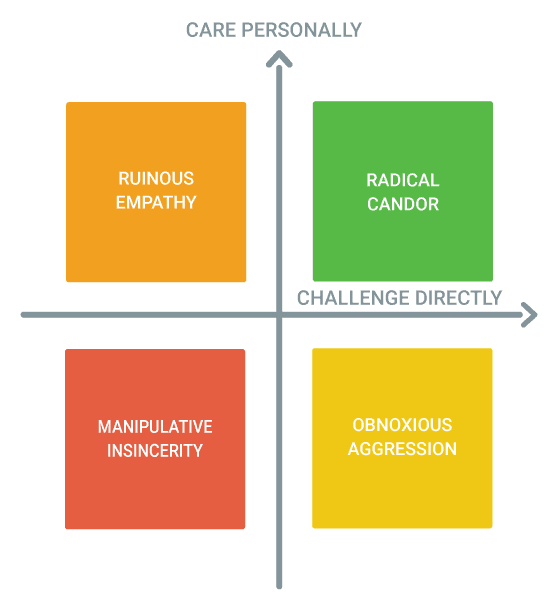
That's basically the idea of 'radical candor' (https://www.radicalcandor.com/wp-content/uploads/2016/03/rad...) and I think the main thing you're getting at.
For example, when a relationship needs to end (a romantic break up, a firing, etc.), there's a limited amount one can do to make someone feel good about themselves. To some degree our challenge in that sort of conversation is to limit our empathy for the purposes of doing the right thing.
In other words, when someone phrases something reasonably kindly and it's not taken well, we can't blame the speaker for the listener's hurt feelings. At some point, even if they're hurt, it's the listener's fault. That judgement can seem cold and maybe counter-intuitive. However, on the contrary, that's just an example of how empathy gets in the way of what is right.
Though I think those cases should be the exception to the norm.
As far as empathy getting in the way - I think in the firing example while managers often feel an urge to be empathetic in a misdirected way (i.e. "this decision is hard for me too") true empathy would be recognizing that if you were the one being fired there is no good way to state it and however difficult it is for you to fire them - it doesn't compare.
I guess to reframe it, it's more about thinking about how the other person will be affected and doing the best you can given the circumstance.
No, the empathetic thing in those situations is to end the relationship quickly precisely because you understand dragging it out will just damage the other party more in the long run.
No - empathy just means feeling the same emotion as people around you, which is not always helpful. What you want is compassion.
I often see "empathy" tossed around as a cure-all for social problem. When someone gets angry at work and it makes you angry - that's empathy. Ever seen footage of a frenzied mob saluting a fascist dictator? That's empathy as well.
That's a particularly narrow definition of empathy, most definitions include something like the following:
"the ability to understand and share the feelings of another." [1]
The capacity for this is what helps - it makes it easier to understand how the other person is feeling.
As opposed to compassion:
"sympathetic pity and concern for the sufferings or misfortunes of others." [2]
Empathy is a more general understanding of emotional state - I don't think it's being incorrectly used.
[1] https://www.google.com/search?q=define+empathy&oq=define+em&...
[2] https://www.google.com/search?q=define+empathy&oq=define+emp...
The OP suggested merely leaving open the possibility that your assumptions are wrong. That's really the opposite of understanding, it's expecting that you're not always going to understand, and making space for the other person to explain themselves and make things right.
Hmm, seems more like you just have to assume that people aren't stupid, and there's a reason they believe the things they do. Until you understand that reason, you just have to keep saying you're confused and ask questions to further clarify.
Once the reason(s) is highlighted, sometimes it's well justified, sometimes it isn't, but at least the core issue can now be addressed.
There are plenty of opportunities to do this when giving criticism/feedback. Not only does it make it easier for the other person to hear, but it also helps you save face if your feedback ends up being wrong.
Rather than "blame", I suppose we're to say Allen accepts responsibility for his confusion and makes an effort to enrol others in his attempts to seek clarity. That way the opportunity arises for any involved to say "ah, I see, thank you".
If we hear what people are saying with a sense of goodwill, and read their words charitably, we give less cause for animosity to arise.
FWIW I don't see this as placing blame on himself, at all: I see it as Allen just stating a fact. Allen is confused and seeking clarification. Confusion can happen for all sorts of reasons with varying parties or circumstances being the cause.
Allen might similarly say "I'm confused" upon reading the time cube website, but Allen's not to blame for that.
I agree with you though that largely politeness comes from being internally focused ("I don't understand, I don't agree, I didn't know") as opposed to externally focused ("You did something confusing, You did something wrong, You didn't tell me"). One instance where it pays to be selfish, I suppose!
It's not about "difficulty" ... as in one takes 5 calories to type out "that's stupid" but the polite sentence takes the same effort or less.
It's about effectiveness and possibly the false cause & effect we attach to one style of communication vs another. E.g. Linux may be successful because Linus is direct and blunt. (It keeps idiots wasting everyone's time away.) Or, Linux is not reaching its full potential because Linus is crude. (It drives talented contributors who are repulsed by crude language away.) We don't know which scenario is superior because we can't replay history in 2 separate universes.
To your particular example, I personally don't like the "I'm confused by this." That is what I call unnecessary "prelude". It's redundant prelude because Allen's next paragraph clearly asks 2 questions so of course he's confused.
Also, Allen writes:
"Can you take a step back and explain your goal here?"
Allen can delete "I'm confused" and "take step back" and get directly to the point:
"Can you explain your goal here?"
That holds especially true when your job is to provide that broader picture for others, and the person you're talking to might not have your perspective.
Having had to give the equivalent of the "No, no, I meant" follow-up response there more than once, I've learned to provide the additional signals to up-level.
Then it depends on how we perceive word choices. To me, "take a step back" has become so overused that it's a "dead metaphor".[1] It has become the opposite of "intentional phrasing" and its most common use is prelude and lubrication.
I'm not saying you're wrong in interpreting "take a step back" more literally. (Literal interpretation is the premise of what your comment dissecting it is based on). Most of the time, you can ignore it based on the way most people insert "take a step back" into their business-speak.
Also, I doubt that surveying 10 random business people what "take a step back" means would result in 6+ out of 10 defining it as "higher-level concerns". It seems like "take a step back" acts more like a discourse marker.[2]
The higher-level point: you're trying to produce a certain reaction in the reader/listener, and every word and phrase you use will contribute to that reaction. Even if you don't care about how they feel for its own sake, there's value in producing the reaction you want and avoiding the reaction you don't.
So, in my case, I've had direct experience with specific choices of phrasing producing undesirable results (and in a way being insufficiently direct), so I've adopted other phrasings that produce the results I do want. The specific things that work for you may vary.
> Also, I doubt that surveying 10 random business people what "take a step back" means would result in 6+ out of 10 defining it as "higher-level concerns". It seems like "take a step back" acts more like a discourse marker.[2]
In the specific context of the whole phrase ("Can you take a step back and explain your goal here?"), I'd consider it semantically meaningful. I wouldn't be surprised if it gets used in semantically null ways, as well.
But even if it were simply a "discourse marker", that shouldn't be automatically discounted and deleted either. To make an analogy to another form of behavior: I've seen a lot of hackers follow a certain counterproductive chain of reasoning regarding fashion. "This makes no sense and shouldn't be a thing that matters. I'm going to treat it as a thing that doesn't matter." (It's a form of the is-ought fallacy.) As opposed to the rather more effective reasoning: "This is a real social signal that turns out to matter, even though I don't think it should. It costs me little to play the game and obtain the results I want."
I'll freely admit to using empathy both because I care about other people and because I've in practice found it incredibly effective.
What is a discourse marker? Not that I have a problem with the phrase "take a step back", I agree it depends on the environment, the context, on the person who is saying it, how they're saying it, and who they're saying it to. But if and when it's just filler, what stops it from turning into "can you go right ahead and take a step back and explain your ultimate goal target here?" If it's a "real social signal" (as opposed to a mere social signal?), what does it signal? Do I want to be signaling that?
There's nothing inherently bad about discourse markers (or dead metaphors) for that matter. They are quite critical to a great deal of communication. I think what the parent was trying to suggest that this meant its use was somehow implicitly deceptive or something, but I don't know why.
Know your audience, and make sure you're sending the signal you think you're sending. If you don't already have all the reputation you need, fashion matters a lot more in establishing a baseline.
So starting off with "Can you explain your goal here?" is concise and isn't horrible. But without any other signal or adornment, it risks being read as the above kind of question. Leading off with "I'm confused" is for indicating that the subsequent questions are the other kind - "please help me with my problem" type deal. It's not strictly necessary to the meaning, but likely has a positive effect in how the questions are interpreted and answered. It's like declaring a variable before you use it. The compiler doesn't need to figure out what type it is (and possibly get it wrong).
"Take a step back" is also used productively here, indicating "whoa whoa there sparky, before we talk about what you're doing, we need to answer why you're even doing it." In other words "I want to talk about something further upstream" or in yet other words, "Let's stop and look at the big picture." Actually it's pretty concise when you consider all the meaning that's crammed into it.
I don't think redundancy or prelude are necessarily the mark of politeness. It's usually just a mark of writing style. For example, you said:
> To your particular example, I personally don't like the
But "personally" is redundant - of course it's your personal opinion. You just used it to emphasize that you don't like Allen's writing style, correct?
But to _your perception_, it's politeness. (You previously wrote: "It's direct ("I'm confused"), but polite.")
On the other hand, I categorized it as prelude.
To attempt a meta observation, it seems people require "social lubrication" in the communication. Otherwise, it sounds harsh. The lubrication is a mark of kindness.
I don't require lubrication and harsh language like Linus' writing style doesn't bother me. The difference is that I would probably use "kinder" language in more situations than he would depending on the recipient.
>But "personally" is redundant - of course it's your personal opinion.
Right... to be meta, it's a restatement of my last sentence. "I personally don't like" is _softer_ than "I don't like" which sounds more like I'm a dictator. If you and I were founder & cofounder where we have "spirited" debate, I'd leave out the redundant "personally". If you were my employee that needs softer language, I put in the redundancies.
Yes, it is to some degree a "social lubricant". We're running a massive intricate machine at full-tilt with a million moving parts that sometimes just barely mesh. And while some parts of it are capable of continuing to work without that social lubricant, it certainly makes things run hotter, and decreases the MTBF. All the more reason to leave some safety margin, and help everything run more smoothly.
I disagree with the view that "softer language" is something you use with weaker people or people who you see as "below" you. I'd also disagree with the characterization as "softer". Empathy isn't "soft", it's incredibly powerful.
That's not at all why Allen's comment is polite, and this is very much what I mean by "kindness requires no effort."
It's polite because it isn't actively negative towards the other person. That's all it takes. Redundancy is irrelevant.
Allen could've easily written:
> What you wrote makes no fucking sense and it's dumb as hell.
Which is both redundant and impolite.
> If you were my employee that needs softer language, I put in the redundancies.
Just to be redundant myself, redundancy is only loosely correlated with politeness. There are plenty of examples of terse, polite speech (and the inverse as well). You don't need to do this, and I would argue it's a hallmark of your particular writing style more than anything else.
If you believe redundancy is irrelevant, we have different opinions on how people perceive communication.
You: not writing an insult is all it takes to be "polite".
Me: People will perceive the omission of prelude and mea culpa "I'm confused" as "active negativity towards the other person". It doesn't require the literal words "you're an idiot".
So I disagree that simply not insulting is "all it takes". It often takes more than that to not make people act defensive. Lubrication, social grooming, etc.
I'm starting to gather as such, and so continuing down this road is probably unproductive.
I suppose we'll have to agree to disagree.
The difficulty is in suppressing knee-jerk reactions and hardwired negative emotions, not on the energy level required.
It was about energy in this case because I was responding to BenchRouter's specific context for "difficulty" when he wrote: "expend the extra effort to type out "this is stupid"". (https://news.ycombinator.com/item?id=14782723)
The kindness and softer approaches are forgotten; all of those times when things aren't in need of a strong shove back to positive territory.
HOWEVER, that preface "I'm confused...[followed by pointed criticism disguised as a question]" often comes off as condescending, rude, and disingenuous. It is often infuriating to the target and those who are witnessing it.
There's always a polite way to say things without masking what you really mean. It may be difficult to come up with the words and sometimes it just isn't feasible, but that's OK, if folks are willing to give each other "a pass" every once in a while and tolerate an occasional outburst.
The secret, I've found, is to assume that everyone is doing their best with what they've got. Everyone has a different set of information, background, experience, etc. Maybe you'll have an opportunity to teach them something; maybe they'll have an opportunity to teach you something.
You should only say you're confused if you are legitimately puzzling over what seems to be a contradiction.
On the other hand, if the other party sees a request for clarification and interpretation it as a passive aggressive criticism, then that's pathological on their end.
Which, taken to its logical conclusion, means that some important figures in our industry (e.g. Linus Torvalds) act quite unprofessionally. Sadly, this seems to be true.
No, it doesn't. It means that the people Linus has to say harsh things do are being unprofessional--because, as Linus himself said in the quote given in the article, when he tries to say things kindly--"Please don't do that"--people don't listen. If those people were being professional, they would realize that when Linus says "Please don't do that", they need to listen.
The article even acknowledges this:
"If you really have trust and conviction that your peers are not wasting your time, you pay attention when they say something - a “please don’t do that”, to quote Linus’ example, ends up being one of the more strongly worded pieces of guidance you can get."
So the problem isn't Linus, it's all the people who don't take the time to realize that it's not a waste of time to pay attention to what he says--so he has to shout to make himself heard.
Build a community that doesn't have that problem, and people will respect disagreement and "don't do that" without the accompanying toxicity.
The Linux community is not built around flames and attacks. Linus' flames are what get public attention, but that doesn't mean they are the majority, or even a significant minority, of all his communications. He has explained many times exactly what the conditions are under which he will flame--basically, that a kernel developer does something that he has already explained many, many times should never be done, like breaking userspace. Do something that meets those conditions, you get flamed. Don't do something like that, and you don't.
I'm also aware of projects to do more formal analysis of various FOSS communities, such as FOSS Heartbeat.
But in the meantime, the plural of "anecdote" is absolutely "data" for sufficiently large values of "plural".
I disagree, but I doubt we're going to resolve that here. To me, "the plural of anecdote is data" means "I can't be bothered to figure out whether the information I have is actually representative of the population".
as a (volunteer) coach, one of the things i often have to correct is making lob passes (slow, often misplaced and disrupting of the flow of action). some kids mistakenly believe they are being nice by giving their teammate a soft pass, but i tell them the kind thing to do is making the direct pass. it gets the ball there faster, it's more likely to be in stride, and makes it harder for the defense to recover or steal. that means it's more likely to lead to a basket and less likely to lead to a turnover for the receiving teammate.
(tl;dr: direct is better and more appreciated than roundabout)
It's like asking everybody to not smell or to not look ugly.
Some people are considered rude for a lot of reasons, mainly cultural, but what they have to say has value regardless
Instead of asking people to be kind (which often means comply to my system of values) we should ask people not to be judgemental and be open minded, which is something that can be learned by everybody
You're arguing semantics here; in almost all cases that is what kindness means in these contexts.
I appreciate the fact that in English I can be more direct without being told that I'm rude though; it happens a lot more when I'm having a conversation in Italian.
I think language shapes the way people think, Italian has so many different and polite ways to be assholes that kindness to me it's more in the intentions people have than in the way they express them.
Any attempt to understand, evaluate or otherwise politely disagree is met by a mob of twitter accounts ready to call you a critical asshole and troll at every turn. I'm not sure why the industry has shifted this way. My only guess is it's generational.
According to who? Certainly not the article: It puts forward Allen's comment as an example of being kind.
> Any attempt to understand, evaluate or otherwise politely disagree is met by a mob of twitter accounts ready to call you a critical asshole and troll at every turn
You could easily change your statement to "any attempt to do anything is met by a mob of twitter accounts ready to call you an asshole" and it would be just as true.
I don't think twitter outrage is a good metric for anything, because it's extremely contradictory, arbitrary, and capricious.
See Allen's comment in the linked post, for example. It's direct ("I'm confused"), but polite. It's asking a question of the submitter in a respectful way that's likely to engender a productive conversation as opposed to putting people on the defensive. Allen's leaving the possibility open that his assumptions are wrong (and often our assumptions are).
It quite literally requires less effort - Allen didn't have to expend the extra effort to type out "this is stupid".
I guess I don't see what's so difficult about that particular type of kindness.