Just because they're very good at supplying an unlicensed minicab service (apparently subsidised by VC money in many areas) doesn't mean they can (i) run a minicab business at a profit so much more efficiently than every other minicab business in history that the average American decides they can sell off their four-wheeled status symbol and commute in a surge-priced Uber or (ii) compete with the manufacturers in supplying self driving cars on demand, whilst likely operating at a huge disadvantage in vehicle acquisition and maintenance costs
Previously I would spend $117 in a monthly metrocard.
Owning a car means always needing a parking space, going out to get gas, paying for insurance, inspections, etc, having to be capable of driving (because when I'm sauced on a Saturday night I really want to get greasy food, but I can't drive soooo...).
If an autonomous car-share program cost about as much as the car payments and gas alone for the the amount we would use it, we would sell our car in a heartbeat. A car isn't much of a status symbol when most of your friends can't afford a nice one either. Kinda makes you look like a dick, in comparison.
- Moving big things - Shopping for big things - Camping - Driving out for the weekend to visit family 1.5 hours out of town - Baby in baby seat
None of these things can easily be targeted by Uber. I rarely use taxis and uber, and my friend's that do, use it as replacement for public transport and not their car.
Van rental (with driver) are a thing, at least where I live, where personal car ownership isn't really a thing.
See for example: https://www.gogovan.com.hk/en/
Big place to shop (e.g.: IKEA) offer delivery.
Isn't that exactly what makes it a status symbol? Keeping up with the Joneses, and all -- it's one thing to not play the game, but that doesn't mean a lot of people don't, and this seems to just be agreeing with what makes it a status symbol.
Most American cities are sufficiently un-dense that things like "always having to look for parking" aren't big deals. Laws ensure places have enough spaces (these policies are very pedestrian-unfriendly, but such places are more car-friendly than the dense coastal cities). Traffic is slower at rush hour but a non-issue any other time in these places.
The average car these days lasts 10+ years. Perpetually renting cars is going to be seen as disadvantage for a lot of people who take out ~5 year loans and then can keep the cars for quite a while after finishing off their payments. Anecdotally I'd wager that people buy new cars more for the status, or for the change of having something new, than to replace something that just doesn't work anymore, nowdays.
> Isn't that exactly what makes it a status symbol?
To be an effective status symbol, something has to be of higher status, but not too high a status. Gold chains are just gauche, despite how valuable they are. So too, once upon a time, having a cell phone.
Conversely, there are groups where being able to afford _not_ to own a car is a status symbol. Think "I live in a neighborhood where everything is walkable", or "I just throw money at Uber because it's easier and I can afford it".
Anything is a potential status symbol, if a group subconsciously agrees that it is. If your group doesn't value humility then too-high-status isn't really a thing.
And for commuters that need a car to get them to work at 8-9am and home around 5-6pm, the chance of a car sharing scheme working out cheaper than ownership is minimal, whether the cars drive themselves or not.
If you want a car at the precise time everybody else happens to be commuting and commuters are the principal users of on-demand car services, it doesn't really matter whether your commute is shorter than some of the others. It's one extra car needed to be available every day at the time when all the other cars happen to be in use and (like most of the rest of the cars in the commuter pool) it'll spend the rest of the day sat in a parking spot, costing little in mileage but plenty in depreciation.
Of course if commuters needing to be around for the start of a normal work day aren't the principal user of the service, then cars can be used more efficiently throughout the day, but then they're not "competing with private car ownership" to any significant degree.
For edge cases like you whose car use consists of occasional ten minute drives, it might already be cheaper to just take taxis/Ubers
Like everything - high bandwidth vehicles will do the bulk of the work, and seamlessly trade off to "last mile" self driving small vehicles.
If the car is electric, it isn't so bad on the environment, and it can park itself in a no humans allowed garage (so little chance for breakins). As for rush hour, I'd hope swarm scheduling lowers congestion substantially (though this and making longer commutes tolerable really just means I'll live further from work).
http://john-s-allen.com/blog/wp-content/uploads/2010/03/muen...
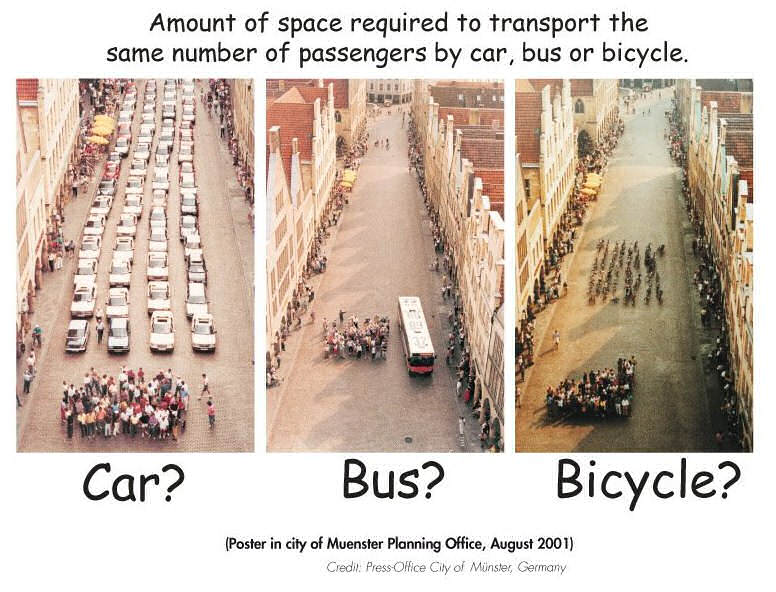
Still doesn't solve the problem - just moves it. If everyone in my office complex needs a ride to the bus around 5pm, and everyone at the other end of the bus line needs a ride home at 5:42pm when the bus arrives in SuburbTown, there will still be unmanageable shortages of self driving small vehicles - unless you own your own.
Huh? If suburban Americans aren't opting to share rides into work now and don't have or want bus services now, particularly not connecting bus services, what difference is non-human drivers going to make?
That's really the key point. Not that roboTaxis are on the near horizon but, if you believe they'll change everything when they arrive, you basically need to point to all the cases that today are almost (but not quite) enabled by Ubers driven by minimum wage drivers.
Do Zipcar and Uber make a difference on the margins? Sure. I know people in fairly dense non-NYC urban area that probably would still have ended up with a car 10 years ago who can get by without one today. But there's a big difference between change at the margins and fundamental shifts.
Amazon is also very different from Uber in that it a) went public earlier and b) didn't need huge outside cash injections like Uber and c) Wasn't making a huge gross loss on sales like people claim Uber is.
I believe Uber has already lost more money than Amazon has in it's entire existence!
http://s1.ibtimes.com/sites/www.ibtimes.com/files/styles/emb...

Except for every single brick & mortar store -- which has always been Amazon's biggest "competitor".
https://ycharts.com/indicators/ecommerce_sales_as_percent_re...
(Note: that growth is still a good reason to be bullish about Amazon!)
All auto sales, gas purchases, alcohol & tobacco, heavy industrial equipment (commercial farm equipment, etc) are included in that category.
Online sales only being 10% of that still probably looks massively outsized if you're drilling down to B&M clothing & electronics purchases. I haven't made a B&M retail purchase any more times than I can count on one hand since 2004.
Amazon and Uber are very different companies, but this wildly oversimplifies the financing of Amazon. Amazon has taken on many billions of dollars in debt over the years in order to operate. If you add it all up, Amazon has taken (in very different terms) about as much money as Uber.
https://www.bloomberg.com/news/articles/2014-12-02/amazon-se...
1) Uber: a) subsidize sales b) build infrastructure 2) Amazon: a) build infrastructure, b) grow sales at a sustainable rate even if it takes 20 years.
I think Zappos had the same business model. But we'll see.
[1] http://venturebeat.com/2016/10/27/aws-reports-3-2-billion-in...
[2] http://www.geekwire.com/2016/amazon-without-aws-online-retai...
As a very good and Amazon customer for a very long time, I've reached the point to jump to something else should it materialize.
If someone starts an electronics site on the same professional, data drive, aggressive level as Zalando, I'm sure Amazon is in trouble here in Germany.
You could say exactly the same for airlines: there's network effect. Each new plane allows your to fly more rotations, have more frequent lines, open new routes... The reality is that most people take decisions based on price.
We know most people are pretty bad at valuing their time, and even so, waiting a minute more for a cheaper service is something people will do for sure. As long as you're below an acceptable waiting time for your car, you can compete on price.
I'm curious about how Uber will avoid being a commodity just like airlines are.
This is why Uber and Lyft end up in driver subsidy cost wars.
Waiting time is a function of: number of cars, size of the city, number of customers (to ignore congestion for now...) To have a good start as a new entrant, it's just a property of the size of the city. Then, you need to grow your fleet with your number of customers to keep waiting time constant. That number of cars to start with, the barrier to entry, is a tiny portion of what you need to add to keep up with demand.
If you don't have to compete with drivers, with autonomous cars, it's not that hard to meet and start a price war.
Again, I don't see how Uber will avoid being squeezed out of their margins the way airlines are. It's not cheap to start an airline, yet many people have done it. And all you need is 3 competitors to drive prices, and margins, down.
...which is exactly what cabs are. In major cities cabs exist because it's cheaper and easier to hire a cab than to drive yourself. That cabs only really exist in densely populated urban areas should tell us something about the economics of this business model.
yes, it tells us that human cab drivers are prohibitively expensive. robot drivers don't need to paid by the hour though. the real disruption to your car isn't a ride-hailing app on your phone. it's robot driven cars. ride hailing apps are necessary piece of predecessor infrastructure for that transportation model. it's the beginning of it, not the end.
The landscape of the future is car manufacturers offering their own "Uber" like service and that service replacing the traditional ownership model. That doesn't mean Uber doesn't have a place before then though. Like good little capitalists, the VC's will cash out and make a ton of money while the real innovation and lasting impact happens elsewhere. So, yeah, Uber should blow up when self-driving cars become a thing but they'll eventually fade away. Unfortunately, that won't be for a long time.
EDIT: Oh, and yeah, people are also going to still be buying a shitload still anyway.
Expect an even bigger fund raise where they hope some other idiots, with even deeper pockets, will keep picking up the tab.
That being said, for Uber to win the self driving car race they have to beat Google, Apple, Tesla, Didi and the automotive incumbents as Sarah Lacy has been pointing out for at least 12 months.
Uber doesn't lock in customers or create any switching pain whatsoever so their current customer base doesn't given them much of an advantage. Their software is slick and robust but it's not so technically advanced that a competitor couldn't create their own ride-calling and dispatch system (as evidenced by Lyft).
I wouldn't hold my breath that any auto maker besides Tesla could compete with Uber.
usage data. they know where people that use their app actually go on a daily basis, and how much they're willing to pay for that service.
"They lose money on every ride, and they have no way to ever turn that around (outside of a monopoly on driverless cars which they won't have), because any time they gain money on a ride, they'll attract indistinguishable competition."
Your response is: "Yes, they'll lose money on every ride, but they'll make it up with volume."
Say all cars are autonomous and on-demand. You need a car. Uber costs $20. Lyft costs $15. Who do you go with? What happens to overall pricing over time?
I have my car all set up how I like it, with a nice aftermarket stereo and amp and hundreds of gigabytes of mp3s because music is important to me, the seat is exactly set up how I like it, etc etc. I specifically bought a car that I actually enjoy driving.
I have an umbrella in the car in case it rains, and a jumper in there if it is cold outside, so I don't have to carry those things with me all the time.
Also, I know that there was no smelly/dirty/messy person in the car before me. Public transport is a yucky experience overall so why would a super cheap Uber end up being any different?
I will personally pay a premium for that comfort and convenience, and I can't be the only one, can I? How much cheaper can an Uber be compared to owning my own car?
I guess it all depends on how much the premium is...
It has never been easy (or cheap) to privately own a car in Singapore but the situation right now is exactly like you mentioned in your comment.
However I'm also a resident of the US and I don't think it's gonna happen over there anytime soon.
Are you sure Singapore is artificially inflating the cost, or that where you live isn't artificially subsidizing the cost of car ownership?
1. https://en.wikipedia.org/wiki/Certificate_of_Entitlement#His...
Monopolization doesn't seem to be happening really in the business Uber is competing in and it seems as likely that any of the half a dozen other players in self driving car business will succeed as Uber.
It happens at home as well. I don't need to bring a bag for evening activities into work because I can just leave it in my car. And I don't need to bring my computer bag to an evening activity for the same reason.
Sure, all this stuff can be worked around when it has to be but there a lot of advantages to having a mobile vehicle you don't have to empty every time you arrive at a destination.
Given proper public transportation, I did. Not owning a car is not only a lot cheaper, it's also quite liberating: - I don't fear I'll wreck it, or worse, I'll badly injure someone in a car accident - I don't have to drive and be angry about other people on the road, like a lot of drivers - I'm not owned by my car, that requires maintenance and cost beyond just running it. - Not fighting for parking spots!
"But, but, you can rent a car with a car seat!"
That response ignores the fact that there are 4 different major categories of car seats, most kids need a specific one at different times of their lives, and if you have multiple kids you need the specific combination of seats. And of course, car seat installation is hard and takes time, even with LATCH, and I wouldn't trust a random Uber driver just handed a seat to install it properly.
And others will see the opportunity and jump in to compete on a market Uber spent all it's money to create. And there will be very little Uber can do to stop them.
Perhaps, Uber may be able to be a few percent more efficient if they have more cars around and more data to use for predictions. The question is can uber be materially cheaper with it's data in the long term?
There will likely be some regulatory capture on the side to discourage other competitors.
[0] http://www.wsj.com/articles/china-opens-antitrust-investigat...
Car makers have falling commodity prices (when they're indeed falling) and rising automation working in their favor. What does Uber have working in its favor?
It seems that scenarios with rising car ownership costs involve mainly cost of parking or general low ridership pattern. Those specific scenarios are associated with dense urban environments, which also have a competitive vector of public transportation, frequently already subsidized by the taxpayer.
I will admit though that Uber has a very attractive offering in LA, with $5 UberPOOL downtown to West side or a UberX ride cheaper for 3-4 people than the cost of metro/bus. Don't know whether LA market is profitable for them or subsidized.
Seems to me that the manufacturers will always be able to undercut on price once cars are fully self-driving, eliminating the value of the driver network.
Or, they could easily decide that that's not their business model. Being a car manufacturer is different from being a fleet operator is different from being a finance company is different from (for that matter) being a car sales and service organization.
A company may decide to do one or more of those connected things and they frequently do in ways that are more direct or less direct. Culture's part of it. But it's also about focusing on capital requirements, core competency, etc.
It's close to competing with my own car. I'm in West LA and use Uber daily, but only use my own car once or twice a week.
The day they can get cost per mile one penny below what you'd spend owning a Toyota Camry, they'll open up the biggest transport market ever created (the intentionally-inefficient American built environment). They're taking all this VC money and expanding so aggressively not because they like the scale, but rather because that's the only way to compete with private car ownership.
[0] https://twitter.com/travisk/status/564065776005808128