Every element of Western music builds on the same building blocks. Western harmony, as taught, relies on understanding chromatic and diatonic harmony; the author did a nice job figuring out and explaining the compromises inherent in equal temperament (without knowing about how ratios and tuning worked before equal temperament; people didn't always fudge the ratios to make them work out the same across all keys), which is cool. But, he still doesn't actually know much about western musical harmony, as evidenced by the assertion that C Major and A minor are "the same", because they share a key signature and the same notes. Had he known that equal temperament is a moden-ish invention, he might have also figured that C Major and A minor actually have (slightly) different notes if your instrument is tuned specifically for that key rather than with equal temperament.
In short, he's just not done learning yet. Most musicians and composers never really are, as it is a vast subject. And, what he's calling "music theory" is really more "equal temperament tuning math" with very little theory.
Not to say it's not interesting and well-presented. It may be useful for non-musical nerds to see it presented in this way.
When you read these sentences, you can very easily speak them out loud, you don't have to mouth each and every vowel to hear it in your head. This is not the case for music notation, even for very experienced musicians. The clue is that they associate notes not with sounds or intervals, but with absolute positions (fingerings, etc.) on their instrument. Maybe they can sight-read a melody with a little effort, but for most of them it will be much simpler to just play it - and this goes triple if it's not tonal and idiomatic for a style you know. Music notation is really a somewhat instrument-independent tabulature.
Solfege or numeric notation systems, which exist in many versions, are much better for reading in your head once you learn them. They're terrific for singers. But for instrumentalists, usually your instrument is already biased to certain keys, and going from notation->sound in your head->fingers would therefore be much harder than going straight from notation->fingers.
It's moer than just that though. The inertia to overcome also includes pretty much all sheet music ever printed, all the schools that have adopted the current system, all the educational materials... etc. etc. the list goes on.
In addition to all of that, the new system needs to convey most of (if not all) the information that the current system has. I have seen a few attempts at improvement, but they all fell short of the current system, which let's face it has been in development for several hundred years.
Displaying a song in whatever notation the musician/reader prefers should be as simple as setting a preference on your hyperPad.
That still leaves the difficult task of figuring out better notations, but it can be done incrementally. You don't need to convert the whole world or the entire notation at once.
I don't know...ebooks still look a lot like treebooks.
The one example I've seen of what you're describing is I've seen jazz musicians play off ipads. This give them access to very large catalogs without lugging around giant binders, and also they can transpose their sheets into any key.
(That's more important than it might sound at first, because different instruments "play" in different keys -- if a pianist thinks the piece is in C major, the clarinetist thinks the piece is in Bb major. So now you don't have to have separate books for the different instruments in the band.)
But the music as written down in these electronic fakebooks is a lot less complex than your average classical piece, so it's a much more tractable problem.
Then there are large PDFs where somebody ran the old paper fake books through a scanner, but they are just images and are not in an actual computer readable format, so they can't be transposed.
So the computer has not solved the notation problem, yet.
Myself, I've memorized most of the standard jazz repertoire.
In fact I suspect that most of the written music repertoire that exists today will never be translated into computer readable form, because it's just too much work. And not enough new music is being composed to form a critical mass around some new notation system or computer format. When somebody composes a tune (I play in one band that does original jazz compositions), they send out a PDF.
Maybe software will eventually automate the process reliably enough to be useful.
Also, a lot of the written stuff is handwritten, not typeset. So it's a subset of the handwriting recognition problem.
It's pretty bad for the bassist, since the bass part is usually the second to last part to be copied, meaning that the copyist was probably drunk. ;-)
The answer is, because it works, and nobody has managed to propose a better one.
A new notation system will need to be a lot better to justify the change, because there is also a lot of value in compatibility with everything that already exists.
I'm not sure a sufficiently better system exists, because as you say, the traditional notation works. It has its quirks and rough corners, but music is complicated enough that any system would probably have similar imperfections.
The first is that spacial recognition takes more effort than symbol recognition, because it's comparative.
The second, and more important being that complex sequences of notes will be very dense on the page, and simple sequences of notes will take up a lot of space on the page, so suddenly there is a tradeoff between having sheet music that doesn't take 10 pages, and having enough space to represent hemi-demi-semiquaver sequences when they inevitably appear somewhere.
[In this case, I'd like to say go apprentice engraving if you are 100% serious.]
Another question is whether or not the length of a trailing line is absolute or relative to the bar itself.
On the subject of filled notes, Hummingbird is also conveying a lot of information that for performance of a score is useless. Note letters (A-G) aren't actually important for performance, only the action or position that they map to for each instrument. No musician parses a score and translates each note to a letter and then each letter to an action, instead going directly from note to action.
Essentially, telling you the note letter with a glyph shape on top of the position on the stave is adding noise to the signal.
I'll admit I'm coming at it from a position where I'm perfectly comfortable with traditional notation, so part of the reason that it appears difficult is simply because it's unfamiliar, however the terseness of traditional notation and ability to read in one "parse" without forward- and back-skipping seems to give it the advantage.
That and over 300 years of existing music, too ;)
"There are multiple cues to the same information. Everything has both a symbol and spatial element, for all kinds of thinkers."
Indeed, in addition to the spatial length of the notes, there is also a symbol next to the notes denoting their life. You can see this on the linked page, in the second section. (Next to "Intuitive.")
I don't know if it's true or not, as I view Hummingbird to be fixing things that aren't broken (is the difference between a whole note and a half that hard to suss?) and doesn't fix the things that are.
It's possible (and fun) to play music where the rhythmic structure changes smoothly and continuously. But it's bloody impossible to notate and very difficult to orally communicate, so music cultures that depend on notation or oral communication have left this territory largely unexplored.
The handful of classical composers that have attempted this (Steve Reich, Brian Current, etc) have either abandoned western notation (Reich) or hacked on their own bespoke glyphs with their own situation-specific explanations (Current).
Electronic musicians can easily explore this space by writing their own software (Autechre, your humble author, etc). When your musicians are mechanical, you can explore all sorts of otherwise impractical permutations of theory.
Most delightful, though, are the non-western cultures that communicate musical ideas entirely without written notation or spoken language, and instead communicate musical ideas through play (Indonesian Gamelan, Australian Aborigines, etc). You get the ineffable human qualities that make music most beautiful, and the freedom to explore structural spaces that are difficult to capture with discrete/unitized/quantized notation and language.
It's really easy to orally communicate. You can just sing it!
(I know what you mean, is it's difficult to describe using a computer keyboard. Using a pen and paper it is really easy, given that you can just draw notes and time signature changes in the margin.)
I'm not really sure what this means, but it sounds interesting.
This could work like that and only the time signature would need a brand new notation, so no I don't think it would be super hard to read.
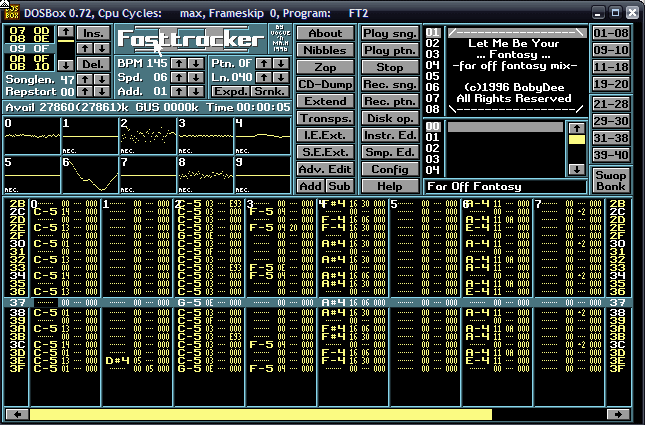
2d grid, time is down, instruments(channels) are right, each cell can have a note or "stop this channel". There also can be modifiers in each cell (louder, start tremolo, slide this note into the next, etc).
It's most applicable to keyboard music, I think. Sight-reading this without rehaersal would be trivial, right?
So it's virtually impossible to try out a new notation system.
But my impression is that this would be phenomenally hard to read, especially in a live performance situation where your attention is divided between the sheet music and other stuff. If I were staring at a solid grid of text, and were to glance away for a split second, I'd be lost. Part of sight-reading for me is being able to read ahead by a few notes or even a few bars.
It may also be that conventional notation displays a lot more density on a single page, because a 16th note takes up no more space than a whole note.
For other styles I think it would be pretty good; although the score won't be as compact, it might be easier to understand a "fake book" scored piece (ala what's used a lot in jazz) written this way, let alone pop (which often can be represented with a melody line and Roman numeral chords).
[1] http://gizmodo.com/qwertys-origin-story-is-a-big-fat-lie-493... (This is just a first one I found in English, but Prof. Yasuoka referred in the article publishes quite a few articles about early typewriters in Japanese, in which he lists several evidences that "jamming" wasn't the reason.)
I'd like to argue that as inefficient as it seems, it's really a reflection of how broad and complex music actually is. This notation and organization system is all a perspective or reference to take when actually trying to comprehend/play music. It's not a fixed set of rules and there are exceptions everywhere.
It's one of those systems where you learn the rules only to know when you're breaking them. So by all means learn to do this, but don't get hung up on real-life deviations.
It actually works well for people performing together, especially when led by a conductor.
Clearly history, culture, notation and reproduction technology have all conspired to produce a certain flawed, but accepted, jargon that you just have to bite the bullet and learn. If we could start again using colours, numbers, augmented reality, etc., then it seems obvious we could come up with a better system, but that would be tantamount to proscribing a new alphabet, or telling everyone to start using base-16.
1. Find Do. This is the first note of the Major scale in the key which you are playing. Find it on the page, and burn it into your mind; everything you're about to do centers on the location of Do. In the key of C (white keys on a piano) Do is right in the middle of the grand staves, keeping things simple. If you know where Do is, you don't have to care about the key signature for like 97% of the notes you're going to read, and you can make educated guesses about what the sharps and flats do by using your musical intuition. Once you've found Do on the page, figure out where Do is musically, and keep it in your head. Make sure that when you're singing or playing any other note, you know where you are relative to Do, and can jump back there without losing your place.
2. Learn your intervals, and learn Solfege. If you're a musician, you already know these things in principal, even if you don't know the words or the terminology. In particular, you should be able to "hear" the distance between Do-Mi-Sol without too much difficulty, because you hear those distances in music a lot.
3. When you're sight reading the first note in a passage, find the note, then step it off visually to the nearest Do. If you're good, you can also step it off to the nearest Sol. I usually root myself on Do and Sol both in a given passage, as it gives me less visual separation between any note I need to find in a hurry.
4. For every note after that first note, pay mind to the spacing on the page:
4a. Moving up and down the scale should be easy; you're a musician, you already know what a scale sounds like, just sing along.
4b. Moving up or down from one line to the next line is a third. Most often you'll hear these relative to Do-Mi-So-Ti in major keys, and La-Do-Mi in minor keys. You'll hear these a lot, so get used to reading them quickly.
4c. Get a good feel for common jumps while you're at it. As a Bass singer, I got really good at reading jumps between Do-Fa and Do-So, because those chord progressions exist in everything, and their sole purpose in life is to make bass singers bored out of their mind. You're a human, in addition to a musician, so you'll pick up on the patterns in any given composition and have the common tricks down before you even realize what your brain is doing. Don't question that, let your brain be awesome all on its own.
That sounds like a lot of steps, until you realize that you're performing most of them already to make sense of any piece of music that you play. Don't worry about the names or the terminology, you can use numbers (1-3-5) if that's easier, or just "hear" it if you don't feel like you need an aide. Remember, the goal is to drop the aide and be able to just perform these steps on your own eventually.
I'm analytical in nature, so I'm always thinking about these things. I suspect the reason most musicians can't describe this process very well is because the process of analyzing our craft detracts from the quality of its output. The more you can commit to "muscle memory" as a musician, the more you can pull your analytical mind out of the process of a performance, the easier it becomes. Your body's built in reflexes are faster than your analytical brain will ever be, and good musicians tap into that biological strength through loads of practice.
I believe the Solfege named intervals (Do-Re-Mi-Fa-So-La-Ti-Do) are only taught as a historical oddity these days (or maybe used more in classical training?). All of my musical instruction, at the high school and college level, used numeric interval names (1-2-3-4-5-6-7-8). Most of the serious musicians I've played with also used the numeric scale rather than Do-Re-Mi. We learned how to sing Do-Re-Mi, "Just in case", but we never used it.
Were you taught in the US, or somewhere else? Maybe it is a regional thing.
I grew up attending a Church of Christ, which used full congregational singing with four part harmony. Our songbooks used a variation on music notation that used shape notes, and the shapes corresponded to Solfege. If you knew your musical intervals, you could completley ignore the key signature, because a Do was always drawn as a triangle, a Sol was a circle, a La was a square, etc etc. This was especially handy because the song leaders were always men, and could not always sing as high as the written music required. They picked whatever key they could sing comfortably, and the congregation adjusted to them. Drove the music majors in the audience nuts. :D
https://en.wikipedia.org/wiki/Shape_note
Growing up with that system meant that Solfege was simply the easiest system I had to understand music. To this day, I struggle with pieces in unusual modes, and with passages that modulate their key and make use of unusual progressions, because it breaks down my innate understanding of music and requires me to think in a different way.
I tried reviewing in my head each week before class what I remembered from the Sound of Music, but made the mistake of thinking that Do-Re-Mi etc. was a static C-D-E instead of realizing that my music instructor was simply describing intervals depending on the key we were in.
In the present day, I would just look it up online, but back in 1991, in a small city in northern France, I didn't have that privilege. It took me several months of twice-weekly instruction before I finally figured out that he was using solfège for intervals, I'm embarrassed to say (to my instructor's frustration and confusion). I'm wincing even now when I think of it.
I asked around at the time and was told it was pretty universal to use solfège there.
I do think using solfège to indicate notes is a much better system for students, since it emphasizes the importance of intervals and keys. It's probably harder at the beginning that just learning static A-B-etc., but worth it.
Having said that, I absolutely hate solfege. But my bachelor's was in piano performance, not vocal.
Interesting note: quite a few countries use a "fixed Do" system rather than "A-B-C". It is quite confusing (and humorous to observe) when a solfege disciple tries to sing with a fixed Do native.
So, I may have to somewhat rethink my dismissal of the solfege, at least for singing intervals. Unless there's a secret system for singing with intervals by number that accommodates accidentals.
As a computer nerd myself, I can understand the argument for 0-based indexing in this case, but I don't recall ever being stumped by it being 1-based. When would you need to add a 3rd and a 4th to get a 6th? Harmonic theory doesn't use addition like that. e.g., playing a 6th is not the same as playing a third and a fourth. So, why do that kind of math with intervals?
I mean, I guess that's not so foreign...But, I tend to think of it as pulling out the notes I need from the scale, and not actually counting up to them. e.g. in my brain I'm grabbing the third and the octave (well 7th, if you've got a third and then the fifth of that third, which I guess is why you're preferring 0-based) that are already there...not climbing up them to find there's the tonic there. I mean, I can see that it's a fifth interval if I go from E to B (in C), but unless I'm building a chord on E, I don't care..it's either the 7 in C, and I'm not so much thinking of its relation to E as I play it, and it's a phrase in C, with maybe an Em chord (either implicit or explicit) underneath; or I'm playing jazz, or some other very chord-based music, and I want my phrase to be relative to the chord we're currently playing (so we're inside that Em, and the key is less relevant).
Sight reading is different, as well, in my brain, but, I think it even bypasses the intervals to some degree and is just distances and shapes and an awareness of the key I'm in. I don't read much these days, but I recall it working best (or at least fastest and most accurately) when most of the theory was turned off in my brain and I just let the shape of the notes (their distance from each other) guide me. But, I feel like it's only in improvising and composition where one would be doing any sort of interval math. But, maybe I'm wrong.
When are you doing this kind of math? When reading, improvising, playing memorized pieces, or composing?
Better:
In equal temperament, log base two: add 4/12 to 5/12 and you get 9/12.
In ratios (depending on tuning, these could be loose approximations): multiply 5/4 by 4/3 and you get 5/3.
You need to think of it as “if the bottom note was the first note of a scale, where in the scale would the top note be?”
As with many questions of indexing, off by one errors are tricky.
It’s a system that confuses names for notes in a scale with names for intervals between notes. You’d rather they called them by cardinal numbers representing some kind of “distance”, instead of a count starting at one.
But that would be applying a later mathematical understanding on the earlier system. If that’s what you want, you should just use a log scale and count twelfth roots of two.
Ideally we’d switch all our indexing to start at zero, and use half-open intervals everywhere. Start at 0 AD, call the ground floor of a building “0”, start spreadsheets with row 0, switch Matlab to index from 0, et cetera. This is pretty unlikely to happen though.
I don't want to count in twelfths, I want to count up the scale.
> call the ground floor of a building “0”
I'm a Brit, we do that here already.
For instance, “minor second”, “major second”, “minor third”, “major third”, “perfect fourth”, “augmented fourth”, “perfect fifth”, “minor sixth”, “major sixth”, “minor seventh”, “major seventh”, “octave”.
Reducing all those ordinal numbers by one really doesn’t help all that much. You still have to remember how the “minor” and “major” labels interact for every interval in the scale, and remember that sometimes the interval between the same two notes is given multiple names depending on the key, etc., which is all horribly confusing mess.
Those interactions are pretty intuitive. Where defined, major + minor = perfect (considering an octave as perfect), perfect + major/minor = major/minor. As long as you remember which notes exist, you can't get it wrong, so you'll never get confused by a piece of arithmetic in an actual piece.
If instead you used digits from –5 to 6, using arithmetic mod 12, it becomes obvious that e.g.:
  -2 + -3 = -5
  4 + 3 = -5
  5 + 5 = -2
  -5 + -1 = 6
  4 + -3 = 1
  etc.
Then it’s easy to see that your “major + minor = perfect” formula only works for some intervals, Etc. Overall the simple heuristics are more obfuscatory than helpful IMO.
Where does it go wrong? Do those cases come up in practice?
Counting up and down the scale is a core use case for a notation for intervals. It absolutely needs to be well-supported. A 12-semitone approach is never going to match the usability of even the existing system.
I am obliged to point out that a 12-semitone approach is in fact part of the "existing system" (see: pitch-class set theory).
(Mind you, I of course think its usefulness is overrated, because I think the "atonal" repertory is tonal.)
My music classes of ~20 years ago treated Solfege as being of historic interest, but not particularly common. While numeric intervals were used daily. It came up somewhat more in sight singing and vocal training than in any of the instrument or theory oriented classes. But, I think it was mostly students who were used to it using it rather than instructors teaching it.
But, maybe I just so strongly preferred numbers that I immediately discarded any instruction involving Solfege as being silly and a waste of my time.
Still, I can only recall seeing numbers (and Roman numerals) in writings on theory and such.
Knowing solfege because you heard it in a movie and using it on a daily basis in the process of teaching or making music are independent concepts.
Anyway, conversation here has brought it to my attention that it is still pretty common, there are some areas where it is useful (maybe even better than numbers, as in the singing and vocal training area; I personally have recognized the limitation of numbers when singing minor notes, for example), and that my own experience was only partly representative of music pedagogy in the US and elsewhere. That said, when I'm teaching people about music, I still plan to only use numbers...the areas where solfege would be useful are pretty advanced, and require more than watching Sound of Music to understand.
> 4c. Get a good feel for common jumps
i think that's why the current system works so well. most musicians have intervals burned into their muscles. to use an excel reference, reading R1C1 from the staves is much faster than reading A1, because you can read R1C1 from any line in the staves.
Indeed. I'm a musician, and something non-musicians often ask (especially techies, it seems) is why we use such an archaic notation system.
The reason is simply that a certain number of musicians have developed the skill of sight reading which is the ability to perform a composition directly from a written sheet, with little or no rehearsal. Those players, myself included, can't quite explain how we do it, and aren't going to learn a new notation system.