As a Swiss citizen, I think the swiss system is very close to perfect in this regard.
Sure, emotional and stupid arguments sometimes prevail, but most of the time the people make the perfect decision. Public discourse is most often also very rational, more so than most world parliaments.
Irrational arguments have been a staple of especially the British political system. I am amazed at the low level of discussion in the UK even by their representatives.
Direct democracy is something that has to be done regularly, otherwise you end up with situations like the UK or California.
I think there's a lot of truth to this. When referendums are seldom, I believe there's a real risk of them turning into spectacle. (And at worst, a weapon for use by nationalists and fascists, like what happened in Germany in the 30s.)
When they are regular, and limited, and like in Switzerland not something pulled on a whim but actually requires some work to call, they might just work. But that also kind of assumes an informed electorate, which is perhaps the main point here – the electorate hasn't been very well informed, either way.
In Switzerland you essentially vote on 2-5 issues every quarter. I think this very regularity has educated the people.
It also helps that by law, if you vote on a proposal that would increase spending, you aso vote on how much your taxes increase. In the case of the Gotard Tunnel it was 1.6% increase in income tax for several decades (if I'm not mistaken). Swiss even vote on buying fighter jets, etc. You would be surprised how well it works.
All that said, the swiss constitution actually states that it is the job of the government to make sure the people have a good standard of living. So many social policies which would be difficult to get through constitutionally in lets say the US are rather simple in the Switzerland.
My only big nitpick in the swiss system is the lack of minority protection an little to no checks and balances by the supreme court on referenda.
Do you find the regularity of referendums naturally makes people more inclined to be educated on the issues at hand? Anecdata obviously, but nevertheless interesting.
That, and the fact that there is no real parliamentary opposition vying for as many populist points. (see my other comments in this thread).
That's not a criticism of diverse cultures, more of states living in relative unanimity being in a bubble.
The difference is that because of direct democracy and every male being armed to the teeth, the government steps in and tries to reduce inequality. That way democracy works again. I mean, Jura used to have straight up ethnic riots.
I have to disagree with you. I have a lot of friends in Sweden that do nothing but complain about the immigration crisis they are facing. In fact one of my Swedish friends is here in the US now looking for a job because immigration has become such an issue in Sweden. She can name many immigrants she knows that are collecting more in welfare from the Swedish Government than what a Doctor makes... That's kinda fucked up if you ask me...
Really? I have seen plenty of claims like that, and every time, they turn out to be false.
And how much exactly does a "doctor" make? Lönestatistik.se lists between 12k and 180k SEK/month. Quite a span.
You've somehow managed to put the phrase "they're stealing both our jobs AND our welfare" unironically in the same sentence, kudos.
All you're doing is portraying yourself as a victim and hijacking the issue back into the bullshit "are we too pc" debate again, which quite frankly most people are already sick of.
If you hang a Swedish flag outside of your house you are automatically deemed a racist by your community. ANY semblance of pro-sweden is viewed as unfair by the immigrant community because they aren't swedish, because they aren't included. They've create a culture of everyone is a victim, citizens and immigrants.
It's really a fucked up situation. A situation I hope never comes to the US.
Is that a cause or an effect though? As in, if your society evolved in such that "most problems" don't exist or aren't serious, then maybe as a consequence there isn't a lot of income disparity. But that doesn't necessarily hold in reverse. Making incomes equal by some method doesn't necessarily make the problems go away.
https://philoofalexandria.wordpress.com/2010/09/25/reynolds-...
The point in discussion, everyone likes equality in a way they having it, without they having to do anything about it. Or in other words making the rich poor in some way. Wasn't this what communism was all about.
The real issue is equality in access to basic resources, which is by and large there already. Beyond this you need to let people win and lose on merit.
You don't go around paying the same money for a haircut and brain surgery. That sort of equality doesn't work. Or to be more precise that's inequality of a very worst kind.
There's also the population size difference. London alone is larger than Switzerland, and that's not even all of England, let alone the whole UK.
MPs have never been able to carry weapons in to the chamber so if it was a rule it's a bit silly (which doesn't mean it's not true given how silly the rest of the UK democracy is).
It turns out that Switzerland is smaller than the Los Angeles metro area both in GDP and population.
It seems it's comparable in size, but not smaller
Take a look http://mapfrappe.com/?show=40241 (it's a rough sketch of Switzerland but the size should be right)
Edit: yes, I think parent meant population, not actual size
Edit: Also, Wikipedia is possibly a better source for comparing sizes of landmasses.
LA for example is only about 66 percent: http://www.laalmanac.com/education/ed33a.htm
This comes up all the time, especially in "Why can't the US do X?" discussions but isn't it just the equivalent of shouting down with "That will never scale!"
Of course it might not be exactly the same. Maybe the bigger country will need more servers spun up or a tweaked algorithm (to continue the analogy), but just saying a country is smaller doesn't mean things are a No before even being tried. I'm assuming there were railroads across other smaller countries before the US had the transcontinental railroad too.
So, specifically in the context of discussing direct democracy, size does matter.
Even in the relatively recent founding history of the United States, the Federalist Papers discuss and try to address a variety of issues which can lead to this outcome.
And ultimately, I think this is what we see with the Brexit outcome and the current Trump campaign in the US. These aren't "new" concepts...throughout history we can see similar outcomes for similar events with similar reasons.
You raise an excellent point though, which is with the ease of communication in the modern era, why don't we have a more informed public? This is something I have thought about trying to tackle with a side dev project...but the issue is complex and difficult to address directly.
Side note, I believe the Roman Empire was a Republic, not a Direct Democracy :)
Nit pick: the Roman Empire, in one sense, was founded while Rome was still ruled by the Republic; in this sense, the Empire is the metropole-periphery arrangement with Rome proper ruling as the metropole and the various provinces as peripheries.
In the other sense (the sense of the Empire as a form of government within the Rome rather than the relation between Rome and the provinces), the Roman Empire was founded when Caesar Augustus was granted a variety of lifetime powers by the Senate.
In either sense, it was not founded by (or during the life of) Julius Caesar.
I also think this is something that works best on "smaller" scales - that is, not on the scale of France, or the UK, or Germany, but on the scale of Switzerland, Luxemburg, Austria, Belgium, Denmark, ...
Here in the US, I find myself wishing political discourse would rise to the level of the UK.
http://www.bbc.co.uk/archive/swingometer/
Here's a clip from 1979 http://www.bbc.co.uk/archive/swingometer/11202.shtml
http://news.bbc.co.uk/1/hi/uk_politics/election_2010/8646445...
The only model I'd suggest that may be even better than direct democracy is liquid democracy (which is a close relative of direct democracy), but seeing as no countries have adopted it I'd say the Swiss model is the best example of how an effective democracy functions.
For those interested in learning what liquid democracy is, this is a brief introduction:
https://en.wikipedia.org/wiki/Swiss_minaret_referendum,_2009
And that was a constitutional amendment referendum!
Quite far from perfect in my view.
Mathematically, 1-(1/e) percent is the ideal cut off (~63%).
What? can you explain?
And yes, what? Do explain!
Or Prop 13.
On June 6th, 1978, nearly two-thirds of California's voters passed Proposition 13, reducing property tax rates on homes, businesses and farms by about 57%. The Environment Prior to Proposition 13. Prior to Proposition 13, the property tax rate throughout California averaged a little less than 3% of market value.
The deep irony of the anti-Brexit narrative is that the same people would froth at the mouth if you said "India would've been better off economically if it hadn't separated from the British Empire." Whether or not that's true, it's an argument--like the anti-Brexit rhetoric--misses the point completely.
http://www.thehindu.com/2005/07/10/stories/2005071002301000....
As the painstaking statistical work of the Cambridge historian Angus Maddison has shown, India's share of world income collapsed from 22.6 per cent in 1700, almost equal to Europe's share of 23.3 per cent at that time, to as low as 3.8 per cent in 1952.
Indeed, at the beginning of the 20th Century, "the brightest jewel in the British Crown" was the poorest country in the world in terms of per capita income
Not sure how useful this statistic is - it's including the collapse of the Mughal Empire in the early 1700's. British company rule is usually dated around the mid-1700's, with the British Raj starting in the mid-1800's. We're also looking at percentage of the global economy, so it's not clear how much of this is a decline in the Indian economy and how much is it not growing as fast as other countries.
A State is the same as a company, except worse - they have an army and a monopoly on violence. After a war, when a king takes over, they tried to integrate with the new people, marry into them and in this way eventually begin to rule them. That began to change when people’s skin color was drastically different. The term Colonists was invented to convey how race got into the mix. The British were never a Raj (kings), they never ruled over India in the traditional sense of the word. They were colonists - they colonized and decimated the Indian economy.
Forget the economy, they decimated the population:https://en.wikipedia.org/wiki/Famine_in_India#Scholarly_opin...
(If you really want something to point fingers at, try the habits that stem from the cultural and religious landscapes. You can't erase millennia worth of those overnight.)
Europeans screwed over every single country they could.
British people could vote for European MPs. It's not like the UK was colonised by Europe.
There is devolution of sovereignty but you're gonna basically end up with that with the kind of trade pacts the EU demands anyways.
Lots of symbolism involved of course.
> The regulation is directly applicable in all EU countries. This means that it:
> - applies immediately as the norm in all EU countries, without needing to be transposed into national law,
> - creates rights and obligations for individuals and they can therefore invoke it directly before national courts,
> - can be used as a reference by individuals in their relationship with other individuals, EU countries or EU authorities.
It's like how the FCC can change regulations regarding radio usage without passing a law. You're just delegating rule-making
It depends on whether you view democracy as a process to perfect society or mitigate against social harm. If you think democracy should perfect (or even just improve) society, it will often seem ridiculous. Knowledgable voters don't determine the outcome of elections and referrendums, and instead the mass of voters who understand the least about the issues at hand determine their outcome. From this perspective, Aristotle's was probably onto something when he thought democracy was better named ochlocracy (i.e. 'mob rule').
However, if you understand that the purpose of democracy is to mitigate against social harm, then the drawbacks make sense. This would be the perspective of Alexander Hamilton and co. in the Federalist Papers. The tendency of political parties and factions, this view claims, is to benefit themselves at the expense of the greater society, and in fact often harming the greater society (e.g. North Korea). Assuming parties will seek their self interest at the expense of the common good, democracy is an institution which means the best interest of the parties is to get people to vote for them, which means they have to do things people actually want. From this perspective, democracy is certainly a problematic process but brings peace and prosperity because it tends, on the whole, to align the parties self interest with the perceived good of the society.
These last 5-10 years have been horrible for the EU. On the hight of this current migration crisis, the UK decides to hold their election.
If I didn't know Cameron was pro EU, I'd see it as a completely UKIP-skewered dickmove. The UK is letting go, just as the "tug-of-war" gets even more hairy.
There's a lot to be critical about with the EU, but going our separate ways isn't the solution for Europe vs the world. And at the height of this crisis it is just... cowardice? I don't know.
That way, it's not just a high-stakes, one day event. Everyone will have a chance to vote, and nobody can (rightfully) say, "I wish I had voted, it didn't go the way I wanted" or "If I had known, I would have voted". You will know, and there will be time for you to vote still.
If I understand correctly, there were heavy rains that affected the turnout for this vote. Should something this important really be that affected by the weather?
There was a lot of rain. Flooding / trains cancelled - biggest thunderstorm I've seen in the UK since moving here 13 years ago. In this case I think it probably made a difference, because those that were fighting to leave were more likely to turn out.
Arguments for would be learning something new, or breaking information during the period of the vote. For instance, if a news story broke about a politician, or something hidden in the wording of a bill would be highlighted, then one might want to change their vote.
Also, propaganda/information campaigns would ramp up towards the end of the vote, which could be good or bad.
Arguments against are basically logistical burden and opportunity for fraud. It's simpler for one vote, cast in stone.
However, assuming one cannot change their vote, I disagree that there is more opportunity for tampering. Each count of the vote is basically a statistical sampling, and it should stay relatively the same.
Here in the US, all elections are handled locally, at the county level. If there is fraud, it's hard to detect the day of the election, so the fraudulent vote becomes part of the official ballot count. Sure, months later, poll workers, voters, and politicians can be prosecuted for election fraud, but at that point, the election has already long been decided. It's very rare that a real recount is held that becomes the actual result. It's easy for fraud to become the accepted results.
However, with a long voting period with daily rolling counts, there is more opportunity for scrutiny, statistical methods, recounts, etc. If anything funny happens, it will be easier to detect with more time, and prevent it from becoming the official results.
Monarchies, Dictatorships, Oligarchies work if the ones in charge are educable, compassionate, and rational.
Democracy wins out a little since the checks and balances of rule by a majority tend to make it a little bit easier to counter the worst excesses of rule by a few. So as a working base it's a good starting point.
Republics are even better since they make it possible for rational actors to prevent the worst consequences of demogoguery and mob rule.
Nothing is perfect though they all have weaknesses. You can't fix government without fixing people. And that doesn't look likely anytime soon.
     Democracy cannot succeed unless those who express their
     choice are prepared to choose wisely. The real safeguard
     of democracy, therefore, is education.
[1] http://www.brainyquote.com/quotes/quotes/f/franklind402955.h...
> "According the polls, university graduates were the most likely people to want to remain in the EU - while those with a GCSE or equivalent as their highest qualification were more likely to back Brexit."
> "Those with no education tended to vote Brexit"
Source: http://www.telegraph.co.uk/news/2016/06/24/eu-referendum-how...
Don't you think opposition to mass immigration policy supported by the pro-EU side might have something to do with lower income/education class voting leave? Something at all... maybe a little bit?
Perhaps, though you might not have noticed it, they were voting their self interest?
Is it surprising that highly educated class wouldn't feel threatened by importing more low-skilled immigrants?
I'm simply illustrating that, it's not as simple as the smart people supported remain, so that's the smarter choice. Smarter for whom?
he specifically mention well educated. not wealthy, smart or whatever and put numbers on his claim. you on the other hand just put words into his mouth which he didn't actually say...
If people are happy to be low information voters, it almost doesn't matter what the other side is voting for, you'll never consider it, you'll just fall in line with what your peers are likely to vote for. There are many formally educated people I saw fall for the low information voter trap, so again this cuts across the board.
If I ever run for office, my lead policy is going to be free puppies for everyone. If people aren't smart enough to take opposing viewpoints seriously then you may as well cut to the chase and appeal directly to their emotions, and pretty much everyone loves puppies. ;-)
Look at the map. London wanted in. Scotland wanted in. The rest of the country is dissatisfied with their state and want out. Look at the US map and you see similar things.
You can call the populace stupid and ignorant, but by doing so you're displaying your own form of ignorance. Lots of facts and figures and economic models can be used to say that everything is just peachy, but the ground truth tells a different story.
Look at the reaction on a forum like this which represents the upper middle class business-oriented citizen towards the societal impact of tech. Globalism is seen as an opportunity here, not a threat. Politicians, media, academia and business have told millions of people that things are great, but they are the problem -- they lack education, skills, wherewithal and have expectations for prosperity that are misaligned with reality.
So they lash out. They think to themselves "If some douche from the Bank of England or the Conservatives doesn't like this, that's good enough for me." That's democracy -- it's a messy business.
Is that a "good" reaction? History will judge. Depending on your POV, the crowd is either wise or rabble. But -- the critique that democracy is somehow broken is an incredible leap of ignorance. We (speaking from the US perspective) have been offered a sham of a democracy that isn't meeting the needs of many. We're very fortunate that we live in an age where peaceful democratic revolution results in a bad day/weeks for stocks. A hundred years ago, you'd have mobs in the streets and soldiers with bayonets shooting into crowds.
If you don't have that resource or power, change for change's sake is rational.
Put another way - when you know your leaders are taking you in the wrong direction, then a random alternative is a rational choice if it is the only other option.
Every citizen takes a standardized test when they reach the age of majority, preferably Raven's matrices. This test would be used for scholastic and career purposes, aside from government.
A representative body of 150 people is randomly selected from those in the top 0.1 percent every N years. The IQ test filters for intelligence, obviously. Random sampling serves as an anticorruption mechanism, increasing the cost of influencing leaders before they are elected. It also strongly reduces the incentive to game the test. And unlike most other election procedures does not maximally select for those most interested in fame and power.
These representatives are given very, very high salaries so there is significant incentive to take the position.
1. IQ test has been shown not to represent actual "intelligence"
2. Intelligence does not mean justice, fairness or anything else.
3. Conflict of interest. What if the so called "most intelligent" people have some interest in the voting?
4. Trainning. I'm pretty sure anyone could end up in resulting a genius by trainning on problem sets for IQ tests.
5. Being smart doesn't automatically make you a good people. Smart and asshole are not mutually exclusive.
2. My system isn't an alternative to perfection, it's an alternative to democracy which is decidedly imperfect. Intelligence is likely a better proxy for pro-social attitudes than the ability to navigate political institutions and then trick a bunch of people into voting for you.
3. Again, compare this not to perfection but to what we currently have.
4. Training for IQ tests has very limited returns. But as I specified, the test will be used outside of politics, too. In fact its most common use would be by academic institutions and employers. Because of this, most people will have incentives to train to whatever extent possible. Thus the test becomes slightly less G-loaded and slightly more a test of conscientiousness, but any plan to train up a bunch of corrupt lackeys would have very poor expected value.
5. Again, compare not to perfection but to what we actually have now.
As if democracy didn't have enough struggles, telecommunications (and especially television) have forever changed the way that the people choose their representatives. Superficialities are much more important now than they were pre-1960, and everything we get is filtered through the media outlets that control the television broadcasts; if they dislike someone, all they have to do is repeatedly re-broadcast a single unflattering yelp and that person's prospects are done. [0]
We need to learn to deal with that.
You'll start to see gaming of the test, where those with resources either get involved in the administration or devote their time to perfecting their offspring's change of getting in that top 0.1 percent. Eventually, those without resources will be wholly unable from achieving scores necessary to be in the top 0.1 percent. You'll have an entire class of people who will either be part of government or feasibly able to join as members die, retire, or finish their terms. They will self-seclude as they have little to gain from interacting with the 99.9%.
As for your second point, random selection is a vital to mitigate that possibility. A publicly verifiable source of randomness would be ideal.
This test sounds incredibly dystopian.
>How does this test help against those that are disenfranchised and without privilege?
In the best possible way. By providing them with a competent government.
>How do we challenge those with privilege and power and their positions and goals?
Could you expand on that without using the term "privilege."
At least from my perspective, the government is fair game for everyone. Already our best and brightest are working for us, however power is incredibly corrupting. The issue isn't the voter, it's the system that seeks to suppress and deny the will of the voter. The voter should have full responsibility, just like someone who decides to take unsanctioned drugs
Also, even granting that IQ tests are as reliable as you assume, you still need to justify a few things:
- Why do you assume the comparative advantage of these extraordinarily IQ people is to spend time as a representative, rather than in academia, science, business, non-elected positions in government, etc? I'm not convinced that the 0.1% most intelligent people make a particularly better voting body than the top 1%, or for that matter the top 15% percent, which certainly includes the majority of our elected representatives today.
- It's been argued that rationality and intelligence in the sense measured by IQ tests are not particularly closely correlated, so I'm not sure why extreme quickness of thought should be privileged in particular for representative positions. Related to that, there seem to be a large number of high-IQ cranks that I wouldn't want to trust the fate of an entire nation to -- for example, Mencius Moldbug.
- Do you have any particular reason to believe that the high IQ members of this body would vote for the good of the entire nation, rather than in their own interests (granted, you've already privileged them with your proposal to use IQ tests pervasively in society)? 0.1% of the US is 320,000, and though your mechanism might prevent the small number of representatives at a given time from enriching themselves to Third World-dictator standards, I don't see any reason they wouldn't grant all 0.1% highest IQ people a $1m per-annum -- it would only cost $320b/year, less than 10% of the 2016 federal revenue.
This mostly sounds like a technocratic wet dream to me -- you could have Robin Hanson rule the U.S with no opposition at all.
Put simply, systems like this deny the population the right of self-determination.
I'm all for democracy, but I also realize that a well informed vote and an uninformed vote are equal and therein lies the problem. It's not really something that can be fixed within a true democracy.
At the end of the day, on most issues (obviously there are exceptions), the "informed" class is just guessing or following a particular ideology. Was NAFTA good for the average American? 20 years later economists still can't definitively answer that question!
Decisions based on educated guesses are always preferable to those based on emotion and sentiment.
edit: stop downvoting me based on emotion and sentiment!
Someone whose job it is to run the country should be much more informed than people who only make political decisions once every couple years for major policy decisions involving the whole country with ride ranging ramifications.
I think its the same argument communists make - that the USSR, China, Cuba, etc have all been failed states that never were what Marx and Lenin intended, and they devolved into totalitarian dictatorships rather than becoming the socialist paradise the ideological founders wanted.
In the context of republics, a similar argument stands. We should have representatives with empathic relations with their constituents going both ways - the people should be picking the best amongst themselves to rule, but most existent democracies have devolved into elites picking the leaders and voters having no relations whatsoever with their own leadership, which was supposed to be the entire point.
So if a citizen felt that a particular person was a better expert on an issue then their representative - they could designate that person to study the bill/policy in depth and cast their vote.
One effect here is that if multiple citizens delegate the same people, then those delegates could spend more time studying the issue than an individual voter. Another effect is that we might get representatives for issues (other than our normal political reps) who would collect voting blocks which could bypass the normal political lobby money path.
As with many human endeavours, it might turn out to be an even bigger circus, but being able to selectively bypass one default representative has the nice potential of short circuiting the pattern of currying favors with entrenched politicians. The approach is sort of a hybrid of direct representation while still allowing 'expertise' to come into the system.
People are fickle and easily divided. For normal elections, we hold them regularly, and that gives people a chance to correct their mistakes or change their minds. But for something like this, there isn't going to be another vote in a few years where people might decide to go back, it's likely to be once and done, at least for decades. The bar for change should be higher when it's like that.
Given this point of view it seems just as reasonable to require a super majority for staying. I.e. unless the wast majority is comfortable with deligating (a very significant amount) of power to the EU, why should it be allowed?
Note that a referendum was held shortly after the UK joined the EC, and that was 67% in favor of it.
https://en.wikipedia.org/wiki/United_Kingdom_European_Commun...
The formal entry into the EU was done with the Maastricht Treaty in 1993 and didn't have a referendum, but it was basically a direct continuation of their EC membership. Although I imagine someone opposed to EU membership might argue that this was the most important point, and the people did not have their say in it.
Since 1992, it could be argued that the biggest change to the EU was the Lisbon Treaty. You can read more about it here.
https://en.m.wikipedia.org/wiki/Treaty_of_Lisbon
To be clear, between 1975 and 2016 there were no UK referendums on EU membership, so technically yesterday's vote was the first time the UK public was consulted about being a member of the EU. In contrast to the EU, the EEC was much smaller in scope, though it's clear that the architects behind the EEC always intended it to become a much bigger political player.
"There will be no peace in Europe if the States rebuild themselves on the basis of national sovereignty, with its implications of prestige politics and economic protection…. The countries of Europe are not strong enough individually to be able to guarantee prosperity and social development for their peoples. The States of Europe must therefore form a federation or a European entity that would make them into a common economic unit."
Jean Monnet, 1943
EDIT: I completely misread the parent post. My bad! :)
Farage was campaigning to leave.
The president of the future is a professional wrestler, iirc.
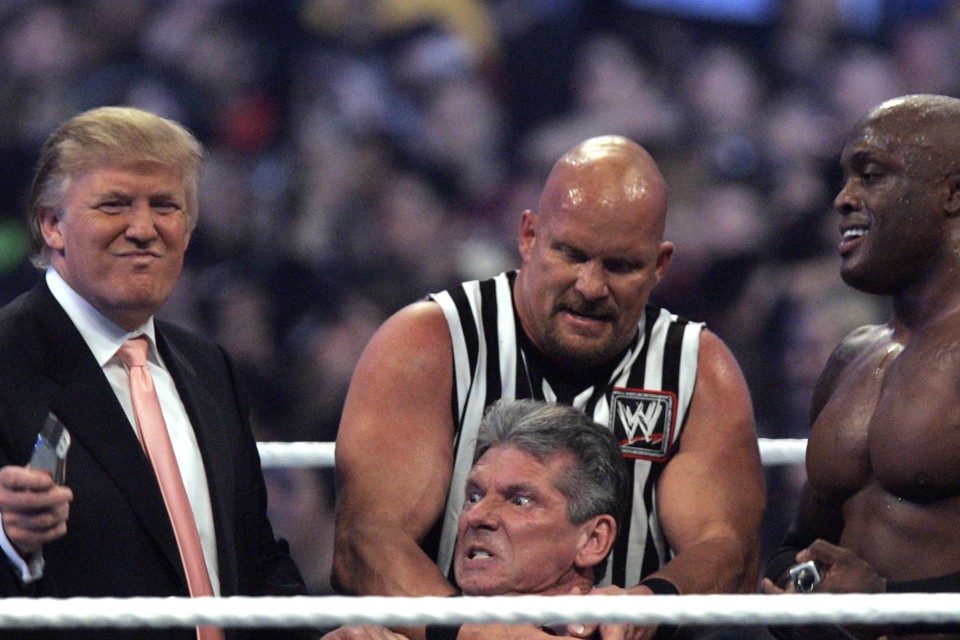
People feel qualified to weigh in on any political issue because that's always been that narrative. I see it asking the general population, without any further information to vote one day or whether Apple should move factories out of China. You know literally nothing about what's going on, so how could you possibly make that decision for Apple? That's up to their board.
I think that people should be able to make big decisions that effect them. Direct democracy is more useful than ever, the elites use our republic to manipulate people more than ever. They game the system and with no balance or checks on their power.
Further, certain other countries do not in fact vote directly for their 'most powerful person' -- in Canada, you vote for your representative locally and the party with the most local representatives sends their leader to be Prime Minister, and even there, the Governor General in Right of the Queen has final say just to make sure.
I think as noble as 'I get to decide what matters most' is, it's worthless when issues reach the kind of complexity that requires specialization in your field. As another poster mentioned above, you don't vote on what kind of medicine a child gets, you leave that up to a doctor -- a professional. Now feel free to pick that professional!
This distinction seems arbitrary and basically restricts the ability for someone or some association of people to promote their ideas.
And that's not entirely false, parents can decide what medicine and procedures to put a child through. Doctors aren't all knowing, they make many mistakes and are even in the favor of special interests like pharmaceutical companies.
I'm in the US so I am a little too uninformed and probably not heavily affected by this to take one side or the other. But knowing what I know I am surprised that this didn't need a 2/3 majority to pass or something similar. Given the result you have roughly half of the country upset by this and in some areas like Scotland, London, etc. you have a majority of people upset by the outcome.
The big business that decides is the media.
I have been reflecting about this for a long time (as Venezuelan I witnessed how people can be manipulated and divided easily)
I have this crazy idea that countries should provide a "voting license" that would require the study of the matter to be chosen previous to the election process. The motto should the same that driving... It is a privilege not a right although everyone has the right to apply for it
The citizens need to have leftover mental energy and time from everyday life to think and learn about politics, form opinions and engage in discussions with each other. Academia needs to be heavily invonved to provide unbiased, politically independent facts, pros and cons for each choice. And there may be a role for online platforms as well to support direct democracy, proving information and a forum for discourse.
Either way, democracy would greatly benefit from an independent information source. While there are some purely subjective decisions to make in a society, a lot of them have some objective underlying facts (eg. is smoking harmful? is there a global warming?). Without an independent information provider, there's no way the average citizen could cast an informed vote on these matters.
If you want to do X, just because people you hate don't like to do X is really a very wrong way to be making decisions about anything.
In general this sort of behaviour doesn't lead to a good ending.
On the opposite end of the scale is the concept of Demarchy, found in several SciFis, where there are no elected politicians, and technology enables everyone to vote on everything constantly.
If only.
They understand how global economics works better than anyone and they manipulate it to their own ends and to the detriment of all others.
England also has the house of lords.
We should try it :-)
Benevolent dictatorship. Someone who can think better than mostly everyone and is dedicated to service to the nation above all else.
In theory (s)he always makes the best decision because (s)he is not swayed by excess emotion and is able to keep the best interest of the nation in view at all times.
Another option arises if we have a truly objective test of benevolent rationality (yes I just made that term up now), then we could weight votes by this measure; this will change political rhetoric from emotional to rational and it would encourage all members of society to become more rational.
We need to design and build our own benevolent dictator, and then keep it running and upgraded as needed :-)
The notion that the people don't know what's best for them.
Bottom line is the working man hasn't cashed in like the global elite and their sympathizers.
In this case I wouldn't have to go home and explain to my children why it is that they probably won't be allowed to go and live in Europe for a bit when they hit their 20s anymore.
British youth will have worse opportunities for working in Europe than they now do, and parents who voted to leave will have to explain that to their children.
> they probably won't be allowed to go and live in Europe for a bit when they hit their 20s anymore.
You write:
> British youth will have worse opportunities for working in Europe than they now do
Which is something else.
Plato and aristotle had the perfect number at 5000, the number of people who can hear a speaker in a forum. Plus, their slaves, servants, women and other property.
If only they used their smarts.. smarter.
Most modern democracies are representative democracies with aspects of direct democracy (in the form of referendums) using some sort of voting system. I don't think there is anything wrong with the idea of a representative democracy, but that most problems arise from the way the voting system is commonly implemented.
As far as I know, all modern democracies implement their primary voting using votes with equal weight. Some democracies, like the United States, have a layer of indirection (the electoral college), but still their primary votes are all weighed equally. While all people should be equal in the eyes of the law and with regard to human rights, there are good arguments that political votes should not be equal. Even with an equal total say for all citizens, it should be possible to weigh different topics that they have a say in towards areas that they are best qualified to make decisions about.
Imagine a political system where all citizens get to vote on representative experts per subject, with an implementation similar to PageRank. People who are indicated to be more qualified for a subject through both historical metrics (previous votes) and objective metrics (qualifications like a degree or work experience) get a stronger vote on representatives for that subject. The elected representatives could either advise politicians (in a binding fashion) or make political decisions directly. This system could strongly reduce a large problem of current democracies that the Brexit vote highlights: all people get an equal say about all issues, regardless of their ability to make qualified judgments about those issues.
Of course there are significant problems with such a weighed voting system, primarily how to make a system that weighs each person's vote fairly and accurately, and who gets to decide how the voting system itself works. This is where modern technology could play a role: by designing a digital voting system that is simple to understand and transparent, so that it can be audited by average citizens. In order to work well, I think this system should be strongly based on the scientific method and should therefore evaluate empirical evidence, instead of emotional sentiments. Another important aspect would be to learn from history, instead of overlooking its lessons. This means the system should be strongly based on political systems that have been shown throughout history to work best, like democracy. It also means that the system should avoid the historical pitfalls of political systems, like concentrating power to a specific group of people.
It would be great to know whether HN thinks that such a system could be designed, or that these ideas are utopian and wont work.
On one hand, this has been a model of democracy. A primary election agenda and referendum. The phrasing of the question was simple, clear and unbiased. The "will of the people" won over the will of the ruling structure. Most politicians and the main parties (especially before the opportunists jumped in) were against leaving. So was the financial sector and most big businesses.
OTOH, some of the problems inherent in democracy were also on display. A "right to my opinion" emotional public moved by very emotional arguments. Lies, untruths and misleading truths were the most prominent arguments on either side. A majority of the discussion was stupid.
We haven't figured this shit out yet. Kings anyone? How about the best wrestler gets to be in charge? ideas?