I'm not claiming this is the cause of frustration, or even a significant factor. Just a thought I had.
It should come as no surprise that it takes two solid incomes in the Bay Area to buy housing close to work, because that's what the market supports. Families didn't become "better off" when two incomes became the norm -- everything just got more expensive.
I think this is one of the nasty secrets why remote work and public transit hasn't taken off like it should; who would support the crazy real estate prices if people could (more easily) choose where they live?
Sort of, but not really. The market can't provide lower-priced housing because of intensive zoning restrictions: http://www.amazon.com/Rent-Too-Damn-High-Matters-ebook/dp/B0... or http://www.voxeu.org/article/causes-and-consequences-land-us.... This: http://www.citylab.com/housing/2013/10/san-francisco-exodus/... pertains specifically to San Francisco and environs.
The housing market by me has been stable with small (tiny) growth and consistent demand. Turnover for new construction has been solid.
Retail & office space, however, is suffering. If you're close to small downtowns with character, the story is different, but strip malls and shopping centers are amazingly screwed. Great example is the Charlestowne Mall in St. Charles. Just the anchors and a movie theater remain.
That said, I look at that excess capacity and see opportunity more than peril. And, it is worth noting, that excess capacity for office/retail space is an issue in city centers as well. This phenomenon is as much a result of changes in consumer behavior as it is subprime aftershocks. It is reductionist to claim otherwise.
I wonder if perhaps we're seeing the results of a shift to the service economy in addition to the shift back to the cities. If we need fewer people to manually perform clerical work in offices, and more people to run the restaurants that we increasingly eat at, then that's going to create a definite shift in demand for different kinds of commercial space.
And different uses for existing space. I'm not a big believer in any economic theory, but I see supply-side drivers abound. Case in point, there are so many vacant ex-Dominick's you can rent/buy for a song.
So many activities to do in this day and age and in this economy. You can surf the Web so much..!
I like the natural prairie landscaping (weeds) by Von Mauer ;)
This "Cycle of automobile dependency" image shows it pretty well. http://imgur.com/Y9vxbNN
Only recently, with huge effort and many setbacks, are we starting to see cities break out of car oriented development and this endless suburban sprawl creating loop.
I'm a bit concerned that the advent of the self driving car could take us backward to more car oriented development and suburbia.
Sure, I can't walk to ten different restaurants and an art museum, but that's pretty low on my list of wants.
For me my decision to live in the city is one of safety (driving cars is dangerous) and time. When I lived in the burbs I spent something like 30-40 full days a year sitting in my car. That's 10% of each year in my car. That's just not a trade I'm willing to make anymore.
You can't walk, take the bus, or ride a bike anywhere. Not only because it's 10 miles away, but because there simply is no safe way to get there without a car.
What I was thinking when I when I wrote "I'm not sure anyone loves suburbia" was that I'm not sure anyone loves that big suburban commute to the city. If that's eliminated, or mitigated by excellent transit connections (ie. pre-automobile street car suburbs), then a lot of negatives go away.
1: which is, really, not THAT much more in terms of cost per mile than using public transportation
And that's entirely a function of bad city design. When I lived in New York, I lived in a Westchester suburb satellite city over 20 miles away from the city. I had a 35 minute commute by train right to Manhattan. There are tons of such suburbs in Westchester, because they have train lines running through the whole area.
Meanwhile, my parents live in D.C. suburbs that are similarly priced, half the distance out of the city, but where the commuting options are a 1-1.5+ hour drive. In Westchester you've got a little downtown and can walk to shops and restaurants. In the D.C. suburbs you have to drive 20 minutes just to get to the drug store.
It's all about city design.
Metro Vancouver recently did a study comparing affordability combining both housing and transportation costs. Once transportation was considered, Vancouver City proper dropped to one of the 3 most affordable Metro Vancouver cities, whereas outlying suburbs rose to least affordable. The gap in transportation costs between the cheapest and most expensive areas was several thousand dollars a year, possibly as high as $12k a year.
http://www.metrovancouver.org/services/regional-planning/Pla...
I would guess that has a lot to do with how one defines the term.
I love living outside of the city. I wouldn't have it any other way. When I'm ready to retire, I plan to move even further away from the city.
I grew up in the suburbs. I am raising my children in the suburbs. I detest going into the city. The traffic, the parking, the population density and the crammed nature of city living all irritate me to no end.
Unfortunately, I have to go into the city for work. That is the primary reason why I'm waiting until retirement to move further away.
Within the last 10 years we have had a real problem in the area. The gentrification of certain inner-city areas has made it impossible for the low income residents to remain there, so they've been moving out to the suburbs and bringing a lot of crime with them.
Try as we might to escape the problems of city living that drove us out two generations ago, the city keeps sending its problems our way.
That's the result of a poorly planned city, not intrinsic to cities. If you've been to Europe, or even NYC, you might have experienced the freedom of jumping on a train to downtown and back, with enough exercise to keep you healthy.
Old cities, like NYC or London were established before the existence of the automobile. It makes sense that they were designed to move large numbers of people without automobiles. I don't live near such a city.
The geography of my area prevents the kind of mass transit system that exists in NYC.
I like cities with good public transit systems but they're not nirvana. And for cities that are just so-so, like SF, the people I know there who don't own cars use Uber, Zipcar, and conventional rentals plenty.
No matter what you choose, you're bound by something.
Here, yes. I prefer those things over the list of things that I mentioned previously.
I have arranged my work schedule to miss the worst of both inbound and outbound rush hour.
When I'm outside of my regular work hours, on evenings and weekends, there is much more freedom in driving one's self as opposed to waiting for public transportation.
For those of us who are so inclined, public transportation is still an option.
There's nothing wrong with the concept of living outside of the city, but the problem is the design and form of development that many suburban cities have taken.
not to mention getting anywhere takes like 5-10 minutes.
what do i miss? a great modern restaurant experience, but classic ethnic is great out here - indian, chinese, mexican etc.
factor in better schools for your children for "free" and i can't see a reason to live in a city.
I pay taxes to my county and my suburban municipality. The city-proper does virtually nothing for me.
The city is not entitled to any of my money.
And if the city proper really did nothing for you, then why would you be working there?
Most of which are maintained by the county, to which I pay taxes.
and there's the federal gas subsidy which is also subsidizing your lifestyle.
From the FEDERAL government, to which I also pay taxes.
Much of the road maintenance is also done by the state government, to which I pay taxes as well.
And if the city proper really did nothing for you, then why would you be working there?
Because decades ago, my employer put offices in the city and it's more expensive to move them than it is to stay put.
Not all of us are working for start-ups. Some of us have employers that predate the interstate highway system.
As telecommuting becomes more of a factor, I will spend less and less time in the city. Hopefully, it'll get to the point where I spend one day here every five years.
I'm told by elders that sloganeering about urban renewal and return began around 1955, about 5 years after the burbs started getting built out.
For example, between 2000 and 2014, SF added about 75,000 residents. In that same period, Irvine, CA added about 150,000 residents, and one quadrant of the Dallas suburbs, Collin County, TX (the northern suburbs) added about 400,000 residents. All of NYC put together in the same period added 500,000 residents, slightly beating out this one part of suburban Dallas.
I personally like living in dense urban areas, but for there to be a sea change in that direction on the scale of overall American trends, people need to be moving into cities in much larger numbers. Here's a modest goal that would represent an undeniable change, even if still only for a small minority of the population: over the next 10 years, 2-3% more Americans live in dense urban areas than currently. That's ~6-9 million more people in dense urban areas. As far as I can tell, we're nowhere near being on track for that to happen.
Also I know there were awful exurbs built during the peak of the bubble, say a decade ago. Sometime between 1960 and "now" suburb designs went badly downhill.
I have observed over my life that suburb street layout corresponds with this zoning trend. If you live in a subdivision/burb with straight lines and many connections to the arterial road, you probably have a grocery store, dentist, bars, and restaurants within short walking distance, but if you live in "bowl of spaghetti" subdivision/burb with exactly one connection to exactly one arterial road, then you probably need to drive at least five miles to buy a gallon of milk.
Then they have kids.
Reston, VA is a great example of this. Much of the workforce holds jobs elsewhere but the suburb is a community unto itself. One doesn't need to live in DC or make a long commute for a night on the town. Perhaps we can find in Reston a happy medium between distant exurbs and everybody on earth living in Manhattan.
Reston would be a great bedroom city if DC had proper regional rail. Standing room only in the Silver line for 45 minutes sucks compared to regional express trains in places like Chicago or NYC.
Now, while I'm definitely a suburbanite, I'd take the 15 minute commute any day over having extra lawn to mow.
Having vehicles that don't require human operation means that cars can spend less time in parking lots as depreciating assets and more time filling transportation demand. By reducing inefficiencies, it should free up traffic congestion and make it easier to commute to these office parks, right?
Self driving cars are an example of doing the wrong thing (automobile oriented development) better. The right thing is developing cities around people, not cars. This means creating walkable spaces with cycling and public transit prioritized above automobiles.
Shared automated cars are public transit.
I'm not saying we shouldn't develop cities with pedestrians in mind, just that it's much easier to adapt a fleet of cars than rebuild an entire city.
> "especially since they don't require to be parked near their passengers during off hours and can spend most of their product lives on the road."
I'd argue that both of these points aren't actually true.
The nature of on-demand cars (human-driven or otherwise) is that they be quickly available. Automated cars might eliminate the need for the car to be figuratively outside the door like they are today, but they still need to be nearby. Making cars automated will let you stretch out the distance between user and car a bit, but there will still be plenty of infrastructure necessary to ensure cars are near their potential users.
Ditto the "spend most of their productive lives on the road" thing. This claim will likely be not true at all, considering how bursty transportation usage is. Figuratively every single mode of transportation (cars, trains, buses, you name it) is planned around massive bursts of usage, usually surrounding the working day. Automated cars are still subject to this - the reality is that if we move towards fleets of automated cars, they will be idle 80% of the time. So do you want rush-hour-traffic volumes of cars circling aimlessly for most of the day, or do you want to park them somewhere during non-peak hours? If the latter, you're back to the problem of provisioning tons of infrastructure for storing them...
IMO the most likely consequence of moving to self-driving on-demand cars is that we eliminate large parking lots in front of stores (yay!) but in exchange we get massive parking structures tying up a lot of space, and not as far from people as we'd probably like.
Height limits in construction for low-density areas will probably increase the amount of land these parking structures cover, and they'll likely be traditional ramp-based instead of some fancy robotics (that are way less reliable and can process less volume). In a sci-fi novel we'd stuff cars into hyper-efficient low-footprint parking structures when not in use, in reality we're probably just going to get gigantic, enormous versions of multi-floor parking garages in the center of the city.
Ubers are rarely parked when on-duty and in a city this doesn't seem to be an issue.
> considering how bursty transportation usage is
I would like to introduce you to the Bay Area and LA freeways, where there is a lull from approx. 11am-2pm, and the roads are fairly packed until 8pm. In large metros the traffic is less bursty than you think.
> in exchange we get massive parking structures tying up a lot of space
We're already doing automated stacked parking in some high-density areas (I've personally seen it in Berkeley and NYC). It could become the norm: https://upload.wikimedia.org/wikipedia/commons/7/7e/Multi-le...
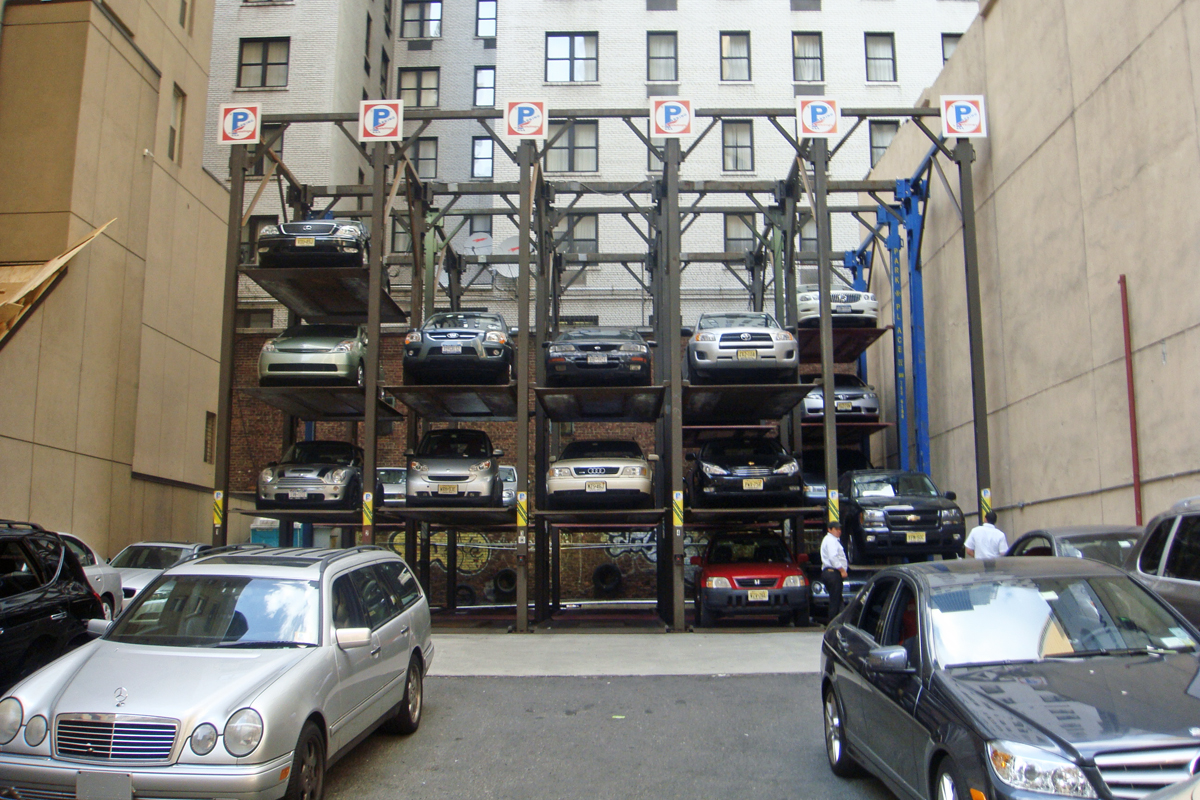
Not every Uber arrives inside five minutes, so I think travelers will be similarly understanding of robocars. That means the fleet doesn't need a giant parking structure anywhere, they just need to keep a few units in every sector (either cruising or parked in surplus spots at the remote edge of store parking), with other units near enough to fill in when demand spikes in a given sector. Lots of existing parking lot owners will make a little more money when the algorithms determine they're optimally located for overnights. It's not like the supermarket needs all its parking spaces outside normal shopping hours. Robocars probably won't typically park on the street, because it's not secure, especially against taggers.
I do expect that robocruising (driving slowly in a parking-limited area while waiting for customers) will be decried as the greatest scourge to afflict red-blooded single-occupancy commuters since the bicycle. I don't expect anyone important will care.
It is much easier when you can commute later or earlier than most people (but still, few people would work, let's say 12am to 8pm)
Car dealers.
That said, I think there's a possible silver lining to gentrification that needs to seriously be considered: There's a lot of evidence to suggest that mixing people of different socioeconomic backgrounds has a large positive impact on social mobility for the less wealthy people in that community. This in turn has a large positive impact on the community's long-term economic growth.
In light of that, I think we need to be very careful about not throwing the baby out with the bathwater. If gentrification takes the form of wholesale displacing entire communities then yes, that's a problem. But if things can be arranged such that wealthier folks moving back to the city leave their gated communities behind rather than bringing them along for the move, then the long-term outcome could be transformative.
As people moved out to more widely-dispersed communities, that caused commuting all the way downtown for work to be increasingly problematic. So of course that encouraged demand for business to also move out to the suburbs.
Eventually things got so dispersed that people had to start driving everywhere. Roads got congested. It became increasingly common for people to spend 1/5 or more of their free time behind the wheel. Attempts to relieve the congestion inevitably require frequent road construction projects, which only increases everyone's sense of frustration.
I think it's pretty plain to see that nobody actually likes this state of affairs, and also that continuing the suburbanization trend would only continue to make it worse. Maybe there was a period back during the baby boom when the suburban lifestyle worked out really well (from a happiness perspective; let's forget about the economic and environmental cost for the sake of argument) for the first people to adopt it, but it's a lot harder to see the attraction now that the wide open spaces have become crowded with cars and parking lots.