Shared automated cars are public transit.
I'm not saying we shouldn't develop cities with pedestrians in mind, just that it's much easier to adapt a fleet of cars than rebuild an entire city.
> "especially since they don't require to be parked near their passengers during off hours and can spend most of their product lives on the road."
I'd argue that both of these points aren't actually true.
The nature of on-demand cars (human-driven or otherwise) is that they be quickly available. Automated cars might eliminate the need for the car to be figuratively outside the door like they are today, but they still need to be nearby. Making cars automated will let you stretch out the distance between user and car a bit, but there will still be plenty of infrastructure necessary to ensure cars are near their potential users.
Ditto the "spend most of their productive lives on the road" thing. This claim will likely be not true at all, considering how bursty transportation usage is. Figuratively every single mode of transportation (cars, trains, buses, you name it) is planned around massive bursts of usage, usually surrounding the working day. Automated cars are still subject to this - the reality is that if we move towards fleets of automated cars, they will be idle 80% of the time. So do you want rush-hour-traffic volumes of cars circling aimlessly for most of the day, or do you want to park them somewhere during non-peak hours? If the latter, you're back to the problem of provisioning tons of infrastructure for storing them...
IMO the most likely consequence of moving to self-driving on-demand cars is that we eliminate large parking lots in front of stores (yay!) but in exchange we get massive parking structures tying up a lot of space, and not as far from people as we'd probably like.
Height limits in construction for low-density areas will probably increase the amount of land these parking structures cover, and they'll likely be traditional ramp-based instead of some fancy robotics (that are way less reliable and can process less volume). In a sci-fi novel we'd stuff cars into hyper-efficient low-footprint parking structures when not in use, in reality we're probably just going to get gigantic, enormous versions of multi-floor parking garages in the center of the city.
Ubers are rarely parked when on-duty and in a city this doesn't seem to be an issue.
> considering how bursty transportation usage is
I would like to introduce you to the Bay Area and LA freeways, where there is a lull from approx. 11am-2pm, and the roads are fairly packed until 8pm. In large metros the traffic is less bursty than you think.
> in exchange we get massive parking structures tying up a lot of space
We're already doing automated stacked parking in some high-density areas (I've personally seen it in Berkeley and NYC). It could become the norm: https://upload.wikimedia.org/wikipedia/commons/7/7e/Multi-le...
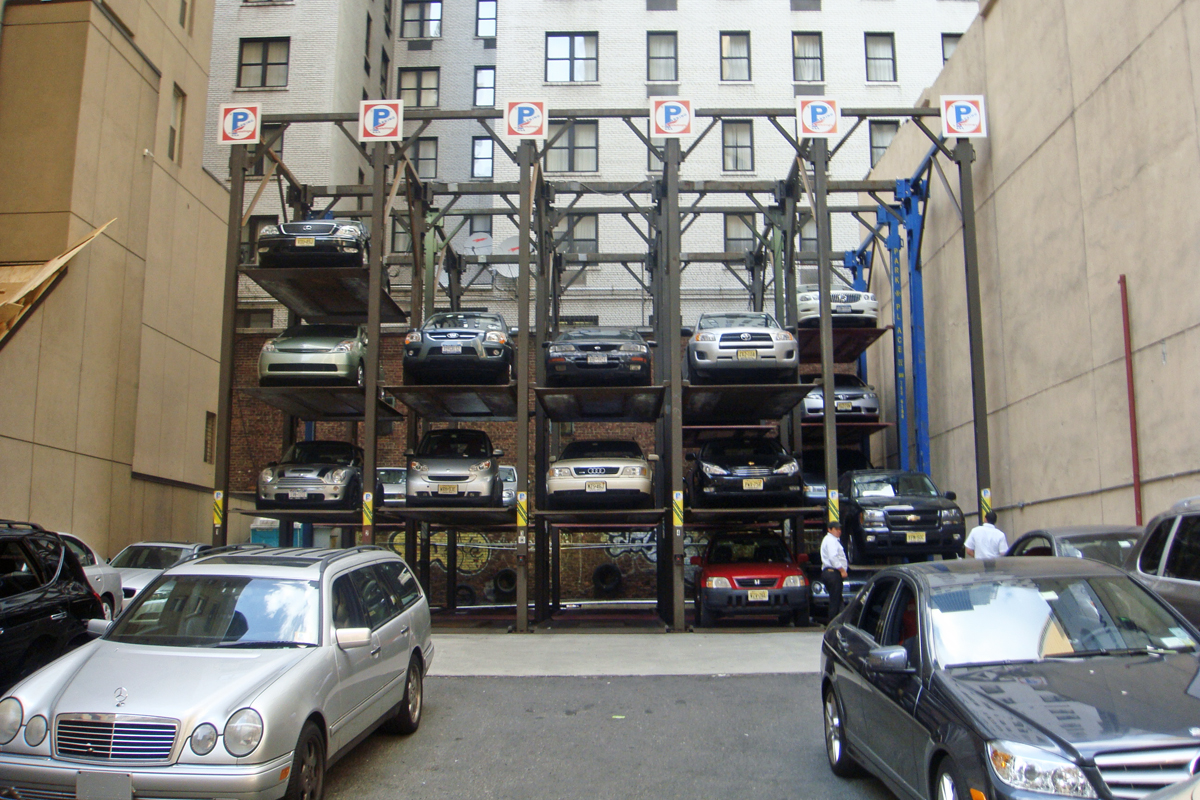
Not every Uber arrives inside five minutes, so I think travelers will be similarly understanding of robocars. That means the fleet doesn't need a giant parking structure anywhere, they just need to keep a few units in every sector (either cruising or parked in surplus spots at the remote edge of store parking), with other units near enough to fill in when demand spikes in a given sector. Lots of existing parking lot owners will make a little more money when the algorithms determine they're optimally located for overnights. It's not like the supermarket needs all its parking spaces outside normal shopping hours. Robocars probably won't typically park on the street, because it's not secure, especially against taggers.
I do expect that robocruising (driving slowly in a parking-limited area while waiting for customers) will be decried as the greatest scourge to afflict red-blooded single-occupancy commuters since the bicycle. I don't expect anyone important will care.
It is much easier when you can commute later or earlier than most people (but still, few people would work, let's say 12am to 8pm)
Self driving cars are an example of doing the wrong thing (automobile oriented development) better. The right thing is developing cities around people, not cars. This means creating walkable spaces with cycling and public transit prioritized above automobiles.