Of course, things change in adulthood, and if young Middle Eastern men who would normally be entering stable relationships with women are prevented from doing so, I can imagine how that would enable angry jihadists. But at that age, the blame probably lies with other social/economic factors and less with their family unit.
And the effect that marriage has on the behavior of men is fairly well-known: http://www.washingtonpost.com/news/inspired-life/wp/2015/04/...
That's true, but if the prosperity and peace of the modern west also are relatively modern and unusual, perhaps the exposure to women has a positive effect.
We are fortunate in having overcome hunger in 4/5ths of the world - but it has left a lot of time on people's hands compared to a hunter gather lifestyle and a lot of unsupervised time similarly
That said - holy moley! this is insane!
But does this work for other sexual choice communities? I suppose there must have been class divides where "working class" men were more likely to go to jail so changing the sexual choice landscape? Gay men?! Ex-military? Prior to public transport was there geographic boundaries? Education?
This is a fascinating subject - why are black women limiting themselves to a reduced choice of black men when presumably other races are open? What is it that makes that choice / boundaries? Clearly parental type must have a big impact, but what else?
This is an indictment of US post-slavery culture to be sure, but thinking about it it is massively wider in scope.
Any pointers to research on this?
Actually, some studies have shown that hunter-gatherers have much more free time than we do. Our wants grow more quickly than our technology can satisfy them.
It turns out that after you feed, shelter, and clothe people, they still want more stuff. What a fucking surprise. But at least I'm not starving, freezing, naked, bleeding out on the plains after being gored by a rhino or squashed by a mammoth.
http://www.amazon.com/Is-Marriage-White-People-American/dp/B...
What about social pressure (you are a "race traitor" fords ting non blacks). Is it an anti white thing? Is the proportion of Hispanic dating higher? What about comparing across cultures - is the incidence of dating cross race lower than in say the UK?
The fact that we are raising race to its own singular cause for this sort of marriage-limiter shows how much race issues have a grip on our societies, but it's interesting to think around the subject.
Still would be interested to know how one can find a epidemiological "natural" experiment to solve this.
It's also pretty ordinary for people to prefer mates that have a broadly similar life experience and perspective as themselves. It's easier to sustain a relationship when you have more common ground.
Attitude seems to be changing for the better anyway.
Here's also an article [0] on the subject that cause quite a stir back in 2011.
[0]:http://www.npr.org/2011/06/29/137499303/author-tells-black-w...
As much as people want to to homogenize the sexes, their are differences in factors that determine desirability.
Powerful women(degrees, income, position in society, etc.) are judged differently in my surrounding(I said in my surroundings, antidotal, don't kill me); than powerful men.
Are a lot of women are attracted to powerful men--yes, for the majority. Unless the man has horrid genes, and even then they line up. The man with the biggest cave still seems to attract to most--especially later in life.
It works in the opposite direction for women. I have never met a man(except in scripts, on t.v.) that judges women on degrees, or wealth, or status in society. I have never heard a man say, "I find women in power/authority sexy!" I don't know why. I hope it changes. I just think we forget about millions of years of biology--men are looking for good genes, a kind disposition--maybe someone to raise the spawn?
Yes, it's wrong. I'm just tired of hearing "Why is she single--she is so accomplished?" Yes, I hope it changes. Go ahead kill me. There's too many examples to list, and it's politically incorrect to even talk about. Again, I'm sorry if I offended anyone.
"Race" is a culture-specific category.
See this map: http://www.censusscope.org/us/map_nhblack.gif
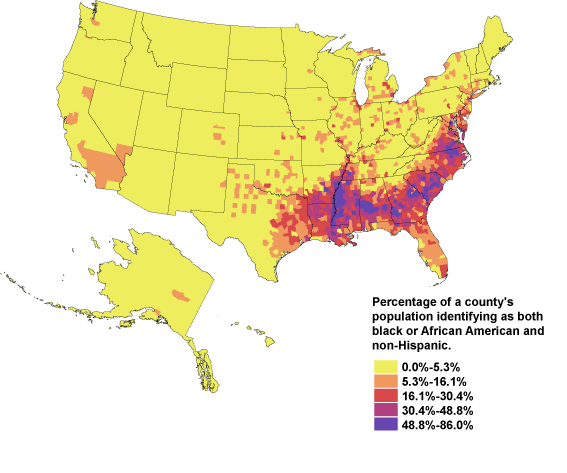
There was also a subtext idea about women (in general) being competitive and 'slut shaming' as an evolved mechanism to collude with each other and push the sexual availability/access down in order force men to have to invest more time/effort/resources into a relationship. I'll try and see if I can find whatever it was - the idea was cool (if not obvious) and the unintentional collusion part didn't occur to me.
There's probably a lot at play though it's hard to make any real statements about evolved behavior outside of cultural pressure and without a lot of time to look at things.
There's also the narrative that places where men outnumber women, men become increasingly competitive and violent towards women and each other. An example is any blue collar "boom" town like North Dakota's fracking industry.

Roughly stated the younger the population the more men you end up with. Generally this is balanced by woman having shorter 'breaks' between relationships until old age when women significantly out number men. See: 1950: http://en.wikipedia.org/wiki/Demographics_of_China#/media/Fi...

vs: 2010 http://en.wikipedia.org/wiki/Demographics_of_China#/media/Fi...

It's hard to read, but the gap actually looks smaller for 15 year olds now vs 1950.
Never the less, you see increased bride imports from impoverished SEAsian neighbors. There is also great pressure on the males to show how meritorious and deserving they are economically, in 'attracting' a mate. I say attracting in quotes, because it's often more disproportionately economic than romantic attraction.
Don't male infants die slightly more, too?
That said, in devoloped nations like the US few infants die so the difference is not that large.
Edit: see page 7 http://www.cdc.gov/nchs/data/nvsr/nvsr62/nvsr62_07.pdf Per 100,000 births of each gender, 99,301 men see 1, vs 99,427 females a gap of 127. By 30 the gap is 1,148 (97,400 vs 98,548)
At 75 it's 62,720:74,464 a gap of -11,744 which is even larger when you consider the population is ~2/3 the size.
And at 100 the absolute gap is only 1,900 (997 : 2897) but there are ~3x as many woman as men.
PS: Edited the line you quoted for clarity.
https://www.google.com/#q=north%20dakota%20gender%20imbalanc...
I'd argue that China's belligerence is lower now than it has been. They've moved from a very communist that strongly distrusted and arguably even hated the West, to a semi-capitalist one who mostly just wants to compete with the West (and makes oodles of $$$ selling to us).
The US has been drum-beating against China a lot recently, but frankly that seems more about the US losing in the "trade wars" than anything specific China did.
All I know is that when one country wants to take what another country currently has, people die. It's the slaughter of impressionable young nationalists in war that I object to, not which country has suzerain over which scrap of land.
> not which country has suzerain over which scrap of land
Personally, I don't care much for which country "owns" which scrap of land either, but usually it is the very same passionate nationalists that you referred to that disagree with us. Which is why, I've asked the original question, with what right does any country own a certain piece of land, or not own certain piece of land.
[0] - http://en.wikipedia.org/wiki/Nine-dotted_line [1] - http://en.wikipedia.org/wiki/Territorial_disputes_in_the_Sou... [2] - http://news.xinhuanet.com/english/china/2013-11/23/c_1329116... [3] - http://www.theatlantic.com/magazine/archive/2014/11/chinas-d...
To clarify, China is militarizing long-standing territorial disputes.
Also note that there is no risk of military conflict between any of the neighbors or between the neighbors and the U.S., despite territorial or other disputes. Vietnam and the Philippines aren't threatening each other, nor are Japan and South Korea, Japan and Vietnam, or any of those countries and the U.S. But almost everyone seems to be in a militarized dispute with China.
> an increasingly belligerent and powerful nation
Powerful is of course true. Increasingly belligerent was the point I was responding to. If you look at China's recent history, they're a lot more West-friendly now than at any point since WWII.
http://articles.latimes.com/2014/jan/10/opinion/la-oe-schmit...
They used to talk about a "Peaceful Rise" and had for a very long time. They stopped.
https://firstlook.org/theintercept/2015/04/18/new-zealand-ch...
Thankfully, the US and other "good" countries are above such things.
I'm just stating the trend is the opposite of the comment I replied to.
Factual statements isn't throwing stones. The "Peaceful Rise" propaganda/party line really did stop awhile ago.
A world where the US faces sudden economic problems is a world that sees economic problems on their own horizon.
Now it's all about the globalists and world government!
I think your worry is a very reasonable one, but it has not become a reality. I wonder why not.
This is akin to wondering why Europeans generated so many young angry crusaders. The term jihadists denotes a religion and a region. Its associated with Middle Eastern countries by definition. Angry young militants from other religions and regions are given different names.
If we look at objective measurements of violence, like murder rate by country [1], we can see that the Middle East is not particularly violent, rather its on par with America. It is harder to find meaningful information on militarism. We do know that the Middle East was host to 3 of the 4 world conflicts that killed more than 10,000 people in 2014 [2]. All of these conflicts have included significant foreign and local involvement. Their causes are complex. In my opinion, they are driven by a desire to control the world's most valuable resource (Oil!) not by cultural factors.
Finally, it is worth noting that Americans use the word Jihad to mean holy war, but in the Middle East the word does not have the same violent meaning [3].
[1]: https://en.wikipedia.org/wiki/List_of_countries_by_intention...
[2]: https://en.wikipedia.org/wiki/List_of_ongoing_armed_conflict...
1. That # of Jihadist does not indicate how violent and militant a culture is because it is not a cross-cultural term.
2. That cross cultural measures of murder rates do not indicate that the Middle East is home to particularly violent cultures.
3. That the Middle East is home to lots of military action, but that it is produced by foreign and local interests and can be explained by financial motives rather than cultural ones.
This has been my experience in San Francisco, thanks to gender imbalances
1) lack of career prospects, especially for university graduates 2) because of #1, young men cannot afford a matrimonial house and ceremony, so can't get laid (adultery is a capital crime.)
That's why 72 virgins in the afterlife is very appealing ... because they aren't getting any in this life.
Source: http://blogs.seattletimes.com/fyi-guy/2014/12/28/end-of-the-...
Why the nuclear rather than the extended family would be considered important for social stability is anyone's guess. We live in an incredibly atomized society that values personal freedom and autonomy over interdependence and social connection, but that doesn't mean "stability".
I'm going to see if I can scare up some data regarding families in Scandinavia, but I don't think your point necessarily contradicts the parent post.
I'd be careful of generalizing across such a diverse region. Isn't it actually a fairly small minority of countries in the Middle East that "generate [lots] of young angry jihadists"?
High: Iran, Iraq, Saudi Arabia, Yemen, Syria, Palestine, Lebanon, Egypt (most members of the original Al-Qaeda and current leader were Egyptian, and then there are Sinai groups)
Medium (mostly just financing since they have low populations and high income): United Arab Emirates, Qatar, Bahrain.
Low: Turkey (?), Jordan, Kuwait, Oman, Israel, Cyprus.
These are obviously based on nationalities of jihadists, not based on percentages of populations whom become jihadists - which I suspect you are confusing my comment as implying.
There are other examples. Jihad has been fought by both Sunni and Shiite groups. But more so by Sunni groups such as IS and AQ - who have tended to have more of a global objective against the west. While Iran and Shiite groups (such as in Syria/Lebanon) are mostly interested in local power grabs to keep spreading their Islamic Revolution outside of Iran.
I highly recommend this New Yorker piece on Iran and their secret proxy wars:
http://www.newyorker.com/magazine/2013/09/30/the-shadow-comm...
Most nation states, certainly including the USA, have at one time or another given material and financial support to terrorist groups. I don't condone it, but Iran is hardly exceptional in that regard.
You asked why many Middle Eastern countries produce "so many" jihadists, implying that the majority of these countries are producing a high number. Thus, it makes no sense to respond by listing examples of terrorists or terrorist groups originating in Middle Eastern countries, since one could give similar examples for more or less any European country or for the USA. We have our homegrown terrorists too (both Islamic and otherwise).
> I believe most people on HN are aware extremists represent a small percentage of the total populations.
I stand by my decision to assume that most people here are smart enough to know the difference. Key word is most people clearly...
I know that you don't care about the number of extremists as a percentage of the total population. I never thought that you did. Neither of us does. Ok?
You're still avoiding the main issue. Are most Middle Eastern countries producing an unusually high number of extremists? You can't show that they are by showing that they produce some extremists. But that's all you've done so far.
In other words, what distinguishes most Middle Eastern countries, in your mind, from e.g. Britain, France and the USA? All of these countries produce some Islamic extremists. So clearly, if you're going to say that there's something special about Middle Eastern countries in this regard, you're going to have to crunch the numbers. I don't see any numbers in any of your posts so far.
Again, none of this has anything to do with the number of extremists in comparison to the total population. The question is whether the number of extremists is significantly larger than the number produced by non-Middle-Eastern countries. In other words, when you said "so many" in your original post, were you correct to imply that the number is generally higher in the Middle East than elsewhere?
Bahrain, Egypt, Jordan, Kuwait, Lebanon, Palestine, Saudi Arabia, Turkey, Yemen
Of those, only Jordan and Saudi Arabia are contributing large numbers of fighters. On the whole, the Middle Eastern countries on the list are contributing relatively few. The next biggest contributors are Tunisia, Bosnia and Kosovo, none of which are in the Middle East.
On top of that, note that BELGIUM is sending at least as many fighters as all of the following Middle Eastern countries (and yes, I am taking into account the different scales on each chart):
Bahrain, Kuwait, Lebanon, Palestine, Turkey, Yemen
Basically, I think you may be forgetting that the "Middle East" isn't anywhere outside of the USA and Europe with lots of brown people.
I didn't mention them because they're not listed on the bar chart. But including them would skew the analysis for obvious reasons.
Again, your source doesn't show that the Middle East is producing more Islamic extremists on the whole than many other regions of the world. If you agree with that, then we agree. Of course, pretty much every country in the Middle East is producing a non-zero number of Islamic extremists -- as is pretty much every country in the West. If that is your only point, why draw attention to the Middle East specifically?
>Middle Eastern expats (or their children), many of whom hold dual citizenship.
You'll need another source on this. It might be true, but it's important to bear in mind that (i) many Muslims are not from the Middle East and (ii) Islamic extremism is not limited to the Middle East. So I am not sure that e.g. the majority of homegrown Islamic extremists in the UK have Middle Eastern backgrounds. It's possible, but I'd like to see some evidence.
>I didn't draw attention to M.E. specifically, you did.
You’re missing the context of the thread. I was replying to someone who singled out the Middle East. From what you say, it seems that you’re not attempting to defend what the OP said, you’re just pointing out that most Middle Eastern countries are producing some number of Islamic extremists. Well, ok, no disagreement there. However, on the evidence we’ve seen so far, it seems that Middle Eastern countries don’t produce an unusually high number compared to many other regions of the world. For that reason, I object to the OP’s singling out of the Middle East as a source of Islamic extremists. It would be better to single out the countries responsible.
I’m still a little skeptical of your claim that most homegrown terrorists in Western countries have Middle Eastern backgrounds. This certainly isn’t true in many cases. For example, the 7 July bombers had Pakistani backgrounds. Do you have a source on this or is it just a hunch?
Those my friend, are religious and cultural norms put in place by their own people. No amount of external pressure has ceased the ungodly treatment of woman, homosexuals and other "miscreants" as they are deemed in much of the middle east.
The U.S. and western powers keep the conservative Middle Eastern dictatorships in place, preventing any social and political reform. That is, in fact, a major cause of resentment by people of the Middle East toward the West.
In fact, Al Qaeda's goal is to overthrow the Middle Eastern dictatorships (and inflict their own oppressive dictatorship on the people there). They targeted the U.S. because they believed that American support is the reason those governments are stable, and that they first have to drive the U.S. out of the Arabian Penninsula.
The people in most Middle Eastern countries have no choice in the matter, and geopolitics is a major reason why.
I don't think there's any evidence Iraq, Libya, Egypt (under Morsi), Syria (under whatever remains) and eventually KSA are going to end up with better treatment for women when all their political reform is over.
Iraq under Saddam was more secular - women's rights to vote, education and political office went back to the 70's. In some areas, they may be holding on, but overall I doubt they'll end up being better off.
Egypt had a huge social/political change, and democracy meant a MB majority. Now they're back with Mubarak-lite (and they all blame the US for abandoning Egypt to the MB).
I can think of two possible, orthogonal answers why that (sort of) fit the hypothesis:
- the key is not 'stable relationships with women' but 'stable sexual relationships';
- many gay men do have stable relationships with women, in the form of strong, non-sexual friendships.
[Edit: I neither support nor reject the hypothesis; I just don't think gay men are necessarily a good control group for it.]
First, the point could be: I'm curious if stable relationships with the gender they find attractive really do lead to less violence/crime by males?.
Second, there are significant differences in the brains of heterosexual and homosexual men (one of the points made by those saying it was not a choice). These could mean that the above point only applies to heterosexual men.
Are you claiming that gay men don't have stable relationships?
[Sorry for my poor assumption there, thanks for clarifying :)]
http://www.theatlantic.com/past/docs/issues/2001/12/hoffman....
Maybe we don't need to look further than the psychological impact of enforced genital mutilation past the age of infancy.
There is little doubt that the triggering of protective behaviour that comes with fatherhood is a benefit to any society.
She calls me out on things that I do habitually or without thinking, usually because they are selfish and hurt her or our relationship in some way. These are habits or personality traits that my close friends and family wouldn't be aware of, but that my girlfriend has exclusive access to as the one with whom I share the most intimate details of my life. She forces me to reflect on why I am the way that I am; sometimes directly when we fight, but often indirectly through her questions and observations.
I'd like to think that our relationship has made us more empathetic and introspective. I don't think it has made me any less extreme in my ideals though.
My personal view is that extremism is generally bred by a low standard of living and a high degree of economic inequality that is forced onto a united group of people that feel like they deserve more than the system has given them. The uniting factor could be race, religion, age - anything, it doesn't really matter.
I've recently been struggling with the notion that, as a 22-year old who is about to graduate, I am to enter an economy and a system set up and controlled entirely by the captains of finance and government who allowed the financial crisis of 2007 to occur, and who have been unable to "fix" the economy through monetary and fiscal reform. This has pushed me towards the study of Bitcoin, a "radical" tool that traditional economists are quick to dismiss as a libertarian/anarchist fantasy. I don't subscribe to any political viewpoint - I simply see a broken system that has destroyed the lives of many of the constituents that it was created to serve through corruption and negligence. Bitcoin is just another tool, such as Quantitative Easing and Interest rate manipulation, that we could possibly implement to reduce the volatility of the financial system and remove some of its susceptibility to greed and corruption.
My interest in Bitcoin nothing compared to ISIS, the PLO, the Black Panthers, or any other minority group that was oppressed and decided to try and change a system that it found unfair and stacked against it. The difference is that these "extremist" groups use violence to fight their battles, because they see the alternative life of dying poor and oppressed as a non-option.
If we were to advance every civilization to a point where the standard of living was high enough and the measure of inequality was low enough, I think we could eradicate most forms of physically violent extremism. Mental "extremism" in the form of thought-experiments pushing the boundaries of the current system would continue, but to the benefit of society in general. Will this ever happen? Probably not.
I study economics and am facing unemployment upon graduation. I'm thinking of travelling, teaching, and/or working for an NGO or a non-profit.
I don't find QE evil. I find it to be an ineffective solution to a problem caused by the corruption and negligence of a select cohort of my elders who hold positions of power in this country. These individuals are not evil; we are all susceptible to greed and selfish interests. They are the product of whatever environment they were raised in.
I'm not crying and wringing my hands without offering a solution. I'm proposing that a New Deal-style investment in infrastructure, education, R&D, and the introduction of virtual currencies could help the economy in the long run.
What do you think?
Congress appointed an independent, 10-person panel of lawyers, economists, businessmen, financiers, and auditors (known as the FCIC) to explore the causes of the financial crisis. Here are there findings, for anyone who is interested in learning a bit more about a topic that is not very well understood for the amount that it is casually discussed.
http://fcic-static.law.stanford.edu/cdn_media/fcic-reports/f...
I don't think are actually any studies that support this, unfortunately. War simply isn't a consequence of gender, it is a consequence of ideology and fear.
... and competition for resources
"Scholars and polling organizations have also noted a consistent gender divide in public opinion on military action, beginning with World War II through the most recent U.S. wars in Afghanistan and Iraq, with men expressing higher levels of support for military action than women (Bendyna et al.,1996; Berinsky, 2009; Burris, 2008; Fite et al., 1990; Moore, 2002; Nincic and Nincic, 2002; Rohall et al., 2006; Shapiro and Mahajan, 1986; Smith, 1984; Wilcox et al., 1993)" (from https://www.academia.edu/1802567/Race_Gender_and_Attitudes_T... )
That brings up an interesting issue for me. It's a somewhat popular trope, that there is an equivalence between Amy offending people and Bob asking her to stop. It's really a rhetorical tactic -- an attempt to disrupt Bob by forcing him to philsophically justify what is obviously and intuitively true to everyone.
There may be a question of whether something is offensive or otherwise does harm to others, of course. But absolutely if someone finds something offensive, they should stand up and say so -- and not be shut down by the new political correctness (i.e., the frequent knee-jerk reaction to people who point out issues of race, gender, etc.).
Try wandering into any programming thread and talking nonsense about eg static typing then complaining about people trying to shut down the conversation.
Interesting, I never thought about this side-effect of mass incarceration. Another aggravating factor in a repeating cycle?
I remember reading a hypothesis of why many middle eastern countries generate so many young angry jihadists is that most of the young men had never had a stable interactions with women in their youth. Most grew up in socially conservative environments and missed out on the stabilizing effect of having relationships with women, not having a sexual output, not having reasons to stay alive for a girl at home, or even missing out on having a female perspective on things (women are arguably less war-prone than men).
Middle eastern young males obviously experience a different social environment than black men do but I'm curious if stable relationships with women really do lead to less violence/crime by males? Or is that merely hopeful thinking by social conservatives?